
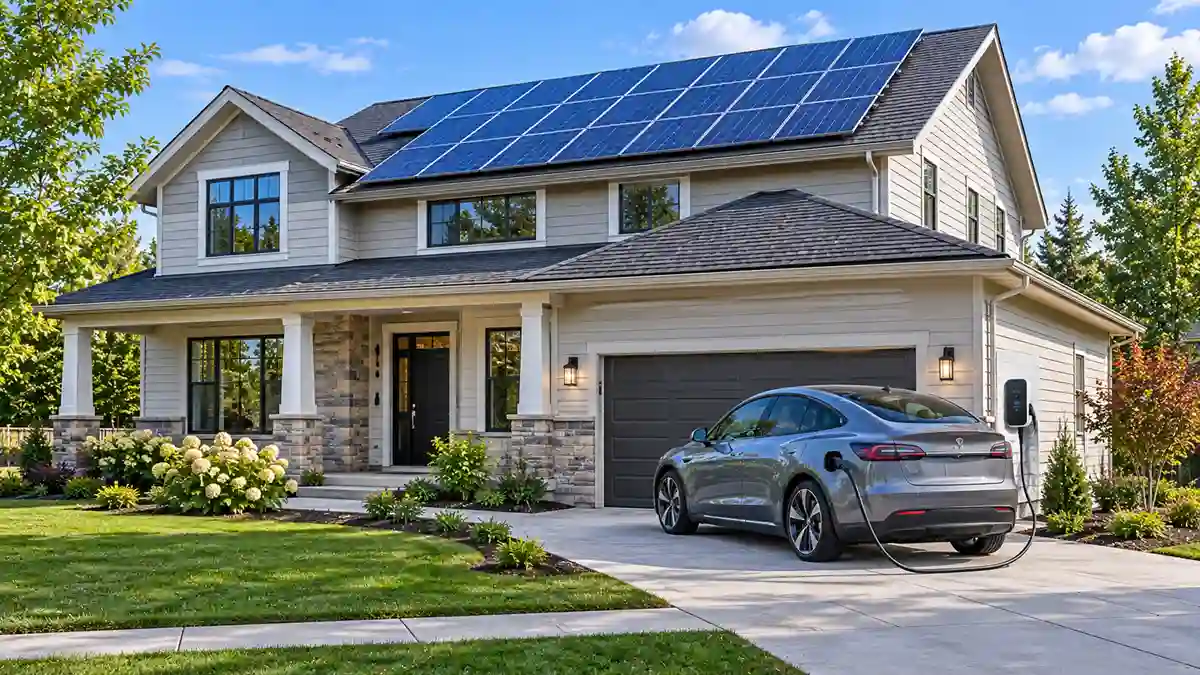
Find out how many solar panels to charge an electric car. Explore practical calculations based on daily driving distance, EV efficiency, panel wattage and sunlight.
If you are planning to charge an electric car using solar energy, one of the first questions is: how many solar panels will you need?
The answer depends on your daily driving distance, the electricity consumption of your vehicle, solar panel wattage and the amount of sunlight available at your location. Someone who drives 20 miles per day will generally need fewer solar panels than a driver who covers 60 miles.
From my experience in solar engineering and system design, I increasingly consider future EV charging requirements when discussing residential solar installations with clients. Even when a homeowner does not currently own an electric vehicle, planning for a future charger can help avoid unnecessary electrical modifications. This means considering inverter capacity, electrical panel space, cable routes and expected charging demand during the initial system design.
In this guide, I explain how many solar panels to charge an electric car using practical calculations, examples and system-design considerations for homeowners in the United States.
How Many Solar Panels Do You Need to Charge an Electric Car?
As a practical example, a driver covering approximately 40 miles per day in an electric car that consumes 30 kWh per 100 miles may need around 7 solar panels rated at 450 watts each to offset the vehicle’s estimated annual electricity consumption.
This estimate assumes:
- Daily driving distance: 40 miles
- EV electricity consumption: 30 kWh per 100 miles
- Solar panel rating: 450 watts
- Illustrative annual solar production: 1,400 kWh per installed kW
Under these assumptions, seven panels provide a total rated capacity of 3.15 kW.
However, this is an annual energy estimate, not a guarantee that the panels will supply enough electricity to charge the car at every hour of the day. Actual panel requirements depend on the property’s solar resource, roof conditions, seasonal production and the driver’s charging schedule.
The most reliable approach is to calculate the vehicle’s annual electricity consumption first and then compare it with the expected annual production of the solar system.
What Determines the Number of Solar Panels Required for EV Charging?
Four main factors determine how much solar capacity you need.
1. Daily Driving Distance
Your daily mileage is one of the most important factors affecting EV charging demand.
For example, a homeowner driving 20 miles per day will generally consume less electricity than someone driving 60 miles. Therefore, the first step is to estimate how many miles you normally travel.
If you already own an electric vehicle, use your driving history or annual mileage records. If you are planning to purchase one, estimate your expected daily or annual driving distance.
2. Electric Vehicle Electricity Consumption
Different electric vehicles use different amounts of electricity.
A compact electric sedan may consume less energy per mile than a large electric SUV or pickup truck. Vehicle efficiency is commonly expressed in kilowatt-hours per 100 miles (kWh/100 miles).
The following figures are illustrative planning assumptions:
| Vehicle category | Example consumption |
|---|---|
| Efficient electric sedan | 25 kWh/100 miles |
| Electric crossover | 30 kWh/100 miles |
| Large electric SUV | 35 kWh/100 miles |
| Electric pickup truck | 45 kWh/100 miles |
These are not fixed values for every vehicle in each category. Actual consumption depends on the model, model year, driving speed, temperature, road conditions, tires and vehicle load.
For a US vehicle, check its specific electricity consumption on FuelEconomy.gov. The EPA fuel economy label provides an electricity consumption figure in kWh per 100 miles.
Important: The EPA’s electricity consumption figure is based on electricity drawn from the outlet and includes wall-to-vehicle charging losses. If you use this figure for solar sizing, do not add another generic charging-loss percentage to the same calculation.
3. Solar Panel Wattage
Solar panel wattage determines the rated power capacity of each module.
For example:
| Solar panel rating | Rated capacity |
|---|---|
| 400W | 0.40 kW |
| 450W | 0.45 kW |
| 500W | 0.50 kW |
Higher-wattage panels can reduce the number of modules required to achieve a particular system capacity. However, the physical dimensions, module efficiency, roof space and electrical compatibility should also be considered.
For the calculations in this article, we will use 450W solar panels.
4. Location and Solar Energy Production
Solar electricity production varies significantly across the United States.
A solar installation in Arizona may generate more electricity annually than a comparable system in a location with lower solar resources. Roof orientation, tilt, shading, weather, temperature and system losses also affect the final output.
This is why you should not use one fixed daily production figure for every property.
The PVWatts Calculator from the National Laboratory of the Rockies can help estimate monthly and annual solar production using the property’s location and system details.
For a preliminary example, this guide uses an annual production factor of 1,400 kWh per installed kW. This is an illustrative assumption, not a guaranteed US-wide production rate.
How to Calculate the Number of Solar Panels for an Electric Car
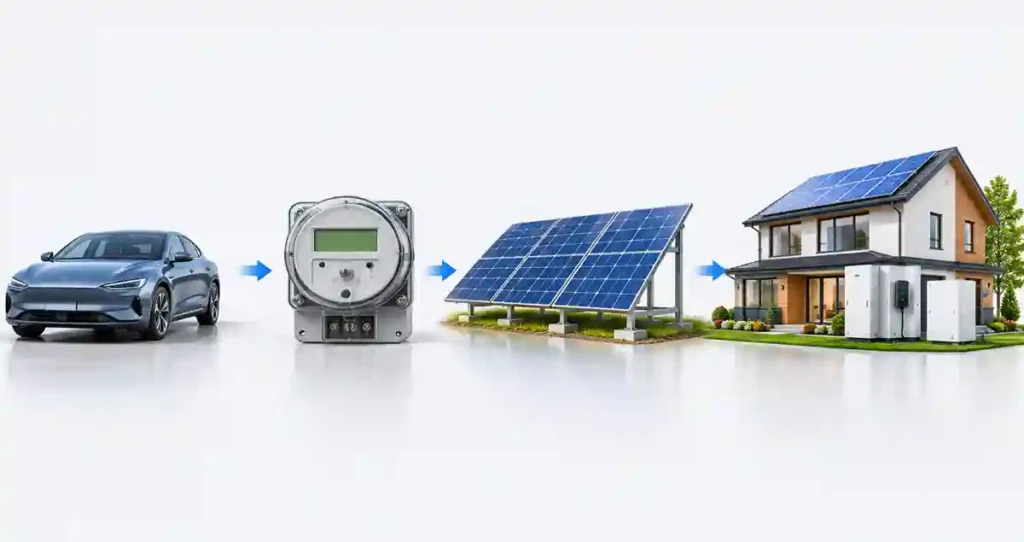
You can estimate the required solar panels using four simple steps.
Step 1: Calculate Daily EV Electricity Consumption
Use this formula:
Daily EV electricity consumption (kWh) = Daily driving distance × EV consumption per mile
Suppose:
- Daily driving distance = 40 miles
- EV consumption = 30 kWh per 100 miles
First, convert the vehicle’s electricity consumption into kWh per mile:
30 ÷ 100 = 0.30 kWh per mile
Now calculate daily electricity consumption:
40 × 0.30 = 12 kWh per day
The vehicle therefore requires approximately 12 kWh of electricity for 40 miles of driving.
Step 2: Calculate Annual EV Electricity Consumption
Multiply daily consumption by 365:
12 × 365 = 4,380 kWh per year
Under this example, the vehicle uses approximately 4,380 kWh annually.
This assumes the driver travels 40 miles every day. If your actual annual mileage is available, use that figure instead:
Annual EV electricity consumption = Annual driving distance × EV consumption per mile
This is often more accurate than assuming the same mileage every day.
Step 3: Calculate Annual Production per Solar Panel
For this example, assume:
- Solar panel rating = 450W
- Annual production factor = 1,400 kWh per installed kW
First, convert the panel rating into kilowatts:
450 ÷ 1,000 = 0.45 kW
Now calculate annual production:
0.45 × 1,400 = 630 kWh per panel per year
Therefore, one 450W solar panel is estimated to generate 630 kWh annually under this illustrative production assumption.
Step 4: Calculate the Number of Solar Panels
Use the following formula:
Number of solar panels = Annual EV electricity consumption ÷ Annual production per panel
Substitute the example values:
4,380 ÷ 630 = 6.95
Round up to the next whole panel.
Estimated requirement: 7 solar panels rated at 450W each.
The total rated solar capacity is:
7 × 450W = 3,150W, or 3.15 kW
This is the estimated additional solar capacity needed to offset the EV’s annual electricity consumption under the assumptions used above. It does not include the home’s existing electricity demand.
Solar Panels Required Based on Daily Driving Distance
The following table shows how the estimated number of solar panels changes with daily driving distance.
Calculation assumptions:
- EV consumption: 30 kWh per 100 miles
- Solar panel rating: 450W
- Annual solar production factor: 1,400 kWh/kW
- Solar production per 450W panel: 630 kWh/year
| Daily driving distance | Daily EV energy | Annual EV energy | Estimated 450W panels |
|---|---|---|---|
| 20 miles | 6 kWh | 2,190 kWh | 4 |
| 30 miles | 9 kWh | 3,285 kWh | 6 |
| 40 miles | 12 kWh | 4,380 kWh | 7 |
| 50 miles | 15 kWh | 5,475 kWh | 9 |
| 60 miles | 18 kWh | 6,570 kWh | 11 |
| 80 miles | 24 kWh | 8,760 kWh | 14 |
These figures represent estimated annual energy offset. They do not guarantee that the solar system will produce enough electricity to charge the vehicle at every moment.
For example, a system may generate more electricity during summer than winter. If the vehicle is normally driven home in the evening, the homeowner may need grid electricity or battery storage to use solar energy generated earlier in the day.
How Many Solar Panels Are Needed for a Full EV Battery Charge?
Daily driving energy and a full battery recharge are two different calculations.
Suppose an electric vehicle has a 60 kWh battery. A recharge from empty to full requires approximately 60 kWh delivered to the battery, subject to charging conditions and the vehicle’s battery management system.
Using the same illustrative solar production assumption:
- Solar panel capacity = 450W or 0.45 kW
- Annual production factor = 1,400 kWh/kW
- Annual production per panel = 630 kWh
- Average daily production per panel = 630 ÷ 365 = approximately 1.73 kWh
The estimated number of panels needed to generate the equivalent of 60 kWh in an average day is:
60 ÷ 1.73 = 34.7
You would need approximately 35 solar panels rated at 450W each to generate the equivalent of 60 kWh over an average day under these assumptions.
However, this does not guarantee a complete recharge in one day. Solar production changes with weather, season, shading and system conditions. The calculation also does not account for the timing of solar generation or the charging limits of the EV and charger.
For most homeowners, sizing solar around regular daily driving is more useful than designing the system around an occasional full battery recharge.
How Many Solar Panels Do You Need Based on Vehicle Type?
Vehicle size and efficiency can also affect the required solar capacity.
For example, consider a driver who travels 40 miles daily and uses 450W solar panels. The following table compares different illustrative vehicle consumption levels.
| Vehicle category | Assumed consumption | Daily energy for 40 miles | Estimated annual panels |
|---|---|---|---|
| Efficient sedan | 25 kWh/100 miles | 10 kWh | 6 |
| Crossover | 30 kWh/100 miles | 12 kWh | 7 |
| Large SUV | 35 kWh/100 miles | 14 kWh | 9 |
| Electric pickup | 45 kWh/100 miles | 18 kWh | 11 |
The calculation uses the same annual production assumption of 630 kWh per 450W panel.
This comparison shows why it is important to use the actual vehicle’s electricity consumption rather than selecting a panel count based only on vehicle category.
How Much Additional Solar Capacity Do You Need for an Existing Home Solar System?
If you already have rooftop solar, you may not need a completely separate installation for your EV.
Instead, calculate the additional electricity demand from the vehicle and compare it with the available production from your existing solar system.
For example, suppose your home currently uses 10,000 kWh annually and your EV adds another 4,380 kWh.
Your combined annual electricity requirement becomes:
10,000 + 4,380 = 14,380 kWh per year
You should compare this figure with your solar system’s actual or estimated annual production.
A 10 kW solar installation does not automatically mean it can support every EV charging requirement. Its annual generation, household consumption, inverter capacity and charging schedule all matter.
If the existing system produces sufficient surplus electricity, you may be able to use that energy for EV charging. If not, additional solar capacity may be required.
For more information, read our guides to residential solar panel installation and solar arrays.
Do You Need a Home Battery to Charge an Electric Car with Solar Panels?
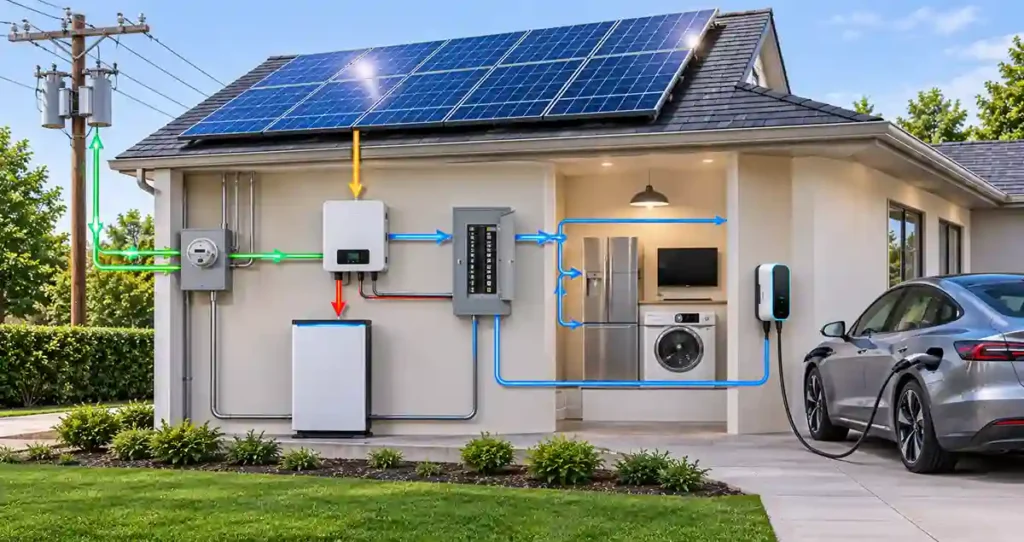
No. A home battery is not essential for every solar EV charging system.
A grid-connected solar installation can supply available solar electricity to household loads and EV charging. When solar production is insufficient, the home can draw electricity from the utility grid, subject to the system configuration and utility arrangement.
A battery becomes useful when you want to store surplus daytime solar energy for charging later, particularly if your vehicle is normally parked at home during the evening or overnight.
However, adding a battery increases system cost and introduces additional conversion and storage losses. Its value depends on electricity tariffs, export compensation, backup requirements and charging habits.
You can explore this subject further in our guides to home battery backup and the solar battery size calculator.
What Size Solar Inverter Do You Need for EV Charging?
Solar panel count alone does not determine whether a system can support an EV charger. The inverter must also be suitable for the solar array, household loads and EV charging equipment.
For example, a home may have a 10 kW solar array and a Level 2 EV charger rated at 7.2 kW. Whether the system can supply the charger directly from solar depends on available solar generation, inverter output capacity and other household loads.
If the homeowner also wants battery backup, the hybrid inverter and battery must be compatible with the required operating arrangement.
Before recommending an inverter, assess:
- Total solar array capacity
- Inverter continuous AC output rating
- Existing household demand
- EV charger power rating
- Battery compatibility and discharge capability, if applicable
- Grid import and export arrangements
- Future system expansion requirements
A suitable design should account for simultaneous household and EV loads rather than sizing the inverter only around the EV charger.
Read our solar inverter guide and solar inverter for EV charging for more information.
Which EV Charger Should You Use with a Solar System?
The appropriate charger depends on the vehicle, available electrical supply and required charging speed.
For most residential solar installations in the United States, Level 1 and Level 2 chargers are the main options.
- Level 1: Uses a standard 120V AC household outlet and provides relatively slow charging.
- Level 2: Uses a 208–240V AC supply and offers faster home charging.
- Level 3: DC fast charging is generally designed for commercial and public charging locations rather than ordinary residential installations.
A solar system can work with compatible AC EV charging equipment, but the charger itself does not automatically guarantee that all charging electricity will come directly from solar panels. Smart charging controls can adjust charging power according to available solar generation, depending on equipment compatibility.
Read our complete guide to EV charger levels explained for a detailed comparison.
How Can You Improve Solar EV Charging Efficiency?
A well-planned system can make better use of available solar electricity.
1. Charge During Peak Solar Production
If your vehicle is parked at home during the day, schedule charging around periods of strong solar production. This can increase direct solar self-consumption.
2. Use Smart EV Charging
A compatible smart EV charger or energy management system can adjust charging power according to solar generation and household demand. Some systems can prioritize surplus solar electricity instead of drawing additional power from the grid.
3. Match Charger Power with Available Supply
A high-power charger does not always mean faster or more economical solar charging. The vehicle’s onboard charger, inverter output and available electrical supply determine the actual charging rate.
4. Consider Future Electrical Requirements
If you are installing solar panels before purchasing an EV, consider the future charger location, electrical panel capacity, wiring route and inverter capability. Planning these requirements early can reduce the need for later modifications.
Engineer’s Recommendation
When designing a residential solar system, I recommend considering future EV charging demand even if the homeowner does not currently own an electric vehicle.
The important step is not simply adding more solar panels. It is evaluating the complete electrical system: solar array capacity, inverter output, distribution panel, cable routing, charger compatibility and expected vehicle usage.
For a homeowner driving around 40 miles daily, our example shows that approximately seven 450W panels could offset the EV’s annual electricity consumption under the stated production assumptions. The final design should still use a location-specific solar production estimate and account for the home’s existing electricity demand.
If the homeowner plans to charge mainly at night, battery storage or grid electricity may be needed depending on the system design and utility arrangement. If daytime charging is practical, smart charging can help use more available solar generation directly.
Frequently Asked Questions for How Many Solar Panels to Charge an Electric Car
1. How many solar panels do I need to charge an electric car?
For an illustrative daily commute of 40 miles, an EV consuming 30 kWh per 100 miles and 450W solar panels, approximately seven panels may offset the vehicle’s annual electricity consumption. The actual number depends on the vehicle, driving distance and location.
2. Can five solar panels charge an electric car?
Yes. Five solar panels may provide enough annual electricity for an efficient EV or a driver with relatively low daily mileage. However, the result depends on panel wattage, local solar production and vehicle consumption.
3. Can I charge my EV directly from solar panels?
Yes. A compatible grid-connected solar system and EV charger can use available solar generation to charge an electric vehicle. However, solar production varies throughout the day, so grid electricity may supplement charging when solar generation is insufficient.
4. Do I need a battery to charge my EV with solar panels?
No. A grid-connected solar system can charge an EV without a home battery. Battery storage is optional and can help store daytime solar energy for evening or overnight charging.
5. How many solar panels are needed for a 60 kWh EV battery?
Using the illustrative assumptions in this guide, approximately 35 panels rated at 450W could generate the equivalent of 60 kWh over an average day. This is an energy-production estimate, not a guarantee of a complete one-day recharge.
6. Can a 10 kW solar system charge an electric car?
A 10 kW solar system can support EV charging, but the available energy depends on its actual production and household consumption. The inverter, charger, vehicle and charging schedule must also be compatible.
7. Is Level 2 charging better for a home solar system?
Level 2 charging is often more practical for regular home EV charging because it can deliver more power than Level 1. However, the best option depends on driving distance, available electrical capacity, vehicle compatibility and charging time requirements.
8. How many solar panels are needed to charge an EV every day?
There is no single answer. The required number depends on daily mileage, vehicle electricity consumption, panel wattage and local solar production. Calculate the daily EV energy requirement and compare it with the expected daily or annual production of the solar array.
Final Thoughts
The number of solar panels required to charge an electric car depends mainly on the vehicle’s electricity consumption, daily driving distance, panel wattage and local solar production.
For a practical estimate, calculate the EV’s annual electricity consumption first, then determine how much energy each solar panel can generate at your location. This approach provides a more reliable starting point than using a generic panel-count estimate.
If you are planning a new residential solar installation, include future EV charging requirements in the design from the beginning. A properly planned system can support both household electricity needs and electric vehicle charging while making better use of available solar energy.
References and Useful Tools
- FuelEconomy.gov – Electric Vehicle Fuel Economy — Check vehicle-specific electricity consumption and efficiency.
- PVWatts Calculator — Estimate location-specific monthly and annual solar production.
- PVWatts Help Guide — Understand the calculator inputs and production estimates.
- U.S. Department of Energy – Electric Vehicles — Learn more about EV technology and charging.
- EPA Automotive Trends Report — Review vehicle efficiency and electricity consumption information.
Related guides
- How Solar EV Charging Works: From Solar Panels to Your EV
- Grid-Connected vs. Off-Grid EV Charging: Key Differences
- Solar Inverter for EV Charging: Capacity, Types and Compatibility
- Direct Solar EV Charging vs. Solar Plus Battery Storage: Which Is Better?
- EV Charger Levels Explained: Level 1 vs. Level 2 vs. Level 3
- Level 1 EV Charger: Speed, Power & Cost
- Level 2 EV Charger: Speed, Installation & Cost
- Level 3 EV Charger: How DC Fast Charging Works