
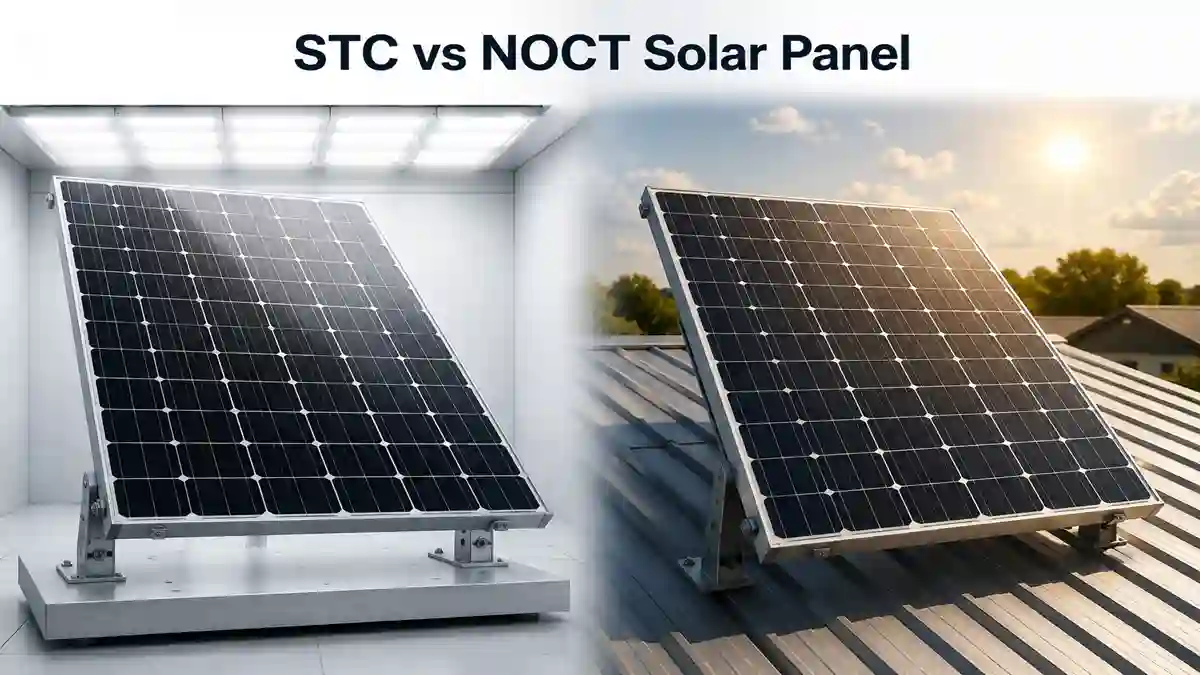
A 600W solar panel rarely produces 600W in everyday conditions. An engineer explains STC vs NOCT solar panel ratings, temperature effects, and which number better predicts real-world performance.
Every solar panel datasheet lists at least two different power ratings, and most buyers only ever notice the first, larger one. Understanding the difference between STC vs NOCT ratings — and why NOCT is often the more realistic predictor of everyday performance — closes one of the more common gaps between what a datasheet promises and what a system actually delivers.
This guide is part of our Solar Panel Efficiency 2026 hub.
What STC (Standard Test Conditions) Measures
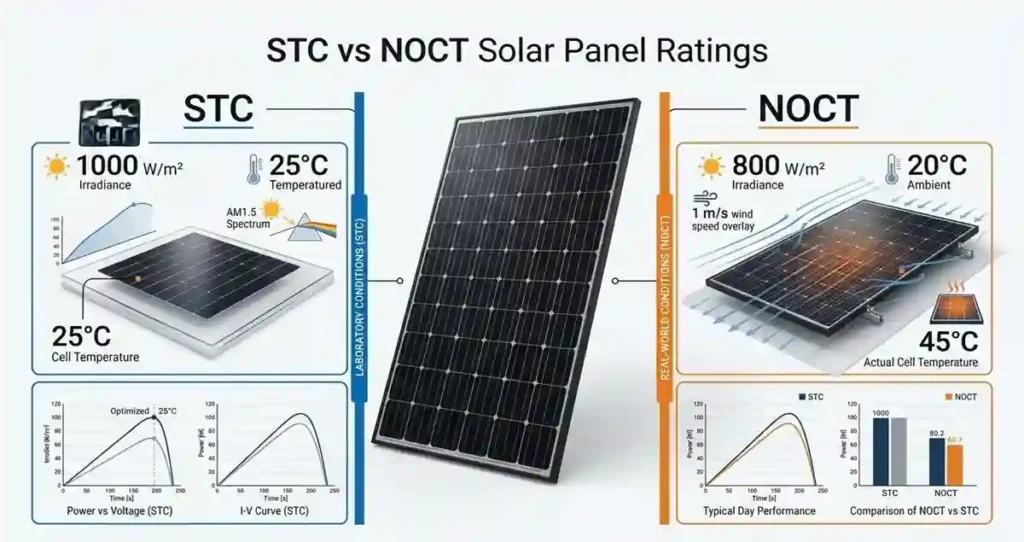
STC is the primary rating printed prominently on every datasheet and used for the headline wattage and efficiency figures — measured at exactly 25°C cell temperature, 1000 W/m² irradiance, and a specific standardized light spectrum (AM1.5). These are deliberately idealized laboratory conditions chosen to create a consistent, comparable baseline across every manufacturer’s products, not a prediction of typical real-world operating conditions.
What NOCT (Nominal Operating Cell Temperature) Measures
NOCT rates the panel under conditions meant to approximate more realistic outdoor operation — typically 20°C ambient air temperature (not cell temperature), 800 W/m² irradiance, and normal wind conditions, allowing the cell to reach whatever temperature it naturally would under those more moderate, realistic conditions rather than being held at a fixed 25°C. Because cell temperature under NOCT conditions typically runs meaningfully higher than the STC standard, and because temperature reduces output as covered in our Temperature Coefficient guide, NOCT-rated power is consistently lower than STC-rated power for the same physical panel.
A Simple STC vs NOCT Example
Consider a solar panel with a 600W STC rating. If the same module delivers 520W under NOCT conditions, the difference doesn’t indicate underperformance or a defective panel. It simply reflects the reality that solar modules operate at higher temperatures and lower irradiance levels outside the laboratory. Understanding this difference helps set realistic production expectations before installation.
Engineer’s Note: I treat NOCT as the more honest everyday performance predictor for most residential and commercial installations, since it accounts for realistic operating temperature rather than an idealized fixed 25°C. STC remains useful specifically for comparing panels against each other on a standardized basis, but if a client wants a single number closer to what they’ll actually see on a typical operating day, NOCT is the better reference point.
STC vs NOCT Side-by-Side
| Parameter | STC | NOCT | Industry Reference |
| Cell temperature | Fixed at 25°C | Allowed to reach natural operating temperature (typically higher) | NREL |
| Irradiance | 1000 W/m² | 800 W/m² | NREL |
| Ambient air temperature | Not specified (cell temp fixed instead) | 20°C | NREL |
| Typical resulting power rating | Higher — the headline datasheet number | Lower — typically 10-15% below STC rating | Fraunhofer ISE |
| Best use | Standardized comparison between panels | More realistic everyday performance estimate | Industry Best Practice |
Note: NOCT power isn’t a guaranteed field output. Actual production depends on local temperature, irradiance, roof orientation, shading, dust accumulation, and overall system design.
The One Number That Matters Most: STC for Comparison, NOCT for Reality
If you remember only one takeaway from this guide, make it this: STC tells you how two solar panels compare under identical laboratory conditions, while NOCT gives you a much better indication of how a single panel is likely to perform in everyday operation. Neither rating should be viewed in isolation, but if your goal is setting realistic expectations rather than comparing datasheets, NOCT is usually the more useful reference point.
Advantages and Disadvantages of Each Rating
| Advantages | Disadvantages |
| STC: universal standard enabling direct panel-to-panel comparison | STC: idealized conditions rarely match real installed performance |
| NOCT: closer approximation of realistic everyday operating output | NOCT: less prominently featured, requires digging into full datasheet |
| Both together: give a genuine best-case and realistic-case range | Neither alone fully predicts your specific site’s actual performance |
Real-World Applications
I reference both figures when setting client expectations during system design — STC to explain the headline number they’ve likely already seen in marketing material, and NOCT to give a more grounded sense of typical everyday output before we even get into site-specific factors like local temperature and shading. Clients who understand this distinction upfront are consistently less likely to feel misled when real-world production comes in below the STC-based number they initially anchored on.
Field Note: A client once compared two competing quotes purely on STC wattage, unaware that the higher-STC panel actually had a less favorable NOCT figure due to a worse temperature coefficient, meaning the two panels performed much closer to each other under realistic operating conditions than the STC numbers alone suggested. Reviewing NOCT figures alongside STC prevented a decision based on an incomplete picture.
Common Misconceptions Worth Clearing Up
People sometimes assume NOCT represents a “worst case” scenario or somehow indicates a problem with the panel. It’s the opposite — NOCT is simply a more realistic operating condition than the deliberately idealized STC standard, and a healthy, well-functioning panel is expected to produce meaningfully less than its STC rating under everyday NOCT-like conditions. That’s normal physics, not underperformance.
Buying Checklist
- Request both STC and NOCT figures when comparing competing panel quotes
- Use STC for standardized panel-to-panel comparison, NOCT for realistic performance expectations
- Don’t be alarmed when real-world output runs below the STC-rated wattage — this is expected
- Factor in temperature coefficient alongside NOCT for the most accurate site-specific performance picture
For how temperature specifically drives the gap between these two ratings, see our Temperature Coefficient guide. For the complete efficiency picture, see Solar Panel Efficiency 2026.
A Third Rating Worth Knowing: PTC
Beyond STC vs NOCT, some datasheets and third-party testing organizations also reference PTC (PVUSA Test Conditions), a third standardized rating that some consider even more representative of real-world performance than either STC or NOCT for certain applications. PTC isn’t universally provided by every manufacturer, but where available, it can offer a useful third data point alongside STC and NOCT for buyers doing detailed comparison shopping.
For most buyers, I don’t consider chasing down PTC data essential — STC for standardized comparison and NOCT for realistic expectations cover the great majority of what’s needed to make an informed decision. But for anyone doing particularly detailed technical due diligence, it’s worth knowing this third rating exists and asking a manufacturer directly if it’s not listed on the standard datasheet.
Why Energy Yield Matters More Than Any Single Rating
STC vs NOCT, and PTC are all useful benchmarks, but none directly predict annual electricity production. Long-term energy yield depends on environmental conditions, system losses, temperature, shading, and module degradation. This is why I encourage clients to evaluate projected kilowatt-hour production rather than focusing exclusively on a panel’s advertised wattage.
Long-term output also depends on Solar Panel Degradation Rate , which gradually reduces power production over decades.
Frequently Asked Questions
Why is my panel’s NOCT rating lower than its STC rating?
NOCT conditions allow the cell to reach a more realistic operating temperature, which is typically higher than the fixed 25°C used in STC testing. Since higher temperature reduces panel output, NOCT ratings are consistently lower than STC ratings for the same physical panel — this is expected, not a defect.
Which rating should I use to estimate my system’s real output?
NOCT provides a more realistic baseline than STC, though for the most accurate site-specific estimate, ask your installer for a full energy yield model accounting for your local climate, shading, and orientation rather than relying on either standardized rating alone.
Do all manufacturers report NOCT ratings?
Most reputable manufacturers include NOCT figures in the full technical datasheet, though it’s less prominently featured than the STC headline number. If a datasheet only shows STC, it’s worth requesting NOCT data directly from the manufacturer or installer, since its absence from marketing material doesn’t mean the figure doesn’t exist.
Is STC the same as real-world panel performance?
No. STC uses standardized laboratory conditions designed to compare solar panels consistently. Real-world operating conditions are usually less favorable.
Is NOCT more accurate than STC?
For most installations, NOCT provides a more realistic estimate of everyday operating performance.
Can two panels with identical STC ratings have different NOCT ratings?
Yes. Differences in temperature coefficient, cell technology, and module design can produce different NOCT performance.
Why do installers still use STC ratings?
STC remains the industry’s universal comparison standard, allowing direct panel-to-panel comparisons across manufacturers.
Should homeowners pay more attention to NOCT?
Yes. Reviewing NOCT alongside STC provides a more complete understanding of expected field performance.
References
STC and NOCT testing standard data is drawn from NREL’s panel testing documentation and Fraunhofer ISE’s Photovoltaics Report.
The Full Efficiency Cluster — What Each Guide Covers
- 7 Factors That Kill Solar Panel Efficiency — the complete roundup of real-world efficiency losses
- Solar Panel Temperature Coefficient — including hot-climate performance specifically
- Solar Panel Degradation Rate — how output declines year over year across a 25-year system life
- LID vs LeTID in Solar Panels — two specific early-life degradation mechanisms explained
- STC vs NOCT Solar Panel Ratings — the two standardized test conditions behind every datasheet number
- Solar Panel Efficiency in 2026: What Actually Matters?
Related guides on SolarVisionAI.com
- Monocrystalline Solar Panels 2026: Still Worth It or Hype
- Polycrystalline Solar Panels: Worth Buying in 2026?
- Thin-film Solar Panels: When They Beat Silicon (2026)
- BIPV Solar Panels: Building-Integrated PV Complete Guide
- Portable Solar Panels: Engineer’s Buyer’s Guide 2026
- CPV Solar Panels: Concentrated Photovoltaic Explained
- Skin Solar Panel: What “Solar Skin” Actually Means
- Solar Fence Post Lights: Cap Sizes, Types & Install Guide
- Bifacial Solar Panels in 2026: How to Boost Energy Output
- Solar Charge Controller: The Complete Guide
- MC4 Connectors: Solar Safety & Installation Guide
- Solar Panel Types, Efficiency & Benefits
- Solar Water Pump Guide
- Commercial Solar Panel Installation: Engineering Guide
- Solar Fence Post Lights: Cap Sizes, Types & Install Guide
- BESS — Battery Energy Storage System Guide
- Commercial Solar Panel Installation
- Solar Refrigerator & DC Fridge — Complete 2026 Guide
- Bifacial Solar Panel Albedo Effect Guide
- TOPCon: Why TOPCon Solar Panel is a Proven Smart Investment in 2026
- HJT: Why TOPCon Solar Panel is a Proven Smart Investment in 2026
- PERC: PERC Solar Panel: Still Relevant or Already Outdated?
- Perovskite: Perovskite Solar Panels: The 2026 Reality Check
- N-Type vs P-Type: N-Type vs P-Type Solar Panels: Honest Comparison
- ABC: ABC (all back contact) Solar Panel: Back Contact Technology Explained
- IBC: IBC Solar Panels: Interdigitated Back Contact Guide
- Tandem: Tandem Solar Panels: Are Stacked Cells Ready for Rooftops?