
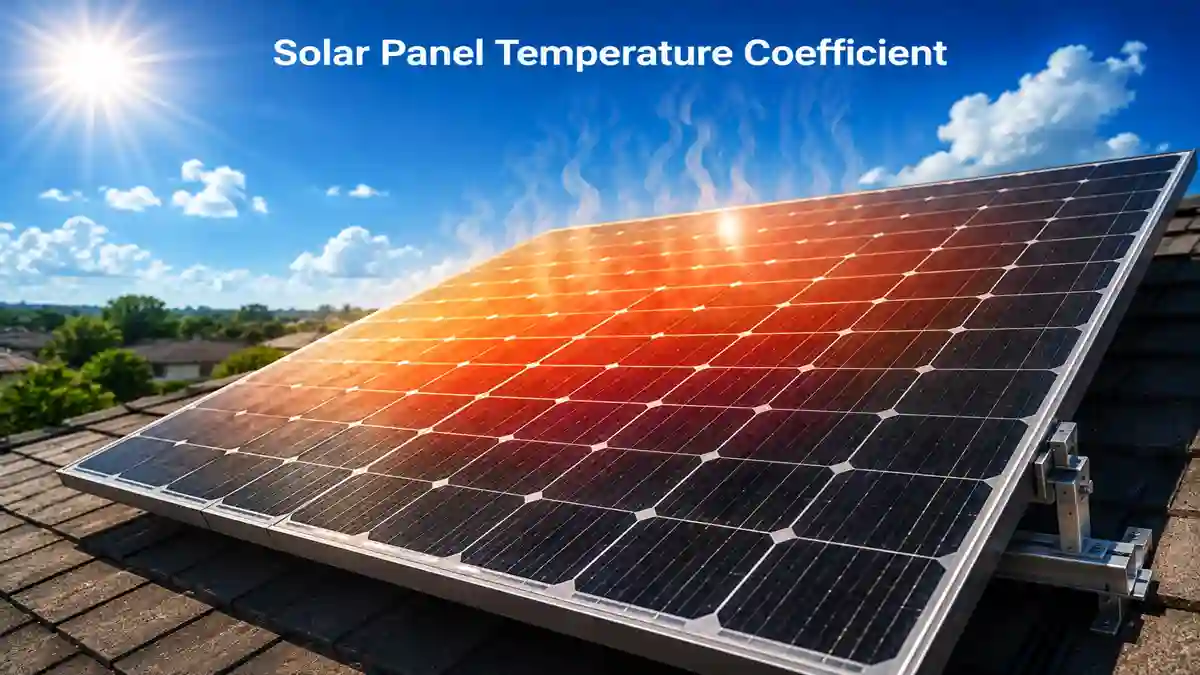
Solar panel temperature coefficient explained by a registered engineer — real hot-climate performance data and which technology handles heat best.
Temperature coefficient is the single most consequential number on a solar panel datasheet that most buyers never think to ask about, and it’s also the reason a hot, sunny climate doesn’t automatically mean maximum solar output. This guide covers the underlying physics and, since it’s the same underlying question, what it means specifically for hot-climate installations — rather than splitting those into two separate pages covering the same ground twice.
This guide is part of our Solar Panel Efficiency 2026 hub.
What Solar Panel Temperature Coefficient Actually Measures
Temperature coefficient describes how much a panel’s power output declines for every degree Celsius its cell temperature rises above the 25°C Standard Test Condition baseline, typically expressed as a negative percentage per degree — for example, -0.35%/°C. This is counterintuitive to many buyers: solar panels actually become less efficient as they get hotter, even though hot climates generally have more available sunlight overall.
Pmax, Voc and Isc: Which Solar Panel Temperature Coefficient Matters?
Solar panel datasheets may list temperature coefficients for maximum power (Pmax), open-circuit voltage (Voc), and short-circuit current (Isc). For comparing real-world power performance, the Pmax temperature coefficient is usually the most useful figure because it describes how maximum electrical power changes as cell temperature rises. Voc and Isc coefficients remain important for system design, particularly when checking inverter voltage limits and electrical behavior across different temperatures.
Example: −0.24%/°C vs −0.40%/°C
Consider two panels operating at a cell temperature of 65°C. The temperature rise above the 25°C STC reference is 40°C.
A panel with a −0.40%/°C Pmax coefficient would experience approximately 16% relative power loss.
A panel with a −0.24%/°C coefficient would experience approximately 9.6% relative power loss.
The difference is 6.4 percentage points of relative power loss, illustrating why temperature coefficient becomes particularly important in hot climates.
Engineer’s Note: The physics behind this is straightforward semiconductor behavior — as cell temperature rises, the voltage a solar cell can produce decreases, even though current stays relatively stable. Since power is the product of voltage and current, rising temperature directly reduces power output. This is an inherent property of how photovoltaic cells work, not a manufacturing defect or design flaw.
Solar Panel Temperature Coefficient by Cell Technology
| Cell Technology | Typical Temperature Coefficient | Practical Meaning | Industry Reference |
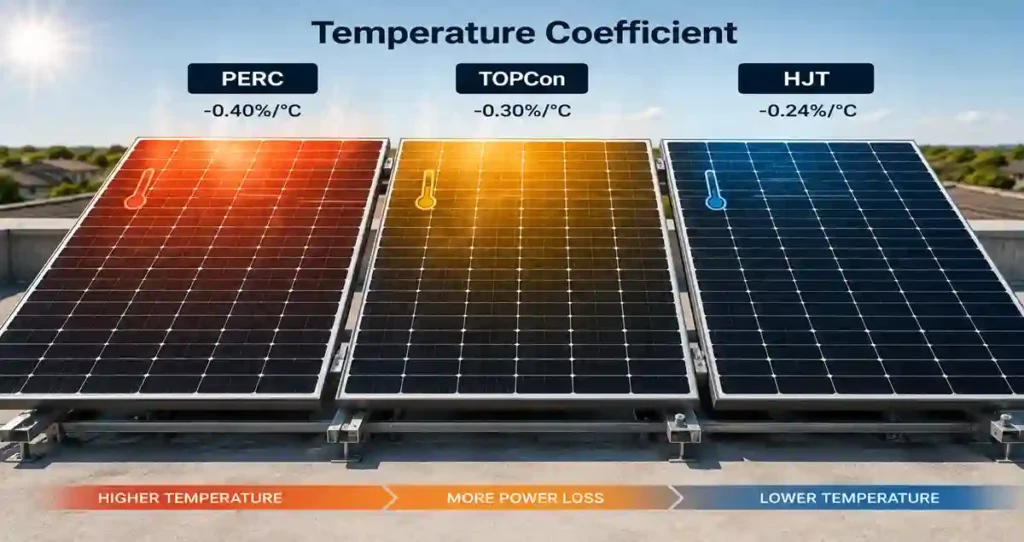
| Standard PERC (P-type) | ~-0.40% to -0.45%/°C | Baseline, most common on the market | Fraunhofer ISE |
| TOPCon (N-type) | ~-0.30% to -0.34%/°C | Meaningfully better than standard PERC | Fraunhofer ISE |
| HJT | ~-0.24% to -0.29%/°C | Best-in-class among mainstream cell technologies | Fraunhofer ISE |
| Thin-Film (CdTe/a-Si) | ~-0.20% to -0.25%/°C | Better than crystalline silicon, offsets lower base efficiency somewhat | NREL |
Note: Temperature coefficient values vary by manufacturer and module design. Always use the Pmax temperature coefficient listed on the specific module datasheet when making a purchasing or engineering comparison.
What This Means for Hot Climate Installations
On a hot roof, actual cell temperature commonly runs 20-30°C above ambient air temperature due to solar heating and limited airflow beneath the panel. A panel rated at 22% efficiency at the 25°C lab standard might be operating at cell temperatures of 55-65°C during peak summer conditions in a hot climate, which for a standard PERC panel with a -0.40%/°C coefficient translates into a real-world efficiency reduction of roughly 12-16 percentage points off the rated STC efficiency during those peak-heat hours.
This is exactly why temperature coefficient, not just headline efficiency, deserves serious weight when specifying panels for a hot-climate installation. A HJT panel with a better temperature coefficient can meaningfully outperform a higher-STC-efficiency panel with a worse coefficient once real operating temperatures are factored in — the datasheet efficiency number alone doesn’t tell this story.
Field Note: I’ve compared modeled annual output between a standard PERC panel and an HJT panel with a notably better temperature coefficient, both specified for the same hot-climate site. The efficiency gap between the two narrowed considerably once realistic operating temperatures were factored into the model, compared to what the headline STC efficiency numbers alone would suggest — the HJT panel’s temperature advantage recovered much of what looked like a smaller efficiency gap on paper.
Advantages and Disadvantages of Prioritizing Temperature Coefficient
| Advantages | Disadvantages |
| More accurate real-world output prediction for hot-climate sites | Panels with the best temperature coefficients often carry a cost premium |
| Better long-term summer performance where heat losses compound daily | Less relevant in consistently cool or temperate climates |
| Helps differentiate between panels with similar STC efficiency numbers | Requires more detailed spec-sheet comparison than efficiency alone |
Real-World Applications
Temperature coefficient becomes a genuinely important selection criterion, not just a nice-to-know spec, for any installation in a consistently hot climate — a system running near peak output for many hours daily through a long, hot season accumulates the temperature-related loss across every one of those hours, which compounds meaningfully over a year compared to a cooler climate where high-heat operating hours are more limited.
For installations in more moderate climates, temperature coefficient still matters but carries less decisive weight in the buying decision, since fewer operating hours occur at the elevated temperatures where the coefficient difference becomes significant.
Common Misconceptions Worth Clearing Up
People sometimes assume a hot, sunny climate is unambiguously the best environment for solar output, since more sunlight seems like it should mean more power. It’s more nuanced — more available sunlight is genuinely beneficial, but the accompanying heat works against output at the same time, and the net result depends on the specific balance between available irradiance and the panel’s temperature coefficient for that climate.
Buying Checklist
- For hot-climate installations, weigh temperature coefficient alongside headline STC efficiency, not as an afterthought
- Compare temperature coefficient figures specifically between competing quotes, since this isn’t always volunteered upfront
- Consider HJT or TOPCon over standard PERC where budget allows in consistently hot climates
- Request a realistic annual yield model accounting for local temperature patterns, not just STC-based projections
For the complete efficiency picture this fits into, see our Solar Panel Efficiency 2026 guide. For our existing dedicated technology guide on this exact climate question, see HJT Solar Panels.
Reading Solar Panel Temperature Coefficient Alongside Other Specs
Temperature coefficient shouldn’t be evaluated as a standalone number divorced from everything else on the datasheet. A panel with an excellent temperature coefficient but mediocre base STC efficiency might still underperform a higher-efficiency panel with a worse coefficient, depending on the specific climate and operating conditions. The right approach is always modeling total expected annual output for your specific site, using temperature coefficient as one input into that model rather than a standalone ranking criterion.
I’d also encourage buyers to ask installers directly for climate-adjusted output projections rather than accepting STC-based estimates at face value, particularly for hot-climate installations where the gap between STC and realistic output can be substantial. A reputable installer should be able to produce this kind of modeling without difficulty.
Frequently Asked Questions
What is a good temperature coefficient for solar panels?
Values closer to zero are better, since a smaller magnitude means less output loss per degree of temperature rise. Standard PERC panels typically run around -0.40%/°C, while premium TOPCon and HJT panels can reach -0.30%/°C or better.
Do solar panels actually work worse in hot weather?
Efficiency decreases as cell temperature rises above the 25°C lab standard, yes, but hot climates typically have more available sunlight overall, so total output doesn’t necessarily decrease — it depends on the balance between available irradiance and the panel’s specific temperature coefficient.
Which solar panel technology performs best in extreme heat?
HJT generally offers the best temperature coefficient among mainstream cell technologies, followed by TOPCon, with standard PERC trailing both. Thin-film also performs relatively well on temperature coefficient, though its lower base efficiency is a separate consideration that needs to be weighed alongside the temperature advantage for any specific project.
Does a lower temperature coefficient mean a better solar panel?
Generally, yes. A less negative Pmax temperature coefficient means the panel experiences a smaller relative reduction in power as cell temperature increases.
What is the difference between Pmax and Voc temperature coefficient?
The Pmax coefficient describes how maximum electrical power changes with temperature, while the Voc coefficient describes how open-circuit voltage changes. Both are important, but Pmax is particularly useful when comparing real-world power retention.
Why does solar panel efficiency fall when temperature rises?
As photovoltaic cell temperature increases, the electrical characteristics of the cell change and the module’s maximum power generally decreases. The extent of this reduction depends on the module’s temperature coefficient.
Which solar panel technology has the best temperature coefficient?
The answer depends on the specific module, but HJT modules often offer particularly strong temperature coefficients compared with many conventional PERC and TOPCon products. Always compare the manufacturer’s published Pmax coefficient rather than assuming a technology-wide value.
References
Temperature coefficient data by cell technology is drawn from Fraunhofer ISE’s Photovoltaics Report and NREL’s cell performance research.
The Full Efficiency Cluster — What Each Guide Covers
- 7 Factors That Kill Solar Panel Efficiency — the complete roundup of real-world efficiency losses
- Solar Panel Temperature Coefficient — including hot-climate performance specifically
- Solar Panel Degradation Rate — how output declines year over year across a 25-year system life
- LID vs LeTID in Solar Panels — two specific early-life degradation mechanisms explained
- STC vs NOCT Solar Panel Ratings — the two standardized test conditions behind every datasheet number
- Solar Panel Efficiency in 2026: What Actually Matters?
Related guides on SolarVisionAI.com
- Monocrystalline Solar Panels 2026: Still Worth It or Hype
- Polycrystalline Solar Panels: Worth Buying in 2026?
- Thin-film Solar Panels: When They Beat Silicon (2026)
- BIPV Solar Panels: Building-Integrated PV Complete Guide
- Portable Solar Panels: Engineer’s Buyer’s Guide 2026
- CPV Solar Panels: Concentrated Photovoltaic Explained
- Skin Solar Panel: What “Solar Skin” Actually Means
- Solar Fence Post Lights: Cap Sizes, Types & Install Guide
- Bifacial Solar Panels in 2026: How to Boost Energy Output
- Solar Charge Controller: The Complete Guide
- MC4 Connectors: Solar Safety & Installation Guide
- Solar Panel Types, Efficiency & Benefits
- Solar Water Pump Guide
- Commercial Solar Panel Installation: Engineering Guide
- Solar Fence Post Lights: Cap Sizes, Types & Install Guide
- BESS — Battery Energy Storage System Guide
- Commercial Solar Panel Installation
- Solar Refrigerator & DC Fridge — Complete 2026 Guide
- Bifacial Solar Panel Albedo Effect Guide
- TOPCon: Why TOPCon Solar Panel is a Proven Smart Investment in 2026
- HJT: Why TOPCon Solar Panel is a Proven Smart Investment in 2026
- PERC: PERC Solar Panel: Still Relevant or Already Outdated?
- Perovskite: Perovskite Solar Panels: The 2026 Reality Check
- N-Type vs P-Type: N-Type vs P-Type Solar Panels: Honest Comparison
- ABC: ABC (all back contact) Solar Panel: Back Contact Technology Explained
- IBC: IBC Solar Panels: Interdigitated Back Contact Guide
- Tandem: Tandem Solar Panels: Are Stacked Cells Ready for Rooftops?