
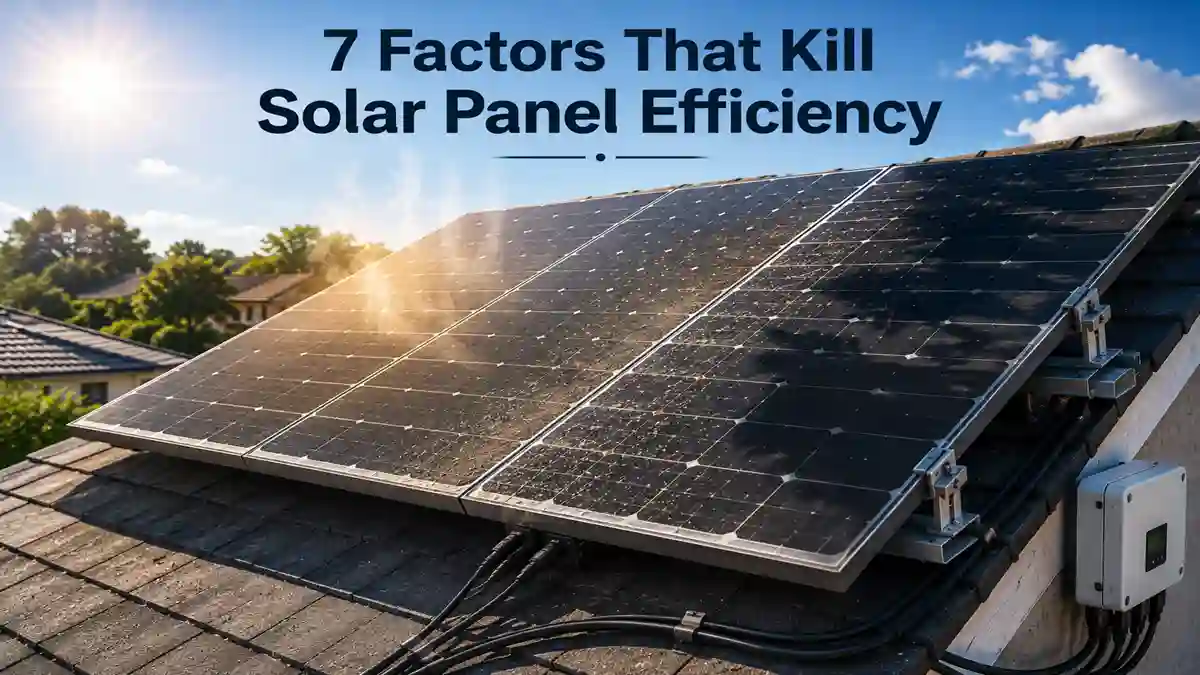
Lab spec sheets don’t tell the full story. An engineer breaks down the 7 real-world losses—from heat to hidden system drops—that kill solar panel efficiency.
Every efficiency number on a datasheet describes a solar panel’s best-case performance under laboratory conditions. What actually happens on a real roof, over real years, involves a predictable set of factors that chip away at that number — some controllable at the design stage, some simply the cost of operating outdoors for 25 years. This guide rounds up the seven that matter most, with links to the deeper technical guides where each gets full treatment.
This guide is part of our Solar Panel Efficiency 2026 hub — read that one for the full efficiency picture, this one for the specific factors working against your system’s rated output.
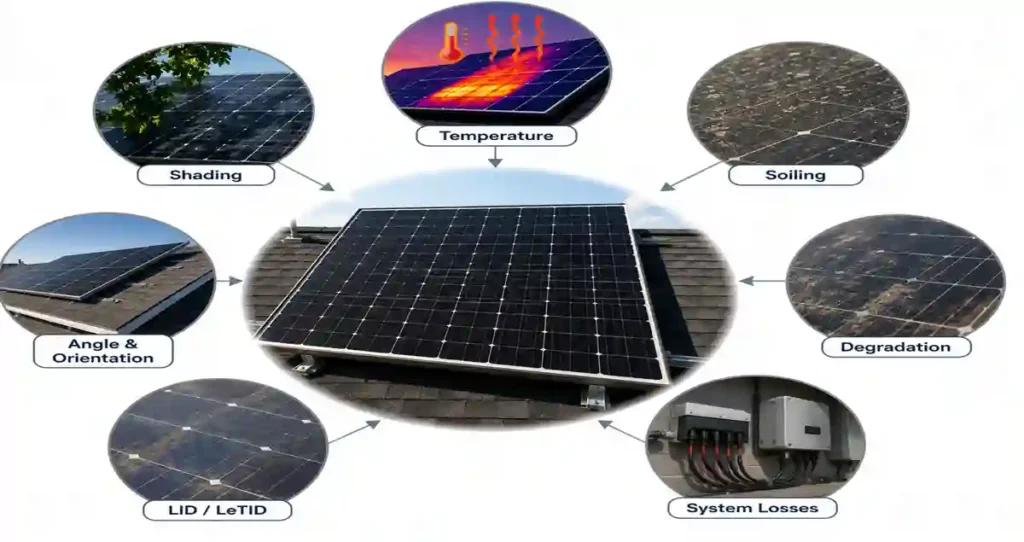
1. Temperature
Every panel loses output as cell temperature rises above the 25°C lab standard, typically 0.3-0.5% per degree Celsius depending on cell technology. On a hot roof, cell temperature can run 20-30°C above ambient air temperature, meaning genuinely significant real-world efficiency loss during peak summer conditions.
2. Shading
Partial shading disproportionately affects output, particularly on older full-cell panel designs where a single shaded cell can drag down an entire series string. Half-cut cell construction, covered in our Half Cut Solar Panels guide, substantially mitigates this but doesn’t eliminate it.
3. Dust, Dirt, and Soiling
Accumulated dust and debris block light from reaching the cells, with typical soiling losses ranging from a few percent in regularly rain-washed climates to considerably more in dry, dusty conditions between cleanings. This is one of the few factors under direct owner control through basic maintenance. Regular cleaning can help restore lost output, but the right cleaning method matters to avoid damaging the module surface. See our guide on How to Clean Solar Panels for safe cleaning methods, recommended frequency, and common mistakes to avoid.
Engineer’s Note: Soiling loss is one of the most commonly underestimated efficiency factors, precisely because it develops gradually and isn’t dramatic the way shading or temperature effects can be. A system that’s never been cleaned isn’t failing; it’s just quietly losing a few percent of output that a basic maintenance schedule would recover.
4. Panel Angle and Orientation
A panel installed at a tilt and orientation mismatched from the site’s optimal angle for its latitude captures less total annual sunlight than one properly optimized, even though the panel itself is identical. This is a design-stage decision, not something correctable after installation without significant retrofit cost.
5. Degradation Over Time
Every panel’s output declines gradually year over year, typically 0.4-0.7% annually depending on cell technology, meaning a system’s year-25 output is meaningfully lower than its year-1 output even absent any other issue. Full detail in our Solar Panel Degradation Rate guide.
6. Light-Induced and Elevated-Temperature-Induced Degradation
Beyond standard long-term degradation, some cell technologies are susceptible to specific early-life degradation mechanisms — LID and LeTID — that cause a measurable output drop shortly after installation before stabilizing. Full detail in our LID vs LeTID guide.
7. Wiring, Inverter, and System-Level Losses
Even a perfectly performing panel loses some output to resistive losses in wiring and conversion losses in the inverter translating DC panel output into usable AC power. These system-level losses typically account for a modest but real percentage of total output, and are worth confirming in any system performance projection.
Advantages and Disadvantages of Understanding These Factors
| Advantages | Disadvantages |
| Setting realistic output expectations prevents mistaking normal loss for a defect | Some factors (temperature, degradation) are simply unavoidable physics, not fixable |
| Identifying controllable factors (soiling, shading) enables real maintenance improvements | Retrofitting design-stage issues (angle, orientation) is often costly after installation |
| Better system sizing accounts for realistic losses rather than idealized STC numbers | Requires more upfront analysis than simply trusting the datasheet efficiency figure |
Real-World Applications
I walk through this exact list with nearly every client during system sizing, specifically to set realistic output expectations rather than letting them anchor on the STC efficiency number alone. A system sized purely against datasheet efficiency without accounting for realistic temperature, shading, and system losses will consistently underdeliver against expectations — not because anything is wrong, but because the sizing never accounted for real-world conditions in the first place.
Field Note: The single most common “my system isn’t performing” call I field turns out to be a combination of ordinary factors from this list — some seasonal shading, a bit of accumulated dust, normal degradation for the system’s age — rather than any actual fault. Walking through this checklist together with the client almost always resolves the concern without needing a technician visit.
Buying and Design Checklist
- Request a realistic annual energy yield estimate accounting for your specific site’s temperature, shading, and orientation, not just STC efficiency
- Establish a basic cleaning/maintenance schedule appropriate to your climate’s dust and soiling conditions
- Confirm degradation rate and LID/LeTID mitigation specifications for your chosen panel technology
- Ask your installer to model wiring and inverter losses specifically, not just panel-level output
Prioritizing These Factors by Impact
If I had to rank these seven factors by typical real-world impact for a standard residential installation, temperature and shading would consistently top the list, followed by degradation accumulating over the system’s operating life. Soiling, angle mismatch, and system-level losses tend to matter but at a smaller relative scale, while LID/LeTID mostly affects early-life performance rather than ongoing annual output. That said, every site is different, and a shaded roof in a mild climate might see shading as its dominant factor while an unshaded roof in a hot climate sees temperature dominate instead.
The practical takeaway is that no single factor should be analyzed in isolation. A comprehensive system design accounts for all seven together, since they interact — a panel with excellent temperature coefficient but poor shading tolerance might still underperform on a heavily shaded hot-climate roof, while the same panel could excel on an unshaded site in that same climate.
Frequently Asked Questions
Why is my solar system producing less than its rated capacity?
This is normal. Rated capacity is measured under lab-standard STC conditions; real-world factors including temperature, shading, dust, orientation, degradation, and system losses all reduce actual output below the datasheet figure.
Which efficiency factor has the biggest real-world impact?
Temperature is typically the single largest factor in hot climates, followed by shading on partially obstructed roofs. Both vary significantly by site-specific conditions, so the biggest factor for any individual system depends on its particular installation.
Can I do anything to improve my system’s real-world efficiency?
Yes, for the controllable factors — regular cleaning addresses soiling loss, and trimming vegetation addresses shading where possible. Temperature and long-term degradation are inherent to the technology, and not something ongoing maintenance can meaningfully change, though choosing a technology with a better temperature coefficient or degradation profile at the purchasing stage does meaningfully affect long-term outcomes.
Does heat permanently damage solar panel efficiency?
High temperatures primarily cause temporary power reduction through the module’s temperature coefficient, while long-term exposure can also contribute to degradation depending on the technology and operating conditions.
How much can dust reduce solar panel output?
The impact varies significantly with local climate, dust accumulation, rainfall, and cleaning frequency. Dry, dusty environments can experience substantially greater soiling losses than systems regularly washed by rainfall.
Does shading affect every solar panel equally?
No. The effect depends on the module’s electrical architecture, shading pattern and system design. Half-cut construction and modern module designs can improve shading tolerance, but no conventional panel eliminates shading losses completely.
Can changing the panel angle improve efficiency?
Changing the tilt and orientation can increase the amount of sunlight reaching the module over the year. The optimal configuration depends on the site’s latitude, roof geometry and project objectives.
Which solar panel technology handles high temperatures best?
Temperature performance depends on the module’s temperature coefficient and cell technology. A panel with a better temperature coefficient generally loses less power as operating temperature rises.
References
Efficiency loss factors and typical loss ranges are drawn from NREL’s system performance research and Fraunhofer ISE’s Photovoltaics Report.
The Full Efficiency Cluster — What Each Guide Covers
- 7 Factors That Kill Solar Panel Efficiency — the complete roundup of real-world efficiency losses
- Solar Panel Temperature Coefficient — including hot-climate performance specifically
- Solar Panel Degradation Rate — how output declines year over year across a 25-year system life
- LID vs LeTID in Solar Panels — two specific early-life degradation mechanisms explained
- STC vs NOCT Solar Panel Ratings — the two standardized test conditions behind every datasheet number
- Solar Panel Efficiency in 2026: What Actually Matters?
Related guides on SolarVisionAI.com
- Monocrystalline Solar Panels 2026: Still Worth It or Hype
- Polycrystalline Solar Panels: Worth Buying in 2026?
- Thin-film Solar Panels: When They Beat Silicon (2026)
- BIPV Solar Panels: Building-Integrated PV Complete Guide
- Portable Solar Panels: Engineer’s Buyer’s Guide 2026
- CPV Solar Panels: Concentrated Photovoltaic Explained
- Skin Solar Panel: What “Solar Skin” Actually Means
- Solar Fence Post Lights: Cap Sizes, Types & Install Guide
- Bifacial Solar Panels in 2026: How to Boost Energy Output
- Solar Charge Controller: The Complete Guide
- MC4 Connectors: Solar Safety & Installation Guide
- Solar Panel Types, Efficiency & Benefits
- Solar Water Pump Guide
- Commercial Solar Panel Installation: Engineering Guide
- Solar Fence Post Lights: Cap Sizes, Types & Install Guide
- BESS — Battery Energy Storage System Guide
- Commercial Solar Panel Installation
- Solar Refrigerator & DC Fridge — Complete 2026 Guide
- Bifacial Solar Panel Albedo Effect Guide
- TOPCon: Why TOPCon Solar Panel is a Proven Smart Investment in 2026
- HJT: Why TOPCon Solar Panel is a Proven Smart Investment in 2026
- PERC: PERC Solar Panel: Still Relevant or Already Outdated?
- Perovskite: Perovskite Solar Panels: The 2026 Reality Check
- N-Type vs P-Type: N-Type vs P-Type Solar Panels: Honest Comparison
- ABC: ABC (all back contact) Solar Panel: Back Contact Technology Explained
- IBC: IBC Solar Panels: Interdigitated Back Contact Guide
- Tandem: Tandem Solar Panels: Are Stacked Cells Ready for Rooftops?