
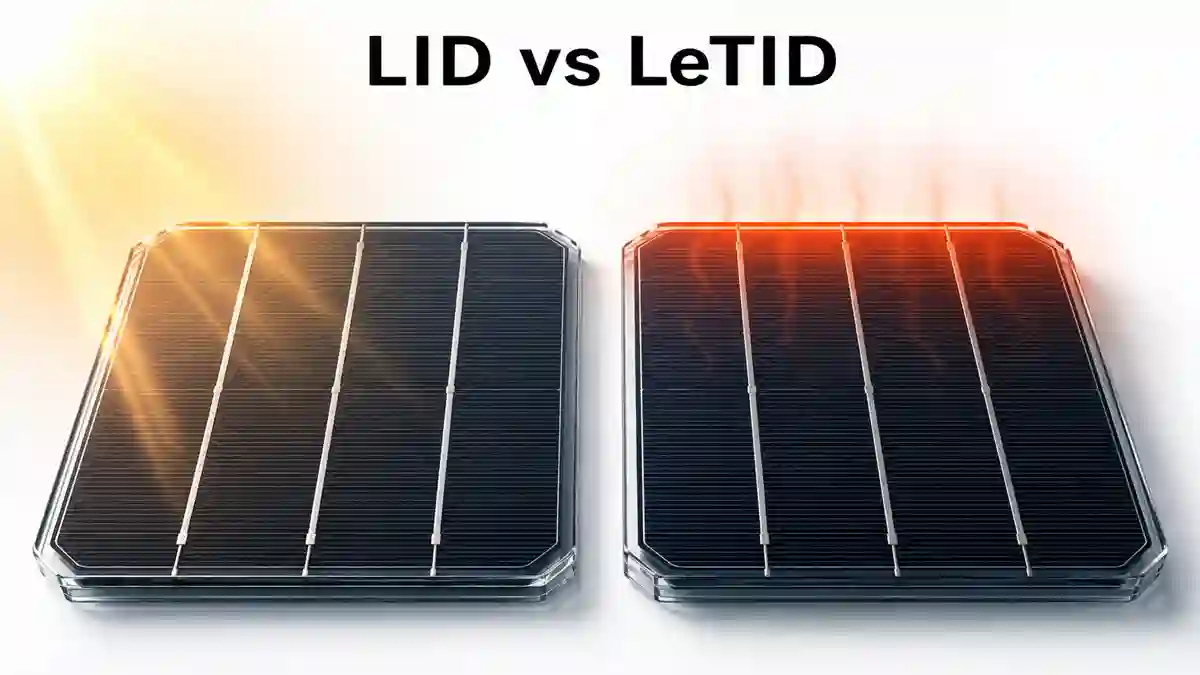
Noticed an early drop in solar output? An engineer breaks down LID vs LeTID degradation, affected cell types, and what manufacturers test for.
LID and LeTID are two specific, well-documented degradation mechanisms that cause a measurable output drop in certain solar cells shortly after installation, before performance stabilizes. Neither is a manufacturing defect — they’re understood physical phenomena tied to specific cell chemistry choices — but knowing which panels are susceptible and how each mechanism differs is genuinely useful when evaluating a datasheet’s degradation claims.
This guide is part of our Solar Panel Efficiency 2026 hub, and is a technical companion to our Solar Panel Degradation Rate — read that one for the full 25-year picture, this one for these two specific early-life mechanisms.
What LID (Light-Induced Degradation) Is
LID occurs in boron-doped P-type silicon cells (the doping type used in standard PERC panels) when the cell is first exposed to sunlight after manufacturing. Boron and oxygen impurities present in the silicon form a defect complex under initial light exposure that temporarily reduces cell efficiency, typically causing a 1-3% output drop within the first hours to days of operation before stabilizing. This is the reason manufacturers often specify a somewhat larger first-year degradation figure separate from the ongoing annual rate.
Engineer’s Note: LID is specifically a P-type silicon phenomenon tied to boron doping. N-type silicon, used in TOPCon and HJT panels, isn’t boron-doped and therefore doesn’t experience LID at all — this is one of the concrete, measurable advantages of N-type technology covered in our N-Type vs P-Type guide, not just a marketing claim.
What LeTID (Elevated-Temperature-Induced Degradation) Is
LeTID is a related but distinct phenomenon that can affect a broader range of cell technologies, including some N-type designs, triggered by a combination of elevated temperature and current flow over extended operating periods rather than simply initial light exposure. LeTID’s onset is typically slower than LID, sometimes not becoming apparent for months of operation, and its severity depends heavily on specific manufacturing process details that vary between producers.
Because temperature plays such an important role in LeTID, I also recommend reviewing our Solar Panel Temperature Coefficient guide when comparing module technologies.
LID vs LeTID Comparison
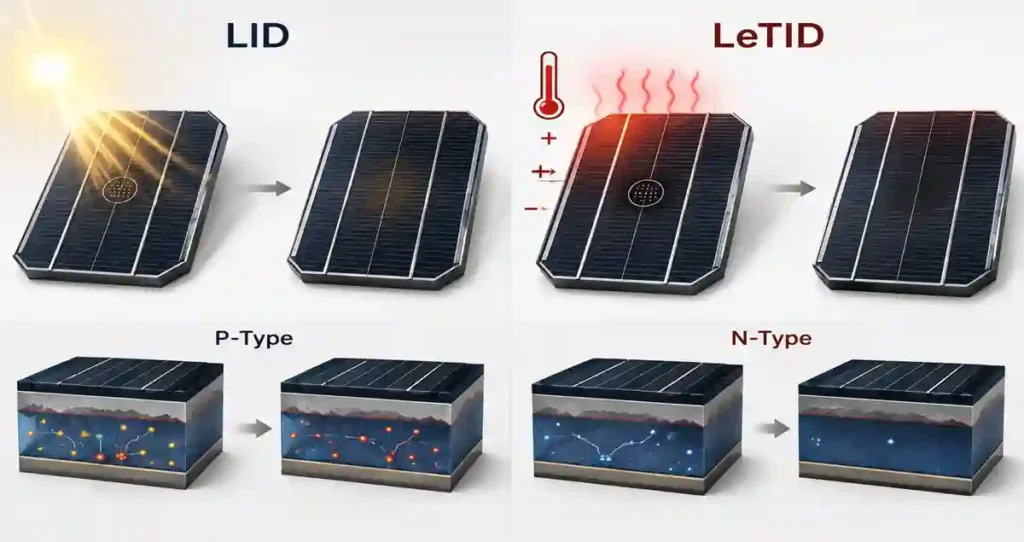
| Characteristic | LID | LeTID | Industry Reference |
| Affected cell types | P-type (boron-doped) silicon only | Broader range, including some N-type | Fraunhofer ISE |
| Onset timing | Hours to days after first light exposure | Can take months to become apparent | Fraunhofer ISE |
| Primary trigger | Initial light exposure activating boron-oxygen defects | Elevated temperature combined with current flow over time | Fraunhofer ISE |
| Typical severity | 1% – 3% output reduction | Variable, manufacturer and process dependent | NREL |
Why Modern Solar Manufacturers Invest So Heavily in LID and LeTID Mitigation
Modern photovoltaic manufacturers don’t simply accept LID and LeTID as unavoidable losses. Process optimization, hydrogen passivation, improved wafer quality, and changes in cell architecture have significantly reduced susceptibility to both mechanisms in many current-generation products. This is one reason why modern TOPCon and HJT modules frequently advertise lower first-year degradation figures than conventional PERC panels.
Advantages and Disadvantages of Understanding These Mechanisms
| Advantages | Disadvantages |
| Helps interpret manufacturer degradation warranty figures accurately | Genuinely technical topic that’s easy to misunderstand without context |
| Informs cell technology choice for buyers prioritizing minimal early degradation | LeTID specifically is harder to predict from datasheet specs alone |
| Prevents mistaking normal early-life stabilization for a defect | Neither mechanism is something an individual buyer can test for directly |
Real-World Applications
This topic comes up in my consulting work mainly when a client notices their new system’s output in the first weeks doesn’t quite match the headline rated wattage, and wants to understand why before assuming something is wrong. Explaining that a modest, expected initial stabilization period is normal for their specific cell technology — and pointing to the manufacturer’s stated first-year degradation figure as the documented expectation — usually resolves the concern immediately.
Field Note: I’ve fielded more than one early-system-performance question that traced back entirely to normal LID stabilization on a standard PERC installation, with no actual issue present. Knowing to check the manufacturer’s stated first-year degradation figure against observed performance, rather than assuming a fault, saved an unnecessary service visit in each case.
Common Misconceptions Worth Clearing Up
People sometimes assume any early-life output drop signals a defective panel requiring warranty service. In the overwhelming majority of cases, a modest, expected decline matching the manufacturer’s stated first-year degradation figure is normal LID or LeTID stabilization, not a fault. A genuine defect would typically show as output significantly below even the manufacturer’s stated degraded figure, not simply matching it.
Buying Checklist
- For minimal LID exposure, prioritize N-type cell technology (TOPCon, HJT) over standard P-type PERC
- Ask manufacturers directly about LeTID mitigation testing, since susceptibility varies by specific manufacturing process
- Compare stated first-year degradation figures across competing quotes as a proxy for LID/LeTID exposure
- Don’t assume early performance matching the datasheet’s degraded figure indicates a problem
- LID and LeTID don’t determine whether a panel will fail, but they do influence how much electricity it will produce throughout its operating life.
For the complete 25-year degradation picture these mechanisms feed into, see our Solar Panel Degradation Rate . For the underlying cell doping distinction, see N-Type vs P-Type Solar Panels.
Why Manufacturing Process Matters for LeTID Specifically
Unlike LID, which follows a fairly predictable pattern tied directly to boron doping, LeTID susceptibility varies considerably based on specific manufacturing process choices even within the same broad cell technology category. Some manufacturers have implemented process refinements specifically targeting LeTID mitigation, while others haven’t prioritized it to the same degree, meaning two panels using superficially similar cell technology can show meaningfully different LeTID resistance in practice.
This is one of the areas where manufacturer reputation and independent testing data genuinely matter beyond just the cell technology category on the datasheet. If LeTID resistance is a priority for a specific project — particularly ground-mount installations in consistently hot climates where LeTID’s temperature and current-flow triggers are most active — I’d recommend asking the manufacturer directly for LeTID-specific testing data rather than assuming it’s adequately addressed based on cell technology alone.
How Modern Solar Panel Technologies Address LID and LeTID
PERC Solar Panels
- Standard P-type PERC cells remain susceptible to conventional LID because of boron-doped silicon.
TOPCon Solar Panels
- TOPCon’s N-type silicon architecture eliminates traditional LID while reducing long-term degradation.
HJT Solar Panels
- HJT combines N-type wafers with a heterojunction structure that offers some of the industry’s lowest degradation rates.
IBC and ABC Solar Panels
- Back-contact architectures improve electrical design but still depend on the underlying silicon chemistry and manufacturing process.
Tandem and Perovskite Solar Panels
- Emerging tandem architectures continue to undergo long-term stability testing, making degradation behavior one of the most important areas of current photovoltaic research.
Frequently Asked Questions
Is LID a defect I should be concerned about?
No. LID is a well-documented, expected phenomenon in P-type silicon cells that manufacturers account for in their stated first-year degradation figures. It’s not a sign of a defective panel.
Do TOPCon and HJT panels experience LID?
No — LID is specifically tied to boron-doped P-type silicon. TOPCon and HJT use N-type silicon, which isn’t boron-doped and therefore doesn’t experience LID, though LeTID can still affect some N-type designs depending on manufacturing process.
How can I tell if my panel’s early performance drop is normal LID or a defect?
Compare your observed output against the manufacturer’s stated first-year degradation figure on the datasheet or warranty document. A decline matching or better than that stated figure is normal stabilization; output significantly below it warrants a warranty inquiry directly with the manufacturer or your installer.
Which solar panels are most vulnerable to LID?
Traditional boron-doped P-type silicon panels are the most susceptible to Light-Induced Degradation.
Can LID be reversed?
No. LID stabilization is generally permanent, although manufacturers already account for it in their first-year degradation specifications.
Does LeTID affect all N-type solar panels?
No. LeTID susceptibility depends heavily on manufacturing processes, even among panels using similar cell architectures.
Should homeowners worry about LID and LeTID?
Not usually. Both mechanisms are well understood and are already incorporated into modern warranty and degradation models.
Can high temperatures increase LeTID?
Yes. Elevated temperatures combined with electrical current are the primary conditions associated with LeTID development.
References
LID and LeTID mechanism data is drawn from Fraunhofer ISE’s Photovoltaics Report and NREL’s cell degradation research.
The Full Efficiency Cluster — What Each Guide Covers
- 7 Factors That Kill Solar Panel Efficiency — the complete roundup of real-world efficiency losses
- Solar Panel Temperature Coefficient — including hot-climate performance specifically
- Solar Panel Degradation Rate — how output declines year over year across a 25-year system life
- LID vs LeTID in Solar Panels — two specific early-life degradation mechanisms explained
- STC vs NOCT Solar Panel Ratings — the two standardized test conditions behind every datasheet number
- Solar Panel Efficiency in 2026: What Actually Matters?
Related guides on SolarVisionAI.com
- Monocrystalline Solar Panels 2026: Still Worth It or Hype
- Polycrystalline Solar Panels: Worth Buying in 2026?
- Thin-film Solar Panels: When They Beat Silicon (2026)
- BIPV Solar Panels: Building-Integrated PV Complete Guide
- Portable Solar Panels: Engineer’s Buyer’s Guide 2026
- CPV Solar Panels: Concentrated Photovoltaic Explained
- Skin Solar Panel: What “Solar Skin” Actually Means
- Solar Fence Post Lights: Cap Sizes, Types & Install Guide
- Bifacial Solar Panels in 2026: How to Boost Energy Output
- Solar Charge Controller: The Complete Guide
- MC4 Connectors: Solar Safety & Installation Guide
- Solar Panel Types, Efficiency & Benefits
- Solar Water Pump Guide
- Commercial Solar Panel Installation: Engineering Guide
- Solar Fence Post Lights: Cap Sizes, Types & Install Guide
- BESS — Battery Energy Storage System Guide
- Commercial Solar Panel Installation
- Solar Refrigerator & DC Fridge — Complete 2026 Guide
- Bifacial Solar Panel Albedo Effect Guide
- TOPCon: Why TOPCon Solar Panel is a Proven Smart Investment in 2026
- HJT: Why TOPCon Solar Panel is a Proven Smart Investment in 2026
- PERC: PERC Solar Panel: Still Relevant or Already Outdated?
- Perovskite: Perovskite Solar Panels: The 2026 Reality Check
- N-Type vs P-Type: N-Type vs P-Type Solar Panels: Honest Comparison
- ABC: ABC (all back contact) Solar Panel: Back Contact Technology Explained
- IBC: IBC Solar Panels: Interdigitated Back Contact Guide
- Tandem: Tandem Solar Panels: Are Stacked Cells Ready for Rooftops?