
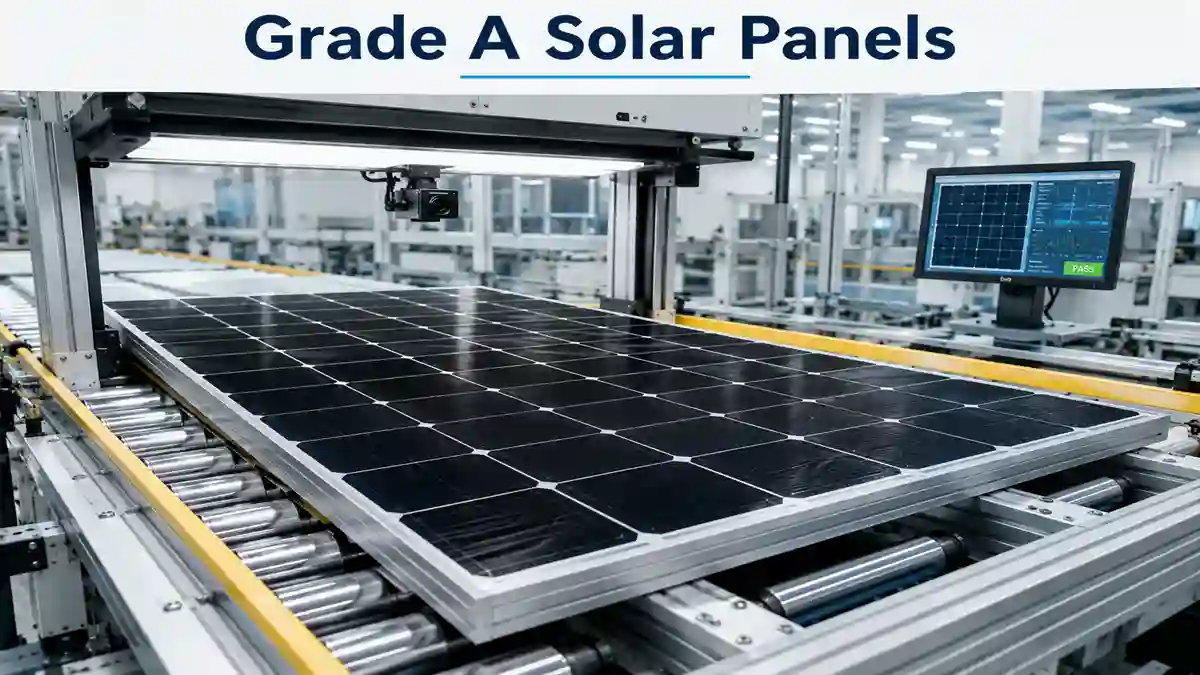
Grade A Solar Panels explained by a registered engineer. Learn how manufacturers inspect, test, and verify photovoltaic modules.
Almost every solar panel supplier claims to sell Grade A Solar Panels, but the term isn’t always as straightforward as many buyers assume. Unlike certifications such as IEC standards, solar panel grading doesn’t follow a single universal classification system.
Many people automatically associate Grade A with better performance and higher reliability, but a label alone doesn’t guarantee superior quality. In many cases, factory verification tells you far more than marketing language.
As an engineer, I rely on flash-test reports, quality-control records, and certification documents rather than labels alone. In this guide, I’ll explain how manufacturers classify Grade A Solar Panels and how you can verify those claims before making a purchase.
This guide is part of our Types of Solar Panels hub, and is the deeper companion to our Solar Panel Grades Explained guide — read that one for the full A/B/C picture; this one for verifying Grade A claims specifically.
What Are Grade A Solar Panels?
Grade A Solar Panels are photovoltaic modules that have successfully passed a manufacturer’s quality-control process and meet the company’s electrical, mechanical, and cosmetic standards. These panels are typically approved for residential, commercial, and utility-scale installations because they deliver the performance specified on the datasheet.
One important point often overlooked by buyers is that there is no single global standard that officially defines a solar panel as Grade A, Grade B, or Grade C. Manufacturers use their own internal inspection procedures to classify modules after production.
In most factories, a panel’s grade is determined through a combination of:
- Electrical performance testing
- Visual inspection
- Cell matching
- Mechanical integrity testing
- Manufacturing consistency
- Cosmetic evaluation
A genuine Grade A Solar Panel should demonstrate stable electrical performance, a uniform cell appearance, minimal manufacturing defects, and complete compliance with the manufacturer’s quality requirements.
Engineer’s Note: A Grade A label should never be accepted as proof of quality on its own. Supporting documents such as flash-test reports, certification records, and warranty information provide much stronger evidence of a panel’s actual manufacturing quality.
What Makes a Solar Panel Truly Grade A?
A Grade A Solar Panel isn’t defined by a marketing label alone. It earns that classification by meeting a series of electrical, mechanical, and visual quality requirements during manufacturing. While standards vary between manufacturers, several characteristics are consistently used to identify premium photovoltaic modules.
Uniform Cell Appearance
Cells should have a consistent color, texture, and surface finish across the entire module. Significant discoloration, mismatched cells, or visible defects can indicate lower manufacturing consistency.
Verified Electrical Performance
A Grade A panel should meet or exceed its rated power output during factory testing. This is typically confirmed through a flash-test report that verifies voltage, current, efficiency, and overall power generation.
Accurate Cell Matching
Manufacturers carefully match photovoltaic cells before assembling a module. Proper cell matching improves electrical performance and reduces energy losses caused by current imbalances.
Minimal Manufacturing Defects
High-quality modules should be free from visible cracks, damaged cells, poor soldering, delamination, and other production defects that can affect long-term reliability.
Mechanical Integrity
A premium module must withstand environmental stresses such as wind, snow, humidity, and repeated thermal expansion and contraction without compromising structural stability.
Positive Power Tolerance
Many premium manufacturers specify a positive power tolerance, meaning the panel will deliver at least its rated output and may even exceed it under standard testing conditions.
Engineer’s Note: If I had to choose only one verification method, I’d ask for the flash-test report. A genuine Grade A Solar Panel should have documented test data supporting the manufacturer’s quality claim.
How Manufacturers Test Grade A Solar Panels
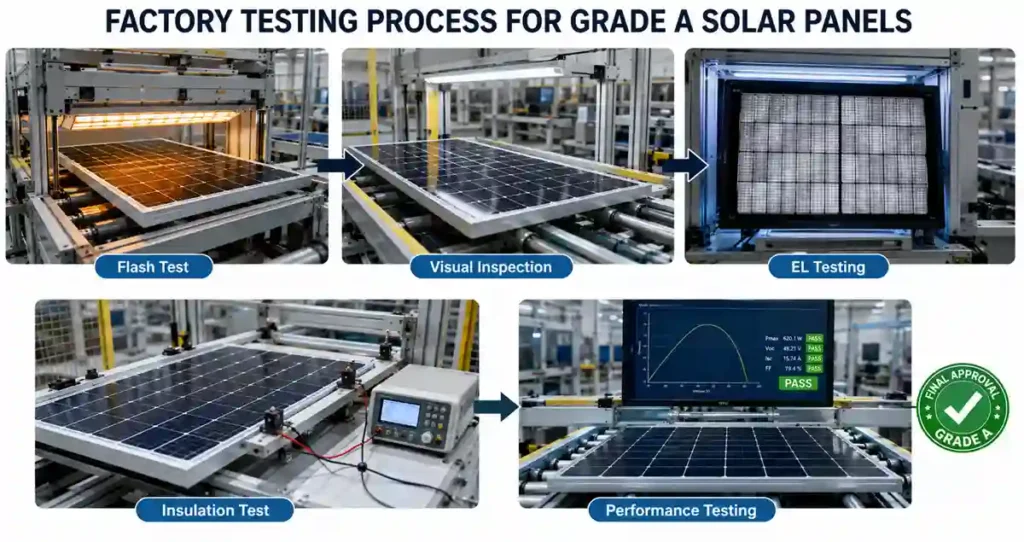
Before a photovoltaic module leaves the factory, it passes through several inspection and testing stages designed to verify its electrical performance, structural reliability, and manufacturing quality. These tests help manufacturers separate Grade A Solar Panels from modules that don’t fully meet production standards.
Flash Testing
Flash testing is one of the most important quality-control procedures in solar manufacturing. A high-intensity light source simulates sunlight while specialized equipment measures the panel’s voltage, current, power output, and efficiency. The resulting flash-test report verifies whether the module meets its rated specifications.
Visual Inspection
Technicians inspect each panel for cosmetic and manufacturing defects, including cell discoloration, scratches, cracks, soldering irregularities, and glass imperfections. Even minor visual defects can influence how a module is classified.
Electroluminescence (EL) Testing
EL testing uses infrared imaging to identify hidden defects that aren’t visible to the naked eye. Microcracks, damaged cells, and internal manufacturing inconsistencies can often be detected through this process before the panel reaches the market.
Insulation Testing
Electrical insulation testing verifies that the module can safely operate under high-voltage conditions without current leakage. This test helps confirm the panel’s long-term electrical safety.
Mechanical Stress Testing
Manufacturers also evaluate a panel’s ability to withstand environmental conditions such as wind loads, thermal expansion, humidity, and mechanical pressure. Modules that fail these tests may not qualify for premium classification.
Engineer’s Note: The flash-test report is the single most valuable document I review when verifying a manufacturer’s Grade A claim. Marketing brochures can make promises, but factory test data provides measurable proof.
Grade A vs Grade B vs Grade C Solar Panels
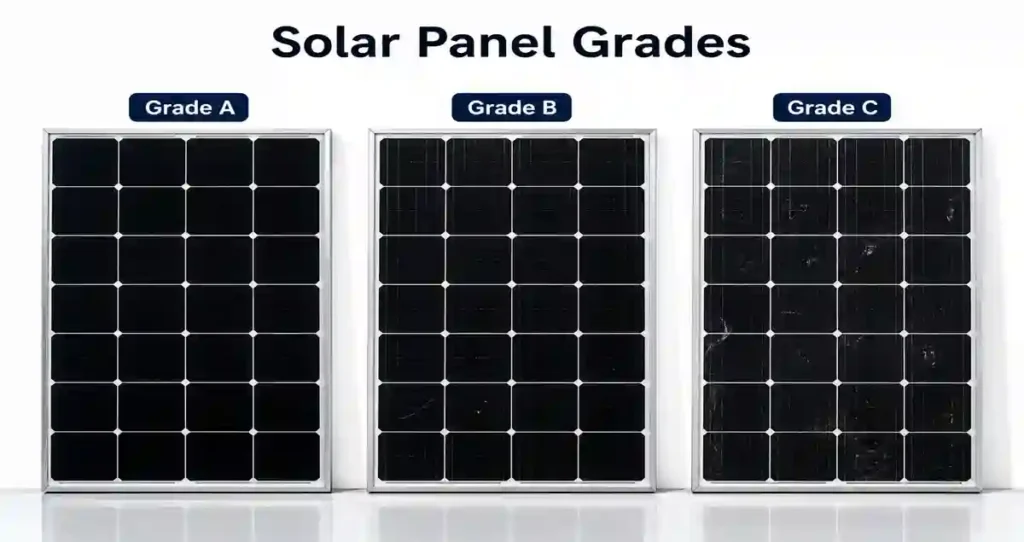
Not all photovoltaic modules leaving a production line are identical. Even panels manufactured from the same batch can show differences in appearance, electrical performance, and manufacturing consistency. To separate these variations, manufacturers often classify modules into different quality categories.
While grading systems vary between manufacturers, Grade A, Grade B, and Grade C generally reflect the results of factory inspection and quality-control testing rather than the underlying solar cell technology.
| Characteristic | Grade A | Grade B | Grade C |
|---|---|---|---|
| Cell appearance | Uniform and consistent | Minor cosmetic variations | Noticeable visual defects |
| Power output | Meets or exceeds specifications | Slightly below specifications | Significant variation |
| Manufacturing quality | Highest factory standard | Acceptable with minor imperfections | Below premium standards |
| Warranty | Full manufacturer warranty | May vary | Often limited |
| Recommended applications | Residential, commercial, and utility projects | Budget-conscious projects | Specialized or secondary applications |
It’s important to understand that Grade B doesn’t automatically mean poor quality, and Grade C doesn’t necessarily mean the panel is unsafe. In many cases, the difference is purely cosmetic. A panel may receive a lower classification because of minor discoloration, slight cell mismatch, or other visual imperfections that have little effect on real-world performance.
Engineer’s Note: I never recommend selecting a panel based solely on its grade. Technology, warranty terms, certifications, flash-test reports, and the manufacturer’s reputation provide a much more complete picture of long-term performance.
How Solar Cell Technology and Solar Panel Grades Work Together
One of the most common misconceptions in the solar industry is assuming that cell technology and panel grading describe the same thing. They don’t. These two classifications evaluate completely different aspects of a photovoltaic module.
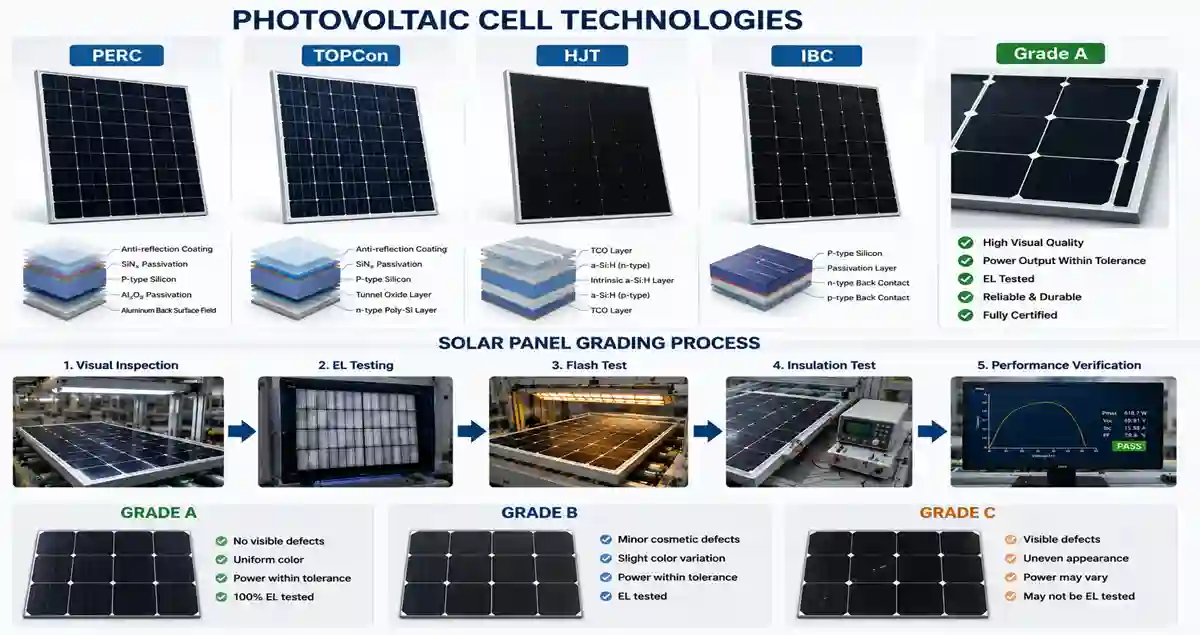
Solar technologies such as PERC, TOPCon, HJT, IBC, and ABC describe the design and architecture of the solar cells themselves. These technologies influence characteristics such as efficiency, temperature performance, degradation rates, and long-term energy production.
Solar Panel Grades, on the other hand, reflect the results of factory quality-control inspections. Grading evaluates manufacturing consistency, electrical performance, cosmetic appearance, and compliance with internal production standards.
Understanding the difference is important because a premium technology doesn’t automatically guarantee a premium manufacturing classification.
- PERC, TOPCon, HJT, IBC, and ABC describe cell technology, not manufacturing quality.
- Grade A, Grade B, and Grade C classifications are assigned after factory inspection and testing.
- A TOPCon or HJT module can still receive a Grade B classification because of cosmetic imperfections or manufacturing inconsistencies.
- A conventional PERC panel can still qualify as Grade A if it meets the manufacturer’s quality requirements.
- Cell technology affects efficiency, degradation, and temperature performance. Panel grading reflects manufacturing consistency and quality control.
- The most informed purchasing decisions evaluate technology, grading, certifications, warranty coverage, and flash-test results together.
Engineer’s Note: I always recommend evaluating the entire package rather than focusing on a single specification. The most efficient technology isn’t always the best choice if manufacturing quality, documentation, and warranty support don’t meet the same standard.
How to Verify Grade A Solar Panels Before You Buy
A Grade A label should never be the only factor influencing your decision. Before purchasing any photovoltaic module, ask for documentation that supports the manufacturer’s quality claim. A few minutes of verification can prevent years of performance and warranty problems.
Request the Flash-Test Report
A flash-test report provides measured electrical data for an individual panel, including power output, voltage, current, and efficiency. This document is one of the most reliable ways to confirm that a module performs according to its stated specifications.
Verify International Certifications
Check whether the panel complies with internationally recognized standards such as IEC 61215, IEC 61730, and other applicable certifications. Independent certification provides additional confidence in the module’s quality and safety.
Review the Serial Number
Every legitimate manufacturer assigns a unique serial number to each module. This number should be clearly visible and traceable through the manufacturer’s records.
Check the Power Tolerance
Review the datasheet carefully and look for the panel’s power tolerance specification. Many premium manufacturers offer a positive power tolerance, meaning the module can meet or slightly exceed its rated output.
Compare Warranty Coverage
A warranty often reveals more about a manufacturer’s confidence than marketing material. Compare both the product warranty and the performance warranty, paying close attention to long-term output guarantees.
Evaluate the Manufacturer’s Reputation
Factory experience, quality-control practices, third-party testing, and after-sales support can be just as important as the panel itself. Established manufacturers typically provide more complete documentation and stronger warranty support.
Engineer’s Note: Whenever I evaluate a panel, I prioritize three documents above everything else: the flash-test report, the certification record, and the warranty document. A genuine Grade A module should have all three readily available.
Red Flags That Should Concern Buyers
Not every panel advertised as Grade A has undergone the same level of testing and verification. In some markets, grading terminology is used more as a sales tool than a documented quality standard. That’s why I recommend looking beyond the label and paying close attention to the supporting evidence.
No Flash-Test Documentation
If a supplier cannot provide a flash-test report, ask why. A reputable manufacturer should be able to provide electrical performance data that supports the panel’s rated specifications.
Missing Certification Information
Panels lacking internationally recognized certifications should be evaluated carefully. Missing or incomplete certification documents can indicate limited quality verification.
Unusually Low Prices
A price that seems significantly lower than competing products deserves additional scrutiny. Cost alone doesn’t determine quality, but extremely aggressive pricing should always prompt further verification.
Incomplete Warranty Information
Review both the product warranty and the performance warranty. Vague warranty language, missing documentation, or unclear coverage terms should be treated as warning signs.
Limited Manufacturer Transparency
Reliable manufacturers typically provide complete technical documentation, including datasheets, certification records, test reports, and traceable serial numbers. A lack of transparency often creates unnecessary uncertainty.
Unverified Suppliers
Always confirm that the supplier is an authorized distributor or an established installer. Documentation provided directly by the manufacturer is generally more reliable than verbal claims made during the sales process.
Engineer’s Note: Whenever a supplier emphasizes the “Grade A” label but avoids discussing testing, certifications, or warranty documentation, I become much more interested in the paperwork than the marketing claim.
Real-World Applications
Understanding Grade A Solar Panels becomes particularly important when technical specifications, warranty terms, and long-term performance influence purchasing decisions. In practice, grading affects much more than a simple label on a sales quotation.
Residential Installations
Homeowners often focus on panel efficiency and price while overlooking manufacturing quality. Verifying a panel’s grade can help reduce the risk of unexpected performance issues and improve confidence in the system’s long-term reliability.
Commercial Projects
Commercial installations depend on predictable energy production and accurate financial projections. Factory-verified modules can provide greater confidence when estimating long-term return on investment.
EPC Procurement
Engineering, Procurement, and Construction (EPC) contractors typically evaluate flash-test reports, certifications, and warranty documentation before approving photovoltaic modules for large projects. Panel grading becomes one component of a much broader quality-assurance process.
Government and Utility Projects
Large-scale projects often require stricter quality-control procedures and documented verification before modules are accepted. Certification records and factory test reports usually carry more weight than marketing terminology.
Field Note: I’ve seen clients reject technically superior panels because they misunderstood grading terminology, while others accepted unsupported Grade A claims without reviewing the accompanying documentation. In both situations, the final decision improved significantly once we compared certifications, warranties, and factory test data rather than relying solely on the grade printed on the quotation.
Common Misconceptions About Grade A Solar Panels
Misunderstanding Solar Panel Grades often leads buyers to focus on labels rather than documented performance. Clearing up a few common misconceptions can help you make a more informed purchasing decision.
“Grade A Always Means the Highest Efficiency”
Not necessarily. Efficiency depends primarily on solar cell technology, cell design, and manufacturing processes, not on the panel’s grade alone. A lower-efficiency panel can still receive a Grade A classification if it meets the manufacturer’s quality standards.
“Grade B Panels Always Perform Poorly”
This is one of the most persistent myths in the industry. In many cases, Grade B modules differ from Grade A panels only because of minor cosmetic imperfections, such as slight discoloration or small visual inconsistencies, while maintaining very similar electrical performance.
“All Manufacturers Use the Same Grading Standard”
There is no universal international standard that officially defines Grade A, Grade B, or Grade C Solar Panels. Manufacturers often use their own internal inspection criteria, which means the same grade may not represent the same quality level across different brands.
“A Grade A Label Is Proof of Quality”
A label alone proves very little. Flash-test reports, certification documents, warranty terms, and quality-control records provide much stronger evidence of a panel’s actual manufacturing quality.
“Solar Panel Grade Is More Important Than the Manufacturer”
The manufacturer’s reputation, testing procedures, after-sales support, and warranty coverage often have a greater impact on long-term system performance than the grade itself.
Engineer’s Note: The best purchasing decisions are rarely based on a single specification. Panel grade should be considered alongside technology, certifications, degradation rates, warranty coverage, and documented factory testing.
Buying Checklist
Before purchasing Grade A Solar Panels, take a few minutes to verify the manufacturer’s claims using documentation rather than relying solely on marketing material.
- Request a flash-test report to confirm the panel’s actual electrical performance.
- Verify international certifications such as IEC 61215 and IEC 61730.
- Review both the product and performance warranties before comparing prices.
- Check the panel’s power tolerance to confirm whether the module meets or exceeds its rated output.
- Verify the serial number and confirm that it’s traceable through the manufacturer.
- Compare cell technology and panel grading together rather than evaluating either specification in isolation.
- Ask for supporting documentation directly from the manufacturer whenever possible.
- Confirm that the supplier is an authorized distributor or an established installer.
- Compare multiple quotations instead of making a decision based solely on price.
- Remember one simple rule: a Grade A label is a claim, while factory documentation is proof.
For the full A/B/C grading picture, see our Solar Panel Grades Explained guide.
The Engineer’s Bottom Line
A Grade A label isn’t proof. A verified flash-test report is. If you check only one document before buying a solar panel, make it the flash-test report.
Frequently Asked Questions
How can I verify a solar panel is genuinely Grade A?
Request the specific flash test report showing measured output for that panel or batch, along with the cosmetic inspection criteria used. A verified claim will have concrete documentation available; a vague or unsupported claim is a reasonable cause for further questions. This verification process typically takes only a short email exchange with a legitimate supplier, making it a low-effort, high-value step in any purchasing decision.
Are all “Grade A” listings trustworthy?
Not automatically — grading terminology isn’t governed by a single universal industry standard, so the same label can reflect different underlying criteria between suppliers. Always verify with documentation rather than trusting the label alone.
What is a flash test report?
A flash test report documents the actual measured electrical performance of a specific panel or production batch under standardized test conditions, providing concrete evidence of real output compared to the rated specification on the datasheet.
What are Grade A Solar Panels?
Grade A Solar Panels are photovoltaic modules that meet a manufacturer’s electrical, mechanical, and cosmetic quality requirements after completing factory inspection and testing. They are typically approved for residential, commercial, and utility-scale installations.
Are Grade A Solar Panels always the most efficient?
No. Efficiency depends primarily on cell technology, including PERC, TOPCon, HJT, IBC, and ABC designs. A panel can receive a Grade A classification while having lower efficiency than another Grade A panel that uses a different cell technology.
Can Grade B Solar Panels still perform well?
Yes. In many cases, Grade B panels differ from Grade A modules only because of minor cosmetic imperfections, such as slight discoloration or cell mismatch. Electrical performance may remain very similar.
Do all manufacturers use the same grading system?
No. There is no universal international standard that officially defines Grade A, Grade B, and Grade C Solar Panels. Most manufacturers use their own internal quality-control procedures to classify photovoltaic modules.
How can I verify a Grade A Solar Panel?
The most reliable verification methods include:
Reviewing the flash-test report
Checking IEC certifications
Verifying the serial number
Reviewing the warranty documentation
Confirming the manufacturer’s technical specifications
What is a flash-test report?
A flash-test report is a factory document that measures a panel’s electrical characteristics under simulated sunlight. It typically includes information about voltage, current, power output, and efficiency.
Are Solar Panel Grades more important than the manufacturer?
Not necessarily. The manufacturer’s reputation, certification history, warranty support, and quality-control procedures often provide more meaningful information than the panel’s grade alone.
Should I buy a solar panel based only on the Grade A label?
No. Always evaluate the complete package, including:
Cell technology
Factory testing
Certifications
Degradation rates
Warranty coverage
Manufacturer reputation
A Grade A label should be considered one factor among many, not the final deciding factor.
References
Information on photovoltaic module testing and certification is based on IEC photovoltaic standards, NREL photovoltaic testing documentation, and industry manufacturing quality-control practices.
Related guides on SolarVisionAI.com
- Monocrystalline Solar Panels 2026: Still Worth It or Hype
- Polycrystalline Solar Panels: Worth Buying in 2026?
- Thin-film Solar Panels: When They Beat Silicon (2026)
- BIPV Solar Panels: Building-Integrated PV Complete Guide
- Portable Solar Panels: Engineer’s Buyer’s Guide 2026
- CPV Solar Panels: Concentrated Photovoltaic Explained
- Skin Solar Panel: What “Solar Skin” Actually Means
- Solar Fence Post Lights: Cap Sizes, Types & Install Guide
- Bifacial Solar Panels in 2026: How to Boost Energy Output
- Solar Charge Controller: The Complete Guide
- MC4 Connectors: Solar Safety & Installation Guide
- Solar Panel Types, Efficiency & Benefits
- Solar Water Pump Guide
- Commercial Solar Panel Installation: Engineering Guide
- Solar Fence Post Lights: Cap Sizes, Types & Install Guide
- BESS — Battery Energy Storage System Guide
- Commercial Solar Panel Installation
- Solar Refrigerator & DC Fridge — Complete 2026 Guide
- Bifacial Solar Panel Albedo Effect Guide
- TOPCon: Why TOPCon Solar Panel is a Proven Smart Investment in 2026
- HJT: Why TOPCon Solar Panel is a Proven Smart Investment in 2026
- PERC: PERC Solar Panel: Still Relevant or Already Outdated?
- Perovskite: Perovskite Solar Panels: The 2026 Reality Check
- N-Type vs P-Type: N-Type vs P-Type Solar Panels: Honest Comparison
- ABC: ABC (all back contact) Solar Panel: Back Contact Technology Explained
- IBC: IBC Solar Panels: Interdigitated Back Contact Guide
- Tandem: Tandem Solar Panels: Are Stacked Cells Ready for Rooftops?