
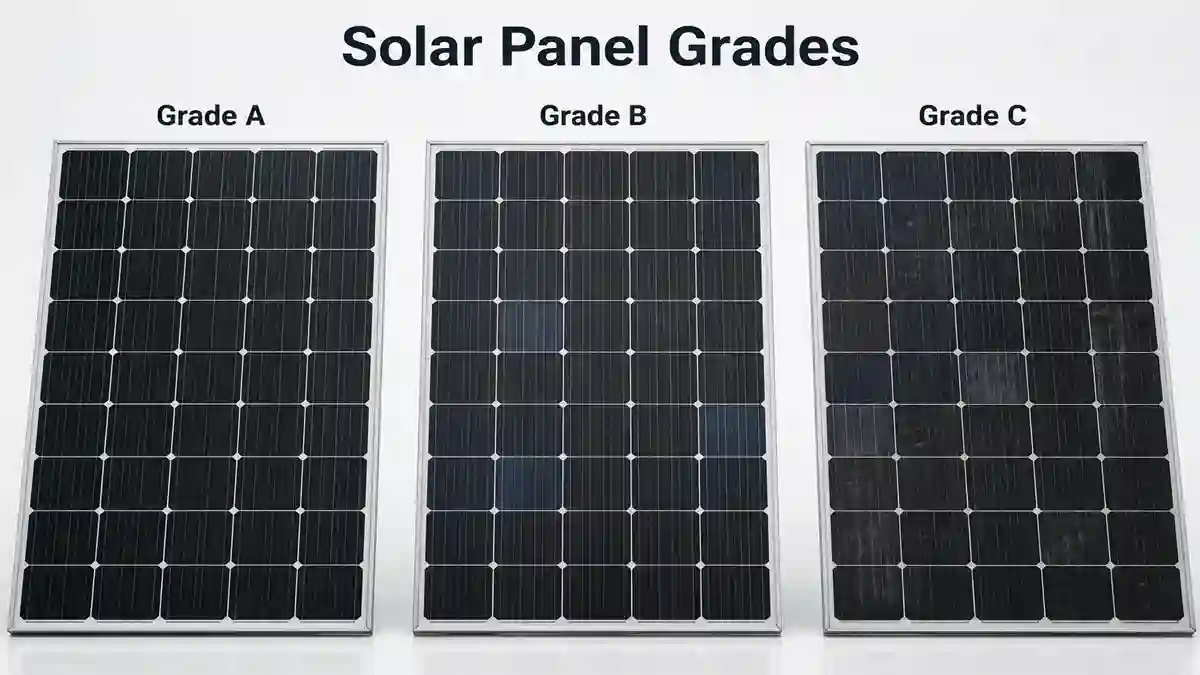
Solar Panel Grades explained by a registered engineer. Learn how manufacturers inspect, test, and classify solar modules.
No two solar panels that roll off a manufacturing line are identical, even from the same production batch using the same materials. Minor cosmetic imperfections, small performance variances, and manufacturing tolerances mean factories sort finished panels into quality grades before they ever reach a distributor — and understanding what those grades actually mean is one of the more practically useful things a buyer can learn before comparing quotes.
This guide is part of our Types of Solar Panels hub, and pairs with our Grade A Solar Panels guide for a deeper look specifically at what to verify when a quote claims Grade A.
What Solar Panel Grades Actually Measure
Grading sorts finished panels based on a combination of cosmetic condition and measured electrical performance against the manufacturer’s rated specifications. It’s a quality control classification applied after manufacturing, distinct from cell technology, panel type, or brand tier — a panel can be a premium TOPCon monocrystalline design and still receive a lower grade if it has a minor cosmetic blemish or measures slightly below its rated output during factory testing.
Engineer’s Note: I want to be direct about something the industry doesn’t always communicate clearly: grading terminology isn’t governed by a single universal standard the way IEC certification is. Different manufacturers apply somewhat different criteria to what they call Grade A, B, or C, which is exactly why verifying the specific grading criteria behind a claim matters more than trusting the letter grade alone.
The Three Grades, Broadly
| Grade | Typical Characteristics | Common Use Case | Industry Reference |
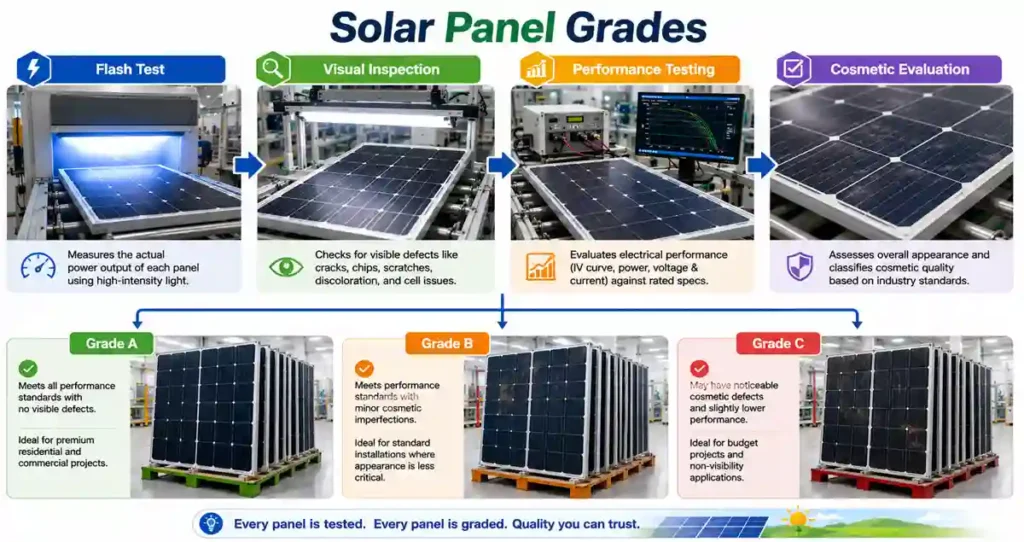
| Grade A | No visible cosmetic defects, performs at or above rated specification | Standard for premium residential and commercial installations | Industry Best Practice |
| Grade B | Minor cosmetic imperfections (small marks, slight discoloration), performance within acceptable tolerance | Budget installations, secondary structures, less visually prominent sites | Industry Best Practice |
| Grade C | Visible cosmetic defects and/or performance below full rated specification | Clearance/discount sales, non-critical applications | Industry Best Practice |
How Manufacturers Actually Sort Solar Panel Grades
Every finished solar panel undergoes both electrical and visual inspection before leaving the factory. Flash testing measures actual power output, while quality inspectors evaluate cosmetic characteristics such as discoloration, cell mismatch, scratches, and visible surface defects. Manufacturers then sort modules into different quality categories before packaging and distribution.
Advantages and Disadvantages of Buying by Solar Panel Grades
| Advantages | Disadvantages |
| Grade A: best cosmetic and performance assurance for premium installations | Grade A: commands a price premium over lower grades |
| Grade B: genuine cost savings for budget or less visually prominent projects | Grade B: minor performance shortfall could compound over a 25-year system life |
| Grade C: steepest discount pricing available on the secondary market | Grade C: cosmetic and performance issues may signal deeper reliability concerns |
| Understanding grades helps buyers avoid overpaying for cosmetic perfection they don’t need | Grading terminology isn’t standardized industry-wide, requiring verification |
Solar Panel Grades vs. Solar Cell Technology
- PERC, TOPCon, HJT, IBC, and ABC describe solar cell technology, not panel quality.
- Solar Panel Grades (A, B, and C) are assigned after factory inspection and quality-control testing.
- A premium TOPCon or HJT module can still receive a Grade B classification because of cosmetic imperfections.
- A Grade A panel doesn’t automatically mean it uses the latest technology. A conventional PERC module can still achieve a Grade A rating.
- The best buying strategy is to evaluate technology, panel grade, warranty, certifications, and flash-test results together rather than relying on a single specification.
Real-World Applications
I specify Grade A as the default for essentially every client-facing residential or commercial installation, simply because the cosmetic and performance assurance is worth the modest premium for a system meant to perform reliably and look presentable for 25 years. Grade B occasionally makes sense for secondary structures — a workshop roof, an agricultural building — where the client has explicitly prioritized cost and the installation isn’t visually prominent.
Grade C panels come up almost exclusively in clearance or secondary-market conversations, and I approach those quotes with considerably more scrutiny, since the combination of cosmetic and performance issues at this tier sometimes correlates with broader reliability concerns beyond what the grading alone discloses.
Field Note: A client once brought me a very attractively priced quote for panels labeled “Grade A” that, on closer inspection of the actual test documentation, didn’t match what I’d consider genuine Grade A criteria — some cosmetic issues that would typically place a panel at Grade B were present. The lesson wasn’t that grading is meaningless; it’s that the specific documentation behind a grade claim matters more than the letter itself.
Common Misconceptions Worth Clearing Up
People sometimes assume grade is the same thing as manufacturer tier (Tier 1, 2, 3). They’re entirely different classifications — tier refers to the manufacturer’s financial stability and production scale, while grade refers to an individual panel’s cosmetic and performance quality as it comes off the line. A Tier 1 manufacturer can produce Grade B panels, and in principle a smaller manufacturer could produce genuinely Grade A output, though tier and grade do correlate to some degree in practice.
Buying Checklist by Solar Panel Grades
- Request the specific grading criteria and test documentation behind any grade claim, not just the letter grade
- Understand grade is independent of manufacturer tier and cell technology — verify all three separately
- For visually prominent installations, prioritize Grade A; for secondary structures, Grade B can offer genuine value
- Approach Grade C quotes with additional scrutiny given the combination of cosmetic and performance factors involved
For a deeper look at verifying genuine Grade A quality specifically, see our Grade A Solar Panels guide.
My closing perspective on grading: it’s a genuinely useful classification system when applied rigorously, and a source of real buyer confusion when applied loosely. The grade letter itself is only as trustworthy as the documentation and process behind it, which is exactly why I keep steering every client conversation back toward requesting concrete evidence — flash test data, cosmetic inspection criteria — rather than accepting a label at face value, regardless of how reputable the supplier’s marketing sounds.
The Grade Letter Matters Less Than the Documentation Behind It
If you remember only one takeaway from this guide, remember this: the documentation behind a solar panel grade matters more than the grade itself. Flash-test reports, inspection records, warranty terms, and certification documents provide a much clearer picture of quality than a simple A, B, or C label.
Frequently Asked Questions
Is Grade B a bad solar panel?
Not necessarily — Grade B panels typically have minor cosmetic imperfections and performance within acceptable tolerance, making them a legitimate lower-cost option for budget-conscious or less visually prominent installations, rather than a defective product.
Does solar panel grade affect the warranty?
This varies by manufacturer and should always be confirmed directly, since warranty terms are not automatically identical across grades from every supplier. Some manufacturers apply identical warranty terms regardless of grade, while others offer reduced coverage for Grade B or C, so this is worth clarifying before purchase rather than assuming.
Is grade the same as Tier 1, Tier 2, Tier 3 manufacturer classification?
No — grade describes an individual panel’s cosmetic and performance quality, while tier describes the manufacturer’s financial stability and production scale. The two classifications are independent, though they often correlate in practice.
Are Grade B solar panels defective?
Not necessarily. Grade B panels often have only minor cosmetic imperfections while maintaining acceptable electrical performance.
Can Grade B panels be used in residential installations?
Yes, although Grade A panels remain the preferred choice for most residential projects because of their superior appearance and performance consistency.
Are Grade C solar panels safe?
Safety depends on the manufacturer’s testing and certification. However, Grade C panels should be evaluated much more carefully before installation.
References
Grading criteria and industry practice context are drawn from established manufacturing quality control standards and IEC certification frameworks referenced across the industry.
Related guides on SolarVisionAI.com
- Monocrystalline Solar Panels 2026: Still Worth It or Hype
- Polycrystalline Solar Panels: Worth Buying in 2026?
- Thin-film Solar Panels: When They Beat Silicon (2026)
- BIPV Solar Panels: Building-Integrated PV Complete Guide
- Portable Solar Panels: Engineer’s Buyer’s Guide 2026
- CPV Solar Panels: Concentrated Photovoltaic Explained
- Skin Solar Panel: What “Solar Skin” Actually Means
- Solar Fence Post Lights: Cap Sizes, Types & Install Guide
- Bifacial Solar Panels in 2026: How to Boost Energy Output
- Solar Charge Controller: The Complete Guide
- MC4 Connectors: Solar Safety & Installation Guide
- Solar Panel Types, Efficiency & Benefits
- Solar Water Pump Guide
- Commercial Solar Panel Installation: Engineering Guide
- Solar Fence Post Lights: Cap Sizes, Types & Install Guide
- BESS — Battery Energy Storage System Guide
- Commercial Solar Panel Installation
- Solar Refrigerator & DC Fridge — Complete 2026 Guide
- Bifacial Solar Panel Albedo Effect Guide
- TOPCon: Why TOPCon Solar Panel is a Proven Smart Investment in 2026
- HJT: Why TOPCon Solar Panel is a Proven Smart Investment in 2026
- PERC: PERC Solar Panel: Still Relevant or Already Outdated?
- Perovskite: Perovskite Solar Panels: The 2026 Reality Check
- N-Type vs P-Type: N-Type vs P-Type Solar Panels: Honest Comparison
- ABC: ABC (all back contact) Solar Panel: Back Contact Technology Explained
- IBC: IBC Solar Panels: Interdigitated Back Contact Guide
- Tandem: Tandem Solar Panels: Are Stacked Cells Ready for Rooftops?