
Solar Panel Tier 1 explained by a registered engineer: learn what Tier 1 measures, why it doesn’t mean Grade A, and what buyers should check.
Buyers frequently search for a static, printed list of solar panel Tier 1 manufacturers. Before diving into rankings, it is critical to address something important upfront: this list changes every quarter as BloombergNEF (BNEF) updates its data.
Any fixed list printed on a blog or datasheet risks going stale within months. Rather than handing you a snapshot that will inevitably age, this guide gives you the underlying BNEF bankability methodology and a failsafe verification protocol so you can independently verify any manufacturer’s current status when making an actual purchasing decision.
The short answer: Solar Panel Tier 1 primarily indicates manufacturer bankability and acceptance in financed solar projects. It does not automatically mean that every panel from that manufacturer is Grade A or the best-performing module available.
Hub Navigation: This guide is part of our Types of Solar Panels hub. It serves as the companion to our core guide on Solar Panel Tier 1 vs Tier 2 vs Tier 3, where we break down what these labels actually measure regarding product quality.
The Short Answer
Tier 1 is an institutional bankability metric, not a physical product certification. Developed by BloombergNEF, the classification identifies solar module manufacturers that have supplied owned-and-manufactured products to multiple utility-scale projects financed by commercial banks using non-recourse debt.
Because BNEF updates its Tier 1 list quarterly based on active project financing and operational solvency, relying on a static, printed list is a mistake. Independent verification against current market data is the only reliable path.
What Does Solar Panel Tier 1 Actually Mean?
Nearly every buyer has heard the term “Tier 1” applied to solar panels, but remarkably few know that it traces back to a specific financial analysis framework.
Bloomberg New Energy Finance is a primary research division providing analysis across energy markets. The Tier classification system was originally developed for institutional investors, project developers, and commercial banks to assess manufacturer bankability—specifically, whether a lender would accept panels from a given manufacturer as collateral for a multi-million dollar non-recourse loan.
It was never designed as a consumer-facing product quality rating, even though it has been co-opted by solar marketing campaigns worldwide.
Solar Panel Tier 1 ≠ Grade A Solar Panel
Solar Panel Tier 1 evaluates the manufacturer, while Grade A is a separate product-level quality classification. A Tier 1 manufacturer does not automatically make every individual panel Grade A.
Solar Panel Tier 1 vs Panel Grade
| Factor | Solar Panel Tier 1 | Panel Grade |
|---|---|---|
| Evaluates | Manufacturer | Individual module |
| Main focus | Bankability | Product-level quality |
| Level | Company-level | Panel-level |
| Typical evidence | Qualifying project financing | Factory testing and inspection |
| Indicates | Manufacturer acceptance/risk | Product condition/performance |
| Measures efficiency? | No | Not directly |
| Measures cell technology? | No | No |
| Guarantees product quality? | No | No |
Important: BloombergNEF’s published methodology specifically establishes its Tier 1 PV Module Maker classification. Tier 2 and Tier 3 are commonly used market terminology and should not be presented as equivalent official BloombergNEF rankings.
This distinction is important because buyers often use Solar Panel Tier 1 and Grade A as if they were the same rating. They are not.
Engineer’s Note: Knowing the institutional-finance origin clarifies why the metric measures what it measures. Banks financing utility-scale solar projects care deeply about whether a manufacturer will remain solvent over a 10- to 25-year debt term to honor warranty guarantees. That is a bankability question, not a panel efficiency question.
Solar Panel Tier 1 vs Tier 2 vs Tier 3
| Label | What it generally means | Buyer interpretation |
|---|---|---|
| Tier 1 | Manufacturer meets BloombergNEF’s published Tier 1 criteria | Strong bankability signal |
| Tier 2 | Common market terminology for manufacturers outside the Tier 1 list | Requires additional due diligence |
| Tier 3 | Common market terminology for less-established manufacturers outside Tier 1 | Requires greater scrutiny |
| Unlisted | Manufacturer is not included in the specific Tier 1 list being referenced | Investigate independently |
Critical note:
Important: BloombergNEF’s published methodology specifically establishes its Tier 1 PV Module Maker classification. Tier 2 and Tier 3 are commonly used industry/market terms and should not be presented as equivalent official BloombergNEF rankings.
Is Solar Panel Tier 1 Still Relevant in 2026?
BloombergNEF publishes its Tier 1 lists quarterly, and its methodology states that only the latest list is relevant. Buyers should therefore verify a current Solar Panel Tier 1 claim rather than relying on an old brochure, quotation, website badge, or supplier statement.
The BNEF Core Methodology
To achieve Tier 1 status under the BloombergNEF framework, a manufacturer must meet strict, objective financial and operational benchmarks:
| Criterion | What It Assesses | Why Financiers Care | Industry Benchmark |
| Bank-Financed Projects | Must have supplied modules to 6+ projects (>1.5 MW each) financed non-recourse by 6 different commercial banks in the past 2 years. | Banks conduct extensive due diligence before committing debt; this acts as outsourced third-party risk assessment. | BloombergNEF Criteria |
| Own Brand & Manufacturing | The manufacturer must own and operate its manufacturing facilities under its own brand name. | Eliminates pure OEM white-labeling and contract rebranding, ensuring direct quality control over production lines. | BloombergNEF Criteria |
| Public Financial Availability | Financial metrics and project track records must be transparent and verifiable in BNEF’s database. | Ensures the firm isn’t hiding systemic debt or insolvency risks that could jeopardize long-term warranty support. | BloombergNEF Criteria |
Why Static “Tier 1 Lists” Go Stale
Because BNEF evaluates bankability quarterly, the list is fluid. Manufacturers gain or lose Tier 1 status based on real-time market shifts:
- Expanding Operations: A growing Tier 2 manufacturer that secures major bank-financed utility deals can gain Tier 1 status during an upcoming quarterly assessment.
- Financial Distress or Restructuring: A long-standing Tier 1 company facing insolvency, debt restructuring, or a decline in bank-financed utility projects can be dropped from the list.
- Bankruptcy Protection: Companies entering corporate restructuring or bankruptcy are immediately removed from official BNEF Tier 1 tracking regardless of their historical market presence.
Field Note: I once audited a commercial procurement proposal where the installer quoted a manufacturer as “Tier 1.” Upon checking BNEF’s active quarterly dataset, we discovered the manufacturer had slipped off the list two quarters prior due to debt restructuring. Had we relied on memory or old sales collateral, the client would have accepted unvetted long-term warranty risk. Always insist on a fresh check.
How to Verify Current Tier 1 Status
When evaluating a manufacturer, use this hierarchical verification protocol to ensure you are relying on primary, accurate data rather than outdated market noise:
| Verification Method | What It Confirms | Reliability | Recommended Action |
| BNEF Quarterly Report | Authoritative, official Tier 1 tracking. | Highest | Request the current quarter’s official BNEF Tier 1 matrix from the supplier or developer. |
| Manufacturer Financial Filings | Direct corporate disclosures and public earnings reports. | High | Cross-check public balance sheets for audited solar module shipment data and debt ratios. |
| Industry Press & Databases | Third-party summaries (e.g., PV Magazine quarterly reports). | Moderate | Verify the publication date against the current quarter to avoid publication lag. |
| Supplier / Sales Collateral | Marketing brochures, website badges, and sales pitch decks. | Low | Never accept a static PDF badge or verbal claim without independent verification. |
BNEF Tier 1 vs. Product Certifications (IEC / UL)
Do not confuse financial bankability with physical product quality. A Tier 1 manufacturer can still produce lower-tier modules or suffer from batch-level manufacturing defects. Real quality verification requires physical testing compliance:
- IEC 61215: Tests terrestrial PV module design qualification and type approval (thermal cycling, humidity freeze, mechanical load).
- IEC 61730: Evaluates module safety qualification to prevent shock, fire, and electrical hazards.
- Flash Test Reports: Factory-level electroluminescence (EL) testing that detects hidden micro-cracks before shipment.
Advantages and Disadvantages of BNEF Tracking
Advantages
- Objective Standard: Provides a strict, quantitative framework free from dealer sales bias.
- Warranty Risk Mitigation: Correlates strongly with corporate longevity and the ability to honor 25- to 30-year linear power warranties.
- Quarterly Agility: Rapidly reflects corporate bankruptcies, mergers, or manufacturing scale-downs.
Disadvantages
- Does Not Guarantee Panel Grade: A Tier 1 manufacturer can output Grade B cells, sub-standard bill-of-materials (BOM), or outdated cell architectures (e.g., legacy Poly/PERC vs. modern N-Type TOPCon/HJT).
- Paywalled Primary Data: BNEF reports are paid research products for institutional subscribers, leading sellers to rely on leaked or outdated PDF lists.
- Excludes Specialized Niche Brands: High-efficiency premium manufacturers catering purely to residential or specialized off-grid markets may not meet BNEF’s utility-scale project threshold despite producing superior modules.
Common Misconceptions About Solar Panel Tier 1
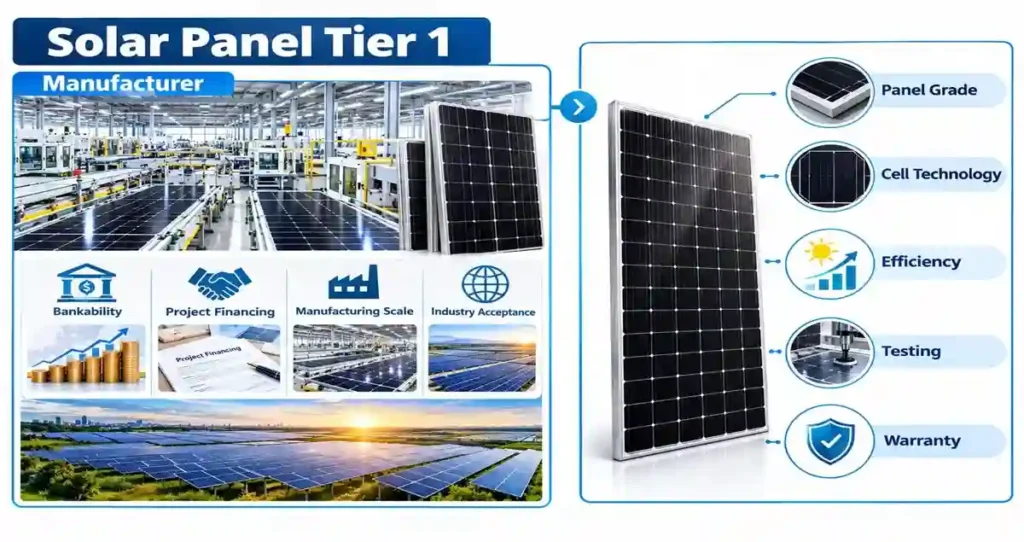
A common misconception is that a Solar Panel Tier 1 label acts as a quality certification for every module produced by that manufacturer. It does not. BloombergNEF explicitly states that its Tier 1 list does not take product-quality information into account and should not replace proper product due diligence.
Solar Panel Tier 1 Buying Checklist
- Verify the manufacturer’s current Solar Panel Tier 1 status.
- Check the exact panel model, not just the manufacturer name.
- Identify the cell technology: TOPCon, HJT, PERC, IBC, etc.
- Compare efficiency and temperature coefficient.
- Review degradation rate and warranty terms.
- Check relevant factory testing and certifications.
- Confirm local availability and after-sales support.
- Compare the price against actual specifications and expected lifetime value.
Key Question Before You Buy
Is the Solar Panel Tier 1 claim based on a current BloombergNEF listing, or simply on the seller’s marketing material?
Conclusion
Solar Panel Tier 1 is a useful manufacturer-level bankability signal, but it should not be treated as a guarantee of individual panel quality. Buyers should evaluate the specific module’s cell technology, efficiency, temperature performance, degradation, warranty, testing, certifications and price separately.
In simple terms: Solar Panel Tier 1 helps you evaluate the manufacturer. The datasheet and testing help you evaluate the panel.
Frequently Asked Questions
1. Does Tier 1 mean the best solar panel?
No. Tier 1 does not necessarily mean the best solar panel. Tier 1 primarily indicates that a manufacturer has demonstrated strong financial stability, manufacturing scale, brand recognition, and participation in projects that meet the relevant criteria. Panel quality should also be evaluated through technology, certifications, warranty, degradation rate, reliability, and independent testing.
2. Is Tier 1 the same as Grade A?
No. Tier 1 and Grade A are not the same thing. Tier 1 is a manufacturer classification based mainly on market and project-financing criteria, while Grade A is commonly used in the industry to describe the condition or quality category of a module. Buyers should not assume that a “Grade A” label automatically means Tier 1.
3. Does Tier 1 guarantee high-quality solar panels?
Not necessarily. Tier 1 status is not a direct quality certification. It can provide confidence in the manufacturer’s market position and bankability, but buyers should still check certifications, product specifications, warranty terms, degradation rates, manufacturing quality, and third-party reliability testing.
4. Is a Tier 2 solar panel manufacturer a bad choice?
No. A Tier 2 manufacturer is not automatically a bad choice. Some Tier 2 manufacturers can offer good-quality products at competitive prices. However, buyers should pay closer attention to the manufacturer’s track record, certifications, warranty support, financial stability, after-sales service, and local availability.
5. Should I choose a Tier 1 solar panel manufacturer over Tier 2?
For many commercial, utility-scale, and bank-financed projects, Tier 1 manufacturers may be preferable because of their stronger bankability and established project track record. However, for residential or smaller projects, a reputable non-Tier-1 manufacturer may also be a suitable option if its products, warranty, certifications, and after-sales support meet your requirements.
6. Who decides which manufacturers are Tier 1?
There is no universal government or international body that officially certifies a manufacturer as “Tier 1.” The term is commonly associated with BloombergNEF’s PV Module Tier 1 ranking, which evaluates manufacturers based on specific bankability and project-financing criteria. Other companies or organizations may use different classification systems, so always check what criteria are being used.
7. How often should I verify Solar Panel Tier 1 status?
You should verify Tier 1 status whenever you are making a major purchase or evaluating a manufacturer for a project, rather than relying on an old list or marketing claim. Tier rankings can change as manufacturers’ financial positions, project portfolios, and market conditions change. For bank-financed or large-scale projects, use the latest available ranking and confirm the requirements with the relevant bank or project financier.
Where can I find the current Tier 1 solar panel manufacturers list?
BloombergNEF publishes the authoritative list quarterly for institutional subscribers. Because the list changes frequently, rely on current-quarter supplier verification or verified industry analysis rather than static tables published on old web pages.
Can a manufacturer lose Tier 1 status?
Yes. If a manufacturer undergoes financial restructuring, files for insolvency, or fails to secure non-recourse debt financing across six major utility projects in a two-year window, it is removed from BNEF’s active matrix.
Is Tier 1 status the same as IEC or UL certification?
No. BNEF Tier 1 assesses corporate financial health and project bankability. IEC (e.g., IEC 61215/61730) and UL standards certify physical safety, structural integrity, and electrical performance at the module level.
Related guides on SolarVisionAI.com
- Monocrystalline Solar Panels 2026: Still Worth It or Hype
- Polycrystalline Solar Panels: Worth Buying in 2026?
- Thin-film Solar Panels: When They Beat Silicon (2026)
- BIPV Solar Panels: Building-Integrated PV Complete Guide
- Portable Solar Panels: Engineer’s Buyer’s Guide 2026
- CPV Solar Panels: Concentrated Photovoltaic Explained
- Skin Solar Panel: What “Solar Skin” Actually Means
- Solar Fence Post Lights: Cap Sizes, Types & Install Guide
- Bifacial Solar Panels in 2026: How to Boost Energy Output
- Solar Charge Controller: The Complete Guide
- MC4 Connectors: Solar Safety & Installation Guide
- Solar Panel Types, Efficiency & Benefits
- Solar Water Pump Guide
- Commercial Solar Panel Installation: Engineering Guide
- Solar Fence Post Lights: Cap Sizes, Types & Install Guide
- BESS — Battery Energy Storage System Guide
- Commercial Solar Panel Installation
- Solar Refrigerator & DC Fridge — Complete 2026 Guide
- Bifacial Solar Panel Albedo Effect Guide
- TOPCon: Why TOPCon Solar Panel is a Proven Smart Investment in 2026
- HJT: Why TOPCon Solar Panel is a Proven Smart Investment in 2026
- PERC: PERC Solar Panel: Still Relevant or Already Outdated?
- Perovskite: Perovskite Solar Panels: The 2026 Reality Check
- N-Type vs P-Type: N-Type vs P-Type Solar Panels: Honest Comparison
- ABC: ABC (all back contact) Solar Panel: Back Contact Technology Explained
- IBC: IBC Solar Panels: Interdigitated Back Contact Guide
- Tandem: Tandem Solar Panels: Are Stacked Cells Ready for Rooftops?