
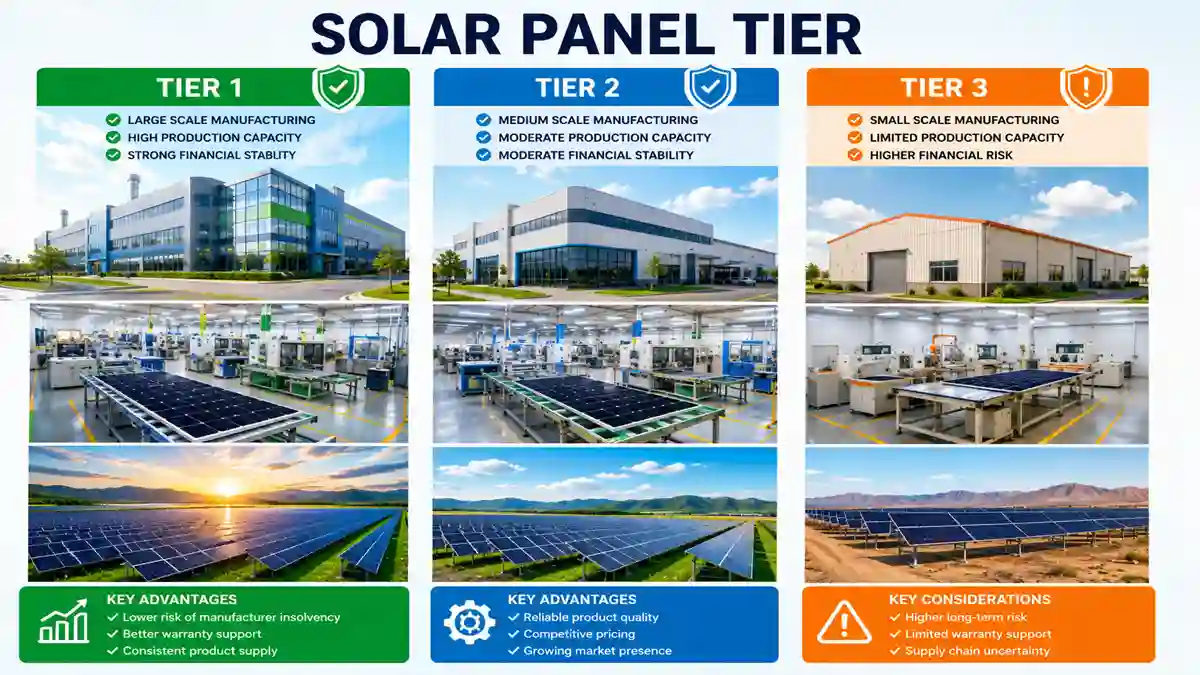
Solar Panel Tier 1, Tier 2 and Tier 3 explained. Learn what tier rankings really mean, how bankability differs from quality, and what buyers should check.
“Tier 1” is one of the most frequently cited, and most frequently misunderstood, terms a buyer encounters while shopping for solar panels. It sounds like a straightforward quality ranking — Tier 1 must be best, Tier 3 must be worst — but the actual classification measures something narrower and more specific than overall panel quality, and understanding that distinction changes how much weight the term deserves in a buying decision.
The Short Answer
Tier 1 does not mean Grade A. Tier 1 primarily tells you about a manufacturer’s bankability, while Grade A is a separate product-level quality classification.
This guide is part of our Types of Solar Panels hub, and pairs with our Solar Panel Tier 1
What Tier Actually Measures
The Solar Panel Tier 1 classification is primarily a measure of manufacturer bankability. BloombergNEF evaluates whether a manufacturer’s own-brand, own-manufacture modules have been used in projects that secured non-recourse financing from commercial banks. The classification therefore reflects the manufacturer’s acceptance in financed solar projects rather than directly measuring panel efficiency, cell technology, or individual product quality.
Engineer’s Note: I explain the distinction this way to clients: Tier 1 tells you a manufacturer is financially substantial and likely to still exist in 10-15 years to honor a warranty claim. It doesn’t directly tell you the specific panel model you’re buying uses the best available cell technology or carries the best specifications. Both questions matter, and they need to be answered separately.
Tier vs Grade: What Are You Actually Measuring?
| Feature | Solar Panel Tier | Solar Panel Grade |
|---|---|---|
| Measures | Manufacturer | Individual module |
| Main focus | Bankability | Product quality |
| Level | Company-level | Panel-level |
| Typical evidence | Project financing history | Factory testing and inspection |
| Can indicate | Manufacturer acceptance and financial/project risk | Module’s tested performance and condition |
| Does it guarantee panel quality? | No | Not by itself |
| Does it identify the best technology? | No | No |
Important note: Tier and Grade should never be treated as interchangeable labels. A Tier 1 manufacturer can offer different products and technologies, and a product still needs to be evaluated using its own datasheet, testing, warranty, and quality documentation.
| Feature | Solar Panel Tier | Solar Panel Grade |
|---|---|---|
| Measures | Manufacturer | Individual panel |
| Evaluates | Financial strength and bankability | Manufacturing quality |
| Determined by | Bloomberg NEF | Factory testing and inspection |
| Focus | Company-level risk | Product-level quality |
| Includes | Production scale and financing | Flash testing, EL testing, cosmetic inspection |
| Best used for | Warranty and long-term manufacturer stability | Verifying panel quality |
Tier 1, 2, and 3 Compared
| Label | What it generally means | Buyer interpretation |
|---|---|---|
| Tier 1 | Manufacturer meets BloombergNEF’s published Tier 1 criteria | Strong bankability signal |
| Tier 2 | Common industry/market terminology for manufacturers outside the Tier 1 list | Requires additional due diligence |
| Tier 3 | Common market terminology for less-established manufacturers outside Tier 1 | Requires greater scrutiny of manufacturer and product |
| Unlisted | Manufacturer is not on the specific Tier 1 list being referenced | Do not assume either good or bad quality without further verification |
Important: Tier 2 and Tier 3 are commonly used market labels, but they should not be presented as equivalent official BloombergNEF classifications. BloombergNEF’s published methodology specifically defines the criteria for its Tier 1 list.
Is Tier 1 Rating Still Relevant in 2026?
Genuinely, yes, though with an important caveat worth understanding. As the solar industry has matured and consolidated, a larger share of global panel production now comes from manufacturers meeting Tier 1 criteria than in the technology’s earlier years, which means Tier 1 status alone is a somewhat less differentiating signal than it once was — a much larger pool of manufacturers now qualify. That said, it remains a meaningful negative screen: a Tier 3 or unlisted manufacturer still represents genuinely higher long-term risk, even if Tier 1 status alone no longer guarantees you’re getting the single best product on the market.
BloombergNEF currently publishes its Tier 1 reports quarterly, so buyers should verify the manufacturer’s status against the current list rather than relying on an old sales quotation, website badge, or marketing brochure.
Field Note: I still check Tier 1 status on every manufacturer I haven’t personally vetted before, precisely because it’s an efficient first-pass risk filter even in 2026. What’s changed is that I no longer stop the evaluation there — Tier 1 gets a manufacturer onto my shortlist, but the actual product comparison (cell technology, grade, datasheet specifications) still happens afterward.
Advantages and Disadvantages of Prioritizing Tier 1
| Advantages | Disadvantages |
| Lower risk of manufacturer insolvency affecting long-term warranty support | Tier 1 status doesn’t directly measure product-level quality or specifications |
| Useful, efficient first-pass filter when evaluating unfamiliar manufacturers | Larger pool of qualifying manufacturers means less differentiation than in earlier years |
| Correlates reasonably well with production scale and manufacturing consistency | Excellent Tier 2 or 3 manufacturers exist and shouldn’t be dismissed outright |
Real-World Applications
As an engineer, one of the most common questions I encounter is whether Tier 1 automatically means a panel is also Grade A. Many buyers assume the two terms are interchangeable because they’re both used as indicators of quality in marketing materials.
In reality, they measure two completely different things. Tier 1 evaluates the manufacturer’s financial strength and bankability, while Grade A evaluates the individual panel’s manufacturing quality and testing results.
I’ve had numerous conversations with clients who were surprised to learn that a panel can come from a Tier 1 manufacturer and still require separate verification for grade, cell technology, and performance specifications.
My goal with this article is simple: remove that confusion entirely. Once buyers understand the difference between manufacturer classification and product classification, they can make much more informed purchasing decisions.
Tier 1 evaluates the manufacturer; Grade A evaluates the individual panel.
Common Misconceptions Worth Clearing Up
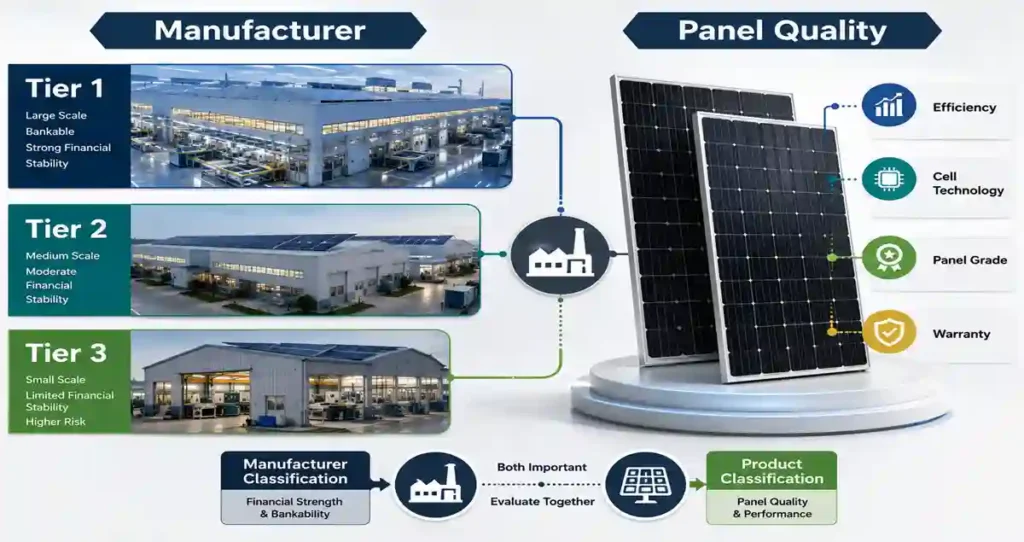
People frequently assume that “Tier 1” means “best quality panel” in general. It specifically means “financially bankable manufacturer,” which is a real and useful signal, but a different question from panel efficiency, grade, or cell technology. A Tier 1 manufacturer can produce panels across a range of quality and technology tiers within their own product line, so Tier 1 status alone doesn’t specify which particular product you’re actually buying.
Field Note
One of the most persistent misconceptions I encounter is the belief that Tier 1 automatically means Grade A. In practice, these terms answer two completely different questions: “Can I trust the manufacturer?” and “Can I trust this specific panel?” Understanding that distinction removes much of the confusion surrounding solar panel selection.
Buying Checklist
- Use Tier 1 status as an initial risk screen, not the final quality determination
- Verify the specific product’s grade, cell technology, and datasheet specifications separately from manufacturer tier
- Don’t automatically dismiss well-vetted Tier 2 manufacturers, particularly for budget-conscious projects
- Check current Tier 1 status directly, since BloombergNEF updates this list periodically
- Is the Tier 1 claim based on the current BloombergNEF list, or only on the supplier’s marketing material?
Questions Every Buyer Should Ask
- Is the manufacturer currently classified as Tier 1?
- Is this specific panel Grade A?
- What cell technology does the panel use (PERC, TOPCon, HJT, or IBC)?
- Can the supplier provide a flash test report?
- What are the panel’s degradation and warranty specifications?
How I Evaluate a Solar Panel
Step 1: Check manufacturer bankability and current Tier 1 status.
Step 2: Check the specific panel’s cell technology and datasheet specifications.
Step 3: Verify panel grade and factory testing documentation.
Step 4: Compare efficiency, temperature coefficient, degradation rate, warranty, and certifications.
Step 5: Compare the actual price and expected lifetime value.
Then finish with
Tier 1 gets the manufacturer onto the shortlist. It does not finish the evaluation.
Frequently Asked Questions
Does Tier 1 mean the best solar panel?
Not directly. Tier 1 primarily measures manufacturer bankability rather than the quality, efficiency, or technology of an individual solar panel. It is a useful risk-reduction signal, but buyers should evaluate the specific product separately.
Is Tier 1 the same as Grade A?
No. Tier 1 and Grade A describe different things. Tier 1 relates primarily to the manufacturer’s bankability, while Grade A is generally used as a product-level quality or classification term. A Tier 1 manufacturer does not automatically make every panel Grade A.
Does Tier 1 guarantee high-quality solar panels?
No. Tier 1 status does not guarantee a particular panel’s efficiency, reliability, or manufacturing quality. Buyers should also review the module’s datasheet, cell technology, degradation rate, warranty, certifications, and factory testing documentation.
Is a Tier 2 solar panel manufacturer a bad choice?
Not necessarily. A manufacturer outside the Tier 1 list can still produce reliable and competitive solar panels. Tier status should be treated as one part of the buying decision rather than a simple good-versus-bad quality ranking.
Should I choose a Tier 1 panel over a Tier 2 panel?
Not automatically. Compare the specific products based on efficiency, cell technology, temperature coefficient, degradation, warranty, certifications, testing, availability, and price. A well-vetted Tier 2 product can sometimes offer better value for a particular project.
Who decides which manufacturers are Tier 1?
BloombergNEF maintains and periodically updates its Tier 1 PV Module Maker classification based primarily on manufacturer bankability and qualifying project-finance criteria. It is widely used as a reference for evaluating manufacturer bankability.
How often should I verify a manufacturer’s Tier 1 status?
Verify the manufacturer’s status against the current BloombergNEF Tier 1 list rather than relying solely on an old brochure, quotation, website badge, or supplier claim. This is particularly important when making a significant purchasing decision.
References
Tier classification criteria and methodology context are drawn from Bloomberg New Energy Finance’s published bankability rankings and industry analysis from PV Magazine.
Related guides on SolarVisionAI.com
- Monocrystalline Solar Panels 2026: Still Worth It or Hype
- Polycrystalline Solar Panels: Worth Buying in 2026?
- Thin-film Solar Panels: When They Beat Silicon (2026)
- BIPV Solar Panels: Building-Integrated PV Complete Guide
- Portable Solar Panels: Engineer’s Buyer’s Guide 2026
- CPV Solar Panels: Concentrated Photovoltaic Explained
- Skin Solar Panel: What “Solar Skin” Actually Means
- Solar Fence Post Lights: Cap Sizes, Types & Install Guide
- Bifacial Solar Panels in 2026: How to Boost Energy Output
- Solar Charge Controller: The Complete Guide
- MC4 Connectors: Solar Safety & Installation Guide
- Solar Panel Types, Efficiency & Benefits
- Solar Water Pump Guide
- Commercial Solar Panel Installation: Engineering Guide
- Solar Fence Post Lights: Cap Sizes, Types & Install Guide
- BESS — Battery Energy Storage System Guide
- Commercial Solar Panel Installation
- Solar Refrigerator & DC Fridge — Complete 2026 Guide
- Bifacial Solar Panel Albedo Effect Guide
- TOPCon: Why TOPCon Solar Panel is a Proven Smart Investment in 2026
- HJT: Why TOPCon Solar Panel is a Proven Smart Investment in 2026
- PERC: PERC Solar Panel: Still Relevant or Already Outdated?
- Perovskite: Perovskite Solar Panels: The 2026 Reality Check
- N-Type vs P-Type: N-Type vs P-Type Solar Panels: Honest Comparison
- ABC: ABC (all back contact) Solar Panel: Back Contact Technology Explained
- IBC: IBC Solar Panels: Interdigitated Back Contact Guide
- Tandem: Tandem Solar Panels: Are Stacked Cells Ready for Rooftops?