
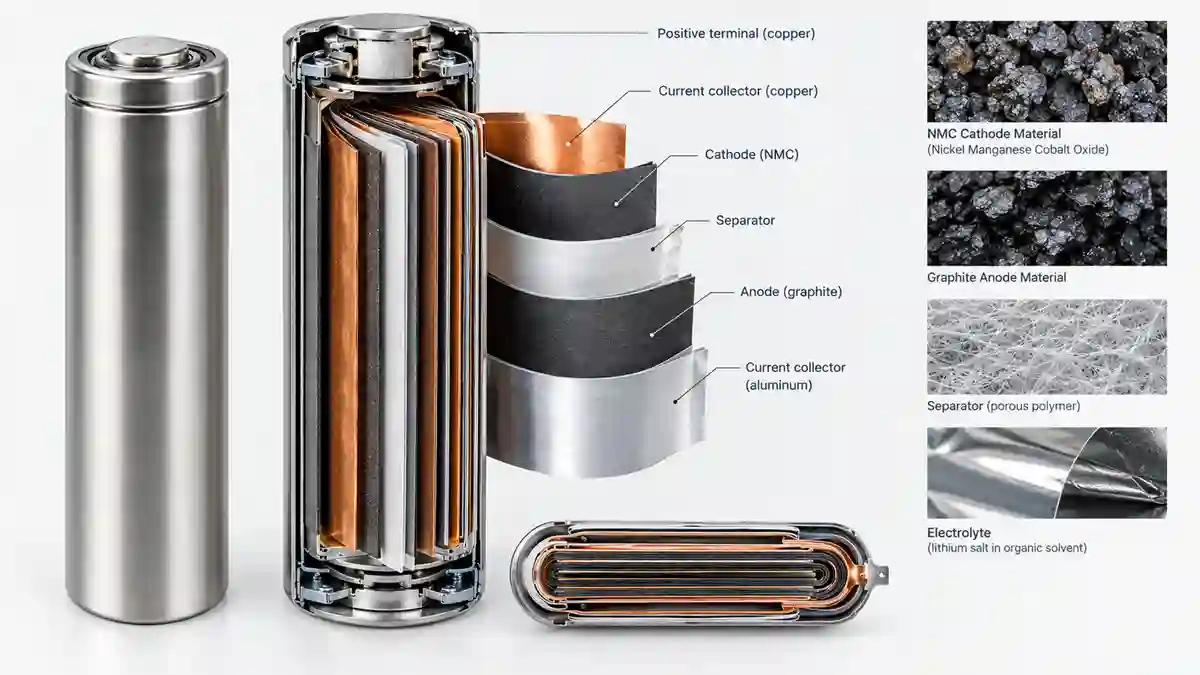
Learn what an NMC battery is, how nickel manganese cobalt chemistry works, its specs, applications, safety, and how it compares with LiFePO4.
If you have used a smartphone, laptop, cordless power tool, or modern electric vehicle, there is a good chance you have already used an NMC battery without realizing it. NMC is one of the major lithium-ion battery chemistries used where high energy density, compact size, and low weight are important.
NMC stands for nickel manganese cobalt oxide, referring to the materials used in the battery’s cathode. Unlike LiFePO4, which uses lithium iron phosphate chemistry, NMC combines nickel, manganese, and cobalt to achieve a different balance between energy density, power capability, cycle life, cost, and thermal stability.
Quick answer
An NMC battery is a lithium-ion battery that uses nickel manganese cobalt oxide as its cathode material. NMC batteries are widely used in electric vehicles, smartphones, laptops, power tools, drones, and other applications where storing more energy in a smaller and lighter battery is important.
Compared with LiFePO4, NMC generally offers higher energy density, while LiFePO4 generally provides longer cycle life and greater thermal stability. The better chemistry therefore depends on the application rather than one chemistry being universally superior.
Engineer’s Note: NMC is not simply an older or inferior version of LiFePO4. It is a different lithium-ion chemistry designed around a different set of engineering priorities. When weight, volume, and driving range are critical, the higher energy density of NMC can be a major advantage. For applications such as stationary solar storage, the priorities can shift toward cycle life, thermal stability, operating conditions, and total cost over the system’s service life.
In this guide, I will explain what an NMC battery is, how its chemistry works, what NMC 811 and other NMC ratios mean, its typical specifications, where NMC batteries are used, and how NMC compares with LiFePO4.
1. What Is an NMC Battery?
NMC is short for nickel manganese cobalt oxide, the material used in the battery’s positive electrode (cathode). It’s a type of lithium-ion battery, the same broad family LiFePO4 belongs to, just built with different materials and different trade-offs.
The “NMC” name usually comes with a ratio attached, like NMC 811 or NMC 622, which tells you the proportion of nickel, manganese and cobalt in the cathode. Higher nickel content generally means higher energy density, but it can also mean lower thermal stability. Manufacturers balance this ratio differently depending on whether they’re prioritizing range, cost, or safety.
2. NMC Battery Chemistry: How It’s Built
| Component | NMC Cell |
|---|---|
| Cathode (positive) | Nickel manganese cobalt oxide |
| Anode (negative) | Graphite |
| Nominal voltage | 3.6 to 3.7 V per cell |
| Maximum charge voltage | Typically 4.2 V per cell |
| Key materials | Nickel, manganese, cobalt, graphite |
Engineer’s Note: The cobalt in NMC is what drives both the cost and some of the supply chain scrutiny this chemistry gets. It’s also part of what makes the structure more stable than pure nickel-based alternatives, so it’s not purely a drawback, it’s a deliberate trade-off manufacturers are still refining.
3. NMC Battery Specs at a Glance
| Specification | Typical Value |
|---|---|
| Energy density | About 150 to 250+ Wh/kg |
| Cycle life | 800 to 2,500 cycles |
| Charging temperature | 0°C to 45°C (cannot charge below freezing, same as LiFePO4) |
| Thermal runaway onset | Roughly 150 to 210°C |
| Self-discharge | Low, similar range to other lithium-ion chemistries |
These are typical manufacturer ranges. Always check the actual datasheet for a specific product, since NMC ratios (811, 622, 532, etc.) shift these numbers meaningfully.
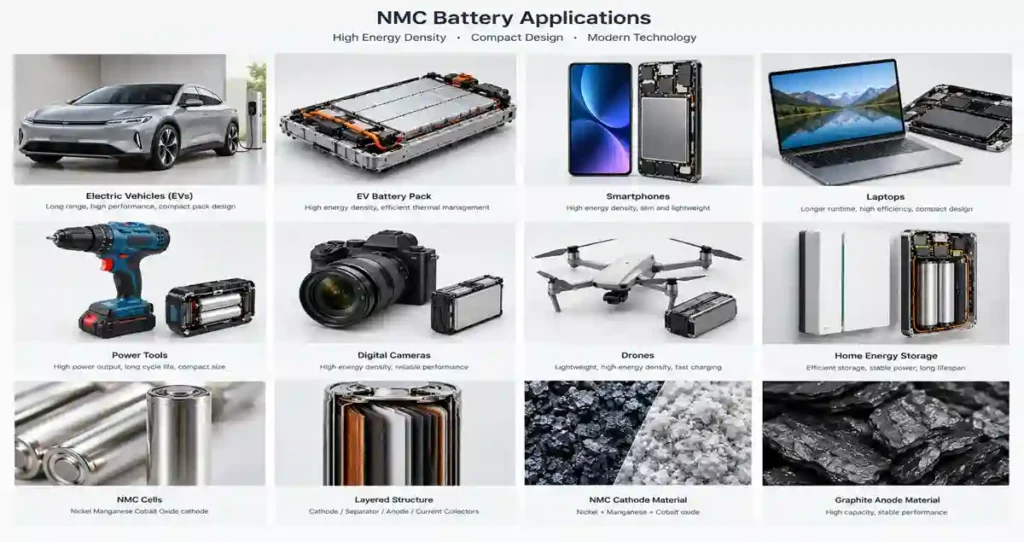
4. Where NMC Batteries Are Used (Applications & Industry Fits)
Because NMC batteries prioritize volumetric and gravimetric energy density (packing maximum watt-hours into minimal size and weight), they dominate applications where weight and space constraints dictate performance.
Here is where NMC chemistry excels—and why engineers choose it for specific industries:
1. Long-Range Electric Vehicles (EVs)
- Why NMC Fits: EV manufacturers rely on NMC cells to deliver high driving range per kilogram of battery weight. Reducing overall pack weight improves vehicle efficiency, acceleration, and handling.
- Typical Ratios Used: High-nickel configurations like NMC 811 or 622 are widely deployed in modern EV platforms to maximize energy density per charge cycle.
2. Consumer Electronics (Smartphones, Laptops & Wearables)
- Why NMC Fits: Handheld devices demand ultra-compact battery dimensions with high capacity. NMC allows manufacturers to maintain slim device profiles while providing all-day power output.
3. Portable Power Tools & Drones
- Why NMC Fits: High-power applications require both lightweight construction and continuous high discharge rates. NMC cells can sustain high C-rates required for power tools, e-bikes, and commercial aviation drones without adding excessive mass.
4. Medical Devices & Aerospace Systems
- Why NMC Fits: Portable medical equipment (such as portable oxygen concentrators and motorized mobility aids) relies on NMC for reliable, compact energy storage where physical footprint and portability are primary design requirements.
Application Fit Summary: NMC vs. Stationary Storage
| Application / Industry | Primary Requirement | Best Battery Chemistry Choice | Key Reason |
| Electric Vehicles & Transport | High Range / Low Weight | NMC | Highest energy-to-weight ratio (Wh/kg) |
| Smartphones & Electronics | Compact Footprint | NMC | Maximum energy in minimal physical space |
| Solar Energy Storage (BESS) | Long Cycle Life & Safety | LiFePO4 | 3,000–6,000+ cycle life with high thermal stability |
| Off-Grid & RV Systems | Daily Deep Cycling | LiFePO4 | Lower cost-per-cycle and inherently safer in enclosed spaces |
Engineer’s Note: A common mistake in energy storage design is forcing high-density mobility chemistries into stationary installations. While an NMC pack can technically power a solar array or home BESS, doing so wastes its greatest strength—lightweight portability—while exposing the system to a shorter total cycle life and narrower thermal operating margins. For stationary solar, stationary weight does not matter; long cycle life and thermal stability do, which is why LiFePO4 remains the standard recommendation for stationary solar storage.
5. NMC vs LiFePO4: The Short Version
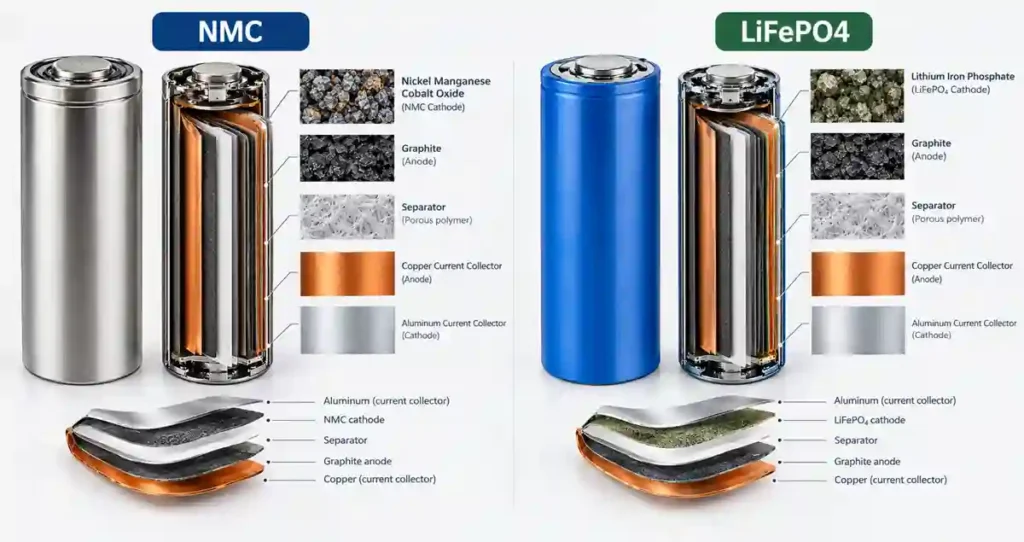
| Feature | NMC | LiFePO4 |
|---|---|---|
| Energy density | Higher (150–250+ Wh/kg) | Lower (90–160 Wh/kg) |
| Cycle life | 800–2,500 | 3,000–6,000+ |
| Thermal stability | Lower | Higher |
| Weight/size for same energy | Lighter, smaller | Heavier, bulkier |
| Best for | EVs, phones, laptops, drones | Solar, RVs, backup power, BESS |
For the full breakdown, including safety, cost per cycle, and cold-weather performance, see our complete LiFePO4 vs Lithium-Ion comparison guide.
6. NMC Strengths and Limitations
Strengths
- Highest energy density of the common lithium-ion chemistries
- Lighter and more compact for the same stored energy
- Well-established manufacturing at massive scale
- Strong power delivery for demanding applications
Limitations
- Shorter cycle life than LiFePO4
- Lower thermal stability, more prone to thermal runaway if damaged or abused
- Relies on cobalt and nickel, both subject to supply and cost volatility
- Not ideal for daily deep-cycling applications like solar storage
7. Is NMC Safe?
Yes, with the same caveat that applies to every lithium-ion battery: safety depends on the whole system, not the chemistry alone. NMC is less thermally stable than LiFePO4, meaning it has a narrower margin before thermal runaway under abuse conditions like puncture, overcharge, or extreme heat. That’s why NMC packs in EVs and consumer electronics rely heavily on sophisticated battery management systems and physical protection.
Engineer’s Note: This doesn’t mean NMC is unsafe in everyday use, it’s in your phone right now. It means the engineering tolerance for mistakes is smaller, which is exactly why this chemistry tends to show up in tightly controlled, factory-built products rather than DIY battery banks.
8. NMC Batteries in Solar Energy Storage: Engineering Trade-Offs & Realities
While early residential battery systems, including early-generation Tesla Powerwalls, used NMC chemistry because of its high energy density and compact footprint, the stationary energy storage market has increasingly shifted toward LiFePO4 for new solar and battery storage applications.
The reason is primarily an engineering trade-off between stationary and mobile applications. In stationary solar storage, weight and physical size are usually less important than cycle life, thermal stability, safety, and lifetime cost.
1. Daily Cycling & Levelized Cost of Storage (LCOS)
Solar energy storage is typically subjected to regular cycling. A battery may charge from solar PV during the day and discharge to supply household or commercial loads during the evening and night.
- Cycle Life: NMC cells commonly offer approximately 800–2,500 cycles to around 80% of their original capacity, depending on cell design, depth of discharge, temperature, charge/discharge rates, and operating conditions. Under daily cycling, this can translate into a relatively shorter service life than LiFePO4.
- LiFePO4 Advantage: LiFePO4 cells can commonly achieve approximately 3,000–6,000+ cycles, with some products rated considerably higher under specified operating conditions. This can provide a significantly longer service life in daily-cycling solar applications.
- Lifetime Economics: Because battery replacement is a major component of the total cost of an energy-storage project, longer cycle life can reduce the replacement frequency and improve the lifetime economics or Levelized Cost of Storage (LCOS).
However, cycle-life figures should always be evaluated against the manufacturer’s test conditions. Depth of discharge, temperature, C-rate, and charging limits can substantially affect real-world battery life.
2. Thermal Margins & Safety in Enclosed Spaces
Solar battery systems may be installed in garages, utility rooms, basements, equipment rooms, or outdoor enclosures where ambient temperatures can become elevated.
NMC chemistry generally has a lower thermal stability margin than LiFePO4. During severe abuse or failure, NMC cathode materials can undergo exothermic decomposition and may release oxygen, increasing the potential for thermal runaway and fire propagation.
- Thermal Stability: The exact thermal-runaway temperature is not a single fixed value. It varies significantly with cell chemistry, electrode design, state of charge, cell construction, and test method. Therefore, generic values such as 150°C–210°C should not be treated as a universal NMC threshold.
- System-Level Protection: Battery safety depends on the complete system, not chemistry alone. Proper BMS protection, temperature monitoring, electrical isolation, cell-level protection, enclosure design, ventilation where required, and appropriate fire-safety engineering are essential.
- Testing & Certification: For stationary energy-storage systems, standards and testing such as UL 9540 and UL 9540A, where applicable, are used to evaluate system safety and thermal-runaway/fire-propagation behavior.
LiFePO4 also requires proper system protection, but its chemistry provides a higher thermal stability margin than conventional NMC, which is one reason it has become widely used in stationary storage.
3. When Does NMC Make Sense for Solar?
NMC has not become irrelevant. Its high energy density can still be valuable when the physical size or weight of the battery is a major design constraint.
Examples include:
- Severe Space or Weight Constraints: Mobile solar systems, expedition vehicles, marine applications, portable power systems, and other applications where every kilogram and cubic meter matters.
- Cold-Weather Applications: NMC can provide useful low-temperature performance advantages compared with standard unheated LiFePO4 systems. However, actual performance depends on the specific cell and battery design, and LiFePO4 systems equipped with appropriate battery heating can also operate effectively in cold environments.
- High Energy Density Requirements: Where a smaller battery enclosure is more valuable than maximum cycle life, NMC’s higher energy density can justify its use.
Solar Storage Comparison: NMC vs. LiFePO4
| Key Metric | NMC Solar Storage | LiFePO4 Solar Storage |
|---|---|---|
| Typical Cycle Life | Approximately 800–2,500 cycles, depending on operating conditions | Approximately 3,000–6,000+ cycles, depending on operating conditions |
| Typical Service Life in Daily Solar Cycling | Often shorter than LiFePO4; highly dependent on DoD, temperature, and operating conditions | Often 10–15+ years in properly designed systems |
| Thermal Stability | Lower thermal stability margin; greater thermal-runaway risk under severe failure conditions | Higher thermal stability and generally greater resistance to thermal runaway |
| Energy Density | Higher | Lower to moderate |
| Weight & Footprint | Advantage where space and weight are critical | Larger/heavier for the same nominal energy capacity |
| Primary Advantage | High energy density and compact design | Long cycle life, thermal stability, and strong suitability for stationary storage |
| Typical Stationary Solar Use | Specialized or space-constrained applications | Widely used for residential, commercial, and utility-scale storage |
Engineer’s Note: For a conventional residential or commercial solar PV system, battery weight is rarely the primary engineering constraint. A battery installed on a properly designed concrete floor does not gain a practical advantage simply because it weighs less.
For stationary solar storage, the more important design considerations are cycle life, depth of discharge, thermal stability, safety, usable capacity, warranty conditions, efficiency, and lifetime cost.
NMC can still be technically appropriate where weight, volume, or low-temperature performance is a critical requirement. However, for most stationary solar energy-storage applications, LiFePO4 offers a strong combination of cycle life, thermal stability, safety characteristics, and long-term economics.
Frequently Asked Questions
What does NMC stand for in batteries?
Nickel manganese cobalt oxide, the material used in the battery’s cathode.
Is NMC better than LiFePO4?
It depends on the application. NMC is better when weight and size matter most, like EVs or electronics. LiFePO4 is better for stationary, daily-cycling use like solar storage, where cycle life and safety matter more than compactness.
What is NMC battery used for?
Mostly smartphones, laptops, power tools, drones, and long-range electric vehicles, anywhere high energy density per kilogram is the priority.
Is NMC a lithium-ion battery?
Yes. NMC is one specific chemistry within the lithium-ion family, alongside others like LiFePO4, NCA, and LCO.
How long do NMC batteries last?
Typically 800 to 2,500 charge cycles, depending on the specific NMC ratio and how the battery is used and charged.
Related Guides
- 24V 200Ah LiFePO4 Battery: Specs, Uses & Buying Guide
- LiFePO4 vs Lithium-Ion: Which Battery Should You Buy?
- LiFePO4 Battery: How It Works, Specs & Buying Guide
- LiFePO4 Batteries for Solar: How to Choose & Size Right
- 48V 200Ah LiFePO4 Battery: Specs, Sizing & Home Storage Guide
- LiFePO4 Battery Charger: Voltage, Amps & Settings
- Solar Panel Repair Guide: Diagnose Problems, Costs & Fixes
- IRS Form 5695 for 2025: Solar Tax Credit Guide
Related guides on SolarVisionAI.com
- Monocrystalline Solar Panels 2026: Still Worth It or Hype
- Polycrystalline Solar Panels: Worth Buying in 2026?
- Thin-film Solar Panels: When They Beat Silicon (2026)
- BIPV Solar Panels: Building-Integrated PV Complete Guide
- Portable Solar Panels: Engineer’s Buyer’s Guide 2026
- CPV Solar Panels: Concentrated Photovoltaic Explained
- Skin Solar Panel: What “Solar Skin” Actually Means
- Solar Fence Post Lights: Cap Sizes, Types & Install Guide
- Bifacial Solar Panels in 2026: How to Boost Energy Output
- Solar Charge Controller: The Complete Guide
- MC4 Connectors: Solar Safety & Installation Guide
- Solar Panel Types, Efficiency & Benefits
- Solar Water Pump Guide
- BESS — Battery Energy Storage System Guide
- Commercial Solar Panel Installation
- Solar Refrigerator & DC Fridge — Complete 2026 Guide
- Bifacial Solar Panel Albedo Effect Guide
- TOPCon: Why TOPCon Solar Panel is a Proven Smart Investment in 2026
- HJT: Why Heterojunction Is the Hot Climate Champion
- PERC: PERC Solar Panel: Still Relevant or Already Outdated?
- Perovskite: Perovskite Solar Panels: The 2026 Reality Check
- N-Type vs P-Type: N-Type vs P-Type Solar Panels: Honest Comparison
- ABC: ABC (all back contact) Solar Panel: Back Contact Technology Explained
- IBC: IBC Solar Panels: Interdigitated Back Contact Guide
- Tandem: Tandem Solar Panels: Are Stacked Cells Ready for Rooftops?