
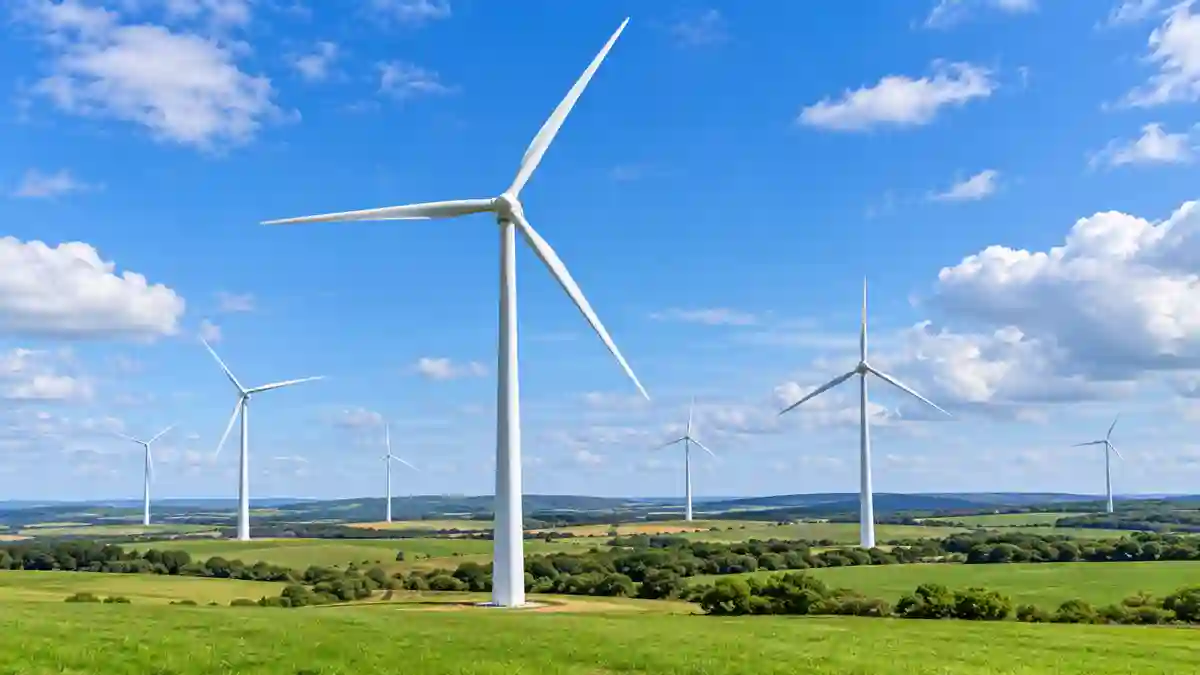
How tall are wind turbines? Explore average turbine height, tower dimensions, hub height, blade length and the size differences between onshore and offshore turbines.
Modern wind turbines are much taller than many people expect. Large utility-scale turbines can reach heights of more than 200 meters when a blade reaches its highest position. Their towers, rotors and blades are designed to capture wind energy efficiently while operating under demanding environmental conditions.
However, when someone asks, how tall are wind turbines?, the answer depends on which measurement is being considered. The height of the tower is not the same as the height of the rotor hub or the turbine’s maximum blade-tip height.
In this guide, we explain wind turbine height, average dimensions, tower height, rotor diameter and the differences between onshore and offshore turbines. We also look at why taller turbines are being developed and how height affects wind energy production.
If you want a broader introduction to wind power technology, start with our complete guide to wind energy.
How Tall Are Wind Turbines?
Most modern utility-scale onshore wind turbines have hub heights around 100 meters, although individual projects use different tower and rotor configurations. Their maximum blade-tip height can be considerably greater because the blades extend above the hub as the rotor turns.
For example, the U.S. Department of Energy reported that the average hub height of newly installed land-based wind turbines in the United States reached approximately 103.4 meters (339 feet) in 2023.
This figure represents hub height, not the total height of the turbine.
Larger wind turbines can have hub heights of 100–140 meters and rotor diameters of approximately 148–196 meters in representative technology configurations examined by the National Renewable Energy Laboratory (NREL).
The following table provides a useful overview.
| Turbine measurement | Typical meaning |
|---|---|
| Tower height | Vertical supporting structure below the nacelle and rotor hub |
| Hub height | Distance from the ground or project reference level to the rotor center |
| Rotor diameter | Full diameter of the circle swept by the rotating blades |
| Blade length | Distance from the hub connection to the blade tip |
| Maximum tip height | Highest point reached by a blade during rotation |
The important distinction is that a turbine with a 100-meter hub height and a 150-meter rotor diameter has a maximum tip height of approximately 175 meters above its ground-level reference.
Understanding Wind Turbine Height Measurements
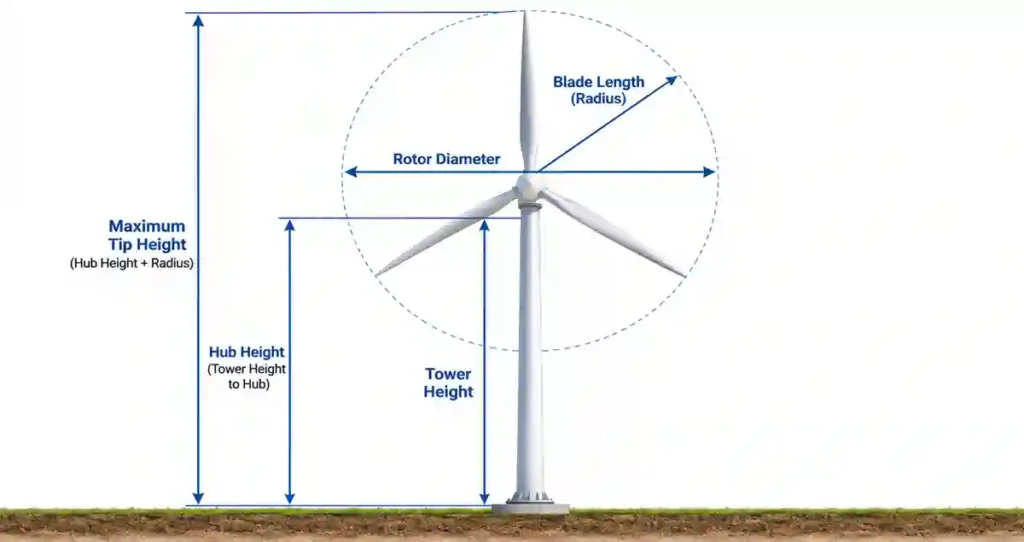
Before comparing turbine sizes, it is important to understand the measurements used by engineers and manufacturers. Wind turbine specifications may include tower height, hub height, rotor diameter and total tip height. Each describes a different part of the machine.
1. Wind Turbine Tower Height
The tower is the tall structural support that carries the nacelle and rotor assembly above the ground or foundation.
Its primary functions include:
- Supporting the weight of the nacelle, generator and rotor.
- Transferring structural loads into the foundation.
- Positioning the rotor at the required operating height.
- Providing access for inspection and maintenance.
- Housing electrical cables and, depending on the design, access equipment.
Wind turbine towers are commonly manufactured from steel sections, although concrete and hybrid tower designs are also used.
Tower height is often discussed alongside hub height, but the two terms should not automatically be treated as identical. The exact tower dimension depends on the turbine’s structural arrangement and the reference point used in its specifications.
2. Wind Turbine Hub Height
Hub height is the vertical distance from the ground to the center of the rotor.
The rotor hub connects the blades to the turbine’s drivetrain. It is positioned at the top of the tower, immediately in front of the nacelle.
Hub height is particularly important because wind conditions generally change with elevation. At many sites, wind speeds increase higher above the ground because surface friction and obstacles have less influence.
For land-based projects, the hub height is normally measured above ground level. Offshore projects use a defined water-level or project reference datum, so their measurements need to be interpreted carefully.
According to the U.S. Department of Energy, the average hub height of newly installed U.S. land-based turbines reached approximately 103.4 meters in 2023.
3. Wind Turbine Rotor Diameter
Rotor diameter is the full distance across the circular area swept by the blades as they rotate.
For a three-bladed turbine, it is measured from the tip of one blade to the tip of the opposite blade when the blades are aligned across the rotor.
A larger rotor captures wind across a greater area, potentially allowing the turbine to produce more electricity, particularly at sites with moderate wind speeds.
The swept area can be calculated using:
A = π × D² ÷ 4
Where:
- A = rotor swept area (m²)
- D = rotor diameter (m)
- π = approximately 3.1416
For example, consider a turbine with a rotor diameter of 150 meters.
A = 3.1416 × 150² ÷ 4
A ≈ 17,671 m²
This means the rotor sweeps an area of approximately 17,671 square meters during rotation.
For a closer look at blade design and construction, see our guide to wind turbine blades.
4. Wind Turbine Blade Length
Blade length is measured from the rotor hub connection to the outer tip of the blade.
For a conventional three-bladed horizontal-axis wind turbine, the approximate relationship is:
Blade Length ≈ Rotor Diameter ÷ 2
For example, a turbine with a 150-meter rotor diameter has blades approximately 75 meters long.
Actual blade dimensions depend on the rotor design and the way the manufacturer defines the measurement.
Longer blades increase the swept area, but they also create greater structural loads. Engineers must consider blade weight, bending, fatigue, aerodynamic performance and transportation limitations.
5. Maximum Wind Turbine Tip Height
Maximum tip height is the highest vertical point reached by a blade during a complete rotation.
It is one of the most useful measurements when comparing the overall height of wind turbines.
For a conventional horizontal-axis turbine installed on level ground:
Maximum Tip Height = Hub Height + (Rotor Diameter ÷ 2)
For example:
- Hub height = 100 meters
- Rotor diameter = 150 meters
- Blade radius = 75 meters
Maximum tip height = 100 + 75
Maximum tip height = 175 meters
This means the blade reaches approximately 175 meters above the ground at its highest position.
For offshore turbines, the same geometric relationship applies, but the hub height and tip height must use the same reference datum, such as mean lower low water (MLLW). Do not combine measurements taken from different reference levels.
Average Wind Turbine Height: Onshore Examples
Wind turbine dimensions have increased as manufacturers develop larger rotors, higher towers and greater generating capacities.
The following figures from NREL’s 2025 Annual Technology Baseline provide a useful comparison between the 2023 U.S. market-average turbine and representative future technology configurations.
| Configuration | Rated capacity | Hub height | Rotor diameter |
|---|---|---|---|
| 2023 market average | 3.4 MW | 103 m | 134 m |
| T1 representative | 6 MW | 115 m | 170 m |
| T2 representative | 8.3 MW | 130 m | 196 m |
| T3 representative | 3.3 MW | 100 m | 148 m |
| T4 representative | 6 MW | 140 m | 196 m |
These are technology reference configurations, not universal dimensions for every wind farm. The T1–T4 configurations represent different wind-resource and design conditions.
The figures show that modern utility-scale turbines can use hub heights of 100–140 meters and rotor diameters approaching 200 meters.
For example, the T2 configuration has a hub height of 130 meters and a rotor diameter of 196 meters.
Its approximate maximum tip height is:
130 + (196 ÷ 2) = 228 meters
That is approximately 748 feet above the ground-level reference.
How Tall Are Offshore Wind Turbines?
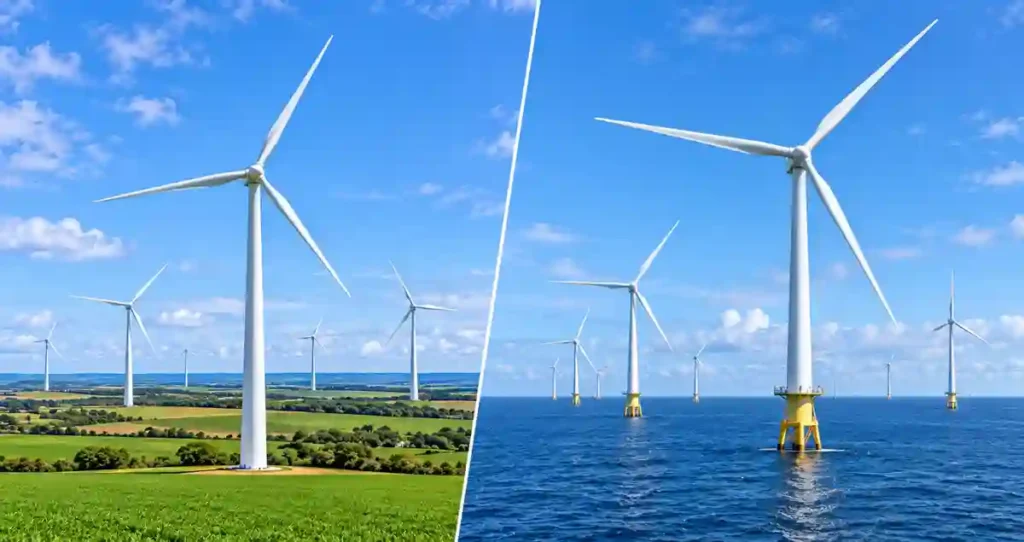
Offshore wind turbines are often larger than onshore models because the offshore environment provides opportunities for larger machines, subject to water depth, foundation design, installation equipment and project economics.
Their dimensions also need to account for the water-level reference and the clearance between the lowest blade tip and the sea surface.
A useful example is the Vineyard Wind 1 project in the United States. Its approved turbine design envelope includes the following dimensions:
| Measurement | Project design range |
|---|---|
| Hub height | 109–144 m |
| Rotor diameter | 164–222 m |
| Maximum tip height | 191–255 m |
| Minimum blade-tip clearance | 27–32 m |
These heights are measured relative to mean lower low water (MLLW), not from the seabed.
The largest configuration in this project envelope reaches approximately 255 meters (837 feet) at the highest blade-tip position.
Offshore wind turbine dimensions vary by project. These figures should not be treated as the average height of every offshore turbine.
Why Are Offshore Wind Turbines So Large?
Several factors influence offshore turbine dimensions:
- Wind resource: Offshore locations can offer strong and relatively consistent wind conditions.
- Larger rotor diameter: A larger swept area can increase energy capture.
- Project economics: Larger turbines can generate more electricity per installed machine, potentially reducing the number of turbines required for a given project capacity.
- Installation conditions: Offshore foundations, vessels and installation equipment must support the selected turbine dimensions.
- Maintenance requirements: Larger machines require suitable access, lifting and maintenance arrangements.
For more information about the technology and how offshore projects differ from land-based systems, consult the U.S. Department of Energy’s Offshore Wind Energy Guide.
Why Are Wind Turbines Getting Taller?
Wind turbines have grown in both height and rotor diameter over the past two decades. This development is not simply about building larger machines. It is about improving energy capture and making wind projects more economical.
1. Access to Stronger Winds
Wind speed often increases with elevation because the influence of ground-level friction, buildings, trees and other obstacles becomes less significant.
A turbine installed at a greater hub height may therefore access a stronger wind resource, depending on local atmospheric conditions.
The actual wind profile varies with terrain, surface roughness, atmospheric stability and weather. A taller tower does not guarantee a higher energy yield at every location.
2. Larger Rotor Swept Area
A larger rotor captures wind across a greater area.
Because the swept area increases with the square of rotor diameter, a relatively small increase in diameter can produce a significant increase in the area available for energy capture.
For example:
| Rotor diameter | Approximate swept area |
|---|---|
| 100 m | 7,854 m² |
| 120 m | 11,310 m² |
| 150 m | 17,671 m² |
| 180 m | 25,447 m² |
| 200 m | 31,416 m² |
This is one reason manufacturers continue developing turbines with larger rotors.
3. Improved Energy Production
The theoretical power available in moving air can be expressed as:
P = ½ × ρ × A × v³
Where:
- P = power available in the wind (W)
- ρ = air density (kg/m³)
- A = rotor swept area (m²)
- v = wind speed (m/s)
This relationship shows that wind speed has a particularly strong influence on available wind power. For the same air density and swept area, a 10% increase in wind speed produces approximately 33.1% more theoretical power in the wind.
However, this does not mean a turbine automatically generates 33.1% more electricity when its hub height increases. Actual output depends on the wind profile, turbine power curve, aerodynamic efficiency, control system, operating limits and other site conditions.
Does a Taller Wind Turbine Generate More Electricity?
Not necessarily. Height is one factor in wind turbine performance, but it is not the only one.
A taller turbine may access stronger winds, while a larger rotor may capture more energy. However, the final electricity production depends on the complete turbine design and the wind conditions at the project site.
Important factors include:
- Average wind speed and wind distribution.
- Hub height and wind shear.
- Rotor diameter and swept area.
- Generator and drivetrain rating.
- Turbine power curve.
- Air density and temperature.
- Wake effects from nearby turbines.
- Availability, maintenance and electrical losses.
A turbine with a larger rotor may produce more electricity at a particular site, but the best configuration depends on the relationship between rotor size, generator rating, wind resource and project costs.
For this reason, engineers evaluate turbine specifications together rather than selecting a turbine based on height alone.
How Tall Are Small Residential Wind Turbines?
Residential and small commercial wind turbines are much smaller than utility-scale machines.
Their tower heights vary depending on the turbine rating, manufacturer recommendations, local wind conditions, nearby obstacles and installation requirements.
Unlike utility-scale wind farms, small wind systems may be installed for individual properties, farms, remote buildings or off-grid applications.
The installation height is particularly important because nearby trees, buildings and other obstacles can create turbulence and reduce energy production.
A residential wind turbine should be installed at a height recommended by its manufacturer and supported by a site-specific assessment.
If you are considering a small wind system, read our guides to home wind turbines and wind turbine kits.
What Determines the Required Height of a Wind Turbine?
Wind turbine height is selected through engineering and project development studies. The tallest possible tower is not necessarily the most economical or technically suitable option.
Several factors influence the final design.
Wind Resource Assessment
Engineers evaluate wind speed, direction, turbulence intensity and wind shear at the proposed site.
Measurements and long-term wind resource assessments help determine the appropriate hub height and turbine configuration.
Terrain and Surface Conditions
Open plains, agricultural land, forests, hills and coastal locations have different wind characteristics.
A turbine installed in an area with significant surface obstacles may require a different hub height from one installed on open terrain.
Structural Loads
Increasing tower height can increase structural demands.
The tower and foundation must withstand the combined effects of:
- Rotor thrust.
- Wind loading on the tower.
- Turbine weight and operating loads.
- Dynamic loading and vibration.
- Fatigue over the design life.
- Extreme weather conditions.
The structural design must be suitable for the selected turbine and the environmental conditions at the project location.
Transportation and Installation
Large turbine components create logistical challenges.
Tower sections, blades, nacelles and lifting equipment must be transported to the site and installed safely. Road geometry, bridge clearances, port facilities, crane capacity and construction access can influence turbine selection.
Environmental and Planning Requirements
Wind energy projects must also consider aviation requirements, radar systems, visual impact, noise, wildlife and local planning restrictions.
These factors can influence the permitted turbine dimensions and the final project layout.
What Happens If a Wind Turbine Is Too Tall?
Greater height can improve access to the wind resource, but it also introduces technical and economic challenges.
A taller turbine may require:
- A stronger tower and foundation.
- Additional structural engineering.
- Larger or more capable installation cranes.
- More complex transportation arrangements.
- Higher material and construction costs.
- Additional planning and environmental assessments.
The goal is not to build the tallest possible turbine. It is to select a turbine configuration that produces reliable electricity at a competitive lifetime cost.
Wind Turbine Height and Off-Grid Applications
For small off-grid systems, turbine height is especially important because the available wind resource can vary significantly between properties.
A small turbine installed close to buildings or trees may experience turbulent airflow and perform below its expected output.
Before installing a wind turbine for an off-grid property, consider:
- Measuring or assessing the wind resource at the proposed installation height.
- Identifying nearby buildings, trees and other obstacles.
- Checking the manufacturer’s tower-height requirements.
- Evaluating the turbine’s rated power and power curve.
- Considering battery storage if electricity is needed when wind generation is low.
- Checking the inverter and charge-controller compatibility.
A wind turbine may also be combined with solar PV to improve the availability of renewable electricity across different weather conditions. Read our guide to solar and wind hybrid systems to understand how both technologies can work together.
For a system designed around wind generation and battery storage, our off-grid wind turbine guide provides additional information.
Frequently Asked Questions: How Tall Are Wind Turbines?
How tall is an average wind turbine?
The average hub height of newly installed U.S. land-based wind turbines reached approximately 103.4 meters (339 feet) in 2023. This is the height to the rotor center, not the maximum blade-tip height.
How tall are the tallest wind turbines?
Some modern offshore turbine project designs reach maximum blade-tip heights of approximately 250 meters or more. The exact height depends on the turbine model and project design.
How tall is a wind turbine in feet?
A utility-scale onshore turbine may have a hub height of around 339 feet, based on the 2023 U.S. average. Its maximum tip height will be higher because of the rotor radius.
What is the difference between hub height and total height?
Hub height is measured from the ground or project reference level to the center of the rotor. Total height generally refers to the maximum height reached by a blade tip during rotation.
How long are wind turbine blades?
Blade length depends on the rotor diameter and turbine design. For example, a rotor with a diameter of 150 meters has an approximate blade length of 75 meters.
Are offshore wind turbines taller than onshore turbines?
Many offshore wind turbines are larger than onshore models. Offshore projects can use larger rotors and higher hub heights, although dimensions vary by project and installation conditions.
Why are wind turbines built so high?
Taller turbines can access stronger and less obstructed winds at some locations. This can improve energy capture, but the final design must also account for structural loads, construction costs and site conditions.
Does wind turbine height affect electricity production?
Yes. Height can influence the wind speed available at the rotor. However, electricity production also depends on rotor diameter, turbine rating, wind conditions, power curve and operating efficiency.
Conclusion
Wind turbine height is an important part of wind energy system design, but it should not be confused with tower height alone. Hub height, rotor diameter, blade length and maximum tip height each describe a different measurement.
Modern utility-scale onshore turbines commonly use hub heights around 100 meters, while larger representative designs can reach 140 meters. Offshore project designs can reach maximum blade-tip heights of approximately 255 meters or more, depending on the turbine and project specifications.
Ultimately, the right wind turbine height depends on the available wind resource, turbine design, structural requirements, installation conditions and project economics. Engineers must evaluate all these factors to select a configuration that delivers reliable and cost-effective electricity.
Engineer’s Note: When comparing wind turbine specifications, always check whether the published figure refers to tower height, hub height or maximum tip height. These measurements are not interchangeable.
For a preliminary design comparison, calculate maximum tip height using the hub height and rotor radius, and confirm that both measurements use the same reference level. Final turbine selection should be based on manufacturer specifications, site-specific wind assessment and applicable project design requirements.
References
- U.S. Department of Energy – Wind Turbines: The Bigger, the Better
- U.S. Department of Energy – Land-Based Wind Market Report 2024 Edition
- NREL – 2025 Annual Technology Baseline: Land-Based Wind
- U.S. Department of Energy – Offshore Wind Energy Guide
- U.S. Bureau of Ocean Energy Management – Vineyard Wind Project Documents
Related guides
- Solar and Wind Hybrid System: Design, Sizing, Cost, and Working
- Wind and Solar Hybrid Controller: Wiring, Inputs and Protection
- Home Wind Turbine: Cost, Output, Sizing and Is It Worth It?
- Wind Turbine Inverter: Grid-Tie, Off-Grid and Hybrid Options
- Home Wind Turbine Kits: What You Need and How to Choose
- Wind Turbine Parts Explained: Components and Their Functions
- Off-Grid Wind Turbine: Sizing, Batteries and System Design
- 7 Powerful Benefits of Solar Power and Wind Power
- Solar and Wind Energy: 7 Key Differences, Pros, Cons and Best Uses
- Wind Turbine Blade: 7 Powerful Facts About Size and Design
- Wind Energy: How It Works, Benefits and Limitations
- Wind Energy Advantages and Disadvantages: 12 Key Pros and Cons
- Wind Turbine Nacelle: Components, Function and How It Works
Related guides on SolarVisionAI.com
- Monocrystalline Solar Panels 2026: Still Worth It or Hype
- Polycrystalline Solar Panels: Worth Buying in 2026?
- Thin-film Solar Panels: When They Beat Silicon (2026)
- BIPV Solar Panels: Building-Integrated PV Complete Guide
- Portable Solar Panels: Engineer’s Buyer’s Guide 2026
- CPV Solar Panels: Concentrated Photovoltaic Explained
- Skin Solar Panel: What “Solar Skin” Actually Means
- Solar Fence Post Lights: Cap Sizes, Types & Install Guide
- Bifacial Solar Panels in 2026: How to Boost Energy Output
- Solar Charge Controller: The Complete Guide
- MC4 Connectors: Solar Safety & Installation Guide
- Solar Panel Types, Efficiency & Benefits
- Solar Water Pump Guide
- Commercial Solar Panel Installation: Engineering Guide
- Solar Fence Post Lights: Cap Sizes, Types & Install Guide
- BESS — Battery Energy Storage System Guide
- Commercial Solar Panel Installation
- Solar Refrigerator & DC Fridge — Complete 2026 Guide
- Bifacial Solar Panel Albedo Effect Guide
- TOPCon: Why TOPCon Solar Panel is a Proven Smart Investment in 2026
- HJT: HJT Solar Panels: Why Heterojunction Is the Hot Climate Champion
- PERC: PERC Solar Panel: Still Relevant or Already Outdated?
- Perovskite: Perovskite Solar Panels: The 2026 Reality Check
- N-Type vs P-Type: N-Type vs P-Type Solar Panels: Honest Comparison
- ABC: ABC (all back contact) Solar Panel: Back Contact Technology Explained
- IBC: IBC Solar Panels: Interdigitated Back Contact Guide
- Tandem: Tandem Solar Panels: Are Stacked Cells Ready for Rooftops?