
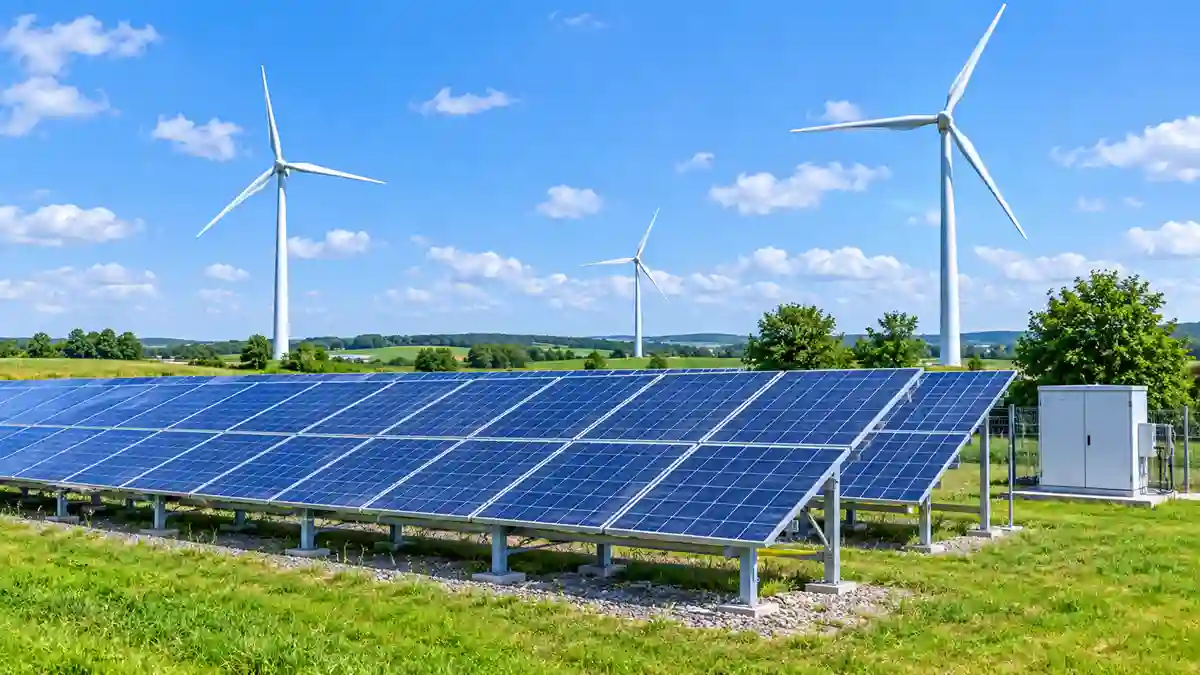
Compare solar and wind energy across cost, efficiency, output, maintenance and environmental impact. Discover their advantages, limitations and best applications.
Solar and wind energy are two of the most widely used renewable electricity sources. Both reduce dependence on fossil fuels, produce electricity without burning fuel during operation and can support residential, commercial and utility-scale power systems. However, they depend on different natural resources and have different installation requirements, operating characteristics and costs.
Solar energy uses photovoltaic (PV) panels to convert sunlight directly into electricity. Wind energy uses rotating turbine blades to capture the kinetic energy of moving air and drive an electrical generator.
Neither technology is automatically better in every situation. Solar can be practical where sunlight is strong and suitable installation space is available. Wind can be attractive at locations with consistent, sufficiently strong wind and enough space for a properly installed turbine.
This guide compares solar and wind energy across seven important factors, including electricity generation, installation, costs, maintenance, reliability, environmental impact and practical applications.
1. How Solar and Wind Energy Work
How solar energy works
Solar photovoltaic panels contain semiconductor cells that convert sunlight into direct current (DC) electricity. An inverter converts this DC electricity into alternating current (AC) for normal electrical loads or grid connection.
A solar installation generally includes:
- Solar photovoltaic modules
- Mounting structures
- DC cables and connectors
- DC isolators and protective devices
- Solar inverter
- AC protection and distribution equipment
- Optional battery storage
Solar production depends on solar irradiance, panel orientation, tilt, temperature, shading, equipment efficiency and operating conditions.
For a detailed explanation, read our guide to how a solar panel works.
How wind energy works
A wind turbine converts the kinetic energy of moving air into mechanical rotation. Its rotor blades turn a shaft connected to a generator, either directly or through a gearbox, depending on the turbine design.
The electrical output is processed through suitable power electronics and control equipment before supplying loads, charging batteries or connecting to the utility grid.
A small wind installation may include:
- Wind turbine and rotor blades
- Tower and foundation
- Generator
- Rectifier, where required
- Wind turbine controller
- Braking or diversion-load equipment, where required
- Battery storage, if used
- Inverter and electrical protection
Wind turbine output depends heavily on wind speed, air density, rotor size, turbine power curve, tower height and surrounding obstacles.
The US Department of Energy explains the basic operating principle in its Wind Energy Basics guide.
2. Solar and Wind Energy: 7 Key Differences
The following table summarizes the main differences between the two technologies.
| Comparison Factor | Solar Energy | Wind Energy |
|---|---|---|
| Primary resource | Sunlight | Moving air |
| Main equipment | PV modules and inverter | Wind turbine, generator and power electronics |
| Generation pattern | Mainly during daylight | Whenever sufficient wind is available |
| Site requirements | Suitable sunlight and installation area | Consistent wind resource and suitable turbine location |
| Moving components | No moving parts in PV modules | Rotating mechanical components |
| Maintenance | Generally lower mechanical maintenance | Requires mechanical and electrical inspection |
| Main output factors | Solar irradiance, shading, temperature and orientation | Wind speed, air density, rotor design and tower height |
| Typical installation | Rooftops, carports and ground-mounted arrays | Open land, suitable towers and selected coastal or rural locations |
| Storage requirement | Optional, depending on energy needs | Optional, depending on energy needs |
| Main limitation | No direct generation at night | Output varies with wind conditions |
The table describes general characteristics. Actual performance depends on equipment selection, location, installation quality and operating conditions.
3. Electricity Generation and Efficiency
Solar panels and wind turbines use different methods to convert natural energy into electricity. Their performance should therefore be compared using suitable measurements rather than assuming that one technology is always more efficient.
Solar energy generation
Solar panels produce electricity when sunlight reaches their cells. Their output changes throughout the day and across seasons.
Important factors include:
- Solar irradiance at the installation location
- Panel orientation and tilt
- Shading from buildings, trees or nearby structures
- Module temperature
- Dust and surface contamination
- Inverter and cable losses
A solar system may have a high output around midday but produce little or no electricity after sunset.
Wind energy generation
Wind turbines can generate electricity during the day or night, provided wind speed is within the turbine’s operating range.
Wind output is particularly sensitive to wind speed. A small change in wind speed can cause a significant change in available wind power because the theoretical power in the wind varies with the cube of wind speed.
The actual electrical output also depends on the turbine’s power curve, control system and mechanical and electrical losses.
A wind turbine installed in a poor location may produce much less energy than its rated capacity suggests.
Understanding capacity factor
Capacity factor is a useful way to compare the actual energy produced over a period with the energy that would have been generated if the equipment operated continuously at its rated output.
The calculation is:
Capacity factor (%) = Actual energy generated ÷ Maximum possible energy × 100
For annual energy estimation:
Annual energy (kWh) = Rated capacity (kW) × 8,760 hours × Capacity factor
The US Department of Energy’s National Laboratory of the Rockies (formerly NREL) provides a useful starting point for understanding this metric. Its Levelized Cost of Energy Calculator gives typical capacity-factor ranges for well-sited wind and PV systems. These are broad reference values, not guaranteed performance figures for a particular installation.
Illustrative generation example
Consider two separate renewable energy installations, each rated at 5 kW.
Solar PV system
Assumed capacity factor: 18%
Annual energy:
5 kW × 8,760 × 0.18 = 7,884 kWh/year
Wind turbine system
Assumed capacity factor: 30%
Annual energy:
5 kW × 8,760 × 0.30 = 13,140 kWh/year
In this simplified example, the wind installation produces more annual electricity.
However, the result does not mean that wind turbines always generate more energy than solar panels. The two capacity factors are illustrative assumptions. Actual solar and wind performance depends on the specific site, equipment and measurement period.
A meaningful project comparison requires solar resource data and a wind assessment at the proposed installation location.
4. Installation Cost and Long-Term Economics
The cost of solar and wind energy depends on more than the price of the generating equipment.
A complete project budget should include installation, electrical protection, structural work, power conversion, commissioning and ongoing maintenance.
Solar installation costs
A solar PV installation generally requires:
- PV modules
- Mounting structures
- Inverter
- DC and AC cables
- Protection and isolation equipment
- Installation labour
- Optional batteries and backup equipment
Rooftop solar may benefit from existing building space, although roof condition, structural capacity and access can affect installation costs.
Ground-mounted systems may require additional land preparation, foundations, mounting structures and cable routes.
Wind installation costs
A wind energy project may require:
- Wind turbine and generator
- Tower
- Foundation and civil works
- Lifting and installation equipment
- Wind controller and power electronics
- Electrical protection
- Optional batteries and inverter
- Maintenance access and safety arrangements
For small wind projects, the tower and foundation can represent a significant part of the overall installation cost. A suitable wind resource assessment is also important before purchasing equipment.
Which technology is cheaper?
There is no universal answer.
Solar PV is often attractive for residential and commercial buildings because it can use existing rooftops and has relatively straightforward installation requirements.
Wind can be economically attractive at sites with strong and consistent wind resources, particularly where the project can benefit from larger turbine installations and suitable infrastructure.
For a broader cost comparison, the International Renewable Energy Agency’s report, Renewable Power Generation Costs in 2024, provides global information on installed costs and levelized costs of electricity.
When comparing quotations, consider the following:
| Cost Factor | Solar PV | Wind Turbine |
|---|---|---|
| Generating equipment | PV modules | Turbine and generator |
| Supporting structure | Roof or ground mounting | Tower and foundation |
| Power conversion | Solar inverter | Suitable wind power electronics and inverter |
| Site assessment | Solar and shading assessment | Wind resource assessment |
| Mechanical maintenance | Generally limited | More significant |
| Battery storage | Optional | Optional |
| Land or roof requirements | Roof or ground area | Suitable turbine location and clearances |
Understand levelized cost of electricity
Levelized cost of electricity (LCOE) estimates the average cost of electricity produced over a system’s operating life.
It considers factors such as:
- Initial installation cost
- Annual electricity production
- Operations and maintenance
- Equipment life
- Financing and discount assumptions
- Replacement costs, where included
A lower equipment purchase price does not necessarily mean a lower lifetime electricity cost.
For an engineering comparison, evaluate the total installed cost and expected lifetime energy production rather than comparing only the price per kilowatt of equipment.
5. Reliability, Availability and Battery Storage
Solar and wind energy have different generation patterns. Understanding these patterns is important when designing a system for a home, commercial building or industrial facility.
Solar availability
Solar PV generates electricity during daylight hours. Production varies with weather, seasons, shading and panel orientation.
A battery can store surplus daytime electricity for use after sunset or during periods of low solar production.
Learn more about home battery backup systems and solar battery installation.
Wind availability
Wind turbines can generate electricity at different times of the day, including overnight. However, this does not guarantee continuous generation.
Wind turbines have operating limits. They generally begin generating above a minimum cut-in wind speed, increase output as wind speed rises, and may shut down at a high cut-out wind speed to protect the equipment.
A battery system can help manage variations in wind generation, but the required storage capacity depends on the load, expected generation and desired backup duration.
Does combining solar and wind improve reliability?
Combining solar and wind can improve energy availability when the two resources produce electricity at different times.
For example, a location may experience strong sunlight during the day and useful wind conditions during the evening or at night.
However, the resources do not always complement each other. Some locations experience low solar and wind availability at the same time.
A hybrid system should therefore be designed using local solar and wind data, load profiles and an appropriate energy-storage strategy.
For a detailed explanation of system integration, read Solar Power and Wind Power: How to Combine Both Sources.
6. Environmental Impact and Land Requirements
Solar and wind energy produce electricity without direct fuel combustion during normal operation. Both can reduce operational greenhouse gas emissions when they replace electricity generated from fossil fuels.
However, neither technology is completely free of environmental impacts.
Environmental impact of solar energy
Solar PV systems require materials for modules, mounting structures, inverters, cables and batteries where storage is included.
Environmental considerations include:
- Raw-material extraction and manufacturing
- Land use for large ground-mounted projects
- End-of-life module collection and recycling
- Battery manufacturing and disposal, where batteries are used
- Construction and transportation impacts
Rooftop installations can make use of existing building surfaces and avoid some additional land-use requirements.
Environmental impact of wind energy
Wind turbines also require materials, manufacturing, transportation and construction.
Potential environmental considerations include:
- Land use and access roads
- Effects on birds and bats
- Noise and visual impact
- Foundation and construction work
- Blade and equipment disposal
- Maintenance and replacement of components
Appropriate project planning, turbine placement and environmental assessment can help reduce these impacts.
Which has a lower environmental impact?
The answer depends on the project location, technology, manufacturing supply chain, operating life, energy production and end-of-life management.
It is not technically accurate to declare one technology universally cleaner than the other without defining the environmental measurement being compared.
7. Best Applications: Where Solar and Wind Make Sense
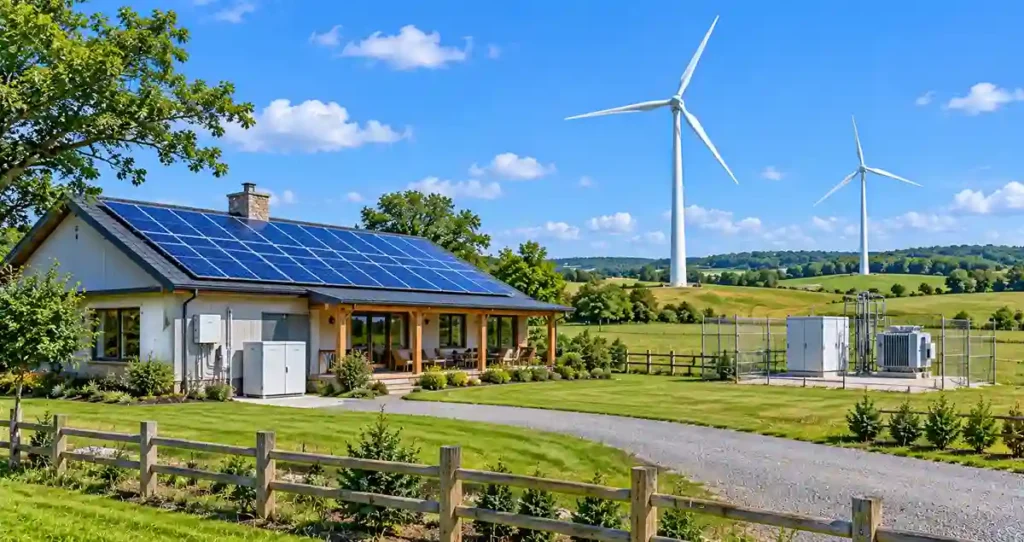
The most suitable technology depends on the available natural resource, project size, electricity demand and installation conditions.
| Application | Solar Energy | Wind Energy |
|---|---|---|
| Residential rooftops | Highly suitable where roof conditions and sunlight are adequate | Usually limited by wind resource, tower requirements and local restrictions |
| Commercial buildings | Suitable for rooftops, parking structures and ground-mounted systems | Suitable where the site has adequate wind and space |
| Remote properties | Useful for daytime generation and battery charging | Useful where reliable wind resources are available |
| Farms and agricultural sites | Can supply pumps, buildings and other daytime loads | Can be useful on suitable open sites |
| Coastal locations | Depends on solar resource and site conditions | May be attractive where wind measurements support a project |
| Large utility-scale projects | Suitable for large solar farms | Suitable for wind farms in resource-rich locations |
| Night-time generation | Requires stored energy or another source | Possible when sufficient wind is available |
When solar energy is the better choice
Solar PV may be the more practical option when:
- The site receives good sunlight.
- A suitable rooftop or ground area is available.
- The project requires relatively simple installation.
- Mechanical maintenance should be minimized.
- Daytime electricity demand is significant.
- Local wind conditions are unsuitable for a turbine.
When wind energy is the better choice
Wind may be more suitable when:
- The site has a strong and consistent wind resource.
- There is enough space for a properly engineered tower.
- Wind generation can complement the site’s electricity demand.
- The project can support tower, foundation and maintenance requirements.
- Solar generation alone does not meet the project’s energy requirements.
When both technologies make sense
A solar and wind hybrid system may be worth evaluating when both resources are available and their generation patterns complement each other.
This can be useful for remote properties, agricultural facilities, isolated telecommunications sites and selected commercial or industrial applications.
However, adding a second generation source increases equipment, control and maintenance requirements. A hybrid system should be justified by its expected energy contribution and overall project economics.
Advantages and Disadvantages of Solar and Wind Energy
Solar energy advantages
- Can be installed on many existing rooftops.
- Has no rotating mechanical components in PV modules.
- Offers modular system sizing.
- Can be expanded in stages, subject to inverter and system limits.
- Can be combined with battery storage.
- Requires relatively limited routine mechanical maintenance.
Solar energy disadvantages
- Direct PV generation stops after sunset.
- Output changes with weather and seasonal conditions.
- Shading can reduce production.
- High module temperatures can reduce electrical output.
- Large installations may require considerable land.
- Batteries add cost when energy is required outside generation hours.
Wind energy advantages
- Can generate electricity during the day or night.
- Can complement solar generation at suitable sites.
- Can provide significant annual energy where wind resources are strong.
- Can be deployed at utility scale or in selected distributed applications.
- Does not require direct sunlight to generate electricity.
Wind energy disadvantages
- Requires a suitable wind resource.
- Output changes with wind speed.
- Towers and foundations increase installation complexity.
- Moving components require inspection and maintenance.
- Turbines can create noise and visual concerns.
- Nearby buildings, trees and terrain can affect wind flow.
Standards and Engineering Considerations
Solar and wind installations must be designed according to their equipment, electrical configuration and local regulations.
The following standards are useful starting points:
| Standard | Main Application | Official Reference |
|---|---|---|
| IEC 61215 | Design qualification and type approval of terrestrial PV modules | IEC Catalogue |
| IEC 61730 | Safety qualification of photovoltaic modules | IEC Catalogue |
| IEC 61400-2 | Safety and design requirements for small wind turbines | IEC 61400-2 |
| IEC 62109 | Safety of power converters used in photovoltaic systems | IEC Catalogue |
| NFPA 70 (NEC) | Electrical installation requirements, including relevant PV, wind and energy-storage provisions in the United States | NFPA 70 |
| IEEE 1547 | Interconnection and interoperability of distributed energy resources | IEEE 1547-2018 |
| UL 1741 | Safety and certification of inverters, converters, controllers and interconnection equipment | UL Standards Catalogue |
These references are not interchangeable or universally mandatory. Confirm the current edition, national adoption, equipment scope and local authority requirements before specifying or installing a system.
Engineer’s Note
From an electrical engineering perspective, solar and wind energy should be compared using expected energy production, site conditions and total system cost rather than rated capacity alone.
A 5 kW solar system and a 5 kW wind turbine do not necessarily produce the same annual electricity. Their output depends on different environmental conditions and equipment characteristics.
For a reliable comparison, evaluate the solar resource, measured wind conditions, hourly load profile, inverter compatibility, protection requirements and expected maintenance costs.
The best technology is the one that delivers the required energy safely and economically at the actual installation site.
Engineer’s Field Notes
Before selecting solar, wind or a combination of both, consider these practical checks:
- Assess the energy demand: Review daily consumption, peak load and operating hours.
- Check the solar resource: Evaluate sunlight availability, shading, roof orientation and usable installation area.
- Measure the wind resource: Use suitable wind data at the proposed turbine hub height. Ground-level observations alone may not represent turbine conditions.
- Review the installation site: Check structural capacity, tower clearances, access and local restrictions.
- Calculate expected generation: Use realistic performance assumptions rather than rated power alone.
- Evaluate storage requirements: Size batteries according to energy demand, backup duration and system operating strategy.
- Check electrical compatibility: Confirm inverter, controller, generator and battery voltage and operating limits.
- Review lifetime economics: Include installation, maintenance, replacements and expected energy production.
For small wind systems, the US Department of Energy’s Small Wind Guidebook is a useful resource for site assessment and project planning.
Frequently Asked Questions
Which is better, solar energy or wind energy?
Neither is universally better. Solar is often practical for rooftops and locations with good sunlight. Wind can be suitable where consistent wind resources and adequate installation space are available.
Is solar energy cheaper than wind energy?
Solar PV is often less complex to install for residential and commercial rooftops. Wind project costs depend heavily on turbine size, tower, foundation and site conditions. Compare total installed cost and lifetime energy production.
Can wind turbines generate electricity at night?
Yes. Wind turbines can generate electricity at night if wind speed is within their operating range. Their output is not guaranteed because wind conditions change.
Do solar panels work on cloudy days?
Yes. Solar panels can generate electricity under cloudy conditions, but their output is generally lower than under strong direct sunlight.
Which technology produces more electricity?
It depends on the installed capacity, resource availability, equipment and site conditions. Annual energy production should be estimated using realistic solar or wind data.
Does wind energy require battery storage?
No. Grid-connected wind systems can export electricity or supply loads without batteries, subject to their electrical configuration and grid requirements. Batteries are useful when storage or off-grid operation is required.
Can solar panels and wind turbines work together?
Yes. A properly designed hybrid system can use solar panels and wind turbines as complementary generation sources. It requires compatible controllers, electrical protection and suitable power conversion equipment.
Which renewable energy source requires less maintenance?
Solar PV generally requires less mechanical maintenance because the panels have no rotating components. Wind turbines have moving mechanical parts that require periodic inspection and maintenance.
Is wind energy suitable for residential properties?
It can be suitable where wind conditions, tower height, space, structural requirements and local regulations support installation. A rooftop turbine should not be assumed to produce useful energy without a proper site assessment.
Is combining solar and wind better than using solar alone?
It can improve energy availability when the two resources complement each other. However, the additional equipment and maintenance must be justified by the expected energy contribution and project economics.
Final Thoughts
Solar and wind energy are both important renewable electricity technologies, but they serve different site conditions and energy requirements.
Solar PV is often a practical choice for residential and commercial buildings because it can use rooftops, has modular installation options and requires relatively limited mechanical maintenance.
Wind energy can provide valuable electricity at locations with suitable wind resources, particularly where generation outside daylight hours is useful.
For some projects, combining both technologies can improve energy availability. The decision should be based on resource assessment, electricity demand, installation requirements, expected annual generation and lifetime cost.
A technically sound renewable energy project begins with the site and the load, not simply the equipment rating.
Related guides
- Solar and Wind Hybrid System: Design, Sizing, Cost, and Working
- Wind Energy: How It Works, Benefits and Limitations
- Wind and Solar Hybrid Controller: Wiring, Inputs and Protection
- Home Wind Turbine: Cost, Output, Sizing and Is It Worth It?
- Wind Turbine Inverter: Grid-Tie, Off-Grid and Hybrid Options
- Home Wind Turbine Kits: What You Need and How to Choose
- Wind Turbine Parts Explained: Components and Their Functions
- Off-Grid Wind Turbine: Sizing, Batteries and System Design
- 7 Powerful Benefits of Solar Power and Wind Power
- Wind Turbine Blade: 7 Powerful Facts About Size and Design
- Wind Energy Advantages and Disadvantages: 12 Key Pros and Cons
- Wind Turbine Nacelle: Components, Function and How It Works
- Wind Turbine Height: How Tall Are Wind Turbines?
Related guides on SolarVisionAI.com
- Monocrystalline Solar Panels 2026: Still Worth It or Hype
- Polycrystalline Solar Panels: Worth Buying in 2026?
- Thin-film Solar Panels: When They Beat Silicon (2026)
- BIPV Solar Panels: Building-Integrated PV Complete Guide
- Portable Solar Panels: Engineer’s Buyer’s Guide 2026
- CPV Solar Panels: Concentrated Photovoltaic Explained
- Skin Solar Panel: What “Solar Skin” Actually Means
- Solar Fence Post Lights: Cap Sizes, Types & Install Guide
- Bifacial Solar Panels in 2026: How to Boost Energy Output
- Solar Charge Controller: The Complete Guide
- MC4 Connectors: Solar Safety & Installation Guide
- Solar Panel Types, Efficiency & Benefits
- Solar Water Pump Guide
- Commercial Solar Panel Installation: Engineering Guide
- Solar Fence Post Lights: Cap Sizes, Types & Install Guide
- BESS — Battery Energy Storage System Guide
- Commercial Solar Panel Installation
- Solar Refrigerator & DC Fridge — Complete 2026 Guide
- Bifacial Solar Panel Albedo Effect Guide
- TOPCon: Why TOPCon Solar Panel is a Proven Smart Investment in 2026
- HJT: Why TOPCon Solar Panel is a Proven Smart Investment in 2026
- PERC: PERC Solar Panel: Still Relevant or Already Outdated?
- Perovskite: Perovskite Solar Panels: The 2026 Reality Check
- N-Type vs P-Type: N-Type vs P-Type Solar Panels: Honest Comparison
- ABC: ABC (all back contact) Solar Panel: Back Contact Technology Explained
- IBC: IBC Solar Panels: Interdigitated Back Contact Guide
- Tandem: Tandem Solar Panels: Are Stacked Cells Ready for Rooftops?