
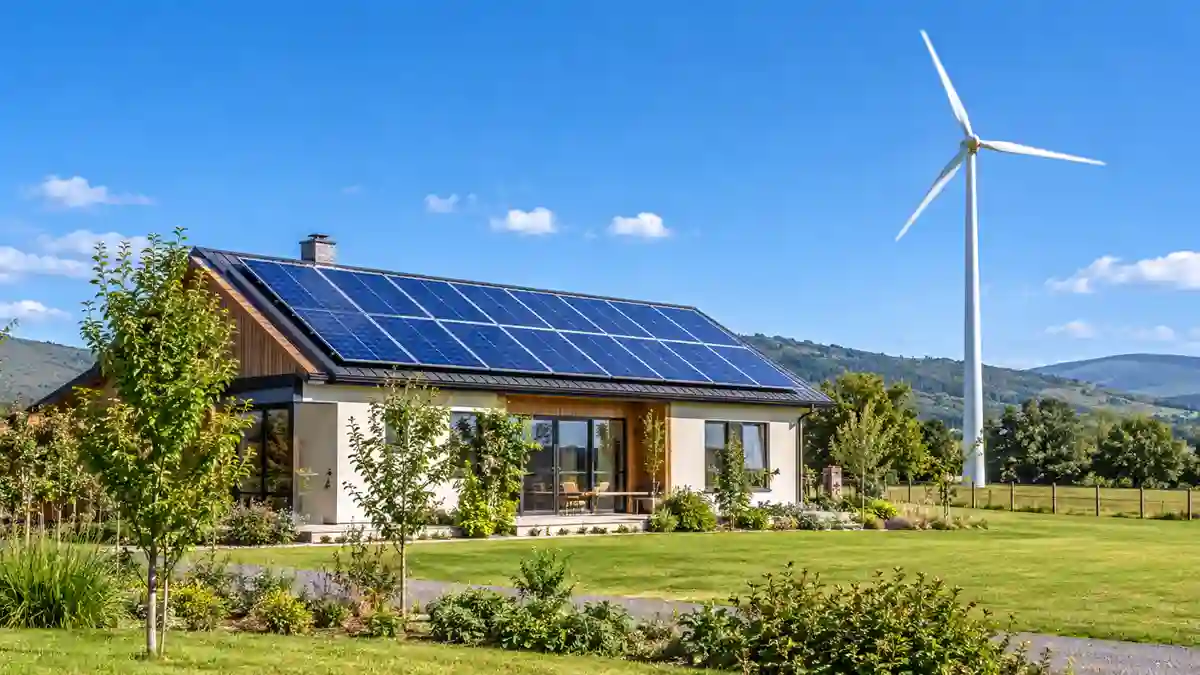
Learn how solar power and wind power work together, how to combine panels and turbines, and how controllers, batteries, and inverters support a hybrid system.
Solar power and wind power are two renewable energy sources that can work together to supply electricity to homes, farms, remote properties, and commercial facilities. Solar panels generate electricity from sunlight, while wind turbines convert moving air into electrical energy.
The main advantage of combining both sources is that their generation patterns can complement each other. Solar production generally occurs during daylight hours, while wind may be available during the day, at night, or during different seasons. In locations where useful wind is available when solar production is low, a combined system can improve energy availability.
However, installing solar panels and a wind turbine at the same property does not automatically create a reliable hybrid system. Both sources need suitable electrical controls, compatible equipment, correct protection, and a properly designed connection to the loads, battery storage, or utility grid.
In my engineering approach, I treat solar and wind as two separate generation sources that must work together through a coordinated electrical system. The first step is to understand the energy demand. The next is to evaluate the available sunlight and wind, select the appropriate equipment, and design how the electricity will be used or stored.
If you are unfamiliar with photovoltaic technology, our guide explains how a solar panel works. You can also read our wind turbine parts guide to understand the main components of a wind energy system.
This guide explains how solar power and wind power can be combined, what equipment is required, how energy flows through the system, and what should be considered before installation.
Solar Power and Wind Power: Design, Sizing, Cost and How It Works
1. How Solar Power and Wind Power Work Together
Solar panels and wind turbines generate electricity through different physical processes.
A solar photovoltaic (PV) module converts sunlight directly into DC electricity. When sunlight reaches its photovoltaic cells, electrical charges move through the semiconductor material and produce current.
A wind turbine uses the aerodynamic force of moving air to rotate its blades. The rotor drives a generator, either directly or through a mechanical transmission, to produce electrical power.
The two sources can supply a shared electrical system, but they do not necessarily produce the same type of electrical output or operate at the same voltage.
A typical hybrid arrangement includes:
- Solar PV modules
- Solar MPPT charge controller or compatible PV power-conversion equipment
- Wind turbine and dedicated wind controller
- Rectifier, where required by the turbine design
- Diversion load or braking equipment, where specified
- Battery bank, if energy storage is required
- Compatible inverter
- AC distribution and protection equipment
- Utility-grid connection or backup generator, where applicable
The solar controller manages the PV charging process. The wind controller manages the turbine according to its operating and protection requirements. Both charging systems must be compatible with the battery and coordinated to prevent charging conflicts.
The US Department of Energy explains the basic photovoltaic process in its guide to solar photovoltaic technology. Its wind energy basics guide explains how turbine blades capture wind energy and drive a generator.
The important point is that solar and wind can share a properly designed energy system, but they should not simply be connected together without the correct controllers and power-conversion equipment.
2. Why Combine Solar and Wind Energy?
The main reason to combine solar power and wind power is to diversify electricity generation.
A solar-only system depends on available sunlight. Its output changes with the time of day, cloud cover, panel orientation, temperature, shading and season.
A wind turbine depends on the local wind resource. Its production changes with wind speed, rotor design, tower height, turbulence and turbine operating limits.
Because these resources respond to different environmental conditions, a combined system may produce electricity across a wider range of weather conditions.
Solar generation during daylight
Solar PV is usually the main generation source during daylight hours. Its output increases as available solar irradiance increases, subject to module temperature, shading, orientation and system losses.
Solar panels are modular and can be expanded by adding compatible modules and supporting equipment, provided the inverter and electrical design allow it.
Wind generation during different hours
Wind can generate electricity during daylight or at night. A site with useful evening and overnight wind may receive additional generation when solar panels are not producing electricity.
However, wind is not guaranteed at night, and some locations have their strongest winds during daytime. The actual pattern must be established through local wind data or site measurements.
Better generation diversity
A hybrid system can reduce dependence on a single resource. This may improve electricity availability when solar and wind conditions complement one another.
The benefit depends on the relationship between local solar irradiance and wind speed over time. A site with weak or turbulent wind may gain little from installing a turbine, even if its solar resource is excellent.
For this reason, both resources should be assessed before deciding the system capacity.
3. Solar-Only vs Wind-Only vs Hybrid Systems
Each renewable energy arrangement has different strengths and limitations.
| Feature | Solar-only system | Wind-only system | Solar-wind hybrid |
|---|---|---|---|
| Energy source | Sunlight | Moving air | Sunlight and wind |
| Main generation period | Usually daylight | Depends on local wind | Depends on both resources |
| Main equipment | PV modules and inverter/controller | Turbine, tower and controller | Both generation systems and coordinated controls |
| Battery requirement | Depends on system purpose | Depends on system purpose | Depends on system purpose |
| Site requirement | Suitable solar exposure | Suitable wind conditions and tower location | Suitable conditions for both resources |
| Maintenance | Generally relatively low | Includes mechanical inspection and maintenance | Includes electrical and mechanical maintenance |
| Main limitation | No PV generation at night | Output varies with wind speed | More equipment and system complexity |
| Best application | Homes and properties with good solar exposure | Sites with a reliable wind resource | Sites where both resources provide useful generation |
Which system is better?
A solar-only system is often the simpler choice where sunlight is strong and the available wind resource is poor. A wind-only system can be suitable for properties with consistently useful wind conditions and appropriate space for a turbine.
A hybrid system is worth evaluating when solar and wind generation complement each other and the additional equipment cost is justified by improved energy availability.
There is no universal winner. The best option depends on the site’s renewable energy resources, electricity demand, installation cost and reliability requirements.
4. Main Components of a Solar and Wind Power System
A solar-wind hybrid system uses equipment from both technologies. The equipment must be selected as one coordinated electrical design.
Solar panels
Solar panels convert sunlight into DC electricity. The modules are connected in series and parallel to achieve the voltage and current required by the solar charge controller or inverter.
Panel selection should consider rated power, operating voltage, current, temperature coefficient, physical dimensions and available installation area.
Our guide to solar panel efficiency explains how module performance affects energy generation.
Wind turbine
The wind turbine converts wind energy into electrical power. Its output depends on wind speed and the turbine’s power curve.
For small installations, turbine selection should include rotor diameter, rated wind speed, cut-in speed, cut-out speed, tower requirements and electrical output characteristics.
See our guide to wind turbine parts and their functions for more information about the rotor, generator, nacelle, tower and electrical components.
Solar charge controller
A solar charge controller regulates electricity from the PV array when charging a battery bank.
MPPT controllers are commonly used because they can adjust the operating point of the PV array to extract available power under changing conditions.
Read our MPPT solar charge controller guide for a detailed explanation.
Wind charge controller
A wind turbine requires a controller designed for its particular generator and operating characteristics.
Depending on the turbine design, the controller may regulate charging, control braking or divert excess energy to a suitable diversion load.
A conventional solar MPPT controller should not be assumed suitable for wind generation. Follow the turbine and controller manufacturer’s instructions.
Battery storage
Batteries store surplus electricity for use when generation is lower than demand.
The battery capacity depends on daily consumption, required autonomy, allowable depth of discharge, charging limits and discharge power.
Lithium iron phosphate batteries are one option for stationary energy storage. Battery selection should consider the BMS, operating temperature, charging current and compatibility with the inverter and charging equipment.
Read our LiFePO4 battery guide and solar battery installation guide.
Hybrid inverter
The inverter supplies AC electricity to household or commercial loads from the DC battery system or other supported sources.
Some hybrid inverters accept solar PV directly, while others support battery charging from multiple sources through dedicated inputs or external equipment.
Do not assume that a standard solar hybrid inverter accepts a wind turbine directly. The wind system may need a separate controller and an approved interface with the battery or inverter.
Our hybrid inverter guide explains the main inverter configurations.
5. How to Connect Solar Panels and a Wind Turbine
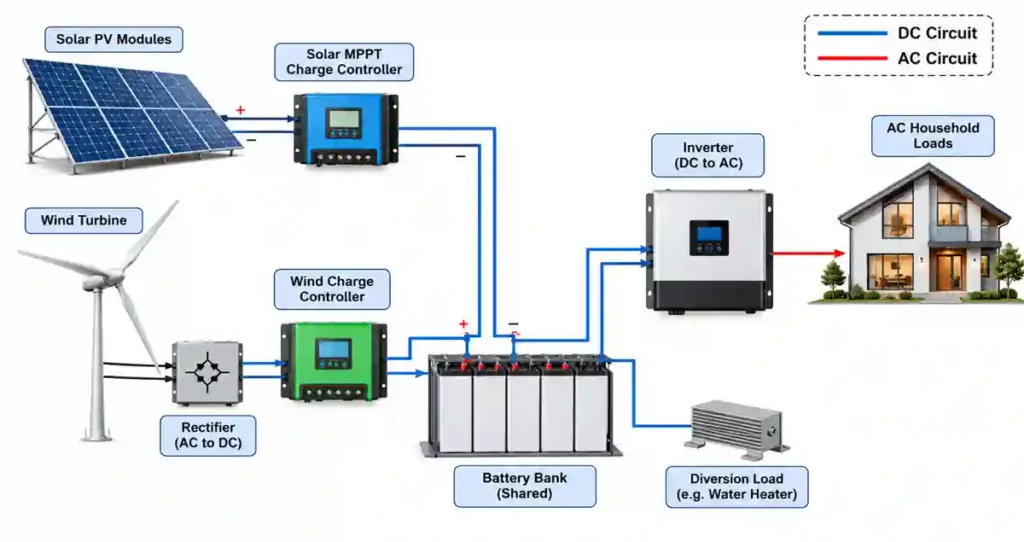
The electrical architecture depends on whether the system is battery-based, grid-connected or designed for both.
For a common battery-based arrangement, the two generation sources use separate control equipment and supply a shared battery bank.
The general energy flow is:
Solar PV array → Solar MPPT controller → Battery bank
Wind turbine → Rectifier, where required → Wind controller → Battery bank
Battery bank → Inverter → AC distribution board → Electrical loads
The wind controller may also connect to a diversion load or braking arrangement, as required by the turbine manufacturer.
The solar and wind controllers must support the same battery voltage and compatible charging settings. Their charge-control behaviour must be coordinated with the battery’s BMS and manufacturer’s operating limits.
Why separate controllers are important
Solar panels and wind turbines do not operate in the same way.
A solar array generally operates within a defined voltage and current range. An MPPT controller adjusts the PV operating point to extract available solar power.
A wind turbine is a rotating generator. Its operating characteristics change with wind speed and rotor speed. Some turbines require a specific electrical loading or braking arrangement to control their operation safely.
Using a solar-only controller for a wind turbine without explicit manufacturer approval can result in poor operation or unsafe conditions.
For more detailed wiring and protection considerations, read our guide to the wind and solar hybrid controller.
6. Grid-Connected vs Off-Grid Solar and Wind Systems
Solar and wind generation can be integrated into different electrical arrangements.
Grid-connected hybrid system
A grid-connected system operates alongside the utility supply. Renewable generation can serve local loads, and surplus electricity may be exported where the utility rules and approved interconnection equipment permit it.
The system needs appropriate grid-interconnection protection, synchronization and anti-islanding functionality.
A battery is optional in some grid-connected configurations. Its requirement depends on whether backup power or energy shifting is needed.
Off-grid hybrid system
An off-grid system operates independently of the utility grid.
Solar panels and wind turbines charge the battery bank through their respective controllers. The inverter supplies AC electricity to the home or facility.
Battery storage is particularly important because renewable generation is variable. The system must be sized to support the loads during periods of insufficient generation.
A backup generator may also be included for extended periods of low solar and wind production.
For more details, see our guides to the off-grid solar system and off-grid wind turbine sizing.
7. Example: How Solar Power and Wind Power Can Work Together
Consider a small property that consumes approximately 5 kWh of electricity per day.
Assume the system includes:
- Solar PV capacity: 2 kW
- Small wind turbine: 1 kW rated
- Battery storage: 10 kWh nominal
- Hybrid inverter: selected according to the actual maximum load
For illustration, assume the solar array produces an average of 6 kWh per day after the relevant system losses.
Assume the wind turbine contributes an average of 2 kWh per day based on a site-specific production estimate.
The combined daily generation is:
Solar generation = 6 kWh
Wind generation = 2 kWh
Total generation = 6 + 2
Total = 8 kWh per day
If the property consumes 5 kWh per day:
Daily surplus = 8 − 5
Daily surplus = 3 kWh
This surplus may be stored in the battery, subject to its charging limits and available capacity, or exported to the grid where the system and local regulations permit.
These figures are illustrative assumptions, not guaranteed production from a 2 kW solar array or 1 kW wind turbine.
Actual solar production depends on location, sunlight, module temperature, orientation and shading. Actual wind production depends on the wind-speed distribution at the turbine’s hub height and its power curve.
The example also represents daily energy balance only. It does not prove that the system can meet the load at every moment. A proper design must examine hourly generation and demand, battery state of charge, inverter power and periods of low renewable generation.
8. How to Size a Solar and Wind Hybrid System
A hybrid system should be sized from the electrical demand and available renewable resources rather than selecting equipment based only on advertised ratings.
Step 1: Calculate daily energy consumption
List the appliances and equipment, their rated power and operating hours.
Daily energy (Wh) = Power (W) × Operating hours
Add the energy consumption of all loads and convert the result into kWh.
For example:
5,000 Wh ÷ 1,000 = 5 kWh per day.
Step 2: Assess the solar resource
Estimate solar energy production using local solar irradiance, system orientation, shading, module temperature and expected system losses.
Do not use a generic peak-sun-hours figure without checking whether it represents the actual location and design period.
Step 3: Assess the wind resource
Check the site’s wind-speed distribution and the turbine’s power curve.
Evaluate tower height, surrounding obstacles, turbulence and seasonal wind patterns.
A turbine’s rated kilowatt capacity is not its guaranteed continuous output.
Step 4: Decide the contribution from each source
Determine how much energy solar and wind are expected to provide.
The contribution should be based on realistic production estimates across different seasons, not simply on the rated capacity of each generator.
Step 5: Size the battery
For a battery-based system, calculate the required storage using daily load, autonomy, usable depth of discharge and battery efficiency.
Nominal battery capacity (kWh) = Daily load (kWh) × Autonomy days ÷ (Usable depth of discharge × Battery efficiency)
Then verify that the battery can also deliver the required continuous and peak power.
Step 6: Select the inverter
The inverter must support the maximum simultaneous load and appliance starting requirements.
Check continuous output, surge rating, DC input voltage, battery compatibility, operating temperature and protection.
Step 7: Design the electrical protection
Provide suitable circuit protection, disconnects, grounding, surge protection, cable sizing and turbine braking or diversion arrangements.
The final design should follow applicable electrical codes, product instructions and local requirements.
9. Advantages of Combining Solar Power and Wind Power
A properly designed hybrid system can offer several benefits.
More than one energy source: The property does not depend entirely on solar or wind generation.
Potentially better energy availability: Wind may generate electricity when solar output is low, depending on local weather patterns.
Reduced dependence on one resource: A combined system can diversify generation and reduce the effect of poor conditions affecting one source.
Flexible system design: Solar and wind capacity can be selected according to available space, wind conditions and load requirements.
Useful for remote properties: Where grid access is unavailable or unreliable, a properly sized hybrid arrangement can provide a renewable electricity supply.
Battery charging from two sources: Both sources can contribute to battery charging when their respective controllers and charging limits are correctly coordinated.
10. Disadvantages and Limitations
Combining two generation technologies also increases system complexity.
Higher initial cost: The installation requires additional equipment, including the turbine, tower, controller and associated protection.
Mechanical maintenance: Wind turbines have moving components that require inspection and maintenance.
Site restrictions: Wind turbines need appropriate tower locations, structural support, access and compliance with local requirements.
Variable generation: Neither sunlight nor wind is continuously available. Battery storage or backup generation may be necessary.
Electrical compatibility: Controllers, batteries and inverters must operate within compatible voltage and charging limits.
Noise and visual considerations: Some turbines may create noise or visual concerns, particularly near residential properties.
Not suitable for every location: If the site has insufficient wind, adding a turbine may increase cost without providing meaningful additional energy.
11. Is a Solar and Wind Hybrid System Better Than Solar Alone?
Not necessarily.
Solar-only systems are often more practical where the solar resource is strong and wind conditions are poor. They usually have fewer mechanical components and simpler maintenance requirements.
A solar-wind hybrid system may be beneficial where the wind resource is sufficiently strong and provides useful generation during periods when solar production is limited.
For example, a remote property with good daytime solar exposure and useful overnight wind may benefit from both sources. However, if wind speed is low or turbulent, the turbine may contribute very little energy.
Before investing in a wind turbine, compare the expected annual energy production with the additional installed cost and maintenance requirements.
The important question is not whether two energy sources are better than one in theory. It is whether the second source provides enough useful electricity at that particular site to justify its cost.
12. Where Solar and Wind Hybrid Systems Are Used
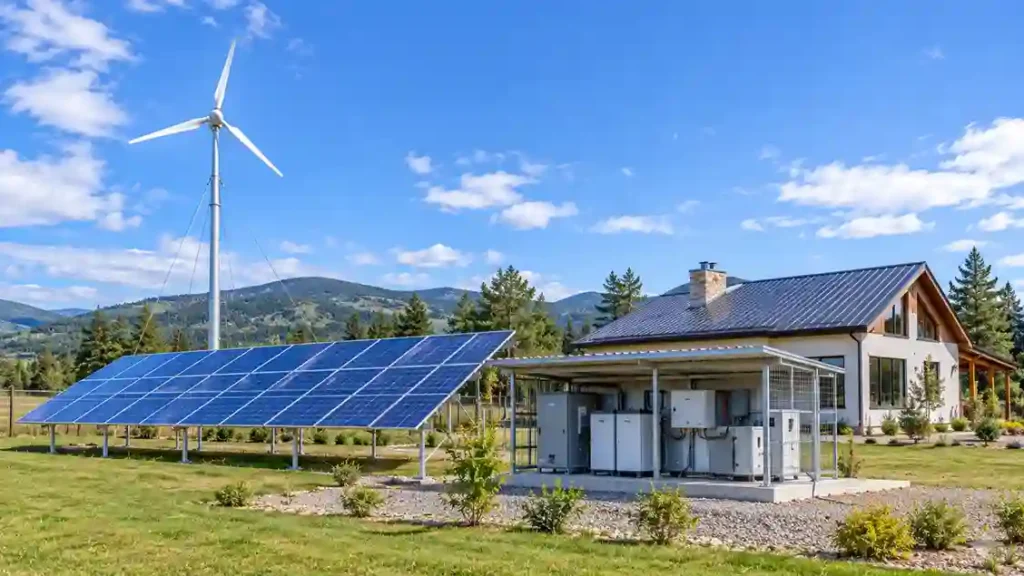
Solar and wind systems can be considered for different types of installations.
Remote homes: Properties without grid access may combine solar panels and wind turbines to improve electricity availability.
Agricultural facilities: Farms may use hybrid renewable systems for lighting, water pumping, monitoring equipment and other electrical loads.
Telecommunication sites: Remote communication installations may use solar and wind generation with battery storage, subject to equipment and reliability requirements.
Remote monitoring stations: Environmental monitoring and other low-power installations can use a combination of renewable generation and battery storage.
Small commercial facilities: Where suitable site conditions exist, a hybrid system may help reduce grid consumption or support remote operations.
Every application requires a load assessment and site-specific generation study.
13. Maintenance of Solar and Wind Equipment
Solar panels and wind turbines require different maintenance approaches.
Solar maintenance generally focuses on module cleanliness, mounting structures, electrical connections, cable condition, inverter operation and performance monitoring.
Wind turbine maintenance also includes inspection of blades, rotor assembly, bearings, generator, mechanical connections, tower, foundation and braking or diversion equipment.
Battery systems require monitoring of operating temperature, state of charge, alarms and manufacturer-specified maintenance requirements.
A practical maintenance schedule should follow the equipment manufacturer’s instructions and the environmental conditions at the site.
Monitoring both generation sources separately is useful. It allows the operator to identify whether reduced system production is related to the solar array, wind turbine, controller, battery or inverter.
14. Engineering Standards and Electrical Codes
| Standard | Scope / Application | Official Link |
|---|---|---|
| IEC 61215 – Terrestrial Photovoltaic Modules | Design qualification and type approval of terrestrial PV modules, including performance testing under specified conditions. | IEC Official Catalogue |
| IEC 61730 – Photovoltaic Module Safety Qualification | PV module safety requirements, including construction and testing. | IEC Official Catalogue |
| IEC 61400-2 – Small Wind Turbines | Safety and design requirements for small wind turbines, including structural, mechanical and electrical subsystems. | IEC 61400-2 |
| IEC 62109 – Safety of Power Converters for PV Systems | Safety requirements for power converters used in photovoltaic systems. | IEC Official Catalogue |
| NFPA 70 – National Electrical Code (NEC) | US electrical installation requirements relevant to PV, small wind systems, energy storage and grid interconnection. | NFPA 70 Official Page |
| IEEE 1547 – Interconnection of Distributed Energy Resources | Interconnection and interoperability requirements for distributed energy resources connected to electric power systems. | IEEE 1547-2018 |
| UL 1741 – Inverters, Converters, Controllers and Interconnection Equipment | Safety and certification requirements for power-conversion and interconnection equipment used in distributed energy systems. | UL Standards Catalogue |
Engineering note: These standards are not interchangeable or universally mandatory. Confirm the current edition, national adoption, equipment scope and local authority requirements before specifying or installing a system.
15. Can AI Improve Solar and Wind Energy Management?
AI-based monitoring and energy-management tools can help analyze generation from solar panels and wind turbines.
A monitoring platform may collect information about PV production, turbine output, battery state of charge, electricity demand and inverter performance.
With sufficient historical data, analytical systems can help identify generation patterns, forecast energy availability and highlight unusual equipment behaviour.
For example, a system may identify that solar production is consistently lower than expected or that wind turbine output has changed compared with previous operating conditions.
However, AI monitoring does not replace correctly selected controllers, protective devices, turbine braking arrangements or qualified maintenance.
The foundation of an effective energy-management system is accurate measurement and reliable equipment communication.
16. Engineer’s Note
When evaluating a solar and wind hybrid installation, I do not begin by adding the rated power of the solar panels and wind turbine.
Instead, I examine the energy requirement of the property and assess how much electricity each source can realistically produce under local conditions.
The solar array and wind turbine should be evaluated separately before their contributions are combined in the overall system design.
I also pay attention to the charging architecture. A solar controller and wind controller may supply the same battery bank, but their operating limits, charging profiles and protection requirements must be compatible.
A technically sound hybrid system is not simply two generators connected together. It is a coordinated electrical installation designed around generation, storage, loads and safety.
17. Engineer’s Field Notes
Before finalizing a solar and wind hybrid system, document the following:
- Daily and seasonal electricity consumption.
- Maximum simultaneous load and motor-starting requirements.
- Solar resource and available PV installation area.
- Wind-speed data at the proposed turbine location.
- Turbine power curve and expected annual energy production.
- Tower height, structural requirements and surrounding obstacles.
- Solar controller and wind controller specifications.
- Battery chemistry, nominal voltage and charging limits.
- Inverter continuous output and surge capability.
- DC and AC cable sizing and voltage-drop calculations.
- Overcurrent protection, disconnects and surge protection.
- Turbine braking or diversion-load requirements.
- Grounding, bonding and lightning protection.
- Utility interconnection requirements, where applicable.
- Local building, electrical and fire safety approvals.
Record the design assumptions and expected performance. This makes it easier to compare actual energy production against the original engineering estimate after commissioning.
Frequently Asked Questions
1. Can solar power and wind power be used together?
Yes. Solar panels and wind turbines can supply a common electrical system when their respective controllers and power-conversion equipment are correctly designed and compatible.
2. What is a solar and wind hybrid system?
It is a renewable energy system that combines photovoltaic solar generation with wind turbine generation. Depending on the design, it can supply loads directly, charge batteries or connect to an approved utility-grid arrangement.
3. Can a wind turbine charge the same battery as solar panels?
Yes. Both sources can charge a shared battery bank through compatible controllers. Their charging limits, voltage settings and battery management requirements must be coordinated.
4. Do solar and wind systems need separate charge controllers?
In a typical battery-based design, solar PV and wind turbines use separate controllers because their generation characteristics and control requirements are different. Integrated equipment can be used only where the manufacturer specifically supports the arrangement.
5. Does a wind turbine generate electricity at night?
Yes, a wind turbine can generate electricity at night if there is sufficient wind. Its output depends on actual wind conditions, not the time of day.
6. Is solar and wind energy more reliable than solar alone?
It can improve energy availability where wind generation complements solar production. However, the improvement depends on local weather patterns, turbine performance, battery storage and system design.
7. Can I connect a wind turbine directly to a solar inverter?
Not unless the inverter manufacturer explicitly supports the turbine connection and required interface. A standard PV input should not be assumed suitable for wind generation.
8. Is battery storage necessary in a solar and wind hybrid system?
Not in every configuration. Battery storage is commonly used in off-grid and backup systems. Grid-connected arrangements may operate without batteries where their design and utility rules allow it.
9. Which is cheaper, solar or wind power?
The answer depends on installation location, equipment, available resources, tower and foundation costs, maintenance and energy production. Solar is often simpler for residential installations, while small wind can be attractive at sites with a strong and suitable wind resource.
10. Can solar and wind power run a complete house?
Yes, a properly sized system can supply a home’s electricity demand. The design must account for daily energy use, peak loads, seasonal generation, storage and backup requirements.
Final Thoughts
Solar power and wind power can work together to provide a more diverse renewable electricity supply. Solar panels produce electricity from sunlight, while wind turbines can contribute additional energy whenever suitable wind is available.
However, a successful hybrid installation requires more than selecting two generation sources. The solar resource, wind conditions, household demand, controllers, battery storage, inverter and electrical protection must all be evaluated together.
For properties with useful solar and wind resources, combining both technologies can improve energy availability and reduce dependence on a single generation source.
The best system is not necessarily the one with the largest combined rated capacity. It is the one that produces useful electricity when the property needs it, operates safely and makes economic sense over its service life.
Related guides
- Solar and Wind Hybrid System: Design, Sizing, Cost, and Working
- Wind and Solar Hybrid Controller: Wiring, Inputs and Protection
- Home Wind Turbine: Cost, Output, Sizing and Is It Worth It?
- Wind Turbine Inverter: Grid-Tie, Off-Grid and Hybrid Options
- Home Wind Turbine Kits: What You Need and How to Choose
- Wind Turbine Parts Explained: Components and Their Functions
- Off-Grid Wind Turbine: Sizing, Batteries and System Design
- Solar and Wind Energy: 7 Key Differences, Pros, Cons and Best Uses
- Wind Turbine Blade: 7 Powerful Facts About Size and Design
- Wind Energy: How It Works, Benefits and Limitations
- Wind Energy Advantages and Disadvantages: 12 Key Pros and Cons
- Wind Turbine Nacelle: Components, Function and How It Works
- Wind Turbine Height: How Tall Are Wind Turbines?
Related guides on SolarVisionAI.com
- Monocrystalline Solar Panels 2026: Still Worth It or Hype
- Polycrystalline Solar Panels: Worth Buying in 2026?
- Thin-film Solar Panels: When They Beat Silicon (2026)
- BIPV Solar Panels: Building-Integrated PV Complete Guide
- Portable Solar Panels: Engineer’s Buyer’s Guide 2026
- CPV Solar Panels: Concentrated Photovoltaic Explained
- Skin Solar Panel: What “Solar Skin” Actually Means
- Solar Fence Post Lights: Cap Sizes, Types & Install Guide
- Bifacial Solar Panels in 2026: How to Boost Energy Output
- Solar Charge Controller: The Complete Guide
- MC4 Connectors: Solar Safety & Installation Guide
- Solar Panel Types, Efficiency & Benefits
- Solar Water Pump Guide
- Commercial Solar Panel Installation: Engineering Guide
- Solar Fence Post Lights: Cap Sizes, Types & Install Guide
- BESS — Battery Energy Storage System Guide
- Commercial Solar Panel Installation
- Solar Refrigerator & DC Fridge — Complete 2026 Guide
- Bifacial Solar Panel Albedo Effect Guide
- TOPCon: Why TOPCon Solar Panel is a Proven Smart Investment in 2026
- HJT: Why TOPCon Solar Panel is a Proven Smart Investment in 2026
- PERC: PERC Solar Panel: Still Relevant or Already Outdated?
- Perovskite: Perovskite Solar Panels: The 2026 Reality Check
- N-Type vs P-Type: N-Type vs P-Type Solar Panels: Honest Comparison
- ABC: ABC (all back contact) Solar Panel: Back Contact Technology Explained
- IBC: IBC Solar Panels: Interdigitated Back Contact Guide
- Tandem: Tandem Solar Panels: Are Stacked Cells Ready for Rooftops?