
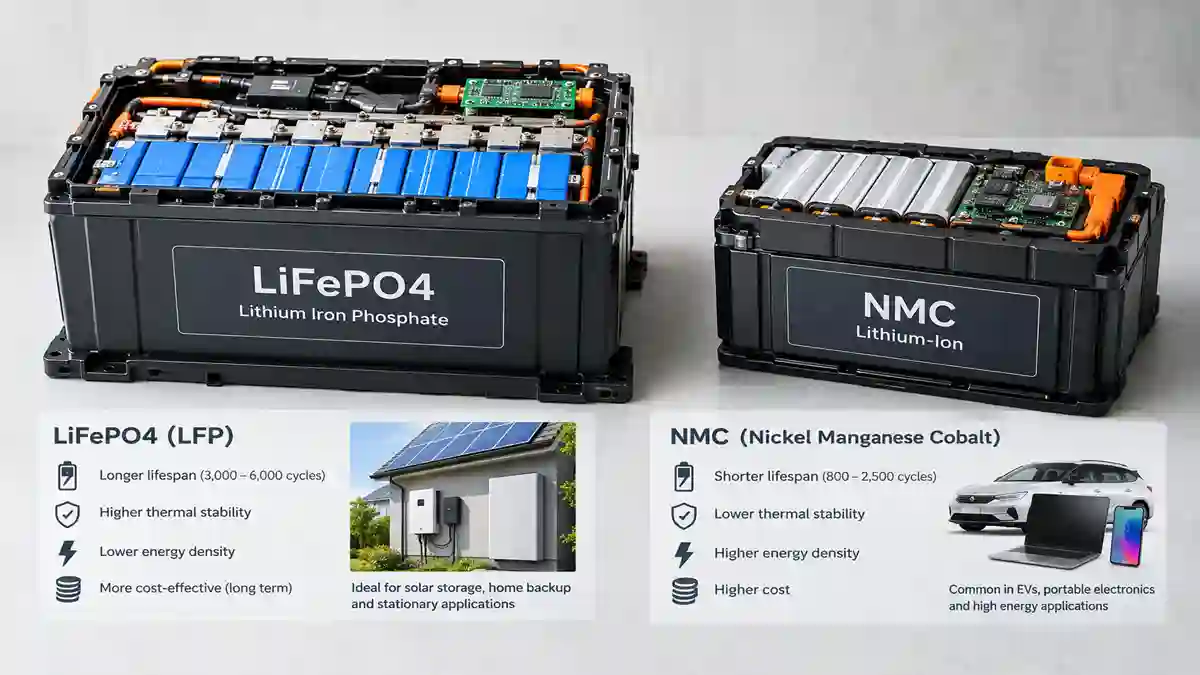
Compare LiFePO4 vs Lithium-Ion (NMC) batteries across lifespan, safety, energy density, and cost. Find out which chemistry fits your solar system or RV build.
I get this question constantly from customers standing between two battery listings, both labeled “lithium,” both claiming to be the better choice, with no real explanation of why one costs more. Here’s the part most product pages skip: LiFePO4 is a lithium-ion battery. When people ask me “LiFePO4 or lithium-ion,” what they actually mean is LiFePO4 versus NMC, the nickel-manganese-cobalt chemistry used in phones, laptops, and most long-range EVs. Once you know that, the comparison gets a lot easier to make.
Quick answer: LiFePO4 (LFP) and NMC are both lithium-ion batteries, but they’re built differently. LiFePO4 lasts roughly 3,000 to 6,000 charge cycles versus 800 to 2,500 for NMC, and it’s significantly more thermally stable, making it the safer, longer-lasting choice for solar storage, RVs, and backup power. NMC packs more energy into less weight and space, which is why it dominates long-range EVs and portable electronics. For anything that sits in place and cycles daily, LiFePO4 wins. For anything that needs to be light and compact, NMC wins.
This guide breaks down the real differences, so you know which one actually fits what you’re building.
1. Side-by-Side Comparison
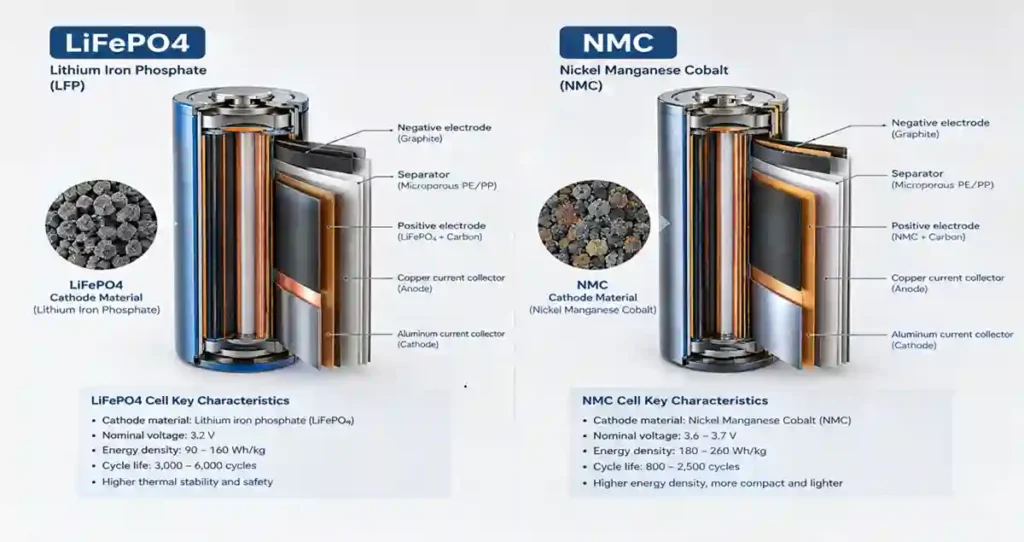
| Feature | LiFePO4 (LFP) | NMC Lithium-Ion |
|---|---|---|
| Cathode material | Lithium iron phosphate | Nickel, manganese, cobalt oxide |
| Nominal cell voltage | 3.2 V | 3.6 to 3.7 V |
| Maximum charge voltage per cell | 3.65 V | 4.2 V |
| Cell energy density | About 90 to 160 Wh/kg | About 150 to 250+ Wh/kg |
| Typical rated cycle life | 3,000 to 6,000+ | 800 to 2,500 |
| Thermal stability | Higher | Lower |
| Contains cobalt/nickel | No | Yes |
| Cost per kWh (cells) | Generally lower | Generally higher |
| Weight/size for equal energy | Heavier and larger | Lighter and smaller |
| Cold charging | Not below 0°C (32°F) | Not below 0°C (32°F) |
| Best for | Solar storage, backup, RVs, standard-range EVs | Long-range EVs, portable electronics, space-limited builds |
These are typical manufacturer ranges. Individual cells vary, so always check the actual datasheet before comparing two specific products.
2. LiFePO4 vs Lithium-Ion Lifespan
This is usually the number that decides it for people. LiFePO4 typically lasts two to three times as many cycles as NMC at the same depth of discharge.
| Chemistry | Typical Cycle Life | Daily Use Equivalent |
|---|---|---|
| LiFePO4 | 3,000 to 6,000+ cycles | Roughly 8 to 16 years |
| NMC | 800 to 2,500 cycles | Roughly 2 to 7 years |
Engineer’s Note: I’ve had customers push back on this, assuming a higher price tag on an NMC pack means it should outlast the cheaper LFP option next to it. It’s the opposite. The chemistry, not the price, is what sets the cycle life ceiling. A well-built LiFePO4 battery will almost always out-cycle a well-built NMC battery of similar quality.
3. Safety and Thermal Stability
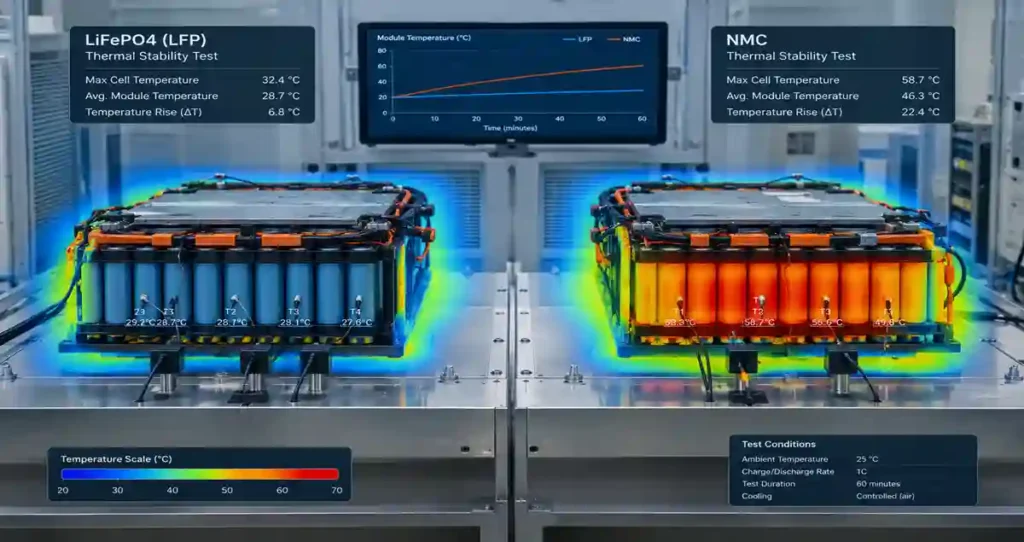
Both chemistries need a proper BMS, correct charging, and real protection hardware. The difference shows up when something goes wrong. LFP’s phosphate cathode holds oxygen far more tightly than NMC’s structure, so it’s much less likely to release oxygen and feed a fire. Commonly cited thermal runaway onset temperatures are around 270°C for LFP versus roughly 150 to 210°C for NMC, though exact figures vary by source and test method.
For a battery installed in a garage, utility room, or under an RV bed, that margin matters. It doesn’t make LFP immune to failure. Fusing, correct chargers, and certified products are still non-negotiable regardless of chemistry. For the safety basics that apply either way, see our LiFePO4 battery guide.
4. Energy Density, Weight and Space
This is NMC’s category to win. For the same stored energy, an NMC pack can run roughly 30 to 40% lighter and smaller than an equivalent LFP pack, depending on the design. That matters enormously for phones, drones, laptops, and long-range EVs, where every gram affects performance.
It matters far less for a home battery bolted to a wall or a battery bank tucked under an RV bed, where weight and space are rarely the limiting factor. That’s exactly why the decision flips depending on the application, not the chemistry’s “quality.”
5. LiFePO4 vs Lithium-Ion for Solar
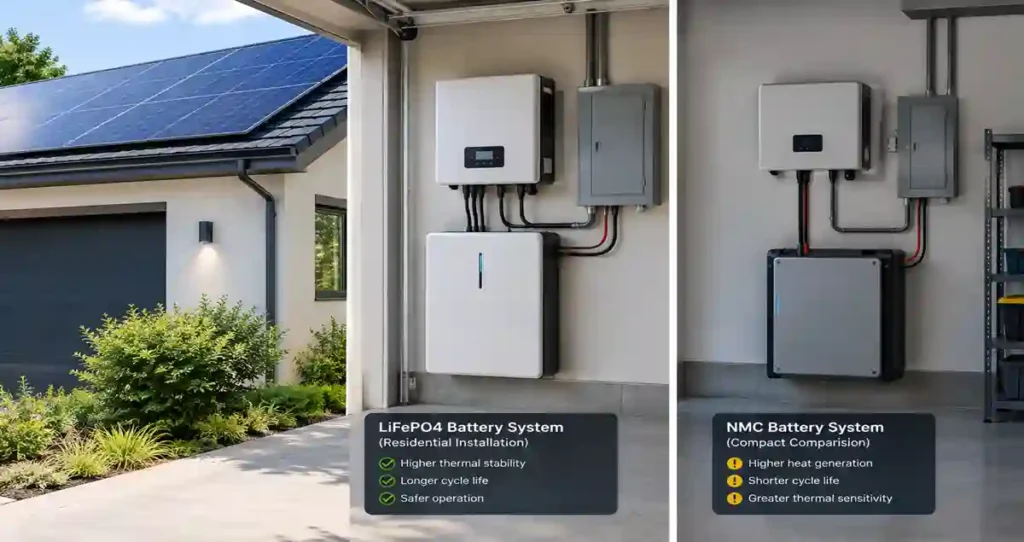
For solar specifically, this comparison isn’t close. Solar batteries cycle daily, often for a decade or more, sitting in spaces with no climate control. That’s the exact environment where LiFePO4’s cycle life and thermal stability pay off.
| Requirement | Why LiFePO4 Fits Better |
|---|---|
| Daily deep cycling | 3,000–6,000+ cycles vs 800–2,500 for NMC |
| Unregulated temperatures | Higher thermal stability in garages/sheds |
| Long ownership period | Lower cost per kWh delivered over 10+ years |
| Indoor or attached installation | Lower fire risk profile |
For the full picture on sizing and installing a solar-paired battery, see our guide to LiFePO4 batteries for solar, and for a broader look at how lithium chemistries stack up in solar systems generally, our lithium-ion battery for solar guide.
6. Materials, Supply Chain and Recycling
LFP contains no cobalt and no nickel. Cobalt sourcing has faced real supply chain and ethical sourcing concerns, and nickel prices swing with global demand. That gives LFP a simpler, more stable supply chain.
The trade-off shows up at end-of-life: nickel and cobalt make NMC batteries more valuable to recycle, while LFP recycling is less profitable today, and the industry is still building out capacity to handle it at scale.
7. Cold Weather Performance
Neither chemistry should be charged below 0°C (32°F), full stop. For discharge, NMC generally holds its capacity somewhat better in freezing conditions than LFP. In cold climates, either chemistry is best kept in an insulated or heated space, or bought with built-in heating if that’s not practical.
8. Which Should You Actually Choose?
| Use Case | Better Choice | Why |
|---|---|---|
| Home solar storage | LiFePO4 | Cycle life, stability, cost per kWh over time |
| RV, van, or boat house battery | LiFePO4 | Long life, safe, built for daily deep cycling |
| Off-grid cabin | LiFePO4 | Daily cycling, low maintenance |
| Commercial and BESS storage | LiFePO4 | Stability at scale, lowest lifetime cost |
| Long-range EV | NMC | Higher energy density, more range per kg |
| Phones, laptops, drones, power tools | NMC | Small and light |
| Very space-limited wall unit | NMC (or compact LFP) | Higher energy density |
For system-level energy storage sizing, see our BESS guide, and for how LFP compares against the broader category of lead-acid and other battery types, our solar battery types guide.
Engineer’s Note: Don’t mix chemistries in one bank, and don’t assume a charger is “compatible” just because the battery is labeled lithium. LFP and NMC have different voltage limits entirely. A charger or inverter has to be set for the specific chemistry, not just “lithium” as a category. I’ve seen this exact mismatch cause premature BMS shutdowns on otherwise good batteries.
For charging voltages and settings specific to LFP, see our LiFePO4 battery charger guide. If you’re still deciding on system voltage before buying anything, our 24V 200Ah LiFePO4 battery guide and 48V 200Ah LiFePO4 battery guide walk through sizing for each.
Frequently Asked Questions
Is LiFePO4 better than lithium-ion?
For stationary storage, backup power, and RVs, generally yes, because it lasts longer and is far more thermally stable. For anything that needs to be as light and compact as possible, NMC is usually the better pick.
Is LiFePO4 a lithium-ion battery?
Yes. LiFePO4 is one specific chemistry within the lithium-ion family. When people say “lithium-ion” in everyday conversation, they usually mean NMC or a similar chemistry, not the category as a whole.
Which lasts longer, LiFePO4 or lithium-ion (NMC)?
LiFePO4, by a wide margin. Typical ratings run 3,000 to 6,000+ cycles for LFP versus 800 to 2,500 for NMC.
Which is safer, LiFePO4 or lithium-ion?
LiFePO4 is generally more thermally stable and less prone to thermal runaway. Neither chemistry is risk-free without proper protection, fusing, and the correct charger.
Is LiFePO4 cheaper than lithium-ion?
Cell cost per kWh is generally lower for LFP, though prices shift with the market. Over a battery’s full lifetime, LFP is usually the cheaper option per kWh delivered in stationary, daily-cycling use.
Is LiFePO4 or lithium-ion better for solar?
LiFePO4. Solar batteries cycle daily for years in spaces without climate control, which plays directly to LFP’s strengths in cycle life and thermal stability.
Related Guides
- 24V 200Ah LiFePO4 Battery: Specs, Uses & Buying Guide
- LiFePO4 Battery: How It Works, Specs & Buying Guide
- LiFePO4 Batteries for Solar: How to Choose & Size Right
- 48V 200Ah LiFePO4 Battery: Specs, Sizing & Home Storage Guide
- LiFePO4 Battery Charger: Voltage, Amps & Settings
- Solar Panel Repair Guide: Diagnose Problems, Costs & Fixes
- IRS Form 5695 for 2025: Solar Tax Credit Guide
Related guides on SolarVisionAI
- Monocrystalline Solar Panels 2026: Still Worth It or Hype
- Polycrystalline Solar Panels: Worth Buying in 2026?
- Thin-film Solar Panels: When They Beat Silicon (2026)
- BIPV Solar Panels: Building-Integrated PV Complete Guide
- Portable Solar Panels: Engineer’s Buyer’s Guide 2026
- CPV Solar Panels: Concentrated Photovoltaic Explained
- Skin Solar Panel: What “Solar Skin” Actually Means
- Solar Fence Post Lights: Cap Sizes, Types & Install Guide
- Bifacial Solar Panels in 2026: How to Boost Energy Output
- Solar Charge Controller: The Complete Guide
- MC4 Connectors: Solar Safety & Installation Guide
- Solar Panel Types, Efficiency & Benefits
- Solar Water Pump Guide
- BESS — Battery Energy Storage System Guide
- Commercial Solar Panel Installation
- Solar Refrigerator & DC Fridge — Complete 2026 Guide
- Bifacial Solar Panel Albedo Effect Guide
- TOPCon: Why TOPCon Solar Panel is a Proven Smart Investment in 2026
- HJT: Why Heterojunction Is the Hot Climate Champion
- PERC: PERC Solar Panel: Still Relevant or Already Outdated?
- Perovskite: Perovskite Solar Panels: The 2026 Reality Check
- N-Type vs P-Type: N-Type vs P-Type Solar Panels: Honest Comparison
- ABC: ABC (all back contact) Solar Panel: Back Contact Technology Explained
- IBC: IBC Solar Panels: Interdigitated Back Contact Guide
- Tandem: Tandem Solar Panels: Are Stacked Cells Ready for Rooftops?