
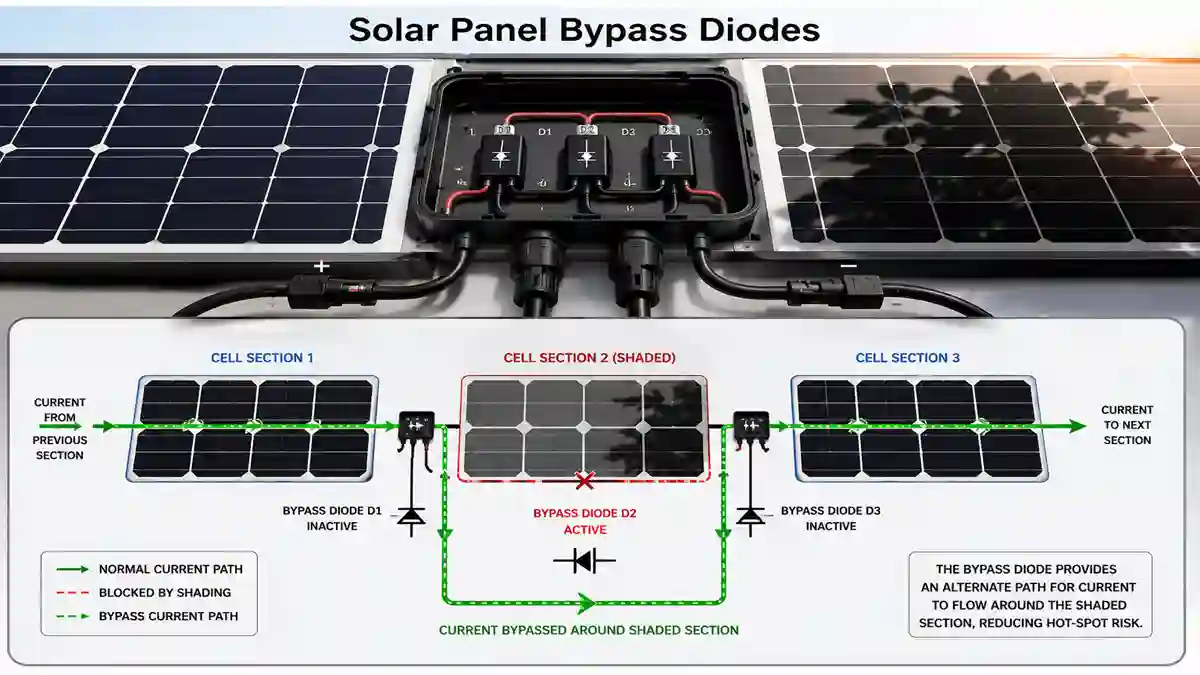
Solar panel bypass diodes explained by a registered engineer — how they work, how they prevent hot spots, and why every panel needs them.
Solar panel bypass diodes are small but critical components located inside a module’s junction box. They help protect shaded cell sections from excessive reverse-bias stress and localized heating that can lead to hot spots. Understanding how solar panel bypass diodes work also explains why partial shading can reduce output even when the module remains physically protected.
Bypass diodes are small, unglamorous components tucked inside every panel’s junction box, and they’re also the single most important protection standing between a partially shaded panel and genuine physical damage. Understanding how they work clarifies why panel manufacturers universally include them, and why their presence and specification quietly matter far more than most buyers realize.
Engineer’s Note: A shaded cell doesn’t simply stop contributing power. In a series-connected module, severe shading can force the affected cell into reverse bias, causing it to dissipate electrical power as heat. Solar panel bypass diodes provide an alternate current path around the affected section, helping limit this stress.
What Bypass Diodes Actually Do
A solar cell that’s shaded stops generating current but doesn’t stop conducting it — when the rest of an unshaded series string continues pushing current through, that shaded cell can be forced to absorb power instead of producing it, converting that power into heat rather than electricity. Without protection, this can create a dangerously concentrated heat buildup at the shaded cell, known as a hot spot, capable of physically damaging the cell, the encapsulant, or even the glass over time.
Normal Connection: Solar cells are typically connected in series within distinct sections of a module.
Effect of Shading: Shading severely reduces the photocurrent generated by affected cells.
Reverse Bias: When current flow is restricted, these shaded cells can become reverse-biased.
Power Dissipation: Electrical power is then dissipated as heat across the reverse-biased cells.
Hot Spot Creation: This intense localized heating leads to the formation of destructive hot spots.
Bypass Diode Mitigation: A bypass diode provides an alternate electrical path around the shaded section, maintaining current flow and protecting the cells from thermal damage.
Engineer’s Note: The physics here is worth understanding precisely: a shaded cell in a series circuit doesn’t just produce zero power; it can actually become a resistive load consuming power from the rest of the string. That reversal from producer to consumer is exactly the mechanism that creates a hot spot, and it’s exactly what bypass diodes are engineered to prevent.
How Bypass Diodes Prevent Hot Spots
A bypass diode is wired in parallel with a section of the panel’s cells, oriented so that under normal unshaded operation, no current flows through it — the diode stays essentially inactive. When a cell within that section becomes shaded and starts resisting current flow, the bypass diode activates, providing an alternate path for current to flow around the shaded section entirely, rather than being forced through the high-resistance shaded cell. This redirected current path prevents the dangerous heat buildup a hot spot would otherwise create.
Most standard panels divide their cells into three sections, each protected by its own bypass diode, meaning a shadow affecting one section triggers only that section’s diode, while the other two-thirds of the panel continues operating normally. This sectional protection is part of why half-cut cell panels, covered in our dedicated guide, achieve even better shading resilience — their parallel-wired cell halves interact with bypass diode protection in a way that further limits the impact of partial shading.
Solar panel bypass diodes do not remove the power loss caused by shading; their primary function is to reduce the electrical and thermal stress created by severe shading.
What Happens When a Solar Panel Is Shaded?
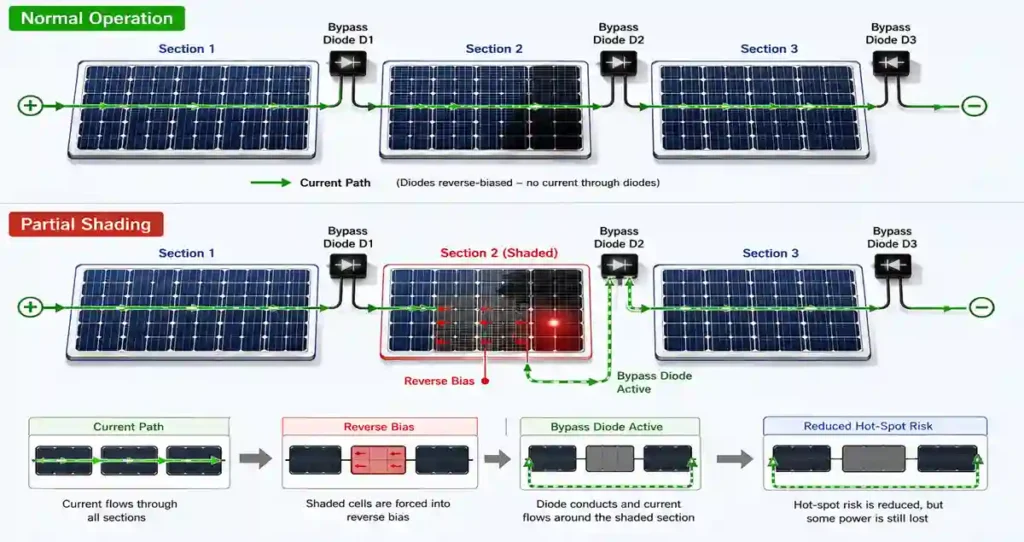
| Condition | What Happens |
|---|---|
| No shading | Cells operate normally, and bypass diodes remain essentially inactive |
| Partial shading | Output decreases depending on the affected cells and circuit configuration |
| Severe shading | Affected cells can become reverse-biased |
| Bypass diode activates | Current is redirected around the affected section |
| Section is bypassed | Hot-spot risk is reduced, but voltage and power output are also reduced |
| Diode failure | Protection can be compromised, and localized heating can become more serious |
How Many Bypass Diodes Does a Solar Panel Have?
Many conventional crystalline-silicon modules use three bypass diodes, with each diode protecting a section of cells. However, the exact number and electrical configuration can vary between module designs. The important consideration is not simply the number of diodes, but which cells each diode protects and how the module’s electrical architecture responds to shading.
3 Diodes vs 1 Diode Solar Panels
The number of bypass diodes affects how much of the module can be bypassed when shading occurs.
With a single-diode design, one bypass diode may protect a much larger section of the module. Severe shading can therefore affect a larger proportion of the panel’s electrical output.
With three protected sections, shading that activates one bypass diode can be limited more closely to the affected section.
| Configuration | Typical Shading Impact | Practical Consideration |
| 1 bypass diode | Larger portion of the module can be affected | Requires closer evaluation, particularly for shaded sites |
| 3 bypass diodes | Shading impact can be contained to a smaller section | Common configuration in conventional modules |
| More than 3 | Potentially smaller affected sections | May be useful for specialized high-shading applications |
Engineer’s Note: I would not choose a panel simply because it has “more diodes.” Diode count is only one part of the electrical design. The cell-string configuration, diode ratings, junction-box design, and overall module architecture also matter.
For sites with significant and unavoidable shading, understanding the module’s actual electrical configuration is more useful than relying on the diode count alone.
Do More Bypass Diodes Always Mean Better Performance?
Not necessarily.
More protected sections can reduce the proportion of the module affected by a particular shading event, but additional diodes also add design complexity.
For a typical residential or commercial installation, a well-designed multi-section module can provide an effective balance between shading resilience and manufacturing complexity.
How Bypass Diodes Differ Across Solar Panel Types
The basic purpose of a bypass diode is similar across photovoltaic modules, but the electrical configuration can vary depending on the cell technology and module design. The important factor is not simply whether a panel uses bypass diodes, but how those diodes interact with the module’s cell sections.
| Solar Panel Type | Typical Diode Approach | Shading Consideration |
|---|---|---|
| PERC | Commonly uses multiple bypass diodes protecting cell sections | Partial shading can bypass affected sections |
| TOPCon | Similar multi-section bypass protection is commonly used | Module circuit design determines shading response |
| HJT | Uses bypass protection integrated with its module electrical architecture | Diode configuration should be checked in the datasheet |
| IBC / Back-Contact | Bypass protection depends on the specific module architecture | Cell layout and string configuration are particularly important |
| Thin-Film | Configuration can differ substantially from conventional crystalline modules | Do not assume the same three-diode arrangement |
Engineer’s Note: Solar panel technology and bypass-diode configuration are two different things. A panel being TOPCon, HJT, PERC or IBC does not by itself tell you how many bypass diodes it contains. For technical evaluation, always check the manufacturer’s electrical schematic, junction-box specifications, and datasheet.
Important Point: Don’t choose a solar panel simply because it has more bypass diodes. The quality of the electrical design, cell-string configuration, diode ratings and module testing are more important than the diode count alone.
Do Solar Panel Bypass Diodes Eliminate Shading Losses?
No. Solar panel bypass diodes primarily provide protection; they do not restore the electricity that a shaded cell or submodule would otherwise produce. When a bypass diode conducts, the affected section may be bypassed, reducing the module’s voltage and available power while helping prevent excessive heating.
Advantages and Disadvantages of Bypass Diode Protection
| Advantages | Disadvantages |
| Prevents physical hot-spot damage from partial shading conditions | Doesn’t eliminate the underlying output loss from shading, only the damage risk |
| Sectional design limits shading impact to the affected section only | Diode failure, though uncommon, removes this protection silently |
| Standard, low-cost component included on essentially every quality panel | Very cheap or unverified panels occasionally use undersized or low-quality diodes |
| Requires no active management — operates automatically as conditions change | Not a substitute for addressing genuine, persistent shading at the design stage |
What Causes Solar Panel Bypass Diodes to Fail?
Bypass-diode failure is relatively uncommon on quality modules, but it can occur.
Potential causes include:
- Repeated thermal stress from shading and hot-spot events.
- Manufacturing defects.
- Electrical overstress.
- Lightning-induced surges.
- Inadequately rated or damaged components.
- Long-term thermal cycling.
A bypass diode can generally fail in two important ways.
Fail Open
The diode no longer provides its intended bypass path. The affected cell section can therefore remain vulnerable during future severe shading events.
Fail Short
The diode conducts continuously, even when shading is not present. This can reduce the output associated with the protected section.
These two failure modes can produce very different symptoms and require appropriate testing.
How Can You Test a Solar Panel Bypass Diode?
The appropriate diagnostic method depends on the installation and the suspected problem.
| Test Method | What It Can Reveal | Equipment |
| Visual inspection | Discoloration, burn marks or physical evidence of hot spots | None |
| Thermal imaging | Localized heating and active hot spots | Thermal/infrared camera |
| I-V curve tracing | Electrical performance abnormalities | I-V curve tracer |
| Multimeter diode test | Diode behavior where direct access is possible | Multimeter with diode mode |
Thermal Imaging
Thermal imaging can be particularly useful because it is non-invasive and can identify abnormal temperature patterns while the system remains installed.
An unusually hot area may indicate a bypass-diode problem, but thermal evidence should not automatically be interpreted as proof of diode failure. Other electrical or physical problems can produce similar symptoms.
I-V Curve Testing
I-V curve tracing provides more detailed electrical information and can help identify abnormalities in module performance.
This is generally more appropriate for professional technicians or engineers because specialized equipment and correct test conditions are required.
Multimeter Testing
A multimeter with a diode-test function can sometimes be used when the panel is safely disconnected, and the diode or junction box can be accessed.
This is not a suitable DIY procedure for an energized photovoltaic system.
Real-World Signs of Bypass Diode Problems
Possible warning signs include:
- Localized hot spots.
- Unusual temperature differences between cell sections.
- Burn marks or discoloration on the rear of the module.
- Unexpected output reduction from an individual panel.
- Persistent electrical abnormalities affecting one module section.
- Physical damage associated with previous shading events.
However, not every output decline is caused by a bypass diode.
Soiling, normal degradation, connector problems, wiring faults, cell damage, and other electrical issues can produce similar symptoms.
Proper diagnosis is therefore important before replacing a diode or an entire module.
Can a Failed Bypass Diode Be Repaired?
In some modules, the junction box and its bypass diodes can be replaced if the rest of the panel remains undamaged and the manufacturer or qualified service provider permits the repair.
However, if a failed diode has already allowed a severe hot spot to damage cells, encapsulation or glass, replacing the entire module is often the more practical solution.
Any repair involving the junction box should be performed by a qualified technician and according to the manufacturer’s requirements.
Real-World Applications
I check bypass diode specification whenever evaluating an unfamiliar manufacturer’s datasheet, since this is exactly the kind of protective component that’s invisible during normal operation but critical during a shading event. Confirming the diode’s current rating matches the panel’s short-circuit current and confirming the panel uses a standard three-section design are both quick checks worth doing before trusting a panel for a site with any realistic shading risk.
Field Note: I diagnosed a panel showing a visible burn mark on its rear surface, tracing back to a bypass diode that had failed to activate properly during a shading event, allowing a hot spot to develop unchecked. That’s a rare but real failure mode, and it’s exactly why the diode failure testing covered in our companion guide matters — this protection only works if the diode itself remains functional.
Common Misconceptions Worth Clearing Up
People sometimes assume bypass diodes eliminate the output loss from shading entirely. They don’t — they prevent physical damage from shading, but the shaded section still isn’t producing power while shaded. The output loss from shading is a separate, unavoidable physics consequence; bypass diodes solve the damage risk, not the temporary output reduction itself.
Buying Checklist
- Confirm the datasheet specifies bypass diode current rating matching the panel’s short-circuit current
- Verify standard three-section diode configuration, or check the specific configuration for non-standard designs
- For sites with known shading risk, prioritize half-cut cell panels for additional shading resilience
- Include diode functionality in periodic system inspection, particularly after any visible cell discoloration or panel hot spots
My closing thought on bypass diodes: they’re a perfect example of a component that earns almost no attention when working correctly and prevents genuinely serious damage when it matters. That invisibility is exactly why I encourage buyers to verify diode specification at purchase time rather than assuming it, since it’s one of the few checks that costs nothing beyond reading a datasheet carefully.
Solar Panel Bypass Diode Testing and Standards
- IEC 61215-2:2021 — PV module design qualification and testing.
- IEC 62979:2017 — bypass-diode thermal runaway testing.
- Relevant manufacturer junction-box and module specifications.
Frequently Asked Questions
What do solar panel bypass diodes do?
Solar panel bypass diodes provide an alternate current path around an affected section of cells when severe shading causes excessive reverse-bias stress. This helps reduce localized heating and the risk of hot spots. They protect the module during shading but do not restore the power that the shaded cells would otherwise produce.
How many bypass diodes does a solar panel have?
Many conventional crystalline-silicon solar panels use three bypass diodes, with each diode protecting a section of cells. However, the exact number and electrical configuration can vary between module designs. Buyers should check the manufacturer’s junction-box and module specifications rather than assuming every panel uses the same configuration.
Do solar panel bypass diodes prevent hot spots?
They can help prevent or reduce hot-spot damage by allowing current to bypass a severely shaded cell section. However, bypass diodes do not guarantee that hot spots can never occur. Their effectiveness depends on the module’s electrical design, shading conditions, diode condition, and proper operation.
Do bypass diodes eliminate shading losses?
No. Bypass diodes primarily provide protection; they do not eliminate the energy loss caused by shading. When a bypass diode conducts, the affected cell section is bypassed, which can reduce the module’s voltage and available power. The main benefit is reducing damaging electrical and thermal stress.
Can solar panel bypass diodes fail?
Yes. Although failures are relatively uncommon in properly manufactured modules, bypass diodes can fail because of thermal stress, electrical overstress, manufacturing defects, or other component problems. A failed diode can compromise protection for the cell section it is designed to protect and may contribute to localized heating under severe shading.
Do bypass diodes improve solar panel efficiency?
Not directly. Under normal operating conditions, bypass diodes are normally inactive and do not materially increase the panel’s rated efficiency. Their main purpose is protection during appropriate shading conditions. A functioning bypass-diode system can, however, help a module continue operating more safely when part of it is severely shaded.
Are bypass diodes important when choosing a solar panel?
Yes, particularly for installations with partial-shading risk. Buyers should look beyond the number of bypass diodes and consider the module’s cell configuration, electrical architecture, junction-box specifications, diode ratings, and relevant qualification testing. For a normally unshaded installation, bypass-diode protection may rarely become noticeable, but it remains an important part of the module’s safety and reliability design.
References
The technical discussion in this guide is based on established photovoltaic module design, testing and bypass-diode engineering practices. Relevant standards include IEC 61215-2 and IEC 62979, while manufacturer datasheets and junction-box specifications should be consulted for module-specific configurations.
- Monocrystalline Solar Panels 2026: Still Worth It or Hype
- Polycrystalline Solar Panels: Worth Buying in 2026?
- Thin-film Solar Panels: When They Beat Silicon (2026)
- BIPV Solar Panels: Building-Integrated PV Complete Guide
- Portable Solar Panels: Engineer’s Buyer’s Guide 2026
- CPV Solar Panels: Concentrated Photovoltaic Explained
- Skin Solar Panel: What “Solar Skin” Actually Means
- Solar Fence Post Lights: Cap Sizes, Types & Install Guide
- Bifacial Solar Panels in 2026: How to Boost Energy Output
- Solar Charge Controller: The Complete Guide
- MC4 Connectors: Solar Safety & Installation Guide
- Solar Panel Types, Efficiency & Benefits
- Solar Water Pump Guide
- Commercial Solar Panel Installation: Engineering Guide
- Solar Fence Post Lights: Cap Sizes, Types & Install Guide
- BESS — Battery Energy Storage System Guide
- Commercial Solar Panel Installation
- Solar Refrigerator & DC Fridge — Complete 2026 Guide
- Bifacial Solar Panel Albedo Effect Guide
- TOPCon: Why TOPCon Solar Panel is a Proven Smart Investment in 2026
- HJT: Why TOPCon Solar Panel is a Proven Smart Investment in 2026
- PERC: PERC Solar Panel: Still Relevant or Already Outdated?
- Perovskite: Perovskite Solar Panels: The 2026 Reality Check
- N-Type vs P-Type: N-Type vs P-Type Solar Panels: Honest Comparison
- ABC: ABC (all back contact) Solar Panel: Back Contact Technology Explained
- IBC: IBC Solar Panels: Interdigitated Back Contact Guide
- Tandem: Tandem Solar Panels: Are Stacked Cells Ready for Rooftops?