
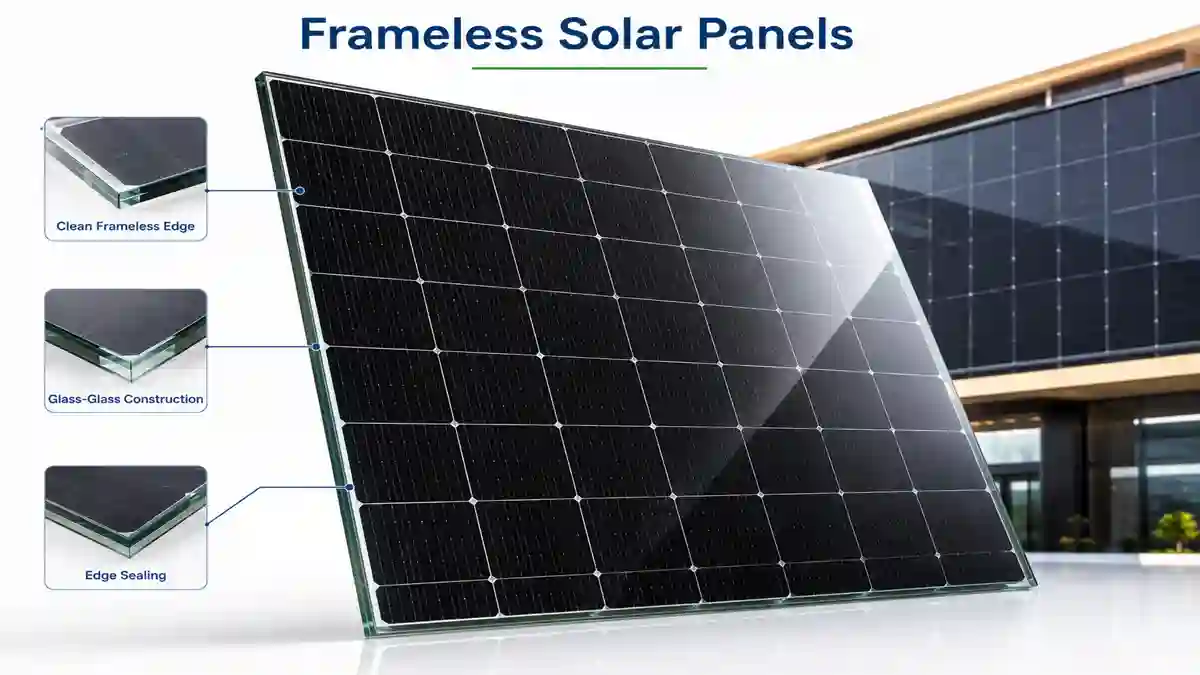
Frameless solar panels explained by a registered engineer — real advantages, structural trade-offs, and when this design makes sense.
Frameless panels remove the aluminum border entirely, relying instead on glass-glass construction to provide structural integrity without a traditional frame. It’s a design choice that trades some familiar structural features for genuine aesthetic and application-specific advantages, and understanding those trade-offs clarifies exactly when this design earns its place over standard framed construction.
This guide is part of our Solar Panel Frame Materials guide for the standard framed alternative.
How Frameless Panels Achieve Structural Integrity
Rather than an aluminum border, frameless panels typically use dual tempered glass layers (glass-glass construction) sandwiching the cells, with the glass itself providing structural rigidity and edge protection. This construction is frequently paired with bifacial cell technology, since the transparent rear glass layer required for frameless construction is the same construction bifacial panels need for rear-side light capture, making the two technologies natural pairing partners.
Engineer’s Note: The absence of a frame doesn’t mean the absence of edge protection — it means the protection comes from the glass and edge sealant system instead of an aluminum border. Quality frameless panels use specifically engineered edge sealing to compensate for what the frame would otherwise provide, and verifying this edge treatment is a genuine quality differentiator between frameless products.
Frameless vs Framed Solar Panels
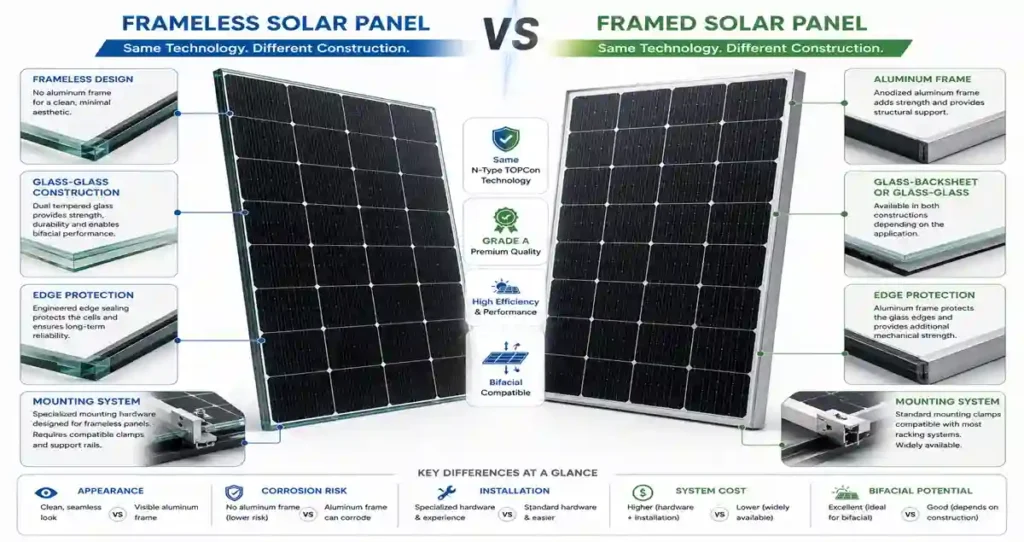
| Factor | Frameless Solar Panels | Framed Solar Panels |
|---|---|---|
| Frame | No conventional aluminum frame | Aluminum frame |
| Construction | Usually glass-glass | Glass-glass or glass-backsheet |
| Mounting | Specialized mounting system often required | Standard clamps widely available |
| Appearance | Clean, minimal appearance | Visible perimeter frame |
| Bifacial compatibility | Frequently paired with bifacial modules | Also available in bifacial designs |
| Edge protection | Depends on glass and edge-sealing design | Aluminum frame provides additional edge protection |
| Installation | Requires compatible hardware and installer experience | Generally simpler |
| Cost | Can carry a system-level premium | Usually more economical |
| Best suited for | BIPV, architectural and selected bifacial applications | Most residential and commercial installations |
Which Solar Panel Types Use Frameless Designs?
Frameless construction is most commonly associated with glass-glass solar panels, particularly in applications where appearance, bifacial generation, or architectural integration is important.
Common examples include:
- Bifacial solar panels — frequently paired with glass-glass construction, although many bifacial panels still use conventional aluminum frames.
- Glass-glass solar panels — a natural platform for frameless construction because the rear glass contributes to the module’s structural design.
- BIPV solar panels — frameless designs can be useful where the photovoltaic module needs to integrate visually with a building.
- Premium architectural solar modules — frameless construction may be selected when the visible aluminum border is undesirable.
- TOPCon and HJT modules — these technologies can also be manufactured in frameless designs; cell technology and frame design are separate decisions.
Engineering Standards & Installation Recommendations
For frameless solar panels, both the module and its mounting system must be compatible and properly certified.
- IEC 61215-2: Covers mechanical-load and environmental qualification testing of PV modules.
- IEC 61730: Covers electrical and construction safety requirements for PV modules.
- UL 61730: Applies to PV module safety certification in applicable markets.
- NEC 690.43: Addresses grounding and bonding requirements where the NEC applies.
Engineer’s Note: There is no universal clamp torque or mounting distance for every frameless panel. Always follow the manufacturer’s approved installation manual and load map.
Installation Checklist
- Use manufacturer-approved clamps and mounting hardware.
- Follow the specified clamp zones, rail spacing, and torque.
- Protect exposed glass edges during handling and installation.
- Check for cracks, chips, damaged seals or delamination.
- Verify the grounding and bonding system according to applicable codes.
- Ensure installers are familiar with glass-glass frameless modules.
This keeps the section technically useful without making generic torque or clamp measurements sound like universal requirements.
Advantages and Disadvantages
| Advantages | Disadvantages |
| Clean, minimal aesthetic increasingly favored for premium and BIPV installations | Requires specialized mounting hardware different from standard framed clamps |
| Natural pairing with bifacial and glass-glass construction for rear-side light capture | No frame edge protection means glass edge quality and sealing matter more |
| No frame corrosion risk, since there’s no aluminum frame to corrode | Generally commands a cost premium over comparable framed panels |
| Well suited to BIPV applications where a visible frame would compromise integration | Fewer manufacturers and installers have deep frameless-specific experience |
Real-World Applications
Frameless panels come up most often in my work on BIPV and premium architectural projects, where the client has specifically prioritized visual integration and a frame would visually undermine that goal. They’re also a natural fit for bifacial ground-mount projects already using glass-glass construction, where going frameless is a comparatively small additional step given the construction similarities already in play.
Field Note: A client considering frameless panels purely for aesthetic reasons on a standard residential rooftop hadn’t initially budgeted for the specialized mounting hardware frameless construction requires, which added meaningfully to the project’s total cost once accounted for. That’s a cost most buyers don’t anticipate when comparing panel prices alone, without factoring in the full mounting system difference.
The lesson for me was simple: comparing only the panel price can give a misleading impression of value. With frameless modules, I always evaluate the panel, mounting hardware, installation requirements and long-term maintenance as one complete system.
When I Would Choose Frameless Solar Panels
I would seriously consider frameless construction when:
- The project has a strong architectural or aesthetic requirement.
- BIPV integration is part of the design.
- A glass-glass bifacial system is already being considered.
- Suitable frameless mounting hardware is available locally.
- The installer has experience with the specific mounting system.
- The additional system cost is justified by the project’s design or performance objectives.
For a normal residential rooftop where none of these requirements exist, I would generally stay with a quality framed module.
Where It Doesn’t Make Sense
Standard residential rooftop installations without a specific architectural or aesthetic requirement driving the decision. Standard framed panels remain simpler to mount with widely available hardware, generally cost less, and offer the same core electrical performance for the overwhelming majority of typical installations.
For most ordinary residential rooftops, frameless solar panels are not automatically the better choice.
Common Misconceptions Worth Clearing Up
People sometimes assume frameless panels are inherently more fragile than framed ones, since there’s no visible aluminum border. Quality frameless construction, with proper glass-glass design and edge sealing, is engineered to be structurally sound for its intended application — the trade-off is more about mounting compatibility and cost than raw durability, when comparing quality products in each category.
Buying Checklist
- Confirm compatible mounting hardware is available and budgeted for before committing to frameless
- Verify glass-glass construction and edge sealing specifications from the manufacturer
- Confirm installer experience with frameless-specific mounting systems
- Weigh the aesthetic and application benefit against the real cost and mounting complexity premium
For standard framed construction and alloy considerations, see our Solar Panel Frame Materials guide. For BIPV applications where frameless design is especially relevant, see BIPV Solar Panels.
The honest summary I’d give any client considering frameless: it’s a genuinely excellent choice when the application calls for it, and an unnecessary cost and complexity add-on when it doesn’t. Let the actual project requirement — aesthetic integration, BIPV compatibility, pairing with an already-planned bifacial system — drive the decision, rather than choosing frameless purely because it sounds like the more modern or premium option.
Cost Comparison Perspective
When clients ask me to quantify the frameless premium, I typically frame it in two parts: the panel-level cost difference, which is usually modest, and the mounting hardware and installation labor difference, which is often the larger and more easily overlooked component of the total cost gap. A complete cost comparison needs to account for both, not just the panel price tag, to give an accurate picture of what choosing frameless actually costs for a specific project.
Frequently Asked Questions
Are frameless solar panels less durable than framed panels?
Not inherently. Quality frameless construction can be structurally sound when the glass, edge sealing and mounting system are properly engineered for the intended application. The important comparison is between the tested specifications of the complete modules rather than simply whether a panel has an aluminum frame.
Do frameless solar panels require special mounting hardware?
Yes, typically. Frameless modules generally require mounting hardware specifically designed for their construction. The mounting system should be confirmed and budgeted before purchasing the panels.
Are frameless solar panels always bifacial?
No. Frameless and bifacial are separate design characteristics, although they are frequently combined because both are commonly associated with glass-glass construction.
Are frameless solar panels more expensive than framed panels?
They can be. The total cost difference may include not only the module price but also specialized mounting hardware and installation requirements. A complete system-level comparison is more useful than comparing panel prices alone.
Are frameless solar panels better for coastal areas?
They can eliminate corrosion concerns associated with a conventional aluminum perimeter frame, but the complete system still needs appropriate corrosion-resistant materials, edge sealing and mounting hardware for the site’s salt-air exposure.
Can TOPCon solar panels be frameless?
Yes. TOPCon describes the solar-cell technology, while frameless describes the module’s physical construction. A TOPCon module can therefore be designed with either a conventional frame or a frameless construction.
When should I choose frameless solar panels?
Frameless panels make the most sense when architectural appearance, BIPV integration, glass-glass construction or a specific project requirement justifies the additional mounting complexity and potential cost. For ordinary rooftops, conventional framed panels are often the simp
References
Frameless construction specifications reference IEC design qualification standards and industry glass-glass panel engineering documentation.
Related guides on SolarVisionAI.com
- Monocrystalline Solar Panels 2026: Still Worth It or Hype
- Polycrystalline Solar Panels: Worth Buying in 2026?
- Thin-film Solar Panels: When They Beat Silicon (2026)
- BIPV Solar Panels: Building-Integrated PV Complete Guide
- Portable Solar Panels: Engineer’s Buyer’s Guide 2026
- CPV Solar Panels: Concentrated Photovoltaic Explained
- Skin Solar Panel: What “Solar Skin” Actually Means
- Solar Fence Post Lights: Cap Sizes, Types & Install Guide
- Bifacial Solar Panels in 2026: How to Boost Energy Output
- Solar Charge Controller: The Complete Guide
- MC4 Connectors: Solar Safety & Installation Guide
- Solar Panel Types, Efficiency & Benefits
- Solar Water Pump Guide
- Commercial Solar Panel Installation: Engineering Guide
- Solar Fence Post Lights: Cap Sizes, Types & Install Guide
- BESS — Battery Energy Storage System Guide
- Commercial Solar Panel Installation
- Solar Refrigerator & DC Fridge — Complete 2026 Guide
- Bifacial Solar Panel Albedo Effect Guide
- TOPCon: Why TOPCon Solar Panel is a Proven Smart Investment in 2026
- HJT: Why TOPCon Solar Panel is a Proven Smart Investment in 2026
- PERC: PERC Solar Panel: Still Relevant or Already Outdated?
- Perovskite: Perovskite Solar Panels: The 2026 Reality Check
- N-Type vs P-Type: N-Type vs P-Type Solar Panels: Honest Comparison
- ABC: ABC (all back contact) Solar Panel: Back Contact Technology Explained
- IBC: IBC Solar Panels: Interdigitated Back Contact Guide
- Tandem: Tandem Solar Panels: Are Stacked Cells Ready for Rooftops?