

Learn How Is Solar Water Heater Connected to a Pool. Explore plumbing order, pumps, filters, solar collectors, bypass valves, controls, and installation tips.
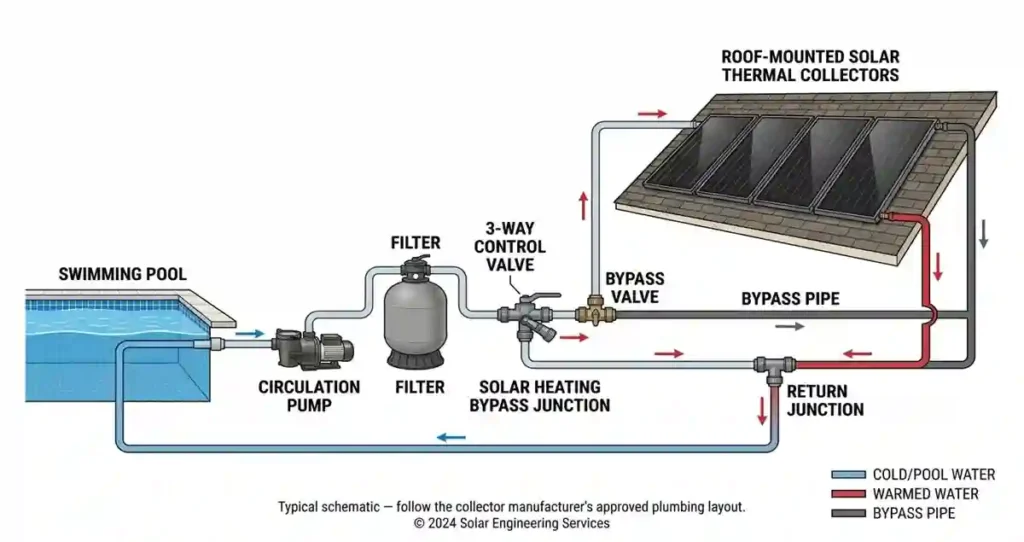
A solar water heater for a swimming pool is usually connected to the existing pool circulation system. Water passes through the pump and filter before entering the solar collector circuit, where sunlight transfers heat to the water. The warmed water then returns to the pool.
However, the plumbing sequence is only one part of a successful installation. Collector elevation, pipe diameter, total hydraulic resistance, pump performance, bypass-valve arrangement, and temperature control all affect how the system operates.
As a solar engineer, I approach this type of installation by separating two questions: how the water should circulate, and whether the available solar energy can provide the required heating performance. A system can be connected correctly but still underperform because the collector area is insufficient, the flow rate is unsuitable, or the pool loses heat faster than the collectors can replace it.
Editor’s Note: This guide focuses on conventional solar thermal pool heating, where solar collectors transfer heat directly to circulating pool water. Photovoltaic panels that generate electricity for a pool pump or heat pump are a different system and are discussed separately.
How Is Solar Water Heater Connected to a Pool?
A common solar thermal pool-heating arrangement follows this sequence:
Pool → Circulation pump → Filter → Solar heating circuit → Pool return
A bypass valve assembly may be installed around the solar collectors to control whether water flows through the heating circuit or follows the bypass route.
The main components are:
- Pool suction and return plumbing
- Circulation pump
- Pool filter
- Solar thermal collectors
- Collector supply and return pipes
- Bypass or diverter valves
- Temperature sensors and controller, where required
- Isolation, check, and other protective valves where specified by the design
The exact arrangement depends on the collector manufacturer, pump configuration, installation height, and local requirements. The manufacturer’s approved hydraulic diagram should determine the final layout.
How the water flows through the system
- The circulation pump draws water from the pool.
- The water passes through the filtration system.
- The valve arrangement directs water through the solar collectors when heating is required.
- Solar radiation heats the water inside the collectors.
- The warmed water returns through the pool return line.
Engineer’s Note: The sequence above is typical, not universal. Some installations use automatic diverter valves, while others use manual valves or manufacturer-specific arrangements. Do not copy a generic plumbing diagram without checking the actual collector specifications and the pool’s existing circulation system.
The Main Components and Their Engineering Functions
1. Pool circulation pump
The pump provides the pressure needed to circulate water through the pool plumbing, filter, and solar collector circuit.
When solar collectors are added, the system’s total hydraulic resistance changes. Additional pipe length, fittings, collector passages, and vertical elevation can affect the operating flow rate.
A pump that circulates water adequately through the original pool system may not provide the required flow after the solar circuit is installed.
For background on pump selection, operating principles, and solar-powered water movement, see our Solar Water Pump Guide.
Engineer’s Field Note: Before recommending a larger pump, I would check the existing pump’s performance at the expected total system head. Increasing pump size without evaluating the hydraulic system can increase electricity consumption, create excessive flow, or fail to solve the actual restriction.
2. Pool filter
The filter removes debris before water enters the solar collectors in a conventional arrangement. This helps reduce the risk of contamination or blockage within the heating circuit.
A restricted filter can reduce circulation and affect the performance of the entire system. Filter maintenance is therefore part of solar pool-heating maintenance, not a separate issue.
Engineering check: If the collector flow appears low, verify the filter condition and the pressure readings before concluding that the collectors or pump are defective.
3. Solar thermal collectors
Solar collectors absorb solar radiation and transfer the resulting heat to circulating pool water. Depending on the system, collectors may be installed on a suitable roof, ground-mounted support, or another manufacturer-approved location.
The collector array must be selected according to the pool’s heating demand, available solar resource, installation space, and hydraulic requirements.
Do not confuse a solar thermal collector with a photovoltaic (PV) module. A thermal collector transfers heat directly to water; a PV module produces electricity.
Our Solar Home Appliances Guide provides broader context on solar water heating and other solar-powered equipment.
4. Bypass and diverter valves
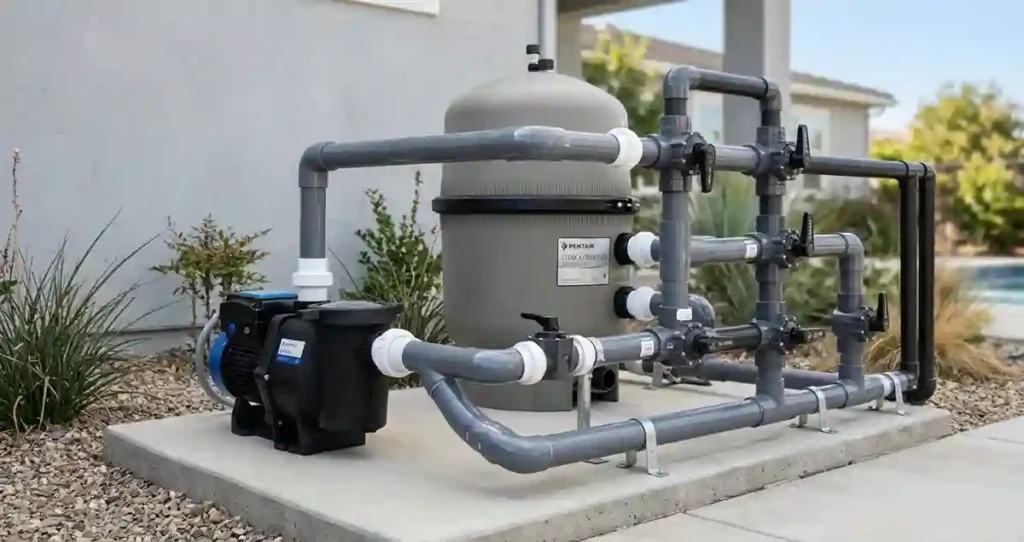
The bypass arrangement allows the system to control the proportion of water passing through the collectors.
Depending on the design, the valves may allow water to pass through the collectors, bypass them, or isolate the heating circuit for maintenance.
The valve layout must be designed to avoid unintended restrictions, unwanted reverse flow, and operating conditions outside the collector’s specified limits.
Engineer’s Note: A bypass valve is not simply an optional fitting to add wherever space is available. Its position and function must match the collector manufacturer’s hydraulic design. Incorrect valve positioning can restrict circulation or prevent the heating system from operating as intended.
5. Temperature sensors and controller
Automatic systems may use sensors to compare collector temperature with pool-water temperature. The controller can then direct water through the solar circuit when useful heat is available.
The exact control logic varies by manufacturer and system design. A controller should be configured according to the equipment instructions, including any requirements for minimum temperature difference, flow, or freeze protection.
A system without automatic controls may rely on manual operation, but the operator must understand when collector circulation is useful and when it should be stopped or bypassed.
What Is the Correct Position for the Solar Pool Heater?
In many conventional systems, the solar collector circuit is connected after the pool filter and before the water returns to the pool.
This arrangement means that filtered water reaches the collectors, helping limit debris entering the heating circuit.
However, the exact connection points should be confirmed against the pool equipment and collector manufacturer’s diagram. Some systems use additional equipment or different hydraulic arrangements.
Before deciding where to connect the collectors, verify:
- Existing pump and filter configuration
- Required collector flow rate
- Collector pressure limits
- Pipe diameter and total pipe length
- Elevation between the equipment pad and collectors
- Required bypass and isolation valves
- Drainage and freeze-protection requirements
Engineer’s Field Note: I would not approve a proposed connection based only on the fact that the pipes can physically be joined. The complete circuit must deliver the required flow without exceeding the operating limits of the pump, filter, collectors, or other components.
How Does the Solar Pool Heater Bypass Work?
A bypass arrangement directs water around the collectors when the solar heating circuit is not required or when the system design calls for bypass operation.
A common arrangement uses a supply connection from the filtered-water line, a route through the solar collectors, and a return connection to the pool return line. A valve assembly regulates the flow distribution.
When solar heating is useful, the system directs an appropriate amount of water through the collectors. When heating is unnecessary, the water may bypass the collector circuit.
When should the collectors be bypassed?
Depending on the system and controller, bypass operation may be appropriate when:
- The collectors cannot provide useful heat.
- The pool has reached its target temperature.
- The system is being isolated for maintenance.
- Seasonal shutdown or freeze protection requires a specific valve position.
- The manufacturer specifies another operating mode.
The correct operating sequence is equipment-specific. Do not assume every system should be operated using the same manual valve positions.
Engineer’s Note: A collector can become a source of heat loss under some conditions if relatively warm pool water circulates through a cooler collector. Automatic controls can help prevent this, but only when the sensors and control logic are installed and configured correctly.
Can the Existing Pool Pump Run the Solar Heater?
Often, yes. Many residential solar thermal pool-heating systems use the existing circulation pump.
However, the pump must provide the collector manufacturer’s required flow rate at the actual operating head. The addition of collectors, pipes, fittings, and vertical elevation can change the pump’s operating point.
A separate pump may be appropriate for some installations, but it should not be assumed necessary.
Before changing the pump, check:
- The manufacturer’s minimum and maximum collector flow requirements.
- The existing pump curve and expected operating point.
- Filter condition and pressure drop.
- Pipe size, length, and fitting losses.
- Collector elevation and circuit layout.
- The circulation schedule and required heating period.
Engineer’s Field Note: If a solar collector circuit performs poorly, replacing the pump should not be the first automatic response. The underlying restriction may be a dirty filter, unsuitable pipe sizing, incorrect valve positioning, or an installation that does not match the collector specifications.
How Much Solar Collector Area Does a Pool Need?
Collector sizing depends on the pool’s surface area, desired temperature, local climate, seasonal sunlight, wind exposure, and heat losses.
There is no single collector-area ratio that will guarantee the same performance in every location. A rule of thumb may provide an initial estimate, but the final design should reflect the actual site and operating requirements.
The following information should be collected before sizing the system:
- Pool surface area and water volume
- Target water temperature
- Expected swimming season
- Local solar availability
- Outdoor and nighttime temperatures
- Wind exposure
- Whether the pool is covered when not in use
- Available collector area and orientation
- Required daily circulation period
A larger collector array can capture more solar energy when sunlight is available, but it also requires more space and may increase hydraulic resistance. Collector sizing and pump selection must therefore be evaluated together.
Why a pool cover matters
Pool heating is not determined by collector output alone. The pool continuously exchanges heat with its surroundings, and evaporation can be a major source of heat loss.
A suitable pool cover helps reduce evaporation and retain heat. Our Solar Blanket Guide explains how pool covers help manage heat loss and how they differ from equipment that actively heats the water.
Engineer’s Note: I would evaluate the collector system and pool cover as complementary measures. A collector adds heat when solar energy is available; a cover helps retain heat already gained. If heat losses are excessive, installing more collector area may not be the most cost-effective first step.
Can a Solar Heater Be Connected to an Above-Ground Pool?
Yes, provided the collector, pump, filter, fittings, and pipework are suitable for the pool and compatible with one another.
Above-ground pools often use smaller circulation systems than in-ground pools. Their pumps may have limited flow capacity, so the additional resistance created by a collector circuit must be checked carefully.
Before connecting a collector, verify:
- The pump’s available flow and head
- Collector flow and pressure requirements
- Hose and fitting compatibility
- Maximum operating temperature and pressure
- Collector support and mounting requirements
- Drainage and seasonal shutdown procedures
Engineer’s Field Note: A collector that works on an in-ground pool cannot automatically be assumed suitable for an above-ground pool. The available pump pressure and the collector’s hydraulic resistance must be checked before installation.
Can Photovoltaic Panels Power a Pool Heating System?
Yes, but this is a different arrangement from direct solar thermal heating.
A photovoltaic system converts sunlight into electricity. That electricity may operate a compatible pool circulation pump, controller, or electric heat pump.
A solar thermal system instead transfers heat directly from the collectors to the pool water.
If PV panels are being used to power equipment, the design must account for the electrical load, motor starting requirements, operating schedule, controller compatibility, and whether battery storage or grid power is required.
Engineer’s Note: Do not connect a standard PV module directly to an ordinary pool pump unless the pump and control equipment are specifically designed for that electrical arrangement. Voltage, current, motor starting, protection, and control requirements must all be compatible.
Common Solar Pool Heater Installation Mistakes
1. Ignoring pump performance
The existing pump may not provide the required flow after the solar circuit is added. Check the pump curve and system head before deciding whether the pump needs to change.
2. Installing collectors in shaded areas
Shading reduces the solar energy available to the collectors. Assess shading over the expected heating season rather than checking only at one time of day.
3. Using unsuitable pipes and fittings
Pipes and fittings must be suitable for the system’s operating pressure, water chemistry, temperature, and outdoor conditions. Follow the manufacturer’s requirements.
4. Incorrect bypass-valve positioning
An unsuitable valve arrangement can restrict flow or prevent the system from operating as intended. Use the approved hydraulic diagram.
5. Overlooking roof structure and access
Roof-mounted collectors need appropriate structural support, secure mounting, weather resistance, safe access, and suitable pipe routing. Do not assume that available roof space is automatically suitable for installation.
6. Ignoring freeze protection
In climates where freezing is possible, the collector and piping design must provide the protection specified by the manufacturer. Some systems require draining or a particular shutdown procedure.
7. Failing to account for pool heat loss
A pool may gain heat during sunny hours and lose a substantial amount when exposed to wind or cool nighttime conditions. A suitable cover can improve heat retention.
Engineer’s Field Note: When a pool owner reports that the water is not reaching the desired temperature, I would check both heat input and heat loss. The issue may involve insufficient collector area, poor circulation, limited sunlight, excessive evaporation, or a combination of these factors.
How to Troubleshoot a Solar Pool Heater
When the system does not appear to be heating the pool effectively, start with simple checks and progress to technical measurements.
| Symptom | Possible cause | What to check |
|---|---|---|
| Little or no temperature increase | Low sunlight, insufficient collector area, or excessive heat loss | Weather, collector exposure, pool cover, and heating demand |
| Low collector flow | Restricted filter, unsuitable pump performance, valve position, or pipe losses | Filter pressure, pump operating point, valves, and pipe layout |
| Water leaks | Loose connections, damaged pipes, or unsuitable fittings | Visible plumbing and component connections |
| Pool gets cooler during collector operation | Collector is losing heat under current conditions | Collector and pool temperatures; controller or bypass operation |
| Automatic heating does not activate | Sensor, controller, configuration, or wiring issue | Sensor readings, controller status, and manufacturer’s diagnostic procedure |
| Repeated pump or system problems | Incorrect hydraulic design or component mismatch | Pump curve, collector limits, system head, and installation diagram |
These checks help narrow down the possible causes, but they do not replace the manufacturer’s diagnostic procedure.
Engineer’s Note: The symptom alone rarely identifies the failed component. A low temperature increase, for example, does not automatically mean the collectors are defective. The cause could be limited sunlight, insufficient flow, poor control settings, high heat loss, or incorrect sizing.
Electrical equipment and pressurised plumbing should be inspected and serviced by qualified personnel. Isolate the relevant equipment according to the manufacturer’s instructions before maintenance.
Solar Pool Heater Maintenance
Routine maintenance helps preserve circulation and heating performance.
Inspect visible pipes, valves, fittings, collector supports, and connections for damage or leakage. Maintain the pool filter according to its manufacturer’s instructions, and check that manual or automatic valves operate correctly.
For roof-mounted systems, confirm that mounting hardware remains secure and that the installation can be accessed safely for inspection.
Follow the manufacturer’s instructions for collector cleaning, seasonal shutdown, drainage, and freeze protection. Do not use cleaning methods or chemicals that may damage the collector material.
Engineer’s Field Note: A maintenance inspection should look beyond the collector surface. Even clean collectors may perform poorly if the filter is restricted, a valve is incorrectly positioned, a pipe is damaged, or the controller is not operating correctly.
Applicable Codes and Engineering Standards
Solar pool heating installations must comply with applicable local building, plumbing, pool-safety, and electrical requirements. Relevant US references include:
- ICC 902/PHTA 902/SRCC 400: Solar pool and spa heating systems.
- ISPSC: Swimming pool and spa installation and safety requirements.
- IPC: Applicable plumbing and piping requirements.
- NFPA 70 (NEC): Electrical safety for pool equipment and controls.
- NSF/ANSI/CAN 50: Relevant swimming pool and spa equipment.
- IEEE standards: Applicable electrical and control-system engineering practices; not a substitute for pool or plumbing codes.
Engineer’s Note: Confirm the code editions adopted by the local authority, the collector manufacturer’s installation instructions, and any permit requirements before installation. Requirements vary by location.
Frequently Asked Questions
How is a solar water heater connected to a pool?
A common arrangement sends water from the pool through the circulation pump and filter, then through a solar collector circuit before returning it to the pool. A bypass valve may control flow through or around the collectors.
Does the solar pool heater go before or after the filter?
In many conventional systems, the solar heating circuit is installed after the pool filter so filtered water enters the collectors. Always follow the approved plumbing diagram for the specific equipment.
Does a solar pool heater need a separate pump?
Not necessarily. The existing pump may be suitable if it can provide the required flow at the total system head. Check the pump curve and collector specifications before adding another pump.
Does a solar pool heater need a bypass valve?
Many systems use a bypass or diverter arrangement to control flow through the collectors. The exact configuration depends on the design and manufacturer’s instructions.
Can a solar pool heater work at night?
A conventional solar thermal collector does not collect useful solar heat at night. Under some conditions, circulating warm pool water through a cooler collector can increase heat loss, so the system may bypass the collectors.
Can I use a solar pool heater with an above-ground pool?
Yes, if the collector and plumbing are compatible with the pool’s pump and filtration equipment. The required flow rate and system pressure must be checked.
Does a pool cover replace a solar pool heater?
No. A cover primarily helps reduce evaporation and heat loss, while a solar thermal heater actively transfers solar heat to the water. They can be used together.
How long does a solar pool heater take to heat a pool?
There is no universal heating time. Performance depends on pool size, collector area, sunlight, outdoor temperature, wind, circulation time, and heat loss. The system should be sized around the desired water temperature and expected operating conditions.
Final Engineering Recommendation
A solar water heater can be connected to a pool by integrating suitable thermal collectors into the pool’s circulation system. In a common arrangement, filtered water passes through the collector circuit and returns to the pool, while a bypass arrangement controls collector flow.
However, correct plumbing does not guarantee good heating performance. The pump, filter, collector area, pipe sizing, valve arrangement, installation location, and control strategy must work together as one hydraulic system.
My engineering recommendation is to confirm the manufacturer’s plumbing diagram, calculate or verify the expected flow, assess the collector location, and estimate the pool’s heating demand before installation. Where heat loss is substantial, a suitable pool cover may improve the result more economically than increasing collector area alone.
Engineer’s Note: The objective is not simply to connect the pipes. It is to design a system that delivers the required water flow, captures useful solar heat, operates within the equipment limits, and maintains the pool temperature as reliably as the available conditions allow.
Related guides on SolarVisionAI.com
- Monocrystalline Solar Panels 2026: Still Worth It or Hype
- Polycrystalline Solar Panels: Worth Buying in 2026?
- Thin-film Solar Panels: When They Beat Silicon (2026)
- BIPV Solar Panels: Building-Integrated PV Complete Guide
- Portable Solar Panels: Engineer’s Buyer’s Guide 2026
- CPV Solar Panels: Concentrated Photovoltaic Explained
- Skin Solar Panel: What “Solar Skin” Actually Means
- Solar Fence Post Lights: Cap Sizes, Types & Install Guide
- Bifacial Solar Panels in 2026: How to Boost Energy Output
- Solar Charge Controller: The Complete Guide
- MC4 Connectors: Solar Safety & Installation Guide
- Solar Panel Types, Efficiency & Benefits
- Solar Water Pump Guide
- Commercial Solar Panel Installation: Engineering Guide
- Solar Fence Post Lights: Cap Sizes, Types & Install Guide
- BESS — Battery Energy Storage System Guide
- Commercial Solar Panel Installation
- Solar Refrigerator & DC Fridge — Complete 2026 Guide
- Bifacial Solar Panel Albedo Effect Guide
- TOPCon: Why TOPCon Solar Panel is a Proven Smart Investment in 2026
- HJT: Why TOPCon Solar Panel is a Proven Smart Investment in 2026
- PERC: PERC Solar Panel: Still Relevant or Already Outdated?
- Perovskite: Perovskite Solar Panels: The 2026 Reality Check
- N-Type vs P-Type: N-Type vs P-Type Solar Panels: Honest Comparison
- ABC: ABC (all back contact) Solar Panel: Back Contact Technology Explained
- IBC: IBC Solar Panels: Interdigitated Back Contact Guide
- Tandem: Tandem Solar Panels: Are Stacked Cells Ready for Rooftops?