
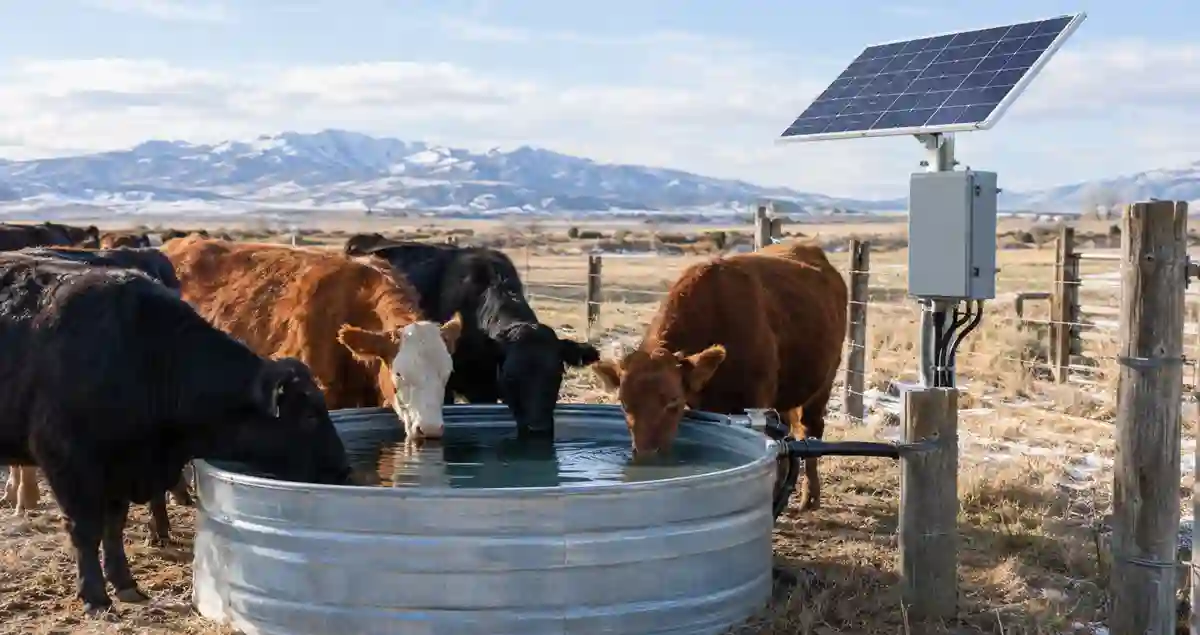
Explore solar livestock water heater options for farms and ranches. Compare PV-powered and solar thermal systems, sizing, installation, and winter limitations.
Providing reliable drinking water for livestock becomes more difficult when temperatures drop below freezing. On farms and ranches, frozen water troughs can disrupt access to water, increase daily maintenance needs, and create additional work during winter.
A solar livestock water heater can help address this challenge when the system is properly matched to the animals’ water requirements, local weather, and available solar energy. Depending on the design, solar energy can power an electric trough heater or supply heat through a solar thermal collector.
However, solar heating is not a universal solution for every farm. A system that works well in a sunny climate may struggle during prolonged cold spells, particularly when animals need access to water overnight.
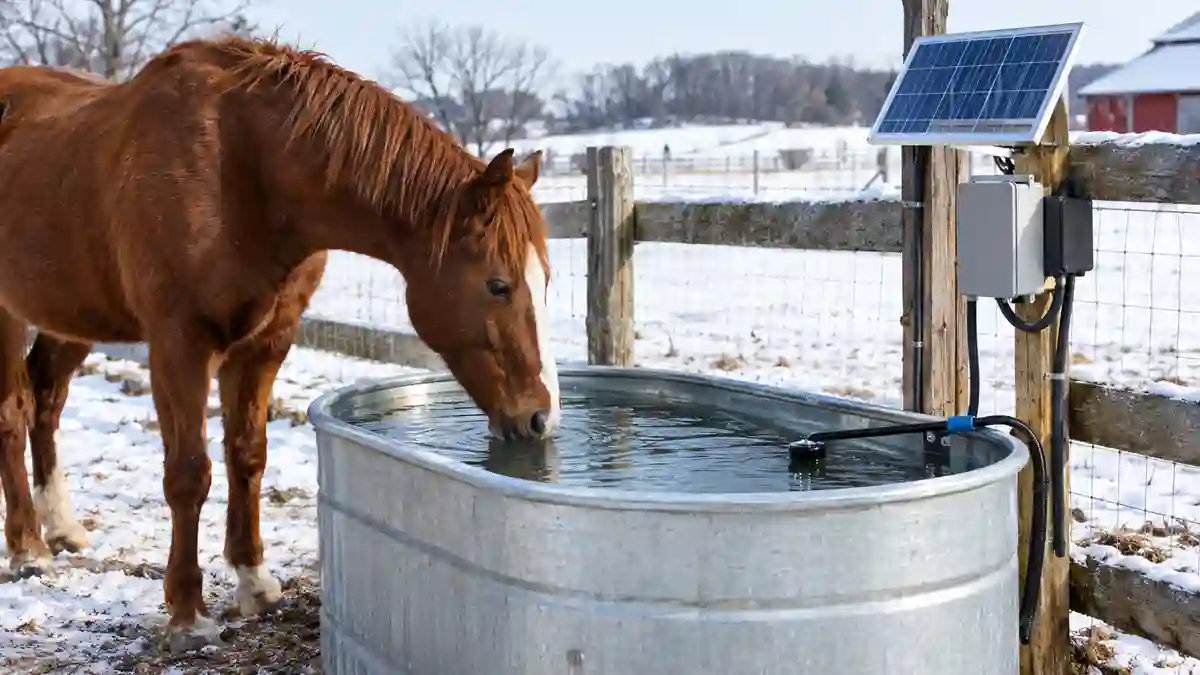
This guide compares the main solar livestock water-heating options, explains how to choose and size a system, and covers installation, operating limitations, and practical considerations for farms and ranches.
What Is a Solar Livestock Water Heater?
A solar livestock water heater is a system that uses solar energy to help heat water supplied to farm animals. Its main purpose may be to reduce freezing, maintain accessible drinking water, or supplement another water-heating arrangement.
The term can describe different technologies, so it is important to understand how each system operates before selecting equipment.
Solar PV-powered heating uses photovoltaic panels to generate electricity for a compatible electric heater. Solar thermal heating captures sunlight as heat and transfers that energy to water through an appropriate system.
Some installations may also use batteries, insulation, temperature controls, or a backup power supply to improve reliability.
The most suitable design depends on the farm’s livestock, trough capacity, minimum winter temperatures, and the amount of heat needed to offset environmental losses.
How Solar Livestock Water Heating Works
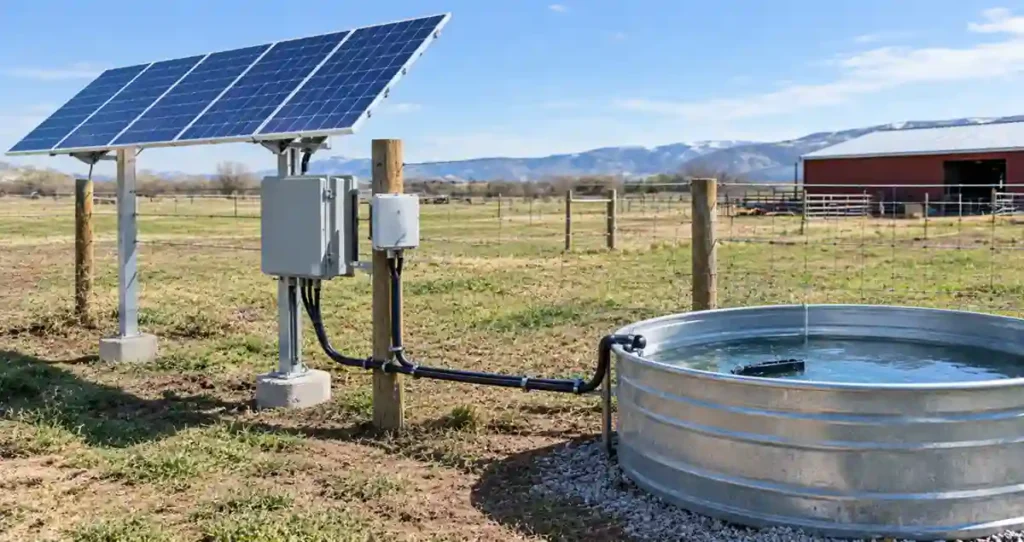
1. Photovoltaic-powered electric heating
Photovoltaic panels convert sunlight into electricity. The electricity can then operate a compatible electric trough heater or purpose-designed heating system.
Depending on the installation, the equipment may include:
- Solar PV panels
- A compatible controller or power-conditioning equipment
- An electric trough heater
- Appropriate wiring, grounding, and electrical protection
- Temperature controls, where supported
- Battery storage or another power source if heating is required after sunset
PV-powered heating can be useful where electric heating is appropriate, particularly on farms with good solar exposure or an existing off-grid electrical system.
However, the solar array must be sized for the heater’s actual energy consumption. Winter sunlight may be limited just when heating demand is highest.
A standard AC trough heater should not be connected directly to a solar panel unless the equipment is specifically designed for that configuration. Voltage, current, control requirements, and electrical protection must all be compatible.
2. Solar thermal heating
Solar thermal systems capture heat directly from sunlight. A collector absorbs solar energy and transfers it to a heat-transfer fluid or, in some designs, directly to water.
A livestock water-heating installation may use:
- Solar thermal collectors
- Insulated pipes
- A circulation pump, if required
- A suitable heat exchanger
- Temperature and circulation controls
- Freeze protection for exposed pipes and components, where necessary
Solar thermal heating can provide useful heat under suitable conditions, but the collected energy varies with sunlight and weather. Heat losses from the trough and piping also affect performance.
A domestic solar hot-water system is not automatically suitable for livestock drinking water. The installation must account for water quality, temperature, materials, circulation, and the risk of freezing in exposed components.
3. Solar energy with battery storage
A PV system with battery storage can make solar-generated electricity available after sunset. This may be useful where a compatible electric heater must operate when the panels are no longer producing power.
The system needs to account for the heater’s power rating, operating hours, battery capacity, conversion losses, and expected winter solar generation.
Batteries do not create additional energy; they store electricity generated earlier and introduce additional cost and efficiency losses. During extended cloudy periods, a system may still require backup power or another freeze-protection strategy.
For farms planning an independent power supply, our guide to off-grid solar systems explains how solar panels, batteries, inverters, and electrical loads work together.
Choosing a System for Cattle, Horses, Sheep, and Goats
Different livestock operations have different water requirements and installation conditions. A system should be selected for the actual trough and animals rather than assuming one heater will work for every application.
Cattle
Cattle operations may use large troughs serving several animals. The volume of water, rate of replenishment, exposure to wind, and number of animals using the trough can all affect the heating requirement.
A small solar-powered heater may be inadequate for a large, exposed trough during severe winter weather. Assess the trough’s capacity and heat loss before selecting the heater and power system.
Horses
Horse owners need a safe, accessible supply of clean drinking water. Heating equipment should be installed so that animals cannot chew cables, damage electrical connections, or contact hazardous components.
For horse-specific guidance, link to the companion article “Solar Water Heater for Horse Troughs: What Works Best?” once that page is published.
Sheep and goats
Smaller livestock operations may use smaller troughs, but water can still freeze when temperatures remain low for extended periods.
Consider the trough material, location, daily water use, and whether animals have access to alternative water points. Equipment should be suitable for the particular installation and protected from damage by animals.
Mixed-livestock farms
Farms keeping several types of livestock may need more than one watering arrangement. Trough capacity, animal access, and heating requirements can differ between areas of the property.
Where separate troughs are used, assess each one individually rather than sizing the entire system from the total number of animals alone.
How to Choose the Right Solar Livestock Water Heater
Before purchasing equipment, evaluate the following factors.
1. Trough capacity and heating demand
The amount of water in the trough affects the energy required to raise its temperature. A large trough generally requires more energy than a small one for the same temperature increase.
However, preventing freezing is not just a one-time heating task. The system must also offset heat lost to the surrounding air, trough walls, and wind.
2. Winter sunlight
Review the solar resource during the coldest months, not just the annual average. Shorter days, cloud cover, shading, and snow can reduce available solar energy.
If heating must continue overnight, daytime solar generation alone will not provide power at that time. Storage, backup power, or another suitable strategy may be necessary.
3. Heater compatibility
Check the heater’s rated voltage, power consumption, operating requirements, and suitability for livestock water applications.
Do not assume that a standard immersion heater, domestic water heater, or AC trough heater can operate directly from a PV panel. Follow the equipment manufacturer’s specifications.
4. Temperature controls and safety
Suitable controls can help manage heating demand and reduce unnecessary energy use. The exact controls required depend on the heater and system design.
Outdoor electrical equipment should be properly rated, protected from moisture and impact, and installed according to the manufacturer’s instructions and applicable electrical codes.
5. Maintenance and backup
Consider how easily the system can be inspected, repaired, and maintained. Remote properties may need a backup plan for periods of poor sunlight, equipment failure, or extreme cold.
A solar system should not be treated as reliable freeze protection unless its performance has been evaluated under the site’s expected winter conditions.
Sizing, Installation, and Seasonal Performance
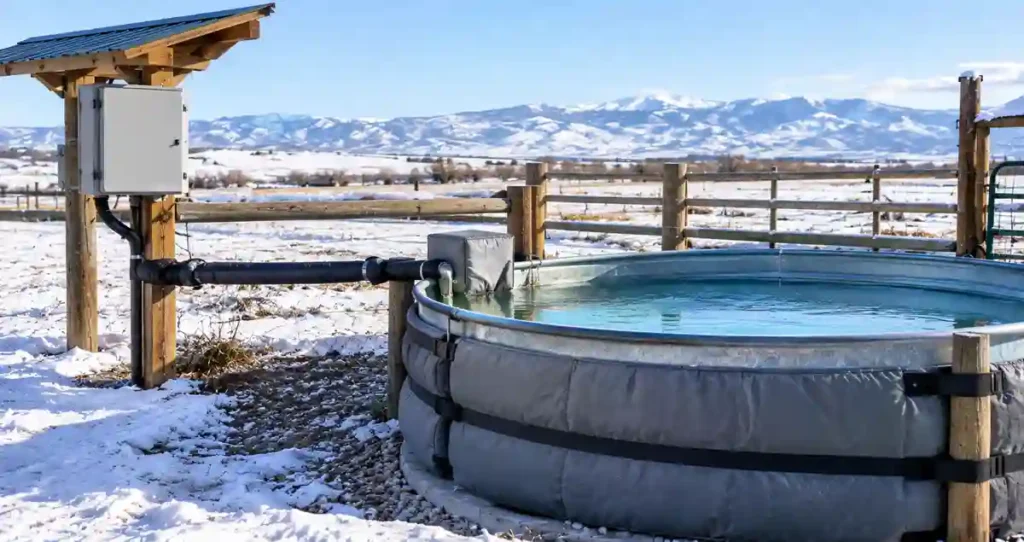
Correct sizing starts with the water volume, required temperature increase, and expected heat loss.
Estimate the energy needed to heat the water
The theoretical energy required to raise the temperature of water can be estimated using:
Q = m × cₚ × ΔT
Where:
- Q is the heat energy required.
- m is the mass of water in kilograms.
- cₚ is the specific heat capacity of water, approximately 4,186 joules per kilogram per degree Celsius.
- ΔT is the required temperature increase in degrees Celsius.
For example, a trough containing 100 US gallons holds approximately 379 litres of water, with a mass of about 379 kg.
Raising that water temperature by 5°C requires approximately 2.2 kWh of thermal energy under ideal conditions.
This is the energy needed for the temperature increase alone. It does not include heat lost to the environment or the energy needed to maintain the temperature.
The actual heating requirement may be substantially higher during freezing weather. A qualified system designer should assess heat loss and the conditions under which the trough must remain usable.
Match the solar array to the load
For an electric heater, calculate daily energy consumption from its rated power and expected operating hours.
For example, a 200-watt heater operating for 10 hours would consume:
200 W × 10 hours = 2,000 Wh, or 2 kWh.
This example illustrates energy consumption only; it does not establish that a 200-watt heater is suitable for a particular trough.
The solar array must generate enough usable energy to meet the load under winter conditions, accounting for system losses. If batteries are used, their usable capacity must also be sufficient for the required operating period.
Our Solar Battery Size Calculator can help readers understand the relationship between energy consumption, backup duration, and battery capacity.
Reduce heat loss
Insulation may reduce heat loss through the trough walls and base. Positioning the trough in a sheltered area can also reduce exposure to wind, provided the location remains safe and accessible for the animals.
Insulation slows cooling but does not produce heat. In sufficiently cold conditions, an insulated trough can still freeze.
Protect pipes and electrical components
Exposed pipes, valves, and circulation equipment may freeze even when the trough itself remains usable. Protect vulnerable components in accordance with the system design and the manufacturer’s guidance.
Keep cables and electrical connections out of reach of animals. Use appropriate grounding, overcurrent protection, and weather-rated equipment. Never use improvised electrical heaters in drinking water.
If the system includes a lithium battery, the charge controller must be compatible with the battery chemistry and manufacturer requirements. Our guide to solar charge controllers for lithium batteries explains the importance of compatible charging settings and protection features.
Plan for seasonal maintenance
Before winter, inspect the trough, heater, solar panels, wiring, controls, and any exposed piping. Remove dirt and debris from panels as recommended by the manufacturer, and check for damage or loose connections.
During cold weather, monitor water access and system operation. A backup water supply or suitable alternative freeze-protection arrangement may be necessary during prolonged cold spells.
Costs, Benefits, and Limitations
The cost of a solar livestock water heater depends on the heating method, trough size, solar array, controls, installation, and whether battery storage is required.
A simple PV-powered arrangement may have fewer components than a system with battery storage, while a solar thermal installation may require collectors, piping, circulation equipment, and a heat exchanger. Actual costs vary considerably by design and location, so a site-specific quote is more useful than a generic price estimate.
Potential benefits
- Uses solar energy when sunlight is available.
- May reduce purchased electricity under suitable operating conditions.
- Can support remote farms where grid power is unavailable or difficult to access.
- Can complement insulation and other measures that reduce heat loss.
Important limitations
- Solar production varies by season and weather.
- Nighttime heating requires stored energy, another heat source, or a suitable alternative.
- Batteries, pumps, controllers, and heat exchangers add cost and maintenance requirements.
- Poor sizing can result in inadequate freeze protection.
- Equipment must be suitable for outdoor use and safe around livestock.
The best choice balances heating demand, reliability, installation complexity, and operating costs. The lowest-cost system is not necessarily the best option if it cannot maintain water access during the coldest periods.
Frequently Asked Questions
Can a solar livestock water heater prevent water from freezing?
It can help, but performance depends on the heating system, trough capacity, weather, and available energy. Solar panels alone cannot guarantee that water will remain ice-free overnight or during extended cloudy periods.
Can solar-powered heating work for cattle water troughs?
Yes, a properly designed system may be suitable for cattle troughs. Large troughs can require substantial heating energy, so assess water volume, heat loss, winter sunlight, and backup requirements before selecting equipment.
Is solar thermal heating better than PV-powered heating?
Neither option is always better. PV-powered systems generate electricity for compatible heating equipment, while solar thermal systems collect heat directly. The suitable choice depends on the installation, required heating capacity, and local operating conditions.
Do I need batteries for a solar livestock water heater?
Not always. Batteries may be needed if a PV-powered heater must operate after sunset and there is no other suitable power source. A system without batteries requires another way to address nighttime heating and periods of low solar production.
Does insulation prevent livestock troughs from freezing?
Insulation reduces heat loss but does not generate heat. During sufficiently cold weather, water may still freeze. Insulation works best as part of a broader water-management and freeze-protection plan.
Can I use a regular domestic water heater for livestock?
Not without confirming that the equipment and installation are suitable for the application. Domestic water-heating equipment may have different electrical, plumbing, temperature, and water-quality requirements. Follow the manufacturer’s guidance and seek qualified advice before adapting equipment.
What should I check before winter?
Inspect the trough, heating equipment, solar panels, wiring, controls, and exposed pipes. Confirm that the system is operating as intended and prepare an alternative plan for extended cold spells or equipment failure.
Final Recommendation
A solar livestock water heater can support farm water management when it is selected and installed for the actual conditions on the property.
Start by assessing trough capacity, livestock requirements, minimum winter temperatures, solar availability, and the amount of heat needed to offset losses. Then compare PV-powered electric heating, solar thermal systems, and appropriate backup arrangements.
For many farms and ranches, the most practical solution combines reduced heat loss, safe equipment, reliable water access, and solar energy where it makes technical and economic sense.
The priority is to provide livestock with dependable access to clean drinking water throughout winter—not simply to install solar equipment
Related guides on SolarVisionAI.com
- Monocrystalline Solar Panels 2026: Still Worth It or Hype
- Polycrystalline Solar Panels: Worth Buying in 2026?
- Thin-film Solar Panels: When They Beat Silicon (2026)
- BIPV Solar Panels: Building-Integrated PV Complete Guide
- Portable Solar Panels: Engineer’s Buyer’s Guide 2026
- CPV Solar Panels: Concentrated Photovoltaic Explained
- Skin Solar Panel: What “Solar Skin” Actually Means
- Solar Fence Post Lights: Cap Sizes, Types & Install Guide
- Bifacial Solar Panels in 2026: How to Boost Energy Output
- Solar Charge Controller: The Complete Guide
- MC4 Connectors: Solar Safety & Installation Guide
- Solar Panel Types, Efficiency & Benefits
- Solar Water Pump Guide
- Commercial Solar Panel Installation: Engineering Guide
- Solar Fence Post Lights: Cap Sizes, Types & Install Guide
- BESS — Battery Energy Storage System Guide
- Commercial Solar Panel Installation
- Solar Refrigerator & DC Fridge — Complete 2026 Guide
- Bifacial Solar Panel Albedo Effect Guide
- TOPCon: Why TOPCon Solar Panel is a Proven Smart Investment in 2026
- HJT: Why TOPCon Solar Panel is a Proven Smart Investment in 2026
- PERC: PERC Solar Panel: Still Relevant or Already Outdated?
- Perovskite: Perovskite Solar Panels: The 2026 Reality Check
- N-Type vs P-Type: N-Type vs P-Type Solar Panels: Honest Comparison
- ABC: ABC (all back contact) Solar Panel: Back Contact Technology Explained
- IBC: IBC Solar Panels: Interdigitated Back Contact Guide
- Tandem: Tandem Solar Panels: Are Stacked Cells Ready for Rooftops?