
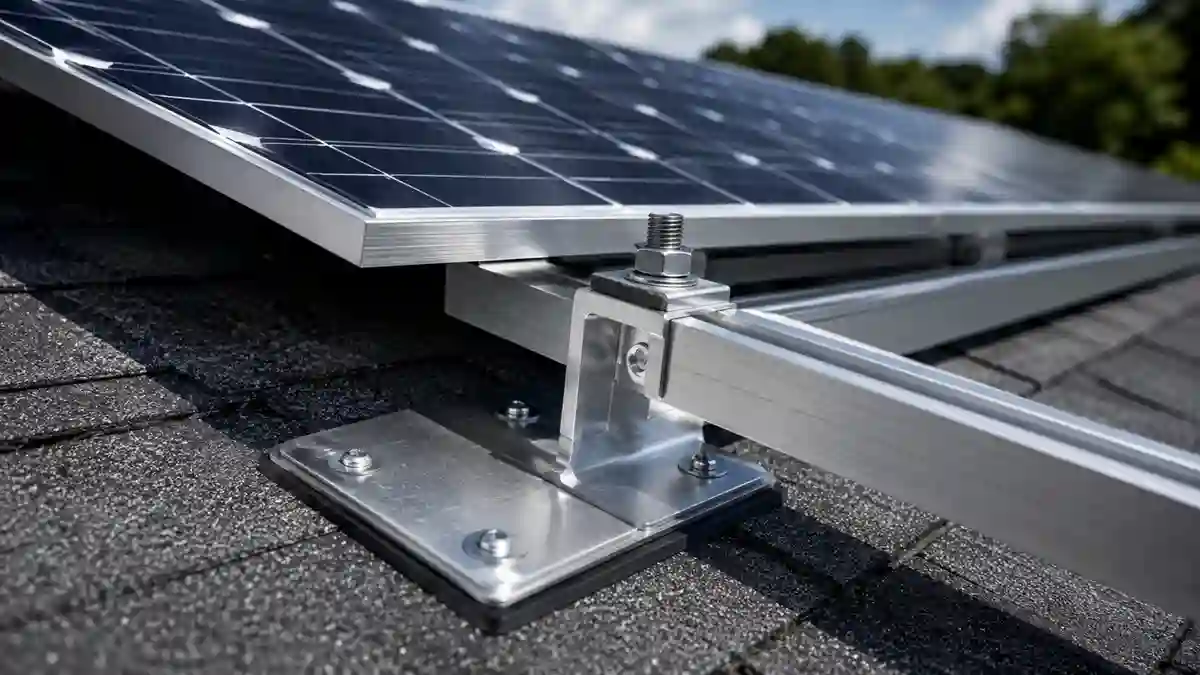
Most solar panel mounting brackets failures trace back to one mistake — wrong substrate assumption. Pull-out ratings, fastener grades, roof types, and hardware checklist inside.
I have reviewed mounting bracket specifications from building owners who chose their hardware based on the cheapest line item in a contractor’s quote. The brackets arrived, the installation went ahead, and six months later, there were roof leaks, cracked rails, and in one case, a panel that shifted 40 mm out of alignment on the first major storm. The cost of re-mounting exceeded the original bracket savings by a factor of eight.
Mounting brackets are the mechanical interface between your solar array and your building. They carry the static weight of the panels, the dynamic wind uplift loads, the thermal cycling stress over 25 years of outdoor exposure, and — on penetrating systems — the waterproofing responsibility for every roof penetration they create. Getting them right is not a detailed decision. It is a structural engineering decision that sits at the foundation of everything covered in the
Solar Mounting Systems: The Complete Engineer’s Guide — the hub page for this cluster.
This guide covers what mounting brackets actually do, how to specify the right type for your roof, and what the engineering standards require.
1. What Solar Panel Mounting Brackets Actually Do
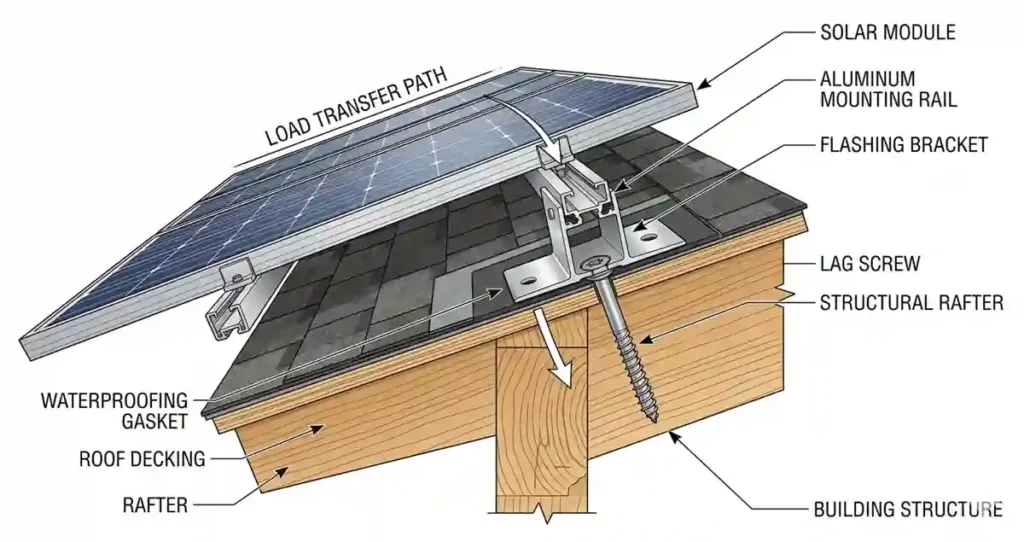
A solar panel mounting bracket performs three simultaneous structural functions: it transfers vertical gravity loads from the module frame through the mounting system to the building structure; it resists horizontal and uplift wind loads — which in high-wind zones can exceed the gravity loads by a factor of two or three; and on roof-penetrating systems it creates and seals the mechanical attachment point through the roof membrane.
Wind uplift resistance requires that the bracket’s pull-out capacity from the roof structure meets or exceeds the calculated uplift force at that attachment point. The load rating methodology behind this is explained fully in the Mounting Brackets for Solar Panels: Types, Load Ratings & Roof Compatibility guide.
Engineer’s Note: The most common bracket specification error I see is selecting hardware based on the bracket’s rated capacity without verifying the capacity of the substrate the bracket attaches to. A flashing-and-lag-screw assembly rated at 800 lbs pull-out capacity means nothing if it is installed into OSB sheathing with no rafter below. Substrate matters. Always.
2. Types of Solar Panel Mounting Brackets
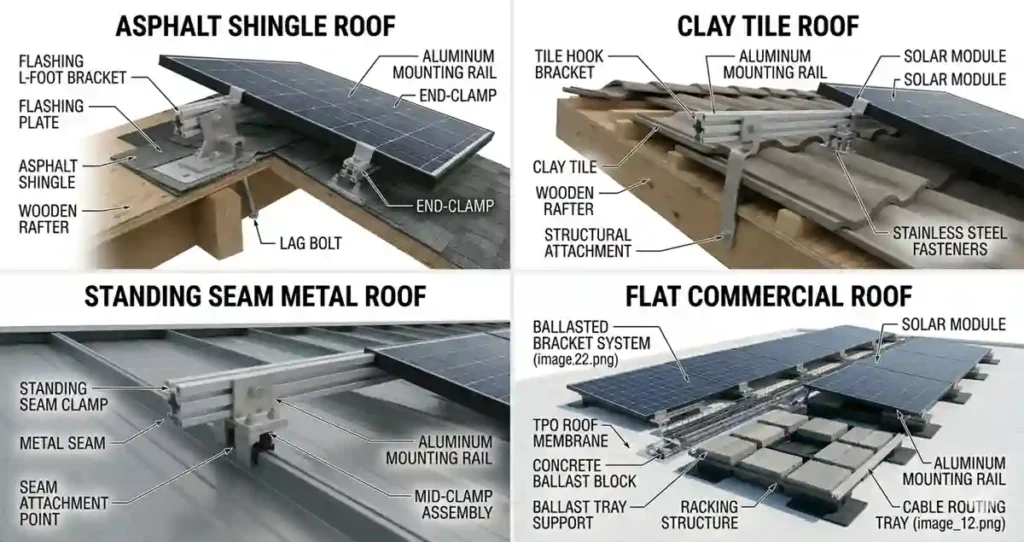
Roof Hook / Flashing Bracket (Pitched Tile or Shingle Roof)
The standard attachment method for pitched roofs. A roofing hook or L-foot slides under the existing roof material, attaches to the structural rafter below, and provides the elevated attachment point for the mounting rail above. The complete rail specification — alloy, T-slot geometry, and span limits — is covered in the Solar Mounting Rails guide. The roof-type-specific waterproofing detail is in the Roof Solar Panel Mounting Brackets post.
Ballasted Bracket (Flat Membrane Roof)
On flat commercial roofs, ballasted bracket systems avoid roof penetrations entirely. The mounting frame is held in place by weight — typically concrete blocks — distributed across the roof surface. This structural verification process is part of the load calculation framework in the Solar Mounting Systems hub.
Through-Bolt Attachment (Metal Roof)
Standing seam metal roofs use clamp-based brackets that grip the raised seam without penetrating the metal. For anyone working through solar panel installation on a metal roof, clamp ratings are the first thing to verify — they are profile-specific, and a clamp tested on a 1.5-inch seam will not perform equivalently on a 2-inch seam of different geometry. The full roof compatibility matrix — including seam clamp requirements — is in the Roof Solar Panel Mounting Brackets guide.
Ground Mount Pier Bracket
Ground-mounted systems use pier brackets that attach the mounting structure to driven piles, helical piers, or concrete footings. The complete ground mount structural system is covered in the Solar Panel Ground Mounting Systems guide.
3. Bracket Specifications: What to Look For
| Specification Parameter | Why It Matters | Minimum Standard |
| Material | Galvanic corrosion between aluminum and steel is a 25-year failure mode | 6063-T5 or 6061-T6 aluminum for rails; 316 stainless or hot-dip galvanized steel for fasteners |
| Pull-out capacity (lbs) | Must exceed site-specific wind uplift calculation | Verify against ASCE 7 wind zone — not manufacturer default |
| Shear capacity (lbs) | Resists lateral sliding — relevant on pitched roofs | Verify against panel weight + seismic zone if applicable |
| Torque spec (in-lbs) | Under-torqued = loose; over-torqued = cracked flashing | Follow manufacturer spec exactly — mark verified fasteners |
| Waterproofing method | Every penetration is a liability | EPDM gasket + butyl sealant on all through-roof penetrations |
| Compatibility with rail | Bracket and rail must be from same engineering system | Mixed brands void load testing and warranty |
4. Solar Panel Mounting Brackets with Hardware: What the Kit Should Include
A complete mounting bracket kit should include the components listed in detail in the Solar Panel Mounting Brackets with Hardware guide: flashing bracket or roof hook assembly, mounting rail sections with splice connectors, mid and end clamps, grounding hardware, all fasteners in grade 316 stainless steel, and installation torque specifications for each fastener point.
Bracket kits sold without specified fasteners — or with zinc-plated carbon steel fasteners — are not appropriate for commercial rooftop use. Zinc-plated fasteners in a coastal or high-humidity environment will show corrosion within five years. Stainless is not optional on any permanent installation.
Field Note: When I receive a commercial mounting hardware submittal, the first thing I check is the fastener specification. If the submittal specifies ‘stainless steel’ without a grade designation, I return it. Grade 304 and Grade 316 are both stainless. Grade 304 will corrode in coastal environments. Grade 316 will not. The difference in cost per fastener is cents. The difference in 25-year performance is real.
5. Mounting Brackets for Solar Panels: Roof Compatibility Matrix
| Roof Type | Recommended Bracket Type | Penetration | Key Engineering Requirement |
| Asphalt shingle (pitched) | L-foot with integrated flashing | Yes — into rafter | Rafter location, pull-out verification, sealing |
| Concrete/clay tile (pitched) | Tile hook with replacement tile | Yes — through tile, into rafter | Profile-matched tile hook, full tile replacement under bracket |
| EPDM/TPO flat | Ballasted frame system | No | Structural capacity for ballast dead load; wind uplift per ASCE 7 |
| Modified bitumen flat | Penetrating with flashing | Yes | Full-surface flashing bonded to membrane; no lap seams at penetration |
| Standing seam metal | Seam clamp (no penetration) | No | Clamp rated to specific seam profile; clamp spacing per wind load calc |
| Corrugated metal | Through-fastener with rubber grommet | Yes | Grommet compression — not over-tightened; check flange pull-out |
| Concrete deck / parapet | Anchor bolt into structural slab | Yes | Embed depth per structural engineer; waterproofing at slab penetration |
6. Common Mistakes in Bracket Selection and Installation
- Rafter spacing assumption: Installers who locate brackets based on assumed 16-inch rafter spacing without physically probing create attachments that miss the framing member. A bracket screwed into sheathing only has essentially zero pull-out capacity.
- Sealant substitution: Silicone sealant is not a roofing sealant. Polyurethane roofing sealant, butyl tape, or EPDM gaskets are the correct materials for roof penetration sealing.
- Over-torquing flashing brackets: Specified torque values are typically 100 to 140 inch-pounds. Over-torquing cracks the flashing bracket and destroys the compressive seal.
- Mismatched rail and bracket systems: Structural load testing is performed on complete systems. Mixing components from different manufacturers voids tested load ratings. The rail T-slot geometry this affects is specified in the Solar Mounting Rails guide (Post 8).
7. What a Correct Commercial Mounting Bracket Installation Looks Like
On a correctly engineered installation, every bracket location appears on the structural drawings with its attachment point verified against rafter or framing layout. Fastener pull-out capacity at each location is documented against the wind uplift calculation for that specific position. Every penetration has been sealed per the roofing manufacturer’s specifications. Torque verification is documented for every fastener. The complete commissioning checklist — including torque verification, grounding continuity, and waterproofing inspection — is in the Solar Panel Rail Mounting Kit: Complete Installation Guide. For the full structural engineering framework, see the Solar Mounting Systems hub.
Frequently Asked Questions
What are solar panel mounting brackets?
Solar panel mounting brackets are structural components that connect solar modules and mounting rails to a roof or ground-mounted support structure.
How do I choose the right solar panel mounting bracket?
The correct bracket depends on roof type, substrate material, wind loads, corrosion exposure, and the mounting system manufacturer’s requirements.
Are all solar mounting brackets compatible with every roof?
No. Different roof types require specific bracket designs such as flashing L-feet, tile hooks, seam clamps, or ballasted systems.
What material is best for solar mounting brackets?
Aluminum alloys such as 6061-T6 and 6063-T5 are commonly used, while fasteners should typically be Grade 316 stainless steel for long-term corrosion resistance.
Do solar mounting brackets affect roof waterproofing?
Yes. Any roof penetration must be properly flashed and sealed to prevent leaks and maintain roof integrity.
How long do solar mounting brackets last?
High-quality mounting brackets are designed to last 25 years or more when installed correctly and matched to the environment.
Related guides on SolarVisionAI.com
Solar Panel Installation: Complete Engineering Guide (2026)
Solar Panel Installation Cost: The Complete 2026 Breakdown
Commercial Solar Panel Installation: Engineering Guide 2026
When Is the Best Time to Install Solar Panels?
Solar Power System in 2026: Types, Cost, ROI & AI Optimization
MC4 Connectors: Solar Safety and Installation Guide