
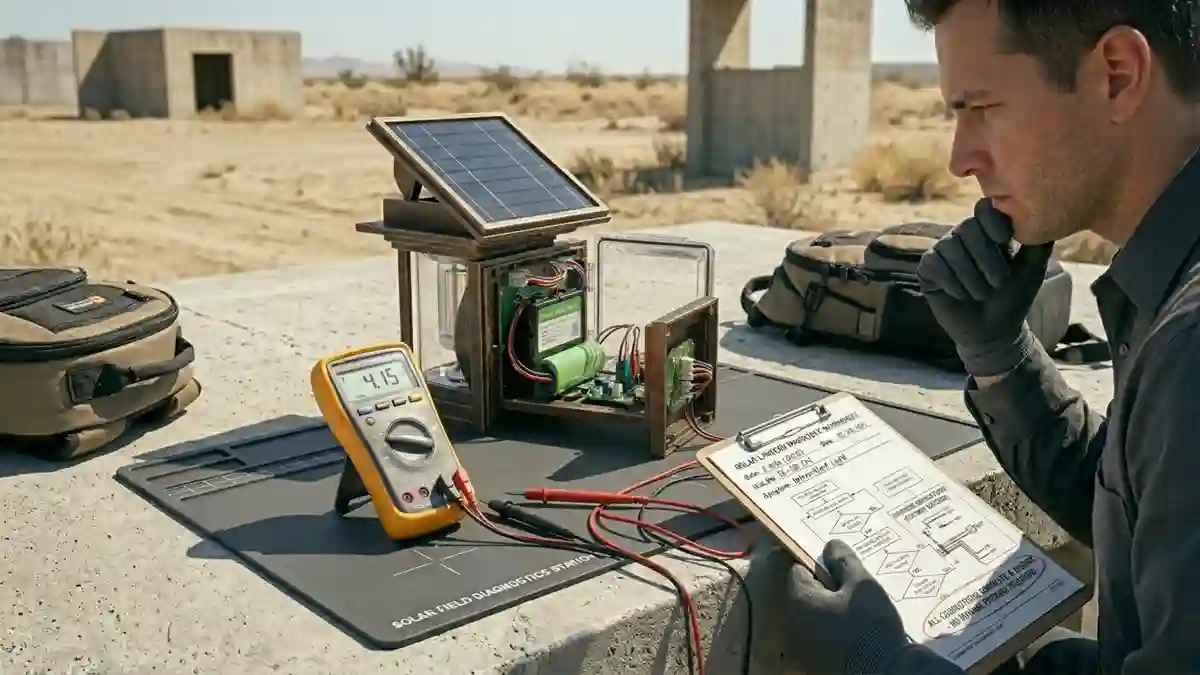
Most solar lanterns just need a $3 NiMH cell. An engineer covers solar lantern replacement parts — the right diagnostic, what to buy, and when to replace instead.
A solar lantern that stops working or runs for only an hour before cutting out is not necessarily at end of life. In the majority of cases, the failure is a single component — such as the battery, solar panel, LED module, or charging circuit — and that component is replaceable. The diagnostic sequence is straightforward: identify which part has failed, determine whether a replacement is available and cost-effective, and fix it rather than discard it.
This guide is the maintenance companion to the solar lanterns buying guide.
1. Solar Lantern Replacement Parts: Which Part Has Failed?
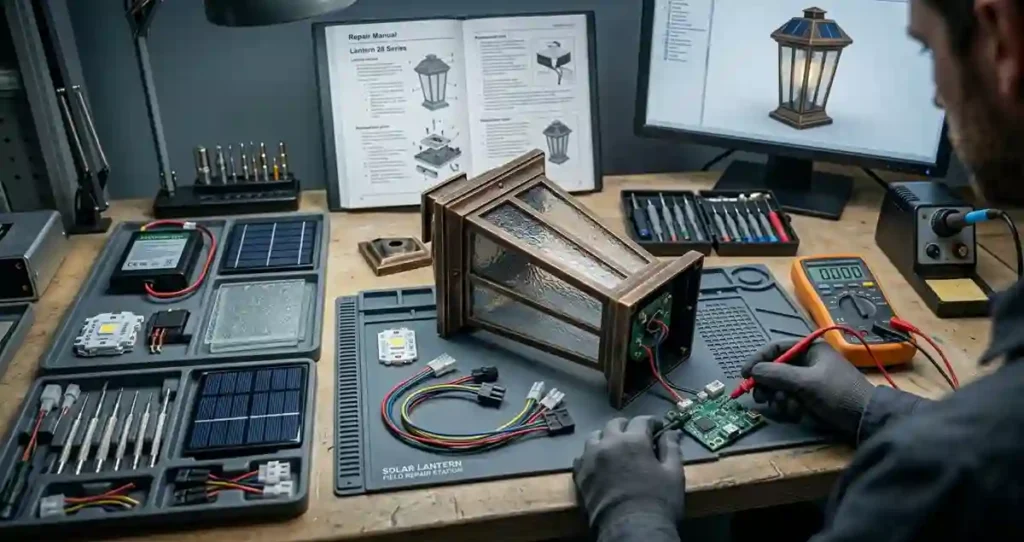
| Symptom | Most likely cause | Diagnostic test | Fix |
| Runs 1–2 hrs then cuts out | Battery degraded — capacity reduced | Measure voltage after full charge: below 1.1V NiMH or 3.5V Li-ion = worn cell | Replace battery cell |
| Doesn’t turn on at all | Battery fully dead | Measure voltage: 0V or very low = dead cell | Replace battery cell |
| Never charges | Solar panel fault or dusk sensor fault | Cover panel — if dusk sensor triggers, panel may be shorted | Test panel output; replace if zero |
| Charges but LED very dim | LED driver fault or LED degradation | Replace battery first. If still dim, LED or driver failed. | Replace LED module if available |
| Intermittent — works some nights | Corroded battery contacts | Inspect contacts — white or green corrosion is common | Clean with fine sandpaper; apply dielectric grease |
2. Battery Cell Replacement — The Most Common Fix
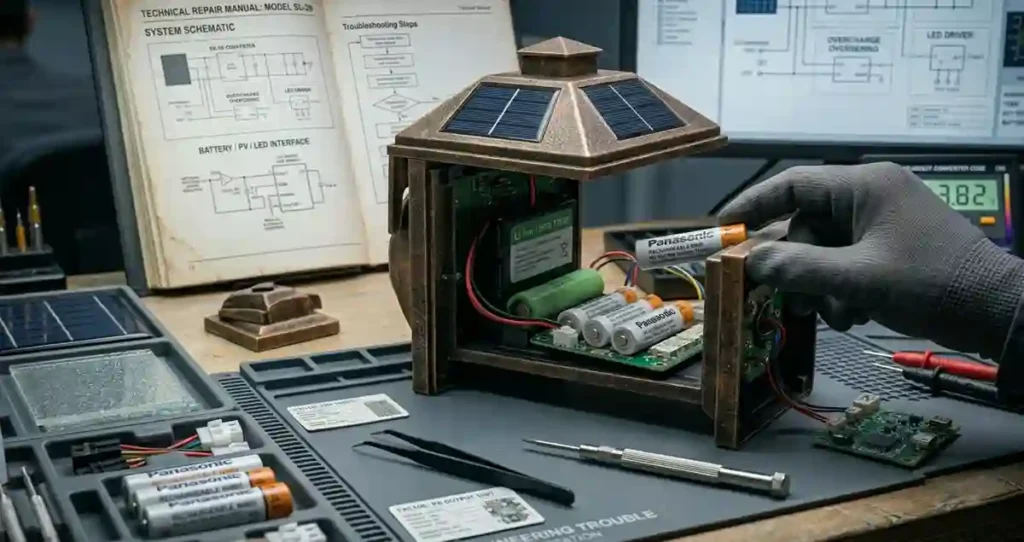
The majority of solar lantern failures are battery cell failures. NiMH cells in solar cap lights and hanging lanterns typically last 500 to 1000 charge cycles — two to three years of daily outdoor use. After that, capacity drops to the point where the lantern cannot sustain its rated lumen output through the night.
Finding the battery
Open the lantern base or rear cover — typically a small Phillips screw or a twist-off base. Most cap lights use one or two AA or AAA NiMH cells. Note the cell voltage (1.2V nominal for NiMH) and capacity (printed on the cell in mAh).
Replacement specification
Replace with NiMH cells only — not alkaline, not standard rechargeable lithium AA cells. Alkaline cells do not accept solar charge. Replacing a 600 mAh cell with a 1000 mAh cell is a direct upgrade that extends runtime without any other modification.
Engineer’s Note: The most common replacement error is substituting alkaline AA cells because they are immediately available. Alkaline cells will provide one night of light from their stored charge and will not recharge from the solar panel. The lantern appears to work once, fails the next night, and the user concludes the lantern is broken. The lantern is fine. The cell chemistry is wrong. Use NiMH only.
| Lantern type | Typical cell | Replacement spec | Cost per cell | Expected life |
| Small cap / hanging (decorative) | AAA NiMH 400–600 mAh | AAA NiMH 800–1000 mAh | $1–3 | 2–3 years |
| Standard cap / post-mount | AA NiMH 600–1000 mAh | AA NiMH 1500–2000 mAh | $2–4 | 2–3 years |
| Larger post-mount / wall-mount | AA NiMH 1200–2000 mAh or integrated Li-ion | Match capacity or upgrade | $3–8 | 2–3 years |
| Portable / camping lantern | Integrated Li-ion pack | Manufacturer-specific — model number required | $5–20 | 1–2 years |
3. Solar Lantern Replacement Parts: How to Test and Replace a Failed Solar Panel
Testing the panel
Use a multimeter in DC voltage mode. In direct sunlight, measure the voltage across the panel terminals. A functional panel should read 2 to 6V depending on panel size. Zero voltage or very low voltage (below 1V) in direct sun indicates a panel fault. A 3×5 cm panel should produce 30 to 80 mA in direct sun.
Panel replacement
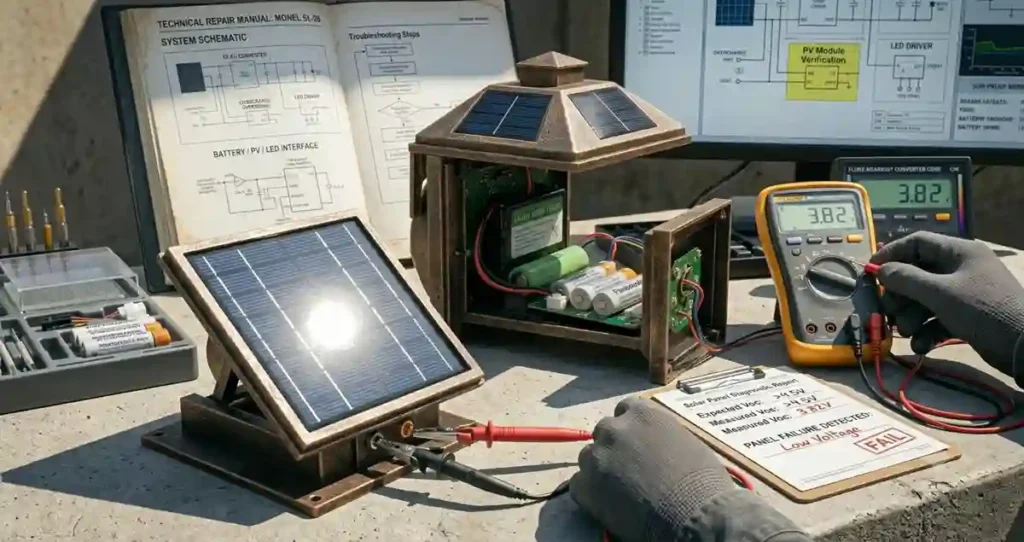
Small solar panels (3×3 cm to 6×6 cm) can be sourced from electronics suppliers for $2 to $8. The key specification to match is the output voltage — the replacement panel must match or be within 10% of the original panel’s open-circuit voltage. Connecting a higher-voltage panel to a charging circuit designed for a lower voltage can damage the LED driver.
Field Note: I have replaced solar panels on several NiMH cap lights where the original panel had delaminated after six years of outdoor use. The replacement panels — sourced for $3–4 each — restored full function. The limiting factor is typically the physical size and connector type, not the panel specification itself. Take a photo of the original panel and its connector before ordering a replacement.
4. Solar Lantern Replacement Parts: Repair or Replace the Entire Unit?
| Fault | Part cost | Difficulty | Worth repairing? |
| NiMH AA/AAA cell | $2–4 | Easy — screw or twist access | Yes — always. Simple and cheap. |
| Integrated Li-ion pack (available) | $5–15 | Medium — may require soldering | Yes if lantern quality is good |
| Solar panel (small cap light) | $3–8 | Medium — soldering required | Yes if lantern cost > $25 |
| LED module | $3–10 | Hard — circuit board access | Only if high-value unit |
| LED driver / control circuit | Often unavailable | Very hard | No — replace the lantern |
| Cracked or UV-degraded housing | $0 — at end of life | N/A | No — replace the lantern |
Engineer’s Note: The economic threshold for repair vs replacement: if the replacement part costs more than 40% of the current purchase price of an equivalent lantern, replacing the lantern is the rational decision. Battery cells for most cap lights cost $2 to $4 — this is almost always below the 40% threshold. LED drivers and integrated control circuits are almost always above it.
For the specifications to look for when replacing the full lantern, see the solar powered lanterns buying guide.
Frequently Asked Questions
What are the most common Solar Lantern Replacement Parts?
The most common Solar Lantern Replacement Parts are rechargeable NiMH batteries, lithium-ion battery packs, solar panels, LED modules, and battery contacts.
Can I replace the battery in a solar lantern?
Yes. Most solar lantern failures are caused by degraded batteries. Replacing the original battery with a matching NiMH or lithium-ion replacement often restores full performance.
How do I know if my solar panel has failed?
A solar panel can be tested using a multimeter in direct sunlight. Most small lantern panels should produce between 2 and 6 volts. Very low or zero voltage usually indicates panel failure.
Is it worth replacing solar lantern parts?
In most cases, replacing batteries and small solar panels is cost-effective. If repair costs exceed approximately 40% of the price of a comparable new lantern, replacement is often the better option.
Can I upgrade the battery capacity in a solar lantern?
Yes. Many lanterns can use higher-capacity NiMH batteries as long as the voltage remains the same. A higher-capacity battery can increase runtime between charges.
Where can I buy Solar Lantern Replacement Parts?
Solar Lantern Replacement Parts are commonly available from electronics suppliers, solar lighting retailers, and online marketplaces. Always match voltage, chemistry, and physical dimensions before ordering.
Final Thoughts
Most solar lantern failures are caused by a single replaceable component rather than complete product failure. By systematically testing the battery, solar panel, and LED system, many lanterns can be restored to full operation for only a few dollars. Understanding which Solar Lantern Replacement Parts are worth replacing can significantly extend the service life of the lantern while reducing unnecessary waste.
Related Guides on SolarVisionAI
Solar Lanterns: The Complete Engineer’s Buying Guide
Solar Powered Lanterns: Specs, Battery Sizing & What to Buy
Outdoor Wall Solar Lanterns: Installation, Sizing & Buying Guide
Best Hanging Solar Lanterns for Outdoors
Best Solar Lanterns for Camping: Lumens, Runtime & Field Performance
Solar Lanterns vs Costco & Walmart: An Engineer’s Honest Comparison