
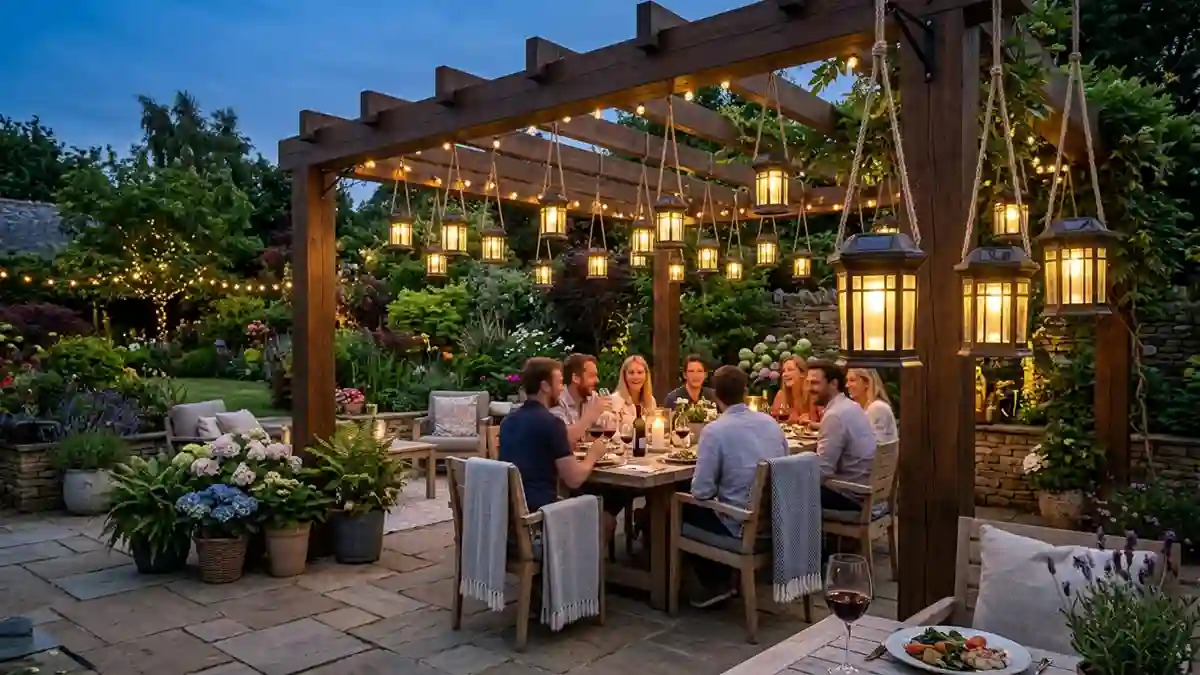
Hanging solar lanterns under a pergola? Most undercharge due to the panel being shaded. Here’s the spacing, IP rating, and lumen guide that fixes that problem.
Hanging solar lanterns look straightforward — you hang them, they charge, they light up at night. The engineering that determines whether they perform adequately is not complicated, but it is rarely covered in product listings. Solar panel placement and orientation under a covered pergola, suspension load ratings, IP rating for rain exposure, and battery sizing for the actual night length in your season: these four factors determine whether a hanging solar lantern works well or disappoints within the first month.
For the complete solar lantern engineering framework, see the solar lanterns buying guide.
1. The Pergola Shading Problem — Why Most Hanging Lanterns Undercharge
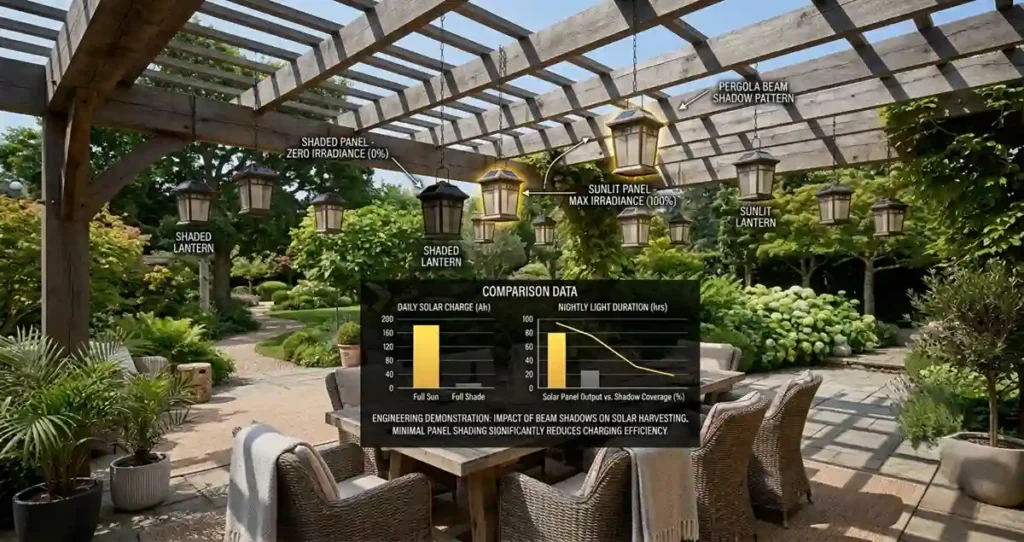
The most common installation location for hanging solar lanterns is under a pergola or covered patio. This is also the most common cause of underperformance: the panel on the lantern body is shaded by the pergola structure for a significant portion of the day.
A lantern hanging below a solid pergola roof receives direct sun only when the sun angle is low enough to reach under the roof edge — typically a few hours per day in summer and almost none in winter. The panel charges from diffuse sky radiation for the remaining hours. Diffuse-only charging delivers approximately 10–20% of the rated panel output.
Engineer’s Note: A hanging solar lantern rated for 8-hour runtime assumes the panel receives full solar irradiance for 5–6 hours per day. Under a solid pergola roof, the same panel may receive 0.5–1.5 equivalent full-sun hours. Runtime drops proportionally. For a 40-lumen lantern on a 1200 mAh battery, the difference is 8 hours vs 1.5 to 3 hours. The solution is either an open-structure pergola or a lantern with a separate panel mounted above the pergola roof.
2. IP Rating for Hanging Outdoor Lanterns
| Installation position | IP rating required | Notes |
| Under solid pergola roof, fully covered | IP44 minimum | Protected from direct rain — splash coverage sufficient |
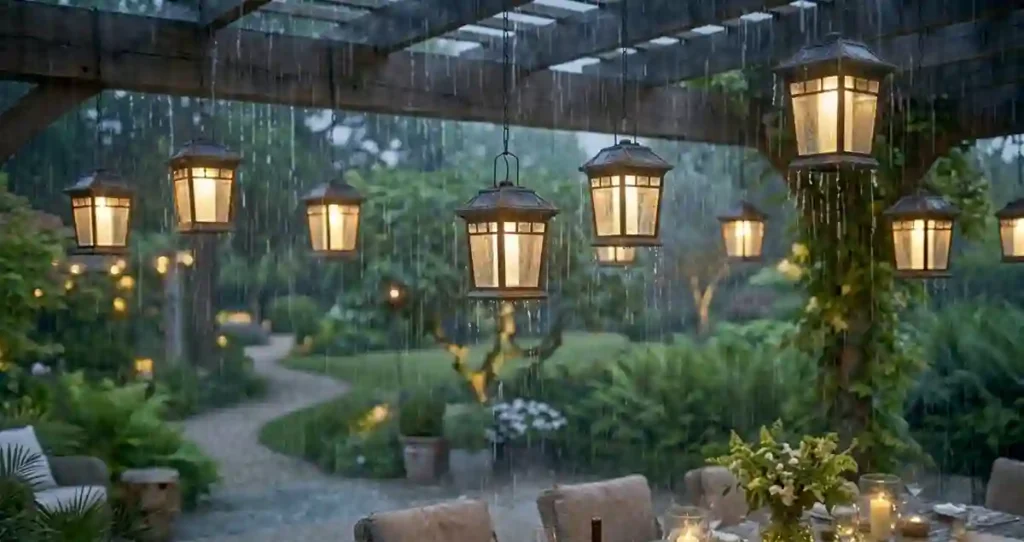
| Under open-structure pergola, partial cover | IP65 | Rain reaches the lantern from angles |
| Open outdoor position — tree, post, hook | IP65 | Full rain and wind-driven rain exposure |
| Near coastal / salt air environment | IP65 + marine-grade housing | Standard aluminum corrodes in 2–3 years in salt air |
3. Suspension Load Ratings
- Verify the hook or bracket is rated for at least 3x the lantern weight
- For pergola hook screws into softwood, a 50mm × 6mm eyebolt into a structural member is the minimum. Do not hang lanterns from screws into end grain — pull-out capacity is near zero
- S-hooks and carabiner links should be stainless steel or galvanised — zinc die-cast hooks corrode and fail in outdoor use within 2–3 seasons
- For multiple lanterns on a string or chain, calculate the total suspended weight and verify the end attachment point accordingly
4. Lumen Output and Spacing
| Space type | Lumens per lantern | Recommended spacing | Effect |
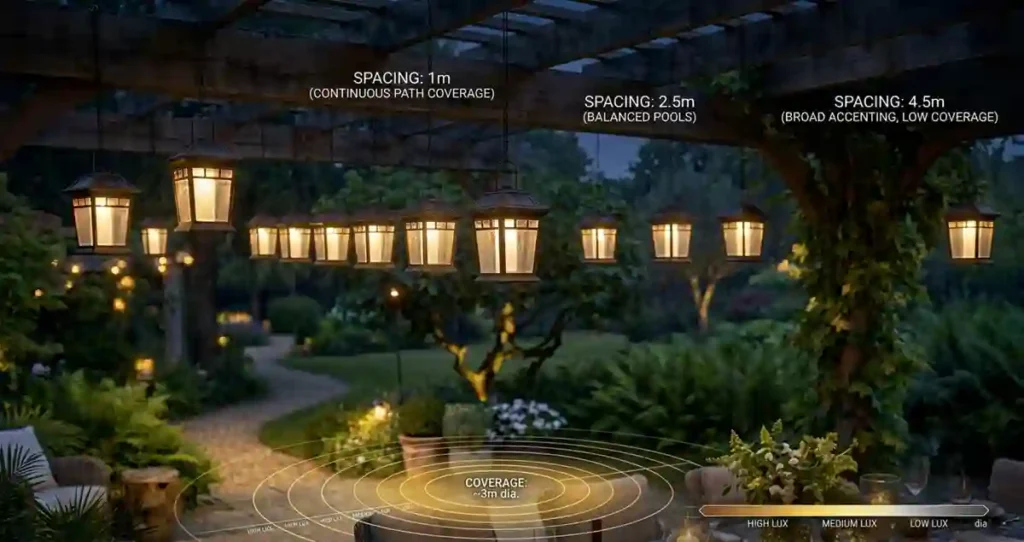
| Small pergola (3×3m) | 20–40 lm | 1.0–1.5m apart | Warm ambient glow across seating area |
| Large pergola / patio (5×5m+) | 30–50 lm | 1.5–2.0m apart | Even ambient lighting without dark spots |
| Garden path (decorative) | 10–20 lm | 1.5–2.5m apart | Decorative definition — not task lighting |
| Outdoor dining table (focal) | 40–60 lm | Single point above table | Functional dining light |
Field Note: A residential client installed eight 15-lumen hanging lanterns at 2.0m spacing across a 6×4m pergola. The result was pleasant in photographs and inadequate for dinner service. Replaced four of the eight with 40-lumen units at the same positions, alternating 15-lumen and 40-lumen. The mixed approach delivered decorative character plus functional light level.
5. Battery Sizing for Hanging Lanterns
Hanging lanterns are most used in summer. They are most likely to underperform in autumn and winter when nights are longest and panel charge hours are shortest. A lantern with a 600 mAh battery that runs all night in July will cut out at 11pm in December.
For year-round reliable hanging lantern performance, use the same battery sizing framework as any other solar lantern. The full battery sizing table is in the solar lanterns pillar guide and the solar powered lanterns battery sizing guide.
Frequently Asked Questions
Do hanging solar lanterns work under a pergola?
Yes, but performance depends on sunlight reaching the solar panel. Hanging solar lanterns installed under a solid pergola roof often receive insufficient direct sunlight and may experience reduced runtime.
What IP rating should hanging solar lanterns have?
For fully covered installations beneath solid roofs, an IP44 rating is usually sufficient to handle baseline humidity. For open pergolas, gardens, trees, and exposed outdoor locations, an IP65 rating is the recommended minimum engineering standard to handle wind-driven rain.
How far apart should hanging solar lanterns be spaced?
Most hanging solar lanterns should be spaced between 1.0 and 2.0 meters apart depending on lumen output and the size of the area being illuminated.
How many lumens do hanging solar lanterns need?
Decorative applications typically require 10–20 lumens, while pergolas, patios, and outdoor dining areas generally benefit from 30–60 lumens per lantern.
Why do hanging solar lanterns stop working early at night?
The most common causes are inadequate solar charging, battery degradation, excessive shading, or insufficient battery capacity for the required runtime.
Can hanging solar lantern batteries be replaced?
Many hanging solar lanterns use replaceable rechargeable batteries, while others use integrated battery packs. Battery accessibility should be verified before purchase.
Related Guides on SolarVisionAI
Solar Lanterns: The Complete Engineer’s Buying Guide
Solar Powered Lanterns: Specs, Battery Sizing & What to Buy
Outdoor Wall Solar Lanterns: Installation, Sizing & Buying Guide
Best Solar Lanterns for Camping: Lumens, Runtime & Field Performance
Solar Lantern Replacement Parts: Cells, Panels & What’s Fixable
Solar Lanterns vs Costco & Walmart: An Engineer’s Honest Comparison
1 thought on “Best Hanging Solar Lanterns for Outdoors: Engineer’s Guide ”