
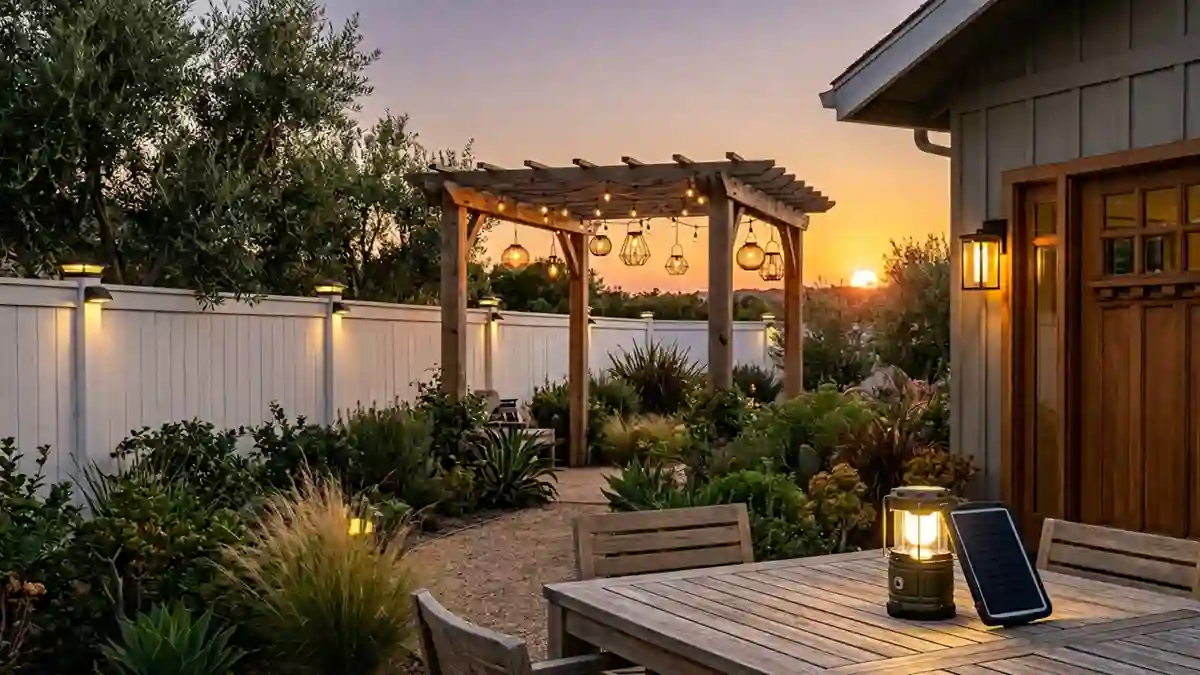
Choosing outdoor solar lanterns? A registered engineer breaks down lumens, IP ratings, and battery sizing so you buy right the first time — no guesswork
Solar lanterns are one of those product categories where the spec sheet tells you almost nothing useful. You get a lumen number, an IP rating if you’re lucky, and a small solar panel size that may or may not be accurate. What you don’t get is any guidance on whether that combination will actually deliver reliable lighting for your specific application.
The question most people arrive with is some version of: which solar lantern should I buy? The honest answer is that it depends entirely on where you’re installing it, what you need it to do at night, and whether the battery can sustain that output through a winter evening in your climate.
This guide gives you the engineering logic behind those decisions — by lantern type, by application, by lumen requirement, and by battery math. The same framework used for commercial solar lighting specifications applies here. The products are smaller; the principles are identical.
1. What Type of Solar Lantern Do You Actually Need?
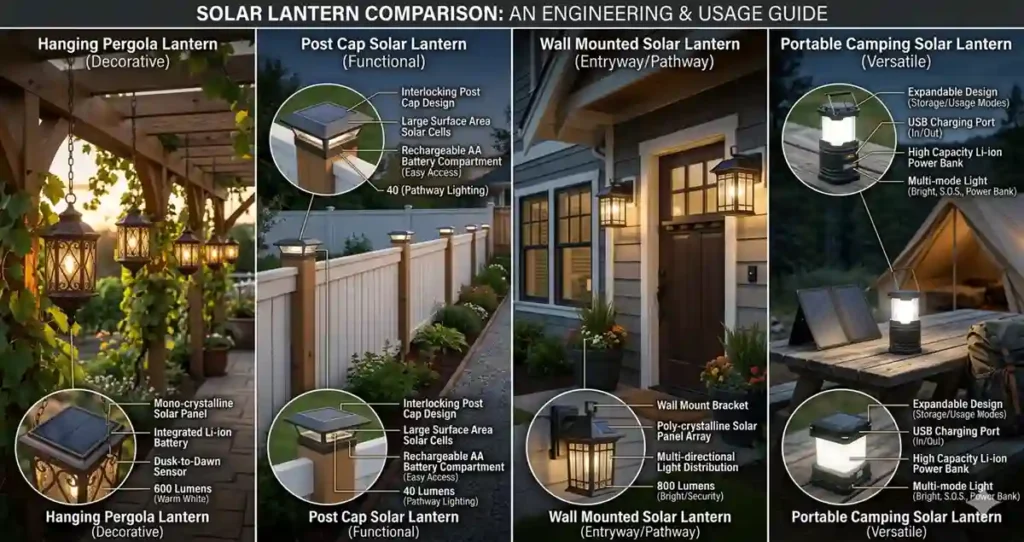
There are five main categories of solar lantern, and they are not interchangeable. The right starting point is the installation location and what the lantern is supposed to achieve — decoration, visibility, or functional outdoor lighting.
| Type | Best use | Min IP rating | Lumen range | Battery typical |
| Hanging | Patio, pergola, garden | IP44 | 15–40 lm | 600–1000 mAh |
| Post-mount cap | Driveway, fence, perimeter | IP65 | 30–80 lm | 800–1500 mAh |
| Wall-mount | Entry, garage, gate | IP65 | 40–100 lm | 1200–2000 mAh |
| Tabletop / portable | Camping, patio, emergency | IP44–IP65 | 50–200 lm | 2000–4000 mAh |
| Inflatable / collapsible | Camping, travel, emergency kits | IP67 | 30–100 lm | 1200–2000 mAh |
Hanging lanterns are primarily decorative. Most are rated IP44 — splash-proof but not suitable for continuous rain exposure. They belong under a porch, pergola, or covered outdoor area, not on an exposed post.
Post-mount and wall-mount lanterns carry the heavier workload: driveway entry, gate posts, perimeter definition. These need IP65 as a minimum — dust-tight and resistant to water jets. A lantern rated IP44 on an exposed driveway post will eventually fail through progressive ingress corrosion on the PCB and battery terminals.
Engineer’s Note: The IP rating distinction between IP44 and IP65 is not marketing tiering — it reflects a fundamental difference in ingress protection. IP44 permits water splash from any direction. IP65 means the enclosure is completely dust-tight and can withstand a sustained water jet from any angle. For any lantern installed outdoors without overhead shelter, IP65 is the engineering minimum, not a premium feature.
For hanging solar lanterns on pergolas and outdoor dining areas, see the hanging solar lanterns guide. For wall-mounted units at entry points, the outdoor wall solar lanterns installation guide covers mounting height, panel orientation, and common install errors.
2. How Many Lumens Does a Solar Lantern Need?
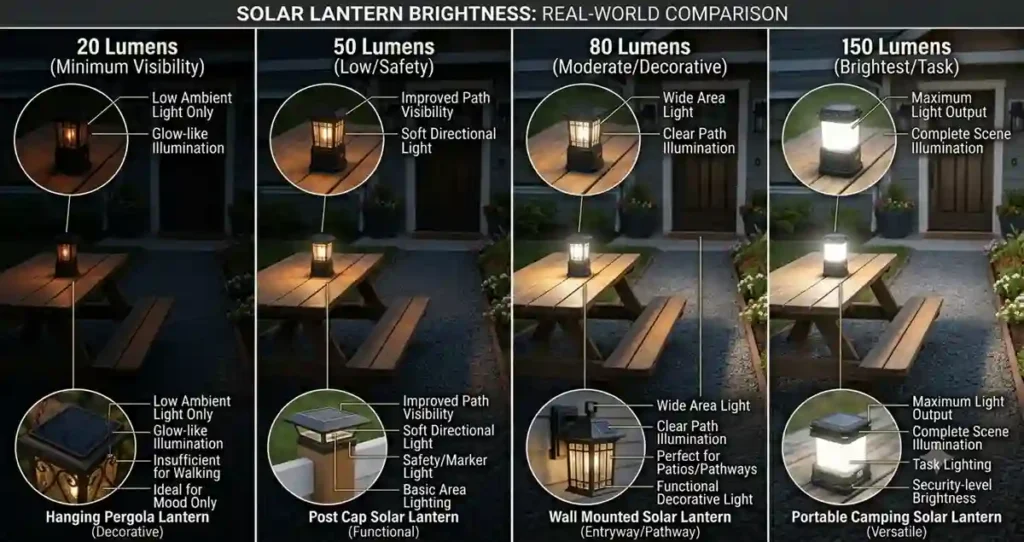
The lumen number on a solar lantern tells you total light output — it does not tell you what that output looks like at ground level, or how far from the lantern that light is useful. Illuminance drops with the square of distance from the source. Double the distance and you have one quarter of the light.
| Application | Lumen range | Visible radius | Battery needed | Panel min |
| Garden / decorative only | 10–20 lm | ~0.5m glow | 400–600 mAh | 3×3 cm |
| Patio / outdoor dining | 20–40 lm | ~1–2m | 800–1000 mAh | 4×5 cm |
| Pathway / perimeter markers | 30–60 lm | ~2–3m | 1000–1200 mAh | 5×5 cm |
| Driveway entry posts | 50–80 lm | ~3–4m | 1500–2000 mAh | 6×6 cm+ |
| Gate posts / security perimeter | 80–150 lm | ~5m+ | 2000+ mAh | Separate panel |
Field Note: A homeowner installed 15-lumen decorative lanterns on driveway entry posts and reported within two weeks that they could not locate the driveway edge when returning at night. Replaced with 58-lumen units on the same posts, same mounting positions. The problem was resolved immediately. The lumen specification was the entire issue — the installation was correct.
For camping applications where the lantern needs to illuminate a tent interior or cooking area, see the solar camping lanterns guide — covering lumen requirements by campsite use case including cold-weather battery performance.
3. Battery Capacity — The Spec Most Buyers Ignore
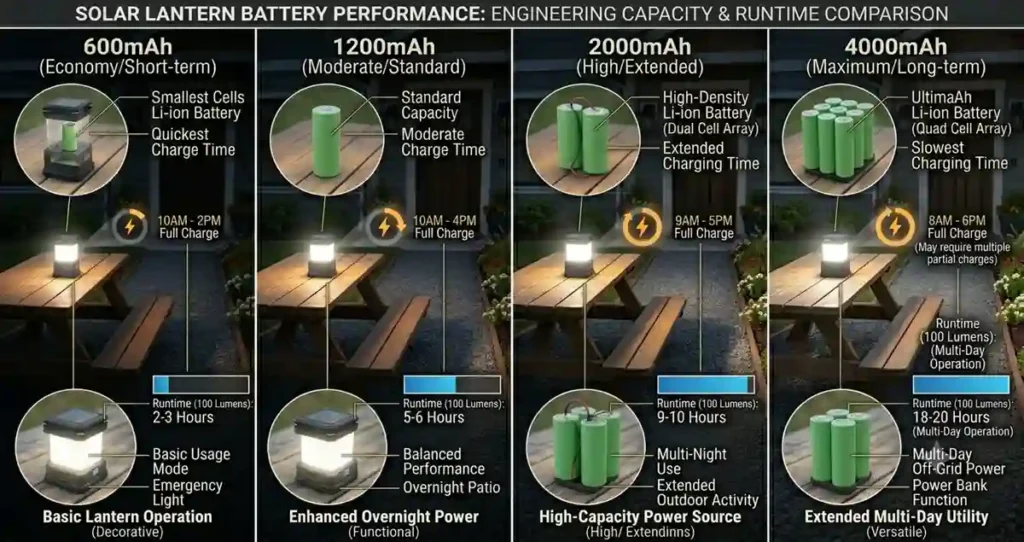
The lumen output number is only half the equation. The battery has to sustain that output long enough to cover the night. This is where the majority of budget solar lanterns fail — the rated lumen output is real, but the battery is too small to maintain it beyond three to four hours.
| LED output | Battery | Runtime (full charge) | Runtime (50% charge) | Winter risk |
| 15 lm | 600 mAh | 5–6 hrs | 2–3 hrs | High |
| 15 lm | 1200 mAh | 10–12 hrs | 5–6 hrs | Low |
| 40 lm | 1200 mAh | 4–5 hrs | ~2 hrs | High |
| 40 lm | 2000 mAh | 7–8 hrs | 3–4 hrs | Medium |
| 80 lm | 2000 mAh | 3–4 hrs | 1–2 hrs | Very high |
| 80 lm | 4000 mAh | 7–8 hrs | 3–4 hrs | Medium |
Engineer’s Note: For year-round reliability, your battery capacity should support at least eight hours of runtime at your chosen lumen output. A 40-lumen lantern needs a 2000 mAh cell for consistent performance through winter nights. A 1200 mAh cell at that output is a summer solution, not an all-season one.
If your battery has degraded and the unit cuts out early, see the solar lantern replacement parts guide for cell compatibility and replacement procedure. For a detailed battery-to-lumen sizing comparison, the solar powered lantern specs and battery sizing guide covers this in more depth.
4. IP Ratings Explained for Outdoor Solar Lanterns
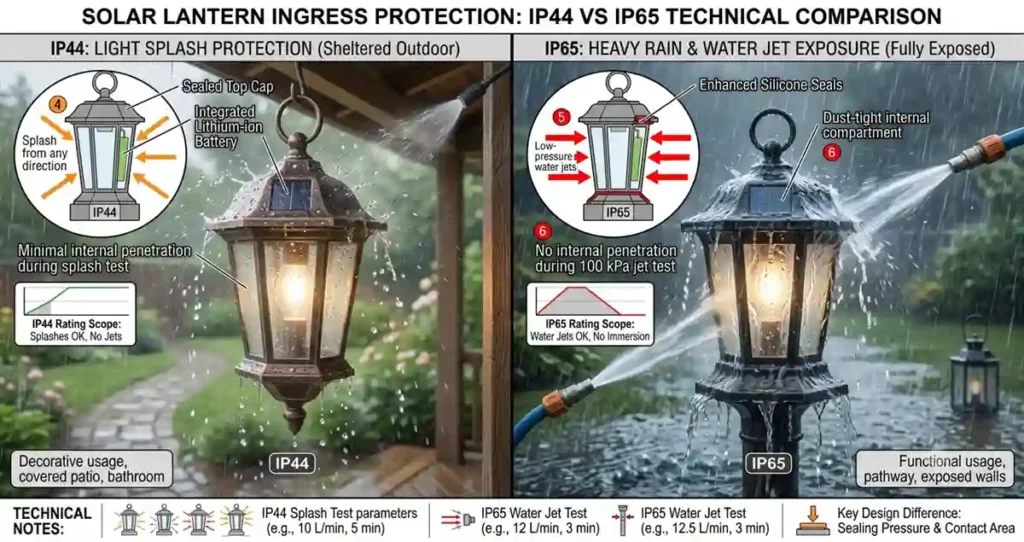
IP ratings define how well an enclosure is protected against solid particles and water ingress. The water ingress rating is the number that matters for solar lanterns.
| IP rating | Water protection | Suitable for | Not suitable for |
| IP44 | Splash from any direction | Sheltered patio, pergola under cover | Direct rain, exposed posts or stakes |
| IP54 | Dust-resistant + splash | Semi-sheltered outdoor areas | Continuous rain, ground-level install |
| IP65 | Dust-tight + sustained water jet | Fence posts, driveway, entry, wall mount | Submersion |
| IP67 | Dust-tight + 1m submersion (30 min) | Ground stakes, flood-prone areas | Permanent submersion |
Engineer’s Note: Manufacturers frequently use ‘weatherproof’ and ‘water-resistant’ without citing an IP number. These terms have no standardised meaning. The only reliable specification is the IP rating. If a product listing does not include an IP number, treat it as unrated and assume it is not suitable for exposed outdoor installation.
5. Seasonal Performance — What Changes in Winter
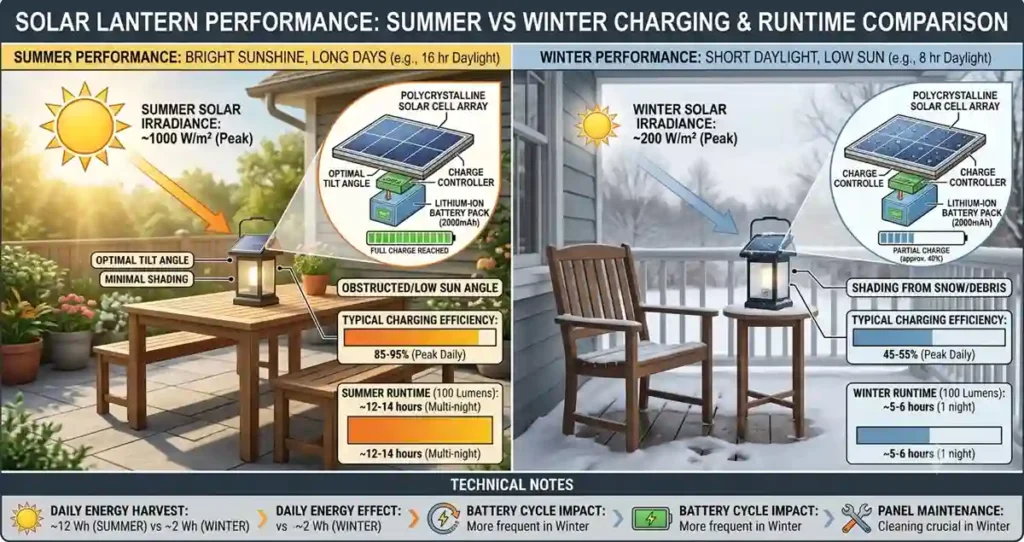
Solar lanterns perform differently across seasons because available charge energy changes significantly. A lantern that runs reliably from May through September may underperform from November through February, particularly in higher latitudes and climates with significant cloud cover.
| Season / condition | Avg sun hrs/day | Charge % (5×5cm panel) | Runtime at 20 lm | Runtime at 50 lm |
| Summer — clear sky | 6–7 hrs | 100% | 10–12 hrs | 5–6 hrs |
| Spring / Fall — clear sky | 4–5 hrs | 70–85% | 7–9 hrs | 3–4 hrs |
| Winter — clear sky | 2–4 hrs | 40–65% | 4–6 hrs | 2–3 hrs |
| Overcast — any season | 0.5–1.5 hr equiv. | 10–25% | 1–3 hrs | Under 1 hr |
Engineer’s Note: If your location receives fewer than three peak sun hours per day in winter — roughly above 50 degrees latitude — size your solar lanterns for summer enjoyment and accept reduced winter runtime regardless of battery size. The panel area on a cap or hanging lantern is too small to overcome a sustained solar deficit. This is a physical constraint, not a product limitation.
6. Five Things the Spec Sheet Doesn’t Tell You
Panel size is not reliably listed
Many solar lantern listings quote panel dimensions that are optimistic. Check the product photos for the actual panel. A 4×4 cm panel driving a 60-lumen lantern is a mismatch that no battery size fully compensates for.
Battery chemistry matters in cold climates
Most small solar cap and hanging lanterns use NiMH AA or AAA cells. NiMH performs better than lithium-ion at low temperatures for small-capacity cells, and it is replaceable with standard hardware store batteries.
Dusk-to-dawn vs motion-only are not the same product
Dusk-to-dawn lanterns run continuously from dark to light. Motion-only lanterns activate on movement and switch off after a timeout. Product listings frequently do not make this distinction clearly.
‘Weatherproof’ is not an IP rating
Manufacturers use ‘waterproof’, ‘weatherproof’, and ‘water-resistant’ interchangeably. None has a standardised meaning. The IP rating is the only reliable specification.
Colour temperature affects function, not just appearance
Most solar cap lights ship at 5000–6000K cool daylight white. For decorative garden and patio use, look specifically for 2700–3000K warm white. This is rarely the default.
Field Note: On a recent commercial perimeter installation, 24 lanterns were specified as ‘fully weatherproof’ with no IP rating on the unit body, packaging, or documentation. All 24 units were rejected and reordered from a supplier who could confirm IP65 certification. Require the IP number in the purchase specification.
For a teardown comparison of what big-box solar lanterns actually contain, see the solar lanterns vs Costco and Walmart comparison.
Frequently Asked Questions
How many lumens does a solar lantern need?
It depends entirely on the application. Ten to twenty lumens is sufficient for garden decoration. Driveway entry posts need fifty to eighty lumens minimum — below that range, the posts are not visible from a moving vehicle at night. The lumen-by-application table in Section 2 maps each use case.
Do solar lanterns work in winter?
Yes, with reduced runtime. Shorter daylight hours mean the battery reaches a lower charge state each evening. For year-round reliability, size the battery for worst-case winter sun hours in your location. Above 50 degrees latitude, plan for two to three peak sun hours per day in December and January.
What IP rating do outdoor solar lanterns need?
IP65 is the minimum for any solar lantern installed outdoors without permanent overhead shelter. IP44 is sufficient for covered patio and pergola use only.
Why does my solar lantern stop working after a few hours?
The battery capacity is undersized for the lumen output, or the battery has degraded. A 600 mAh cell driving a 30-lumen LED typically runs three to four hours. Most cap and portable lanterns use replaceable standard AA or AAA NiMH cells.
Can I replace the battery in a solar lantern?
In most cases, yes — see the full procedure in the solar lantern replacement parts guide. Most cap lights use standard AA or AAA NiMH cells accessible by removing the base.
Final Thoughts
The lumen number on a solar lantern is a starting point, not an answer. Get the application requirement right first — decoration, patio ambience, pathway visibility, driveway entry, or security perimeter. Work backward from there to the lumen range, battery capacity, IP rating, and panel size that supports it. That sequence gives you a lantern that performs consistently long-term, not just through the first summer.
Related Guides on SolarVisionAI
Solar Powered Lanterns: Specs, Battery Sizing & What to Buy
Outdoor Wall Solar Lanterns: Installation, Sizing & Buying Guide
Best Hanging Solar Lanterns for Outdoors
Best Solar Lanterns for Camping: Lumens, Runtime & Field Performance
Solar Lanterns vs Costco & Walmart: An Engineer’s Honest Comparison