
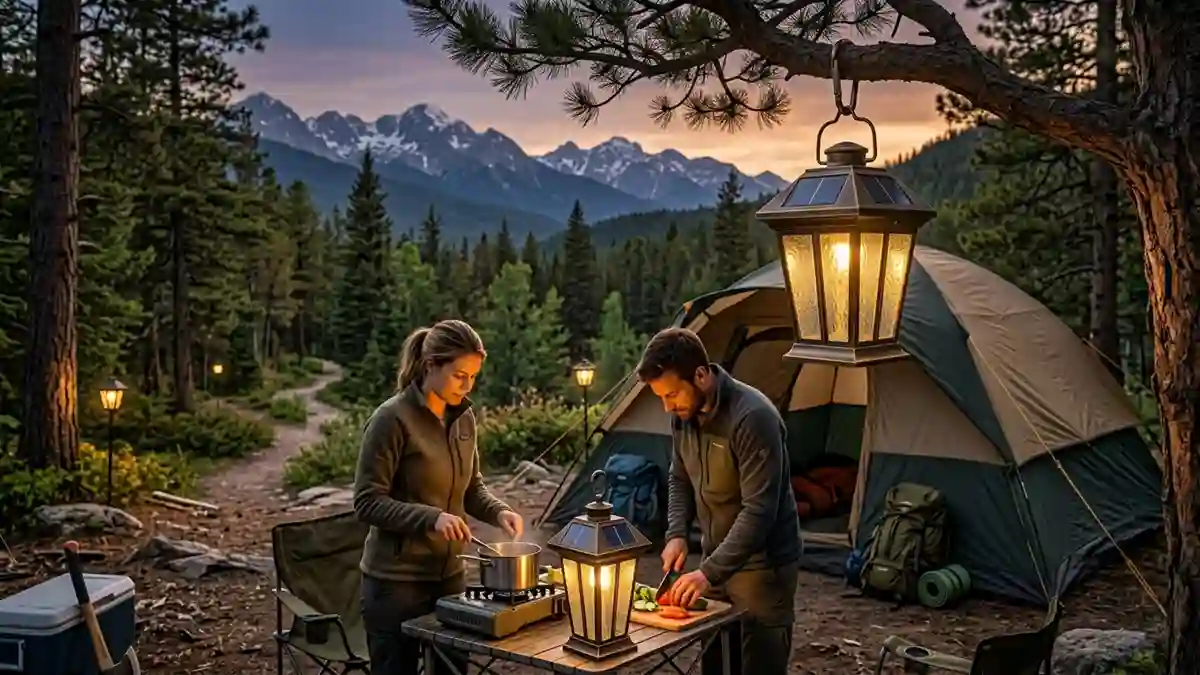
Solar Lanterns for Camping fail in shaded campsites and on cold nights. An engineer covers real charge times, lumen needs by use case, and what to look for before you buy
A camping solar lantern has different engineering requirements than a garden or driveway lantern. It needs to be portable, light enough to carry in a pack, durable enough to survive being dropped on a rock, bright enough to illuminate a cooking area or tent interior, and equipped with efficient solar panels and batteries capable of harvesting and storing energy from whatever sun is available at the campsite — which may be two hours of direct sun through tree cover, not six hours of unobstructed irradiance.
For the broader solar lantern engineering framework, see the solar lanterns buying guide.
1. Lumen Requirements by Campsite Use Case
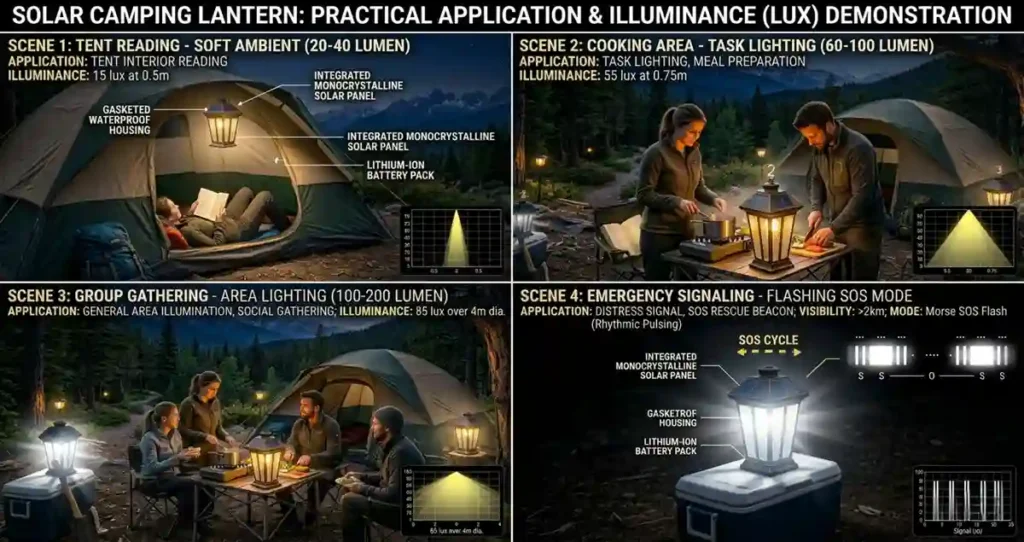
| Use case | Lumen range needed | Notes |
| Tent interior reading | 20–40 lm | Directed downward — softer is better for sleep disruption |
| Campsite ambient (cooking, eating) | 60–100 lm | Wide-angle distribution needed — not a spotlight |
| Perimeter / path to facilities | 30–60 lm | Ground-level illumination for navigation |
| Emergency signalling | 200+ lm (flash mode) | Most quality lanterns include strobe/SOS mode |
| Group campsite (4–6 people) | 100–200 lm or multiple 60-lm units | Single high-lumen unit or distributed lanterns |
The practical recommendation for most camping: a lantern with at least two brightness modes — a low mode (20–40 lm) for tent use and a high mode (80–120 lm) for campsite cooking and socialising. Multiple brightness modes extend total battery runtime significantly.
2. Advertised Charge Times vs Real-World Field Performance
| Condition | Effective solar hours | Charge % achieved | Notes |
| Clear sky, full sun, panel perpendicular | 6–8 hrs | 100% | Best case — rarely achieved in forest camping |
| Clear sky, flat panel on tent top | 4–5 hrs effective | 65–80% | Typical for panel laid flat |
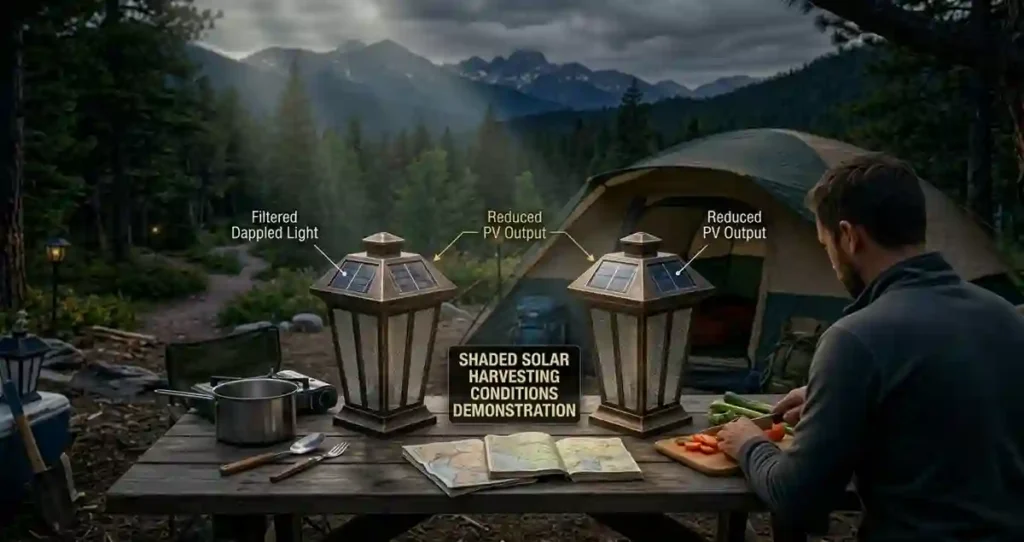
| Partial shade (tree canopy) | 1–3 hrs effective | 20–45% | Very common at forest campsites |
| Overcast sky | 0.5–2 hrs effective | 5–20% | Common in mountain and coastal camping |
| Cold temperature (below 5°C) | As above minus 10–25% battery capacity | Reduced | Lithium-ion capacity drops significantly below freezing |
Engineer’s Note: For camping in shaded environments — forest sites, valley floors — plan on 20 to 50% of the rated charge per day. A lantern with a USB-C input as backup charging from a power bank is not a luxury feature for these conditions; it is the difference between a functional light and a discharged one on day three of a five-day trip.
3. Cold-Weather Battery Performance

Most camping solar lanterns use lithium-ion or lithium-polymer cells. Both lose capacity in cold temperatures — usable capacity at 0°C is typically 75 to 85% of the room-temperature rated capacity. At -10°C, usable capacity drops to 50 to 70%.
- If camping regularly below 5°C, look for lanterns that specify cold-weather operation or use NiMH chemistry
- Store the lantern inside your sleeping bag overnight if temperatures are likely to drop below -5°C — a warm battery at the start of the evening has more usable capacity than a cold one
- The rated runtime is a room-temperature number. Apply a 20–30% reduction for cold camping conditions.
Field Note: On a three-day winter camp at approximately -8°C night temperatures, a lantern rated for 10 hours at low mode delivered approximately 6.5 hours before needing recharge. Charged inside the tent using a power bank for one hour each morning. The USB-C input was the critical feature that made the lantern usable — solar charging during the day was insufficient due to overcast skies.
4. Durability and Portability Specs
| Spec | Camping minimum | Why it matters |
| IP rating | IP65 | Rain, river spray, tent condensation |
| Drop rating | 1.0m+ rated drop test | Lanterns get knocked off rocks and tent poles |
| Weight | Under 400g backpacking; up to 800g car camping | Carrying weight is a real constraint |
| Packability | Collapsible or flat profile preferred | Pack volume as important as weight for backpackers |
| Charging input | USB-C preferred | Power bank backup charging when solar is insufficient |
| Modes | Minimum 2 brightness + SOS strobe | Battery management and emergency signalling |
5. Inflatable and Collapsible Camping Lanterns
Inflatable solar lanterns offer a compelling packability advantage: deflated, they are flat and lightweight enough to fit in a shirt pocket. Inflated, the translucent body provides wide-angle, diffuse light distribution well-suited to tent and campsite ambient lighting.
The engineering tradeoff: the integrated solar panel is smaller than a rigid lantern of equivalent lumen output, and the battery capacity is typically lower. These are short-duration lanterns — ideal for two to four hours of evening use. For multi-day camping, pair an inflatable lantern with a larger portable power bank for USB recharging.
For the full inflatable lantern specification and battery sizing, see the solar powered lanterns guide.
Frequently Asked Questions
How many lumens do camping solar lanterns need?
Most campers need 60 to 100 lumens for cooking, eating, and general campsite use. For reading inside a tent, 20 to 40 lumens is usually sufficient.
Do Solar Lanterns for Camping work in shaded campsites?
Yes, but charging performance can be significantly reduced under tree cover. Many Solar Lanterns for Camping receive only 20 to 50% of their rated solar charge in heavily shaded campsites.
Do Solar Lanterns for Camping work in cold weather?
Most Solar Lanterns for Camping use lithium batteries, which lose capacity in cold temperatures. Runtime may decrease by 20 to 50% in freezing conditions.
Should Solar Lanterns for Camping have USB charging?
Yes. A USB-C charging input allows the lantern to be recharged from a power bank when solar charging is limited by clouds, shade, or winter conditions.
What IP rating is recommended for Solar Lanterns for Camping?
An IP65 rating is recommended for most camping applications because it protects against rain, splashes, and outdoor exposure.
Are inflatable Solar Lanterns for Camping worth buying?
Inflatable lanterns are lightweight and highly portable, making them ideal for backpacking. However, they usually have smaller solar panels and batteries than rigid lanterns, resulting in shorter runtimes.
Related Guides on SolarVisionAI
Solar Lanterns: The Complete Engineer’s Buying Guide
Solar Powered Lanterns: Specs, Battery Sizing & What to Buy
Outdoor Wall Solar Lanterns: Installation, Sizing & Buying Guide
Best Hanging Solar Lanterns for Outdoors
Solar Lantern Replacement Parts: Cells, Panels & What’s Fixable
Solar Lanterns vs Costco & Walmart: An Engineer’s Honest Comparison