
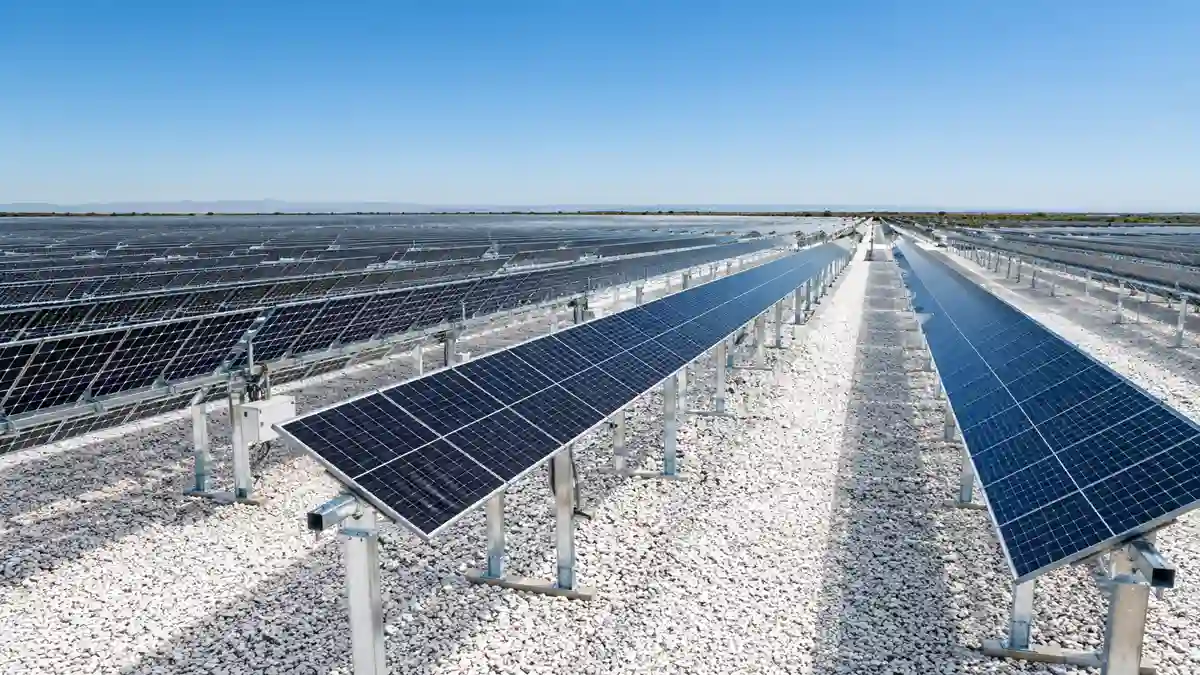
Bifacial Solar Panels ground mounting installation explained by a registered engineer — racking height, spacing, and albedo best practices for maximum gain.
A quick scope note before diving in: this guide covers the installation practices specific to getting genuine rear-side gain out of a bifacial ground-mount array — racking height, row spacing, and ground surface. If you’re looking for general ground-mount structural guidance that applies to any solar panel type, that’s a broader topic covered separately in our mounting systems content. This page is specifically about what changes when the panels on that ground-mount structure happen to be bifacial.
This guide is part of our Types of Solar Panels hub, and builds directly on our Bifacial Solar Panel Albedo Effect guide — read that one first for the underlying physics, this one for how actually to design the installation around it.
Why Ground Mount Is Bifacial’s Best Application
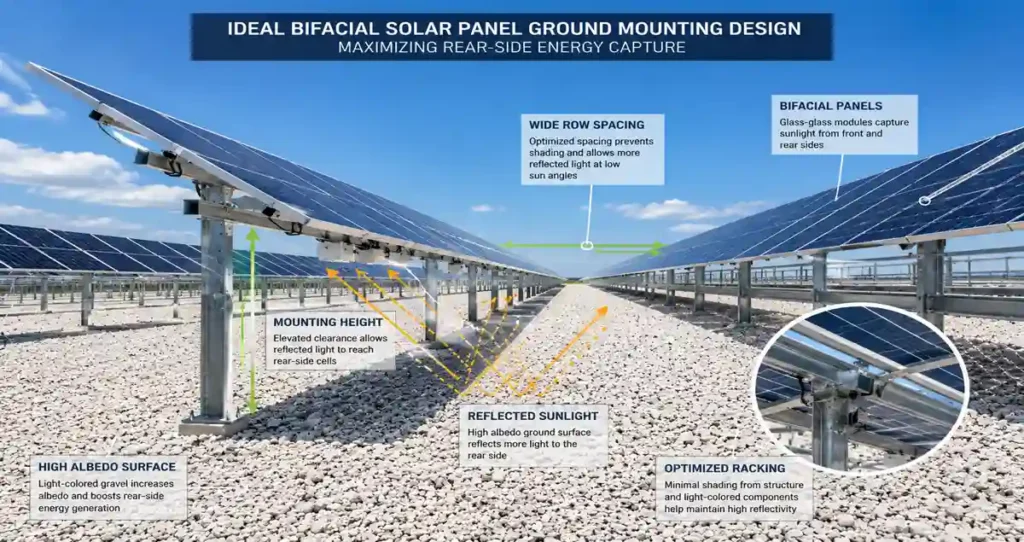
Ground-mount installations solve both of bifacial’s core requirements simultaneously: they allow deliberate control over mounting height, and they allow deliberate control over what surface sits beneath and around the array. Neither is generally true for rooftop installations, which is exactly why I default to recommending bifacial solar panels most readily for ground-mount projects specifically, rather than as a blanket recommendation across every installation type.
Engineer’s Note: The mounting height figure I check first on any bifacial ground-mount design is clearance from the panel’s lower edge to the ground surface. Too low, and reflected light simply can’t reach the rear cells at a useful angle regardless of how reflective the ground is. As a general engineering guideline, I look for meaningfully more clearance than a typical fixed-tilt monofacial ground-mount design would use — the exact figure depends on tilt angle and row spacing, and should be confirmed against the specific racking manufacturer’s bifacial-optimized specifications.
Key Installation Variables
| Variable | Why It Matters | Best Practice | Industry Reference |
| Mounting height | Determines whether reflected light reaches rear cells | Elevated clearance beyond standard monofacial ground-mount height | NREL |
| Row spacing | Prevents adjacent rows from shading each other’s rear-side gain | Wider spacing than typical monofacial arrays, especially at low sun angles | Fraunhofer ISE |
| Ground surface | Directly determines available albedo for rear-side capture | Light gravel, reflective membrane, or maintained light ground cover | NREL |
| Racking material and color | Dark racking directly beneath panels can locally reduce reflected light | Light-colored or minimal-footprint racking where feasible | Industry Best Practice |
Advantages and Disadvantages
| Advantages | Disadvantages |
| Ground mount gives full control over the two variables bifacial needs most | Elevated racking and wider spacing increase structural and land costs |
| Properly designed installations can realize gains close to manufacturer claims | Poorly designed ground-mount bifacial still underperforms significantly |
| Ground cover can be deliberately specified and maintained for albedo | Ongoing ground cover maintenance is an added operational consideration |
| Scales well for utility and large commercial solar ground-mount projects | Higher upfront design complexity than a standard monofacial ground-mount |
Real-World Applications of Bifacial Solar Panels ground mounting
The best-performing bifacial ground-mount design I’ve been involved with combined three things working together rather than any single factor: elevated racking with generous ground clearance, row spacing wide enough that neighboring rows didn’t shade each other’s rear-side capture even at low winter sun angles, and a deliberately specified light gravel ground cover maintained free of dirt and vegetation buildup. No single element alone would have delivered the same result — it was the combination that mattered.
I’ve also reviewed ground-mount bifacial designs that underperformed specifications, and in every case I’ve diagnosed, the root cause traced back to one of the same few issues: mounting height too low for the ground cover’s reflectivity, dark racking components sitting directly beneath the panels and locally killing reflected light, or ground cover that had degraded over time — gravel that had become dirt-covered, or vegetation that had grown in and darkened the surface — without anyone accounting for that maintenance need at the design stage.
Field Note: A client once asked why their bifacial ground-mount system’s output had noticeably declined two years after installation despite no apparent equipment issues. The cause turned out to be exactly the kind of albedo degradation I just described — the originally light gravel ground cover had become overgrown with vegetation and darkened with accumulated dirt, quietly eroding the rear-side gain the whole system had been designed around. A basic annual ground-cover inspection would have caught it early.
Coordinating Structural and Electrical Design Together
One pattern I see repeatedly on bifacial ground-mount projects is structural racking design happening in isolation from the electrical and energy-yield modeling, when the two genuinely need to inform each other. A structural engineer optimizing purely for wind load and cost might specify a mounting height and row spacing that meets every structural code requirement while quietly underperforming on rear-side gain, simply because nobody connected the structural decision back to the bifacial performance goal driving the project in the first place.
I make a point of reviewing racking specifications against bifacial gain modeling as a single coordinated exercise rather than two separate approvals, precisely because the two disciplines optimize for different things by default. A structurally sound, code-compliant design that happens to deliver mediocre bifacial performance isn’t a failure of either discipline individually — it’s a failure of coordination between them, and it’s entirely avoidable with the right process.
Common Misconceptions Worth Clearing Up
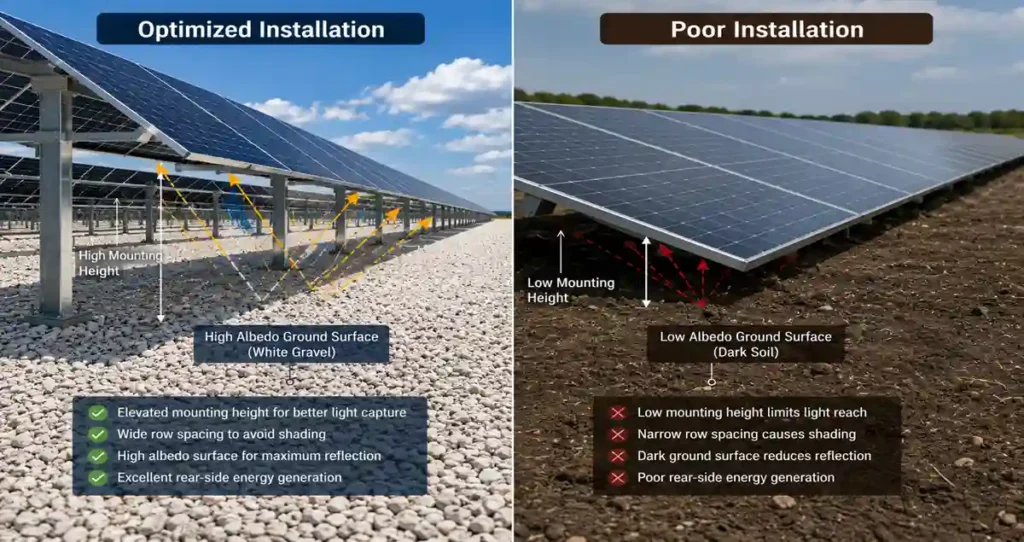
People sometimes assume any elevated racking automatically qualifies as “bifacial-optimized.” Elevation is necessary but not sufficient — row spacing and ground surface both have to cooperate with that height for the design to actually deliver meaningful rear-side gain. A bifacial system on tall racking over bare, dark soil with tightly packed rows can still underperform a well-designed system on more modest racking over the right ground cover.
Design Checklist for Bifacial Solar Panels ground mounting
- Confirm racking manufacturer’s specific bifacial-optimized height and spacing guidance, not generic monofacial ground-mount specs
- Specify ground cover material explicitly as part of the project scope, not as an afterthought
- Model row-to-row shading at low sun angles specifically for rear-side capture, not just front-side production
- Include ground cover maintenance in the system’s ongoing maintenance plan
- Request site-specific gain modeling from your installer using your actual mounting height and ground surface, not manufacturer best-case figures
For the underlying physics behind why ground surface matters this much, see our Bifacial Solar Panel Albedo Effect guide. For the broader buying decision between bifacial and monofacial, see Monofacial vs Bifacial Solar Panels.
Ground-mount bifacial done well is one of the most satisfying projects to review, precisely because every design variable is within the project’s control from day one. Unlike a rooftop retrofit constrained by an existing structure, a ground-mount build starts with a blank site — which means there’s no excuse for leaving bifacial performance on the table through a mounting height or ground cover decision that could have been specified correctly from the start.
Engineering Assessment
| Feature | Rating |
|---|---|
| Rear-side Energy Gain | ★★★★★ |
| Ground Mount Compatibility | ★★★★★ |
| Installation Complexity | ★★★★☆ |
| Commercial Value | ★★★★★ |
| Long-Term Performance | ★★★★★ |
| Overall Recommendation | ★★★★★ |
Frequently Asked Questions
How high should bifacial panels be mounted on ground-mount racking?
Higher than a typical monofacial ground-mount design, though the exact figure depends on tilt angle, row spacing, and ground reflectivity. Always confirm against the specific racking manufacturer’s bifacial-optimized specifications rather than assuming a universal number.
Does row spacing matter more for bifacial than monofacial ground mount?
Yes. Beyond preventing front-side shading, bifacial row spacing also needs to prevent neighboring rows from blocking reflected light reaching each other’s rear cells, particularly at low sun angles, which typically calls for wider spacing than a monofacial design would need.
What ground cover is best for bifacial ground-mount systems?
Light-colored, reflective surfaces — light gravel, crushed stone, or reflective membrane — perform best. Bare dark soil or unmaintained vegetation significantly limits the rear-side gain a bifacial system is designed to capture.
Are bifacial ground-mounted solar panels compatible with lithium batteries?
Yes. The mounting system does not affect battery compatibility. Bifacial solar panels work with lithium battery systems in exactly the same way as monofacial panels, provided the inverter and charge controller are correctly matched.
References
Mounting height and spacing guidance for bifacial ground-mount systems reference NREL’s bifacial performance research and Fraunhofer ISE’s Photovoltaics Report.
Related guides on SolarVisionAI.com
- Monocrystalline Solar Panels 2026: Still Worth It or Hype
- Polycrystalline Solar Panels: Worth Buying in 2026?
- Thin-film Solar Panels: When They Beat Silicon (2026)
- BIPV Solar Panels: Building-Integrated PV Complete Guide
- Portable Solar Panels: Engineer’s Buyer’s Guide 2026
- CPV Solar Panels: Concentrated Photovoltaic Explained
- Skin Solar Panel: What “Solar Skin” Actually Means
- Solar Fence Post Lights: Cap Sizes, Types & Install Guide
- Bifacial Solar Panels in 2026: How to Boost Energy Output
- Solar Charge Controller: The Complete Guide
- MC4 Connectors: Solar Safety & Installation Guide
- Solar Panel Types, Efficiency & Benefits
- Solar Water Pump Guide
- BESS — Battery Energy Storage System Guide
- Commercial Solar Panel Installation
- Solar Refrigerator & DC Fridge — Complete 2026 Guide
- Monofacial Solar Panels: Are They Still Worth Buying in 2026?
- TOPCon: Why TOPCon Solar Panel is a Proven Smart Investment in 2026
- HJT: Why TOPCon Solar Panel is a Proven Smart Investment in 2026
- PERC: PERC Solar Panel: Still Relevant or Already Outdated?
- Perovskite: Perovskite Solar Panels: The 2026 Reality Check
- N-Type vs P-Type: N-Type vs P-Type Solar Panels: Honest Comparison
- ABC: ABC (all back contact) Solar Panel: Back Contact Technology Explained
- IBC: IBC Solar Panels: Interdigitated Back Contact Guide
- Tandem: Tandem Solar Panels: Are Stacked Cells Ready for Rooftops?