
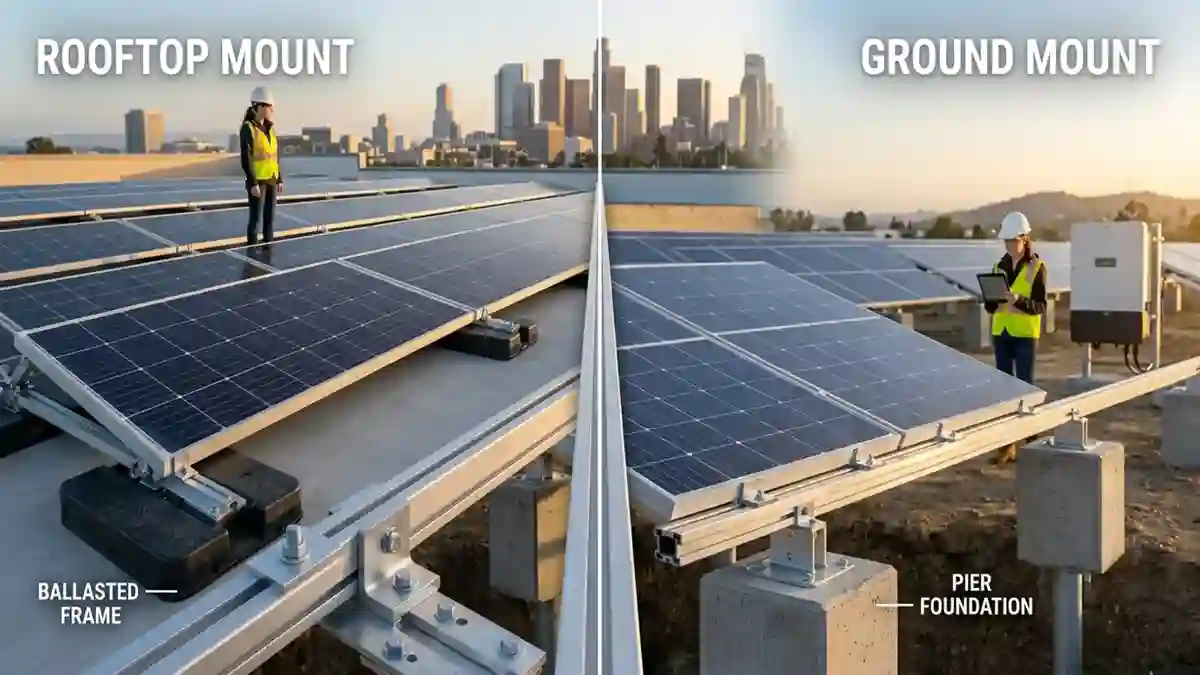
Compare ground mount vs roof mount solar systems. Expert engineering analysis of load capacities, installation costs, site footprints, and 25-year energy yields.
This is the question that precedes every other decision in a commercial solar project. Before you select an inverter, before you choose a panel brand, before you request a single quote — you need to know where the array is going. Because the answer determines the structural engineering scope, the electrical design, the installation timeline, and, in many cases whether the financial case closes at all.
This guide gives you the framework for making that decision. For what happens after you choose ground mounting — foundation engineering, structural frame design, and installation sequence — see the Solar Panel Ground Mounting Systems guide. For the complete engineering context of both system types, see the Solar Mounting Systems hub.
Ground Mount vs Roof Mount Solar Step by Step
1. The Core Trade-Off
Roof-mounted solar uses existing, owned building space. It adds no real estate cost, has shorter electrical runs to the building’s main service entrance, and is visually integrated. Ground-mounted solar uses land that may or may not be available, requires foundation engineering and site preparation, and adds conduit runs — but offers complete freedom in orientation, tilt, and system layout.
The financial comparison is not simply ‘which costs less per watt.’ It is which option delivers the better energy yield per dollar invested over 25 years on this specific site? That calculation requires site-specific data that most comparison articles never actually compute.
2. When Roof Mount Is the Right Choice
- Adequate roof area: The array fits on the roof with acceptable shading and setback margins (typically 3-foot setbacks from roof edges and HVAC equipment for code compliance and maintenance access).
- Acceptable roof condition: The roof membrane has at least 10 years of remaining service life. The bracket compatibility assessment that flags roofs near the end of membrane life is in the Mounting Brackets for Solar Panels guide.
- Structural capacity confirmed: A structural engineer’s analysis confirms the roof framing can carry the additional solar loads without modification.
- Acceptable orientation: The primary roof surface faces within 45 degrees of true south and has no significant shading between 9 am and 3 pm.
- No available land: Ground mounting is not viable because the property has no suitable area within a practical conduit run distance of the building’s electrical room.
3. When Ground Mount Is the Right Choice
- The roof is structurally limited: The existing roof framing cannot carry solar loads without reinforcement. Ground mounting avoids this structural intervention entirely.
- Roof orientation is poor: A building with a primary roof facing northeast or northwest loses 20 to 35% of potential annual energy yield. A ground mount on the same property at optimal orientation recovers this loss.
- Roof replacement is near: A roof within 5 years of replacement is not a good candidate for solar installation. Ground mounting keeps the two projects independent.
- Shading is significant: Rooftop shading from HVAC equipment, parapets, or adjacent buildings that cannot be resolved through layout optimization is a real production loss. Ground mounts can be positioned to avoid all of these.
- System size exceeds roof capacity: A building whose electrical load requires a 500 kW system but whose roof can only accommodate 250 kW needs the remainder on the ground.
4. The Engineering Comparison
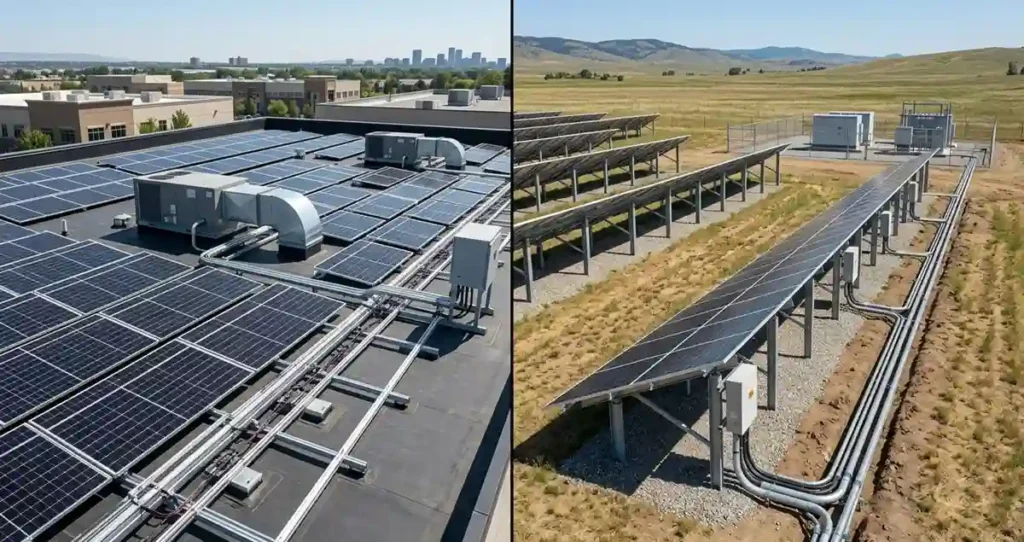
| Engineering Factor | Roof Mount | Ground Mount | Winner |
| Structural scope | Existing structure analysis + roof framing verification | Foundation engineering independent of the building | Ground mount (no existing structure dependency) |
| Electrical run length | Short — inverter typically mounts on or near roof | Long — DC or AC run from array to building electrical room | Roof mount |
| Orientation/tilt control | Fixed by roof geometry | Fully adjustable — optimal for latitude and shading | Ground mount |
| Wind load | Calculated at building height + exposure | Calculated at array height — often lower for low-profile arrays | Typically comparable |
| Maintenance access | Roof access required — fall protection, limited workspace | Ground level — easier, safer, lower cost | Ground mount |
| Shading risk | High — HVAC, parapets, adjacent buildings | Low — position selected to avoid shading | Ground mount |
| Land requirement | None | 0.007 to 0.012 acres per kW installed | Roof mount |
| Permitting complexity | Building permit + solar permit | Building permit + grading permit + possibly zoning | Roof mount |
5. The Energy Yield Difference — Real Numbers
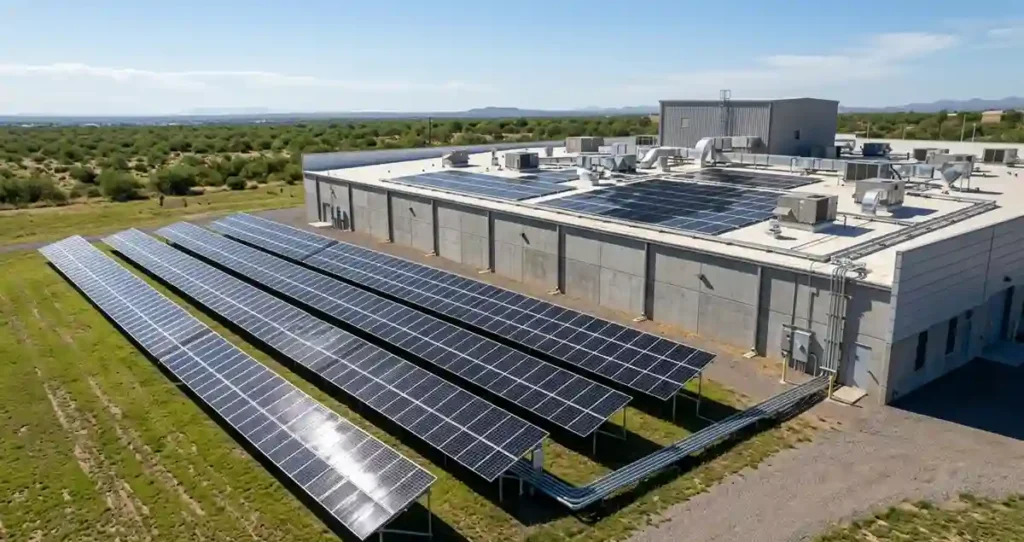
For a 200 kW system at approximately 35° North latitude, the annual production difference between a constrained rooftop installation and an optimally oriented ground mount is typically 8 to 18%. At a commercial electricity rate of $0.12/kWh, a 15% production improvement on a 200 kW system represents approximately $10,000 to $14,000 per year in additional electricity value. Over 25 years, that compounds to $300,000 — which needs to be weighed against the additional ground mount foundation and conduit cost (typically $25,000 to $75,000 additional for a 200 kW ground array).
Engineer’s Note: The energy yield comparison must use site-specific shading analysis — not a generic comparison. A clean, south-facing, unshaded rooftop at a 30-degree pitch may outperform a poorly sited ground mount in a shaded area. Use PVsyst or SAM to model both configurations with actual site shading data before making the final decision.
6. The Solar Ground Mount System — What It Consists Of
A ground mount solar system consists of a foundation system (driven steel piles, helical anchors, or concrete piers), a structural steel or aluminum substructure, the aluminum mounting rail system, module clamps, and the electrical wiring infrastructure. Each of these elements is covered in detail in the Solar Panel Ground Mounting Systems guide, including foundation selection criteria, pile sizing, and the complete installation sequence.
For the bracket hardware that connects the rail system to the ground mount structure, the Solar Panel Mounting Brackets guide covers the pier bracket type and structural requirements. For roof mounting bracket selection on the rooftop alternative, see the Roof Solar Panel Mounting Brackets post.
7. Frequently Asked Questions for Ground Mount vs Roof Mount Solar
Is ground-mounted solar more expensive than roof-mounted solar?
Yes, ground-mounted systems typically carry a higher upfront capital cost. This is driven by required civil engineering works, including geotechnical soil analysis, foundation design (such as driven steel piles or concrete piers), and longer underground trenching for DC/AC conduit runs. However, the higher initial cost is often offset over time by superior energy yields due to optimal orientation and tracking opportunities.
How much land area does a ground-mounted solar system require?
On average, a commercial ground-mounted solar array requires between 0.007 and 0.012 acres per kilowatt (kW) installed. For a standard 200 kW commercial ground system, you will need to allocate roughly 1.4 to 2.4 acres of unshaded, clear land to accommodate the modules, row spacing, and inverter clearance.
Can any commercial roof support a rooftop solar system?
Not without a formal structural analysis. While many commercial roofs possess adequate capacity for flush-mount arrays, an engineering review must verify dead loads, snow loads, and wind uplift constraints per local building codes. If a roof is within 5 to 10 years of needing a total membrane replacement, ground mounting or delaying the solar project is highly recommended to avoid steep deinstallation and reinstallation costs.
Which system type offers better energy production over 25 years?
Ground-mounted solar systems generally offer an 8% to 18% increase in annual energy production compared to roof-constrained systems. This production advantage stems from the structural freedom to align the panels at a perfect true-south azimuth and optimal tilt angle, eliminating shading losses from rooftop HVAC units, parapet walls, or nearby structures.
Does a ground-mount system require different permits than a roof-mount?
Yes. A rooftop installation primarily requires standard building and electrical permits. A ground-mounted solar array introduces heavier civil engineering variables, meaning you will also need to secure grading permits, environmental or land-use clearances, and confirm strict compliance with local municipal zoning setbacks and land easements.
Related guides on SolarVisionAI.com
Solar Panel Installation: Complete Engineering Guide (2026)
Solar Panel Installation Cost: The Complete 2026 Breakdown
Commercial Solar Panel Installation: Engineering Guide 2026
When Is the Best Time to Install Solar Panels?
Solar Power System in 2026: Types, Cost, ROI & AI Optimization