
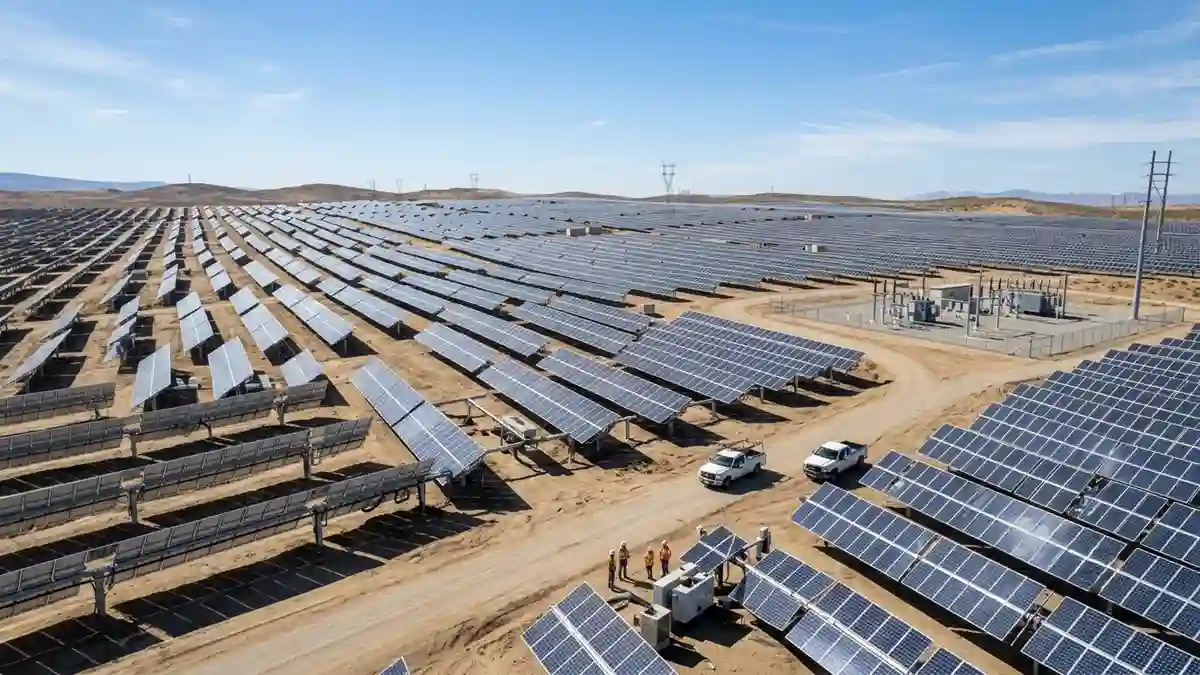
Solar tracker system explained — how single axis, dual-axis, and AI-optimized trackers work, when tracking beats fixed mounting, and the structural engineering behind each type.
A fixed solar panel array points in one direction for 25 years. A solar tracker follows the sun across the sky every day — adjusting the panel angle to maximize the irradiance captured at every hour of daylight. In the right application, that movement translates directly into energy yield improvements of 15 to 45% compared to a fixed solar installation at the same location.
In the wrong application, it translates into higher capital cost, increased maintenance complexity, and mechanical failure modes that a fixed system will never have. The decision between fixed and tracking is an engineering and financial decision — not a default.
This guide is the hub for the solar tracker cluster on SolarVisionAI. It covers what solar tracker systems are, the three main types, when tracking makes engineering and financial sense, and the structural requirements each type imposes. For the full fixed mounting system context — including ground mount foundations, rail specifications, and bracket engineering — see the Solar Mounting Systems hub.
1. What a Solar Tracker System Does
A solar tracker system is a motorized mounting structure that rotates solar panels to follow the position of the sun as it moves across the sky. Unlike fixed mounting systems — which set the panel at a fixed tilt and azimuth optimized for average annual performance — a tracking system adjusts panel orientation continuously or at set intervals throughout the day.
The fundamental physics is straightforward: a solar panel produces maximum power when sunlight strikes it perpendicularly. At sunrise and sunset, a fixed south-facing panel at 25-degree tilt intercepts sunlight at a significant angle — and loses a proportional fraction of potential power. A tracker eliminates this loss by keeping the panel face perpendicular to the sun throughout the day.
The engineering and financial complexity comes from everything required to make that rotation happen reliably at scale for 25 years outdoors: the drive system, the control electronics, the structural frame that must support dynamic loads in multiple orientations, and the maintenance that moving parts require.
2. The Three Types of Solar Tracker Systems
Single Axis Solar Tracker System
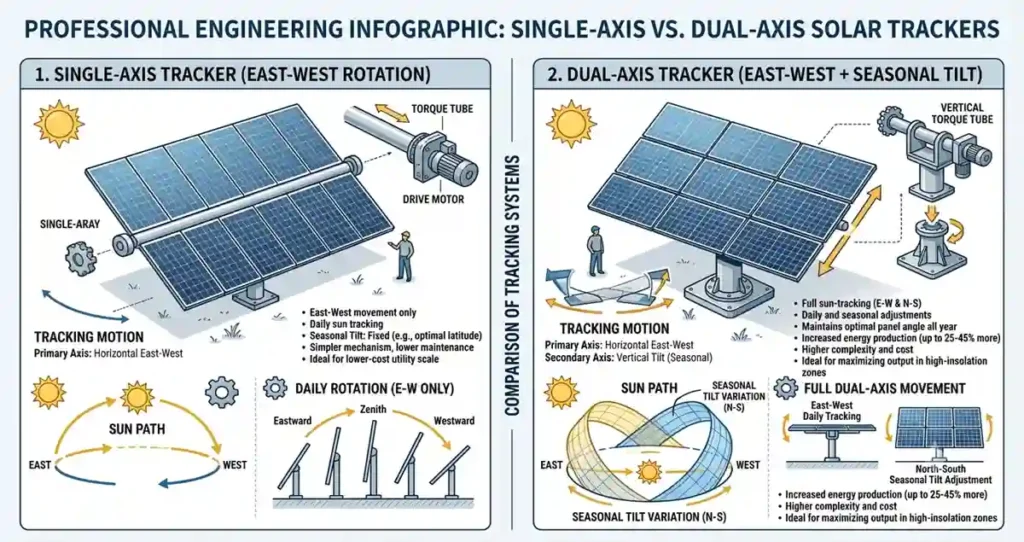
The dominant tracker configuration in US commercial and utility-scale solar. A single axis tracker rotates on one axis — typically a horizontal north-south axis — tracking the sun’s east-to-west movement across the sky throughout the day. It does not track the sun’s seasonal north-south movement (declination change). The full engineering specification for single axis systems — including drive systems, structural frame design, foundation requirements, and US commercial applications — is in the Single Axis Solar Tracker System guide.
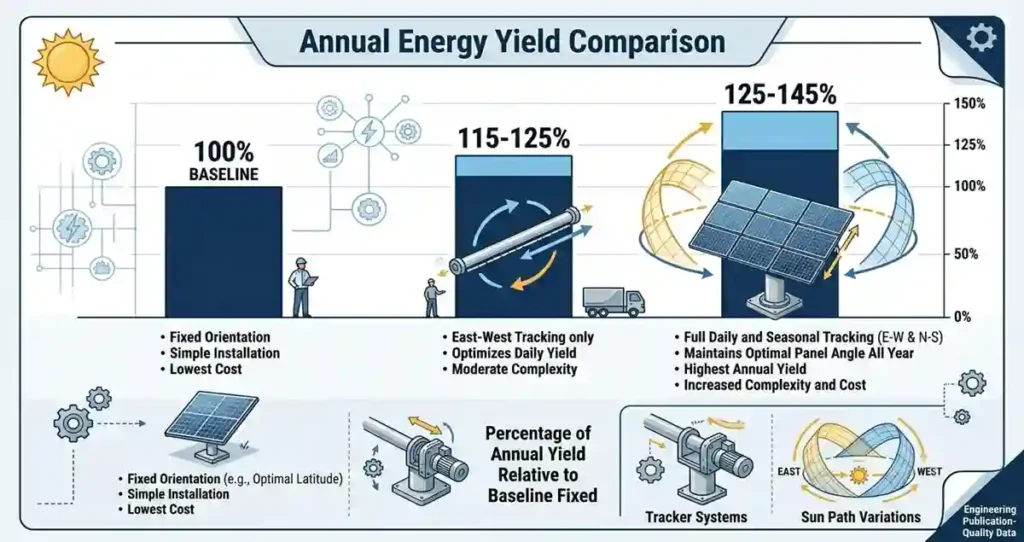
Typical energy yield improvement over fixed: 15 to 25% more annual energy production at most US latitudes. This is the standard benchmark used in project financial models for utility-scale solar in the southwestern US.
Dual Axis Solar Tracking System
Dual axis trackers rotate on two independent axes — typically azimuth (east-west rotation) and elevation (tilt adjustment). This allows the tracker to follow both the daily east-west arc of the sun and the seasonal north-south declination change. The complete engineering analysis of dual axis systems — including the X and Y axis drive mechanisms, structural loading in all orientations, and the AI optimization that makes dual axis economically viable in commercial applications — is in the Dual Axis Solar Tracking System guide.
Typical energy yield improvement over fixed: 25 to 45% more annual energy production. The additional gain over single axis tracking is typically 5 to 15% — the financial case for the additional mechanical complexity must be evaluated against this incremental yield improvement.
Passive Solar Tracker
Passive trackers use thermal expansion of a working fluid — typically a low-boiling-point gas — to drive rotation without a motor or external power source. As the sun heats the fluid on one side of the tracker, it expands and shifts the balance of the system, rotating the panel toward the sun.
Passive trackers are used almost exclusively in small residential and off-grid applications. They have no motor, no control electronics, and no external power requirement — but they are slower to respond, less precise in tracking, and limited in the structural loads they can carry. For commercial applications above 10 kW, active tracking systems are the engineering standard.
3. Fixed vs Tracking — When the Engineering and Financial Case Closes
| Factor | Fixed Mounting | Single Axis Tracker | Dual Axis Tracker |
| Annual energy yield (vs fixed) | Baseline | +15 to 25% | +25 to 45% |
| Capital cost premium (vs fixed) | None | 8-12% additional | 20-35% additional |
| Moving parts | None | 1 drive axis | 2 drive axes |
| Maintenance requirement | Minimal — visual inspection | Annual drive/bearing inspection | Semi-annual drive/bearing inspection |
| Land use efficiency | Highest — arrays can be tightly spaced | Moderate — inter-row spacing required for rotation clearance | Lowest — full clearance radius required |
| Wind load complexity | Standard ASCE 7-22 fixed panel | Dynamic — load varies with tracker angle | Dynamic — load varies in both axes |
| Best application | Rooftop commercial; space-constrained sites | Utility-scale ground mount; agricultural (agrivoltaic) | Small commercial; high-irradiance sites; precision applications |
| Typical US project size | Any size | 500 kW to utility scale | 10 kW to 500 kW commercial |
Engineer’s Note: The financial case for tracking depends entirely on the local electricity rate, available incentives (particularly IRA Section 48 ITC, which applies equally to tracking and fixed systems), the specific site’s irradiance profile, and the project’s cost of capital. I have seen utility projects in Arizona where single axis tracking added $0.003/kWh to the levelized cost of energy while adding 22% more revenue. I have also seen small commercial projects in the Pacific Northwest where tracking added cost without sufficient yield improvement to justify it. Model the specific site — do not apply a generic answer.
4. Structural Engineering Requirements for Solar Tracker Systems
Solar tracker systems impose structural engineering requirements that are fundamentally different from fixed mounting systems — and more complex in almost every dimension.
Foundation Engineering
Tracker systems impose higher and more variable loads on foundations than fixed systems, because the load direction changes with tracker angle. A fixed system imposes a predictable dead load and a calculated worst-case wind uplift from a fixed direction. A tracker imposes those same loads from continuously changing angles — including positions where the combined wind and gravity load vector is most unfavorable for the foundation. Foundation design for tracker systems requires dynamic load analysis across the full range of tracker rotation, not just the worst-case fixed position. The ground mount foundation types — driven piles, helical piers, and concrete piers — that underpin tracker structures are covered in the Solar Panel Ground Mounting Systems guide.
Drive System Engineering
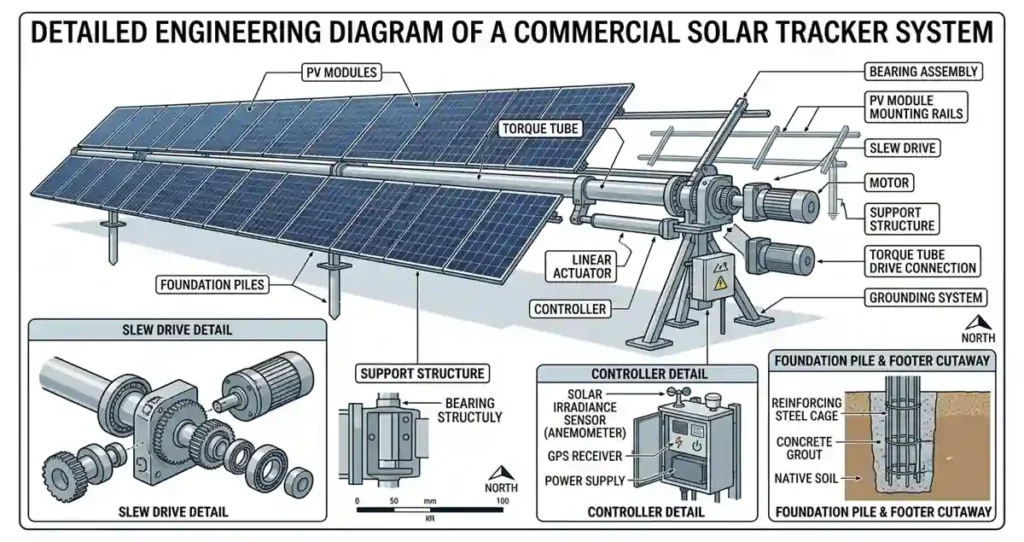
The drive system is the mechanical heart of a solar tracker. It consists of the motor (typically a low-speed, high-torque DC gear motor or linear actuator), the drive mechanism (slewing ring, linear push rod, or rack and pinion), and the structural connection between the drive and the rotating frame.
Drive system specification requires: torque calculation for the worst-case combination of panel weight, wind load, and friction at maximum operating temperature; motor selection for the required torque at the design rotation speed; and drive mechanism sizing for the structural loads transmitted through the connection to the rotating frame.
Wind Load — The Critical Difference
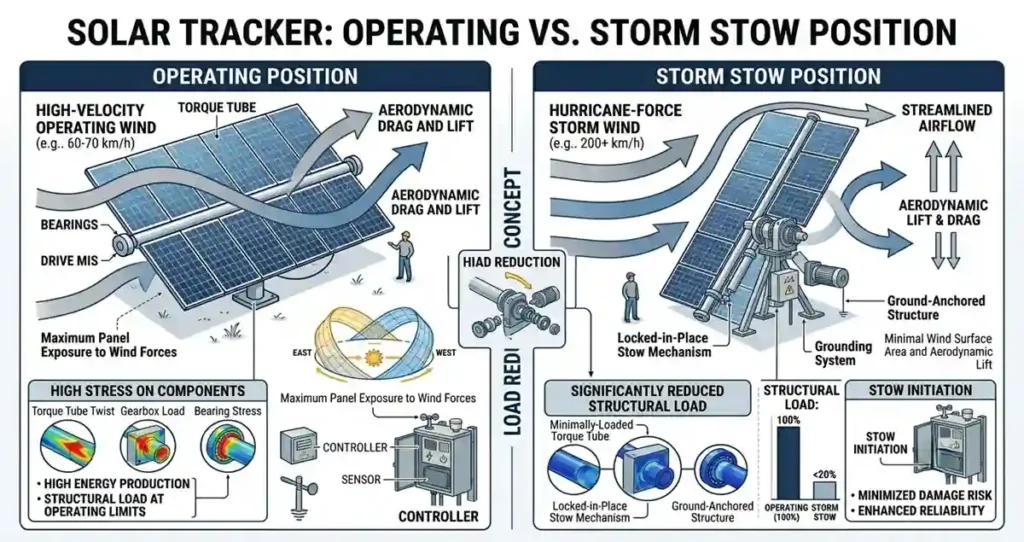
Wind load on a tracker system is not a single calculated value — it is a function of the tracker angle at the moment the wind event occurs. ASCE 7-22 provides wind load calculation methods for solar panels, but tracker-specific wind engineering typically requires computational fluid dynamics (CFD) analysis or wind tunnel testing to characterize the load coefficients across the full range of tracker positions.
Most commercial tracker manufacturers provide site-specific wind load data as part of their engineering package. This data — not a generic ASCE 7-22 calculation — should be the basis for foundation design on a commercial tracker project.
5. Solar Tracker Systems in the US Market — Current Context
Single axis trackers now account for the majority of new utility-scale solar capacity installed in the United States. According to the US Energy Information Administration, tracker penetration in utility-scale solar projects exceeded 75% in the southwestern states by 2024, driven by the combination of high direct normal irradiance (DNI), available flat land, and competitive tracker pricing as manufacturing volumes increased.
The IRA Section 48 Investment Tax Credit applies to the full installed cost of solar power systems, including tracker hardware — which improves the economics of tracking systems relative to non-incentivized markets. Tracker systems also qualify for accelerated depreciation under MACRS, which further improves the financial case for US commercial and utility projects.
For the complete ground mounting engineering context — including foundation types, pile sizing, and structural frame design — that tracker structures build on, see the Solar Panel Ground Mounting Systems guide. For the fixed system baseline that tracker yield gains are measured against, see the Ground Mount vs Roof Mount Solar guide.
6. The Tracker Cluster — Navigation
- Single Axis Solar Tracker System — How It Works & What to Buy
- Dual Axis Solar Tracking System — Complete Engineer’s Guide + AI Optimization
For the full mounting system context that tracker systems sit within, see the Solar Mounting Systems hub.
Frequently Asked Questions.
What is a solar tracker system?
A solar tracker system automatically adjusts solar panel orientation to follow the sun and maximize solar energy production throughout the day.
How much more electricity does a solar tracker produce?
Single-axis trackers typically increase annual energy production by 15% to 25%, while dual-axis trackers can increase production by 25% to 45%, depending on location and solar resource.
What is the difference between single-axis and dual-axis solar trackers?
Single-axis trackers follow the sun from east to west. Dual-axis trackers additionally adjust for seasonal changes in the sun’s elevation angle.
Are solar trackers worth the extra cost?
They can be worthwhile when the additional energy production exceeds the added capital, maintenance, and operating costs.
Do solar trackers require maintenance?
Yes. Motors, bearings, drive systems, controllers, and structural components require periodic inspection and maintenance.
Are solar trackers used on residential solar systems?
Most residential systems use fixed mounting due to lower cost and simplicity. Trackers are more common in commercial and utility-scale installations.
What happens during high winds?
Modern trackers automatically move into a stow position designed to reduce structural loading during severe wind events.
How long do solar tracker systems last?
Most commercial tracker systems are designed for service lives similar to solar modules, typically 25 years or more with proper maintenance.
Related guides on SolarVisionAI.com
Dual Axis Solar Tracking System: Complete Engineer’s Guide
Solar Panel Installation: Complete Engineering Guide (2026)
Solar Panel Installation Cost: The Complete 2026 Breakdown
Commercial Solar Panel Installation: Engineering Guide 2026
When Is the Best Time to Install Solar Panels?
Solar Power System in 2026: Types, Cost, ROI & AI Optimization