
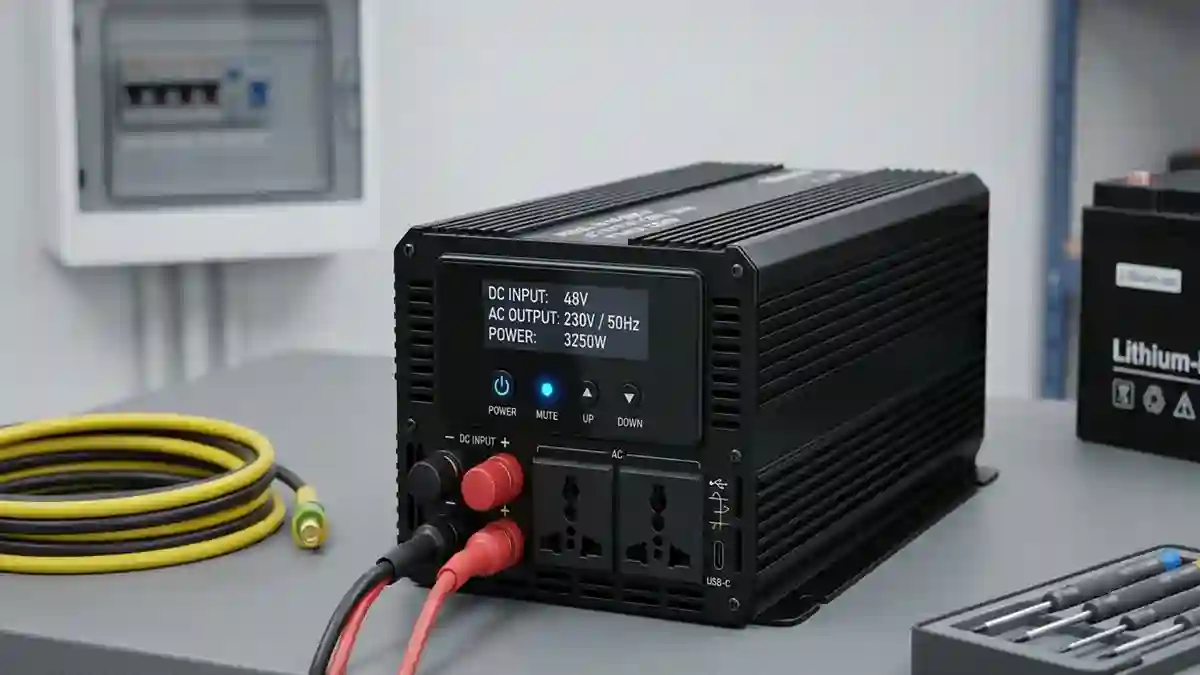
Learn what a power inverter is, how it works, and how to choose the right one. Complete 2026 guide covering types, solar inverters, battery systems, and AI-powered inverter technology.
Every solar power system, every battery backup installation, and every off-grid setup has one component at the center of the entire electrical architecture — the power inverter. After working across residential rooftops, industrial solar installations, and off-grid energy projects, the single most misunderstood component I consistently encounter is not the panels or the batteries — it is the inverter.
This holds globally — whether in the United States, Canada, across Europe and the United Kingdom, in Australia and New Zealand, or throughout the Gulf, Africa, and Asia — the inverter remains the critical decision point for system performance and reliability.
Here is the engineering reality: solar panels generate DC power, and lithium batteries store DC power — but your appliances run on AC power. The inverter is the device that bridges this gap. Get it wrong — wrong type, size, or waveform — and the system underperforms or fails. Get it right, and you have a clean, efficient system capable of powering homes, farms, schools, and industrial facilities for decades.
What has changed in recent years is that inverters are no longer passive devices. Modern AI-powered inverters actively manage energy flow, learn consumption patterns, optimize solar harvest, and communicate with battery energy storage systems in real time. This is where SolarVisionAI operates — and this guide covers everything from basic DC-to-AC conversion to advanced AI-driven energy management.
Whether you are sizing a 10kW solar system, designing an agricultural installation, or evaluating AI inverter technology for commercial use, this guide provides the technical foundation to make the right decisions.
| Quick Answer: A power inverter is an electrical device that converts direct current (DC) from solar panels or batteries into alternating current (AC) for powering household and industrial appliances. Modern AI power inverters go further by intelligently optimizing energy flow, battery charging, and solar energy harvesting in real time, improving overall system efficiency and performance. |
1. How Does a Power Inverter Work?
The operating principle of a power inverter is straightforward, but the implementation — particularly in modern solar inverters — is considerably more sophisticated than most people realize.
At its core, an inverter uses high-frequency electronic switching (MOSFETs or IGBTs operating at tens of kilohertz) to chop the DC input into a rapidly alternating signal, which is then filtered and shaped into a smooth AC sine wave. The output is regulated to the correct voltage — 120V at 60Hz for North America, 230V at 50Hz for most of the rest of the world.
In a solar energy system, understanding how solar panels work makes the inverter’s role clearer. Monocrystalline solar panels — including modern TOPCon solar panels and bifacial solar panels — generate a DC voltage that varies with irradiance, temperature, and shading. The inverter must handle this variable input and produce a stable, regulated AC output regardless. This is a non-trivial power electronics challenge, and it is why inverter quality has such a significant impact on overall system performance.
Pure Sine Wave vs Modified Sine Wave
The quality of the AC output waveform is one of the most important — and most overlooked — inverter specifications.
| Type | Waveform Quality | Best For | Efficiency Impact |
| Pure Sine Wave | Identical to grid power | All appliances, motors, sensitive electronics, and solar systems | Optimal — no derating needed |
| Modified Sine Wave | Stepped approximation | Basic resistive loads, simple tools, and lights | Motors run 10–20% less efficiently |
| Square Wave | Rough square wave | Simple resistive loads only | Not recommended for modern devices |
For any solar energy system — residential or commercial — pure sine wave is the only correct choice. Modified sine wave inverters will damage variable-speed motor drives, reduce the lifespan of compressors in solar air conditioners and solar refrigerators, and interfere with sensitive electronics. The cost difference does not justify the risk.
2. Solar and Power inverter:Types of Power Inverters: A Technical Overview
While all inverters perform the same core task—converting Direct Current (DC) to Alternating Current (AC)—they are engineered for very different energy sources and scales. We categorize them into two main “Families”: System-Integrated (Solar) and Stand-Alone (Mobile/Portable).
The Solar Inverter Family (Grid & Off-Grid Systems)
These are high-voltage, high-efficiency units designed to handle the variable output and complex $V-I$ (Voltage-Current) curves of PV strings.
- String Inverter: The “Central Nervous System.” Multiple panels are wired in series to form a string, which feeds into a single centralized inverter. They are cost-effective and easy to maintain, but they are sensitive to shading—one shaded panel can reduce the performance of the entire string.
- Micro Inverter: Panel-level conversion. Installed on the back of each panel, they convert DC to AC at the source. This eliminates the “Christmas light” effect of shading and allows for granular, panel-level monitoring—ideal for complex or partially shaded roofs.
- Hybrid Solar Inverter: The “All-in-One” solution. These units manage the complex “Three-Way” traffic between solar panels, a Battery Energy Storage System (BESS), and the utility grid. Modern AI-powered hybrids use predictive logic to decide whether to store, use, or sell energy in real-time.
The Stand-Alone Family (Battery-Only Sources) Power Inverter
These are typically used for smaller, mobile, or emergency applications where the DC source is a steady battery bank rather than a fluctuating solar array.
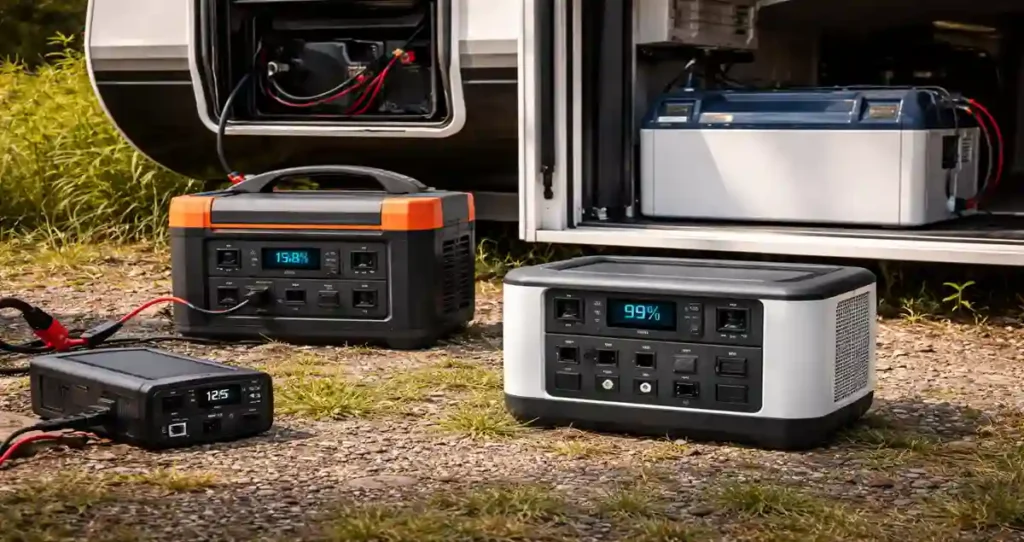
- Car Power Inverter: Compact units that plug into a 12V cigarette lighter (limited to ~150W) or connect directly to the car battery. They are intended for light loads like laptops or phone chargers.
- RV and Truck Power Inverter: Heavy-duty version of the car inverter, often hardwired into a 12V or 24V “house” battery bank. These often include an integrated “Converter” (AC-to-DC) to charge the batteries when the vehicle is plugged into shore power.
- Home Power Inverter (Backup Only): Unlike a solar inverter, this is a “Battery-to-Load” device used for emergency backup. It sits dormant until a blackout occurs, then draws from a dedicated battery bank to power critical circuits.
- Portable Power Inverter with Battery: Often marketed as “Solar Generators,” these are all-in-one units (Inverter + Battery + Charge Controller). They are plug-and-play and ideal for camping or apartment dwellers who cannot install a permanent system.
Engineering Note: You cannot connect solar panels directly to a Stand-Alone (Car/RV) Inverter. These units lack the MPPT (Maximum Power Point Tracking) logic and voltage regulation required to handle the fluctuating Open Circuit Voltage (Voc) of a solar panel. Attempting this will likely result in permanent equipment failure.
3. How to Select the Right Inverter: Engineering Criteria
Inverter selection is a system-level decision, not a product-level one. The correct inverter depends on your load profile, battery architecture, solar array size, and grid connection requirements. Here is the framework I use across residential, commercial, and industrial projects.
Step 1 — Define your load profile
Calculate the total connected load (sum of all device wattages) and the realistic simultaneous load (what will actually run at the same time). The inverter must handle the simultaneous load continuously, plus the startup surge of any motors — compressors, pumps, and air conditioners draw 3–6x their running wattage for 1–2 seconds on startup. A solar water pump rated at 750W running watts may require a 3,000W surge rating from the inverter.
| Device | Running Watts | Startup Surge |
| Refrigerator / solar refrigerator | 150–400W | 800–1,200W |
| Solar air conditioner (1 ton) | 900–1,100W | 2,500–4,000W |
| Solar water pump (1HP) | 750W | 2,500–3,500W |
| LED TV (55 inch) | 80–120W | No surge |
| Laptop | 45–100W | No surge |
| Microwave | 1,000–1,500W | 1,500–2,000W |
| Electric drill | 500–1,000W | 1,500–2,500W |
| Solar street light controller | Varies | Minimal |
Step 2 — Select waveform type
Pure sine wave for any system with motors, compressors, or sensitive electronics. This covers virtually every residential, commercial, and industrial application. The only scenario where a modified sine wave is acceptable is powering basic resistive heating elements in a controlled setting where no other equipment is connected.
Step 3 — Match battery voltage and chemistry
Inverter input voltage must match the battery bank voltage. Small systems (under 3kW) typically use 12V or 24V. Medium systems (3–10kW) use 24V or 48V. Large systems (10kW+) use 48V or higher. Lithium batteries — particularly LiFePO4 — have a different charge profile than lead-acid, and the inverter or charge controller must support the correct charging algorithm. Mismatched charging is the leading cause of premature battery failure in DIY solar installations.
Step 4 — Evaluate the MPPT charge controller integration
In a solar system, the MPPT charge controller is responsible for extracting maximum power from the solar array and converting it efficiently into battery charging current. In a string inverter system, the MPPT function is built into the inverter. In a hybrid solar inverter, MPPT may be built-in or external. In a standalone battery system, a separate MPPT charge controller handles solar input.
The MPPT voltage window must encompass your solar array’s operating voltage range — which varies with temperature, irradiance, and the specific panel technology used. TOPCon solar panels and bifacial solar panels have slightly different voltage-temperature coefficients compared to standard monocrystalline solar panels, so always verify MPPT range compatibility when working with premium panel technologies.
Step 5 — Check efficiency at partial load
Most inverter datasheets show peak efficiency — typically 95–98% for quality units. What matters more in practice is efficiency at 25–50% load, because that is where most systems operate most of the time. A well-designed inverter should maintain above 90% efficiency across its entire load range. Idle power consumption also matters for systems that stay on continuously — some inverters draw 15–30W doing nothing, which adds up to significant energy waste in a 24/7 installation.
4. AI Power Inverters: The Next Generation of Energy Management
This is where inverter technology moves beyond traditional engineering into intelligent automation — a core focus of SolarVisionAI. Modern AI-powered inverters are not just devices that convert DC to AC; they actively manage energy flow across the entire system.
A conventional inverter operates on fixed logic. It charges the battery when solar energy is available, supplies loads when needed, and exports excess power to the grid when the battery is full. While effective, this approach is static. It does not adapt to changing weather conditions, usage patterns, or electricity pricing.
In contrast, AI-driven inverters replace rigid rules with adaptive intelligence. These smart energy systems continuously analyze multiple data points — including solar generation, battery state of charge, load demand, weather forecasts, and historical usage. Based on this data, they make real-time decisions to optimize performance.
Over time, these intelligent inverter systems learn the behavior of your installation. This allows them to improve efficiency, reduce energy waste, and deliver more consistent power management tailored to your specific environment.
Core AI Capabilities in Modern Inverters
Predictive Load Management
AI-based inverter systems analyze daily, weekly, and seasonal consumption patterns. They anticipate peak usage periods and adjust battery charging accordingly. This ensures energy is available when demand is highest, while minimizing reliance on the grid during expensive tariff periods.
AI-Enhanced MPPT
Traditional MPPT (Maximum Power Point Tracking) responds to current conditions. In contrast, smart inverter systems use predictive logic to anticipate changes such as passing clouds, temperature fluctuations, and shading effects.
In systems using advanced technologies like bifacial or TOPCon solar panels, this intelligent tracking can recover additional energy that conventional systems often miss — improving overall solar harvest.
Battery Energy Storage Optimization
AI-driven energy systems actively manage battery cycling to extend lifespan. Instead of following fixed charge/discharge cycles, they adjust based on real-time conditions and future forecasts.
For example, these systems may limit deep discharge when low sunlight is expected, or allow deeper cycling when full recharge is predicted. This intelligent control can significantly increase battery longevity in large-scale BESS installations.
Grid Interaction and Energy Optimization
In grid-connected systems, intelligent inverter systems analyze real-time electricity prices and forecasts. They decide when to store energy, when to use it, and when to export it back to the grid.
This capability is especially valuable for commercial and industrial installations where energy cost reduction is a key performance metric.
Fault Detection and Predictive Maintenance
AI-based inverters continuously monitor system health, including temperature, voltage levels, and harmonic distortion. If performance deviates from expected values — such as reduced output from a solar string — the system generates alerts before major failures occur.
This predictive maintenance approach helps identify issues like faulty connectors, panel degradation, or wiring problems early, reducing downtime and repair costs.
Multi-Source Energy Coordination
In advanced systems that combine solar panels, battery storage, grid power, and backup generators, intelligent inverter systems coordinate all energy sources efficiently.
They automatically determine the best energy source at any moment, ensuring optimal performance across residential, commercial, and off-grid applications. This is particularly important in off-grid living systems, agricultural installations, and large-scale solar projects.
AI Power Inverter Generators
The concept of AI-powered inverter generators represents another evolution in energy systems. Unlike conventional generators that run at a fixed speed, these intelligent systems adjust engine output based on actual demand.
When integrated into hybrid systems, the AI determines when the generator should operate — typically only when battery levels are low and solar input is insufficient. This reduces fuel consumption, lowers operating costs, and extends generator lifespan.
Quantified Benefits: AI vs Conventional Inverters
| Parameter | Conventional Inverter | AI-Driven Inverter System |
|---|---|---|
| Solar Harvest | Standard MPPT | AI-optimized MPPT (+5–15%) |
| Battery Lifespan | Baseline | Extended by 20–35% |
| Energy Cost | Fixed optimization | Dynamic energy arbitrage |
| Fault Detection | Reactive | Predictive and proactive |
| Grid Optimization | Rule-based | Forecast-driven decisions |
| System Learning | None | Continuous improvement over time |
Why This Matters
Intelligent inverter systems are not just an upgrade — they represent a shift in how energy systems operate. By continuously adapting to real-world conditions, they deliver higher efficiency, better reliability, and longer system life.
5. Power Inverters in the Full Solar System Architecture
An inverter does not operate in isolation. Understanding how it integrates with the rest of the solar system is essential for proper system design, performance, and troubleshooting.
Solar Panels
The panels are the generation source. Modern installations primarily use monocrystalline solar panels, with premium systems deploying TOPCon solar panels (efficiencies above 22%) or bifacial solar panels (providing 5–20% additional energy from reflected irradiance).
Panel characteristics directly impact inverter performance. Parameters such as I–V curves and temperature coefficients define how the inverter’s MPPT operates. Bifacial and TOPCon panels typically have higher open-circuit voltages and steeper power curves, so the inverter’s MPPT input range must safely accommodate the array’s maximum Voc at low temperatures.
MPPT Charge Controller
In systems where the solar array connects to batteries through a separate MPPT charge controller (instead of a hybrid inverter), the controller becomes the critical link between generation and storage.
It must be correctly sized for maximum input voltage and current, and its charging profile must match the battery chemistry. Lithium, lead-acid, and gel batteries all require different charging algorithms — and incorrect configuration is a common cause of battery failure.
Battery Energy Storage System (BESS)
The battery energy storage system stores energy for use when solar generation is unavailable. Modern systems predominantly use lithium batteries, especially LiFePO4, due to their long cycle life (3,000–6,000 cycles), thermal stability, and efficiency.
For proper operation, the inverter and BESS must communicate through a compatible battery management system (BMS), typically via CAN bus or RS485. In larger commercial and industrial systems, BESS is often deployed separately and coordinated through a centralized energy management system, with capacities ranging from tens to hundreds of kWh.
MC4 Connectors
MC4 connectors are the standard weatherproof DC connectors used across solar PV systems to link panels, strings, and inverters. They are UV-resistant and rated for up to 1,500V DC in large-scale installations.
Improper crimping or loose connections are a leading cause of DC arc faults — a serious safety risk. Modern AI-enabled inverter systems can detect early fault signatures, helping prevent failures before they escalate.
6. Power Inverter Applications Across Industries
Power inverters are not confined to residential rooftops. Here is how they are deployed across different sectors.
Residential
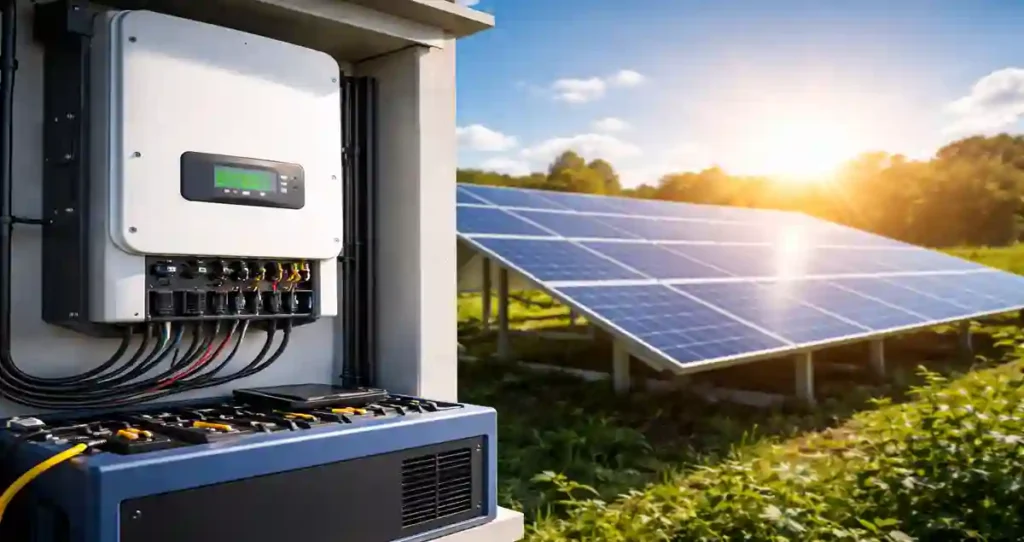
The typical residential application is a solar home system — panels, a hybrid solar inverter, and battery storage. Systems are sized around daily energy consumption, with a 10kW solar system being a common specification for a medium-to-large home with solar air conditioners, solar refrigerators, and general solar home appliances. Off grid living installations add larger battery banks and often a backup generator under AI dispatch control.
Smaller residential applications include balcony solar systems — compact plug-in solar setups popular in apartments and urban settings — where a micro inverter or small string inverter feeds directly into the home circuit through a standard outlet. These systems typically produce 400–800W and require no electrical installation permits in many jurisdictions.
Commercial and Industrial
Commercial solar maintenance programs manage large string inverter arrays across retail, office, and industrial facilities. Inverter performance monitoring is central to these programs — identifying underperforming strings, scheduling cleaning (relevant for how to clean solar panels safely on commercial installations), and tracking degradation over the system lifetime.
Industrial solar panel installations often involve three-phase inverter systems, medium-voltage grid connections, and integration with factory energy management systems. AI inverters in industrial settings can coordinate solar generation with production scheduling — running energy-intensive processes during peak solar hours to minimize grid energy costs.
Agricultural
Agricultural solar panel installations power irrigation systems, livestock facilities, grain drying, and cold storage. Solar water pumps are a particularly important application — replacing diesel-powered pumps with solar-plus-inverter systems reduces operating costs dramatically in regions with high solar irradiance. AI inverter systems optimize pump operation to match irrigation schedules with solar generation peaks.
Educational Institutions
School solar panel installations serve a dual purpose — reducing energy costs and providing a live learning platform for students studying renewable energy. Modern school installations increasingly incorporate AI monitoring dashboards that display real-time generation, consumption, and battery data — making the energy system itself an educational resource.
7. Power Inverter Brands: What to Know
In the 2026 landscape, the “best” inverter is defined by its ecosystem and regional compliance. We categorize these into two distinct tiers: Tool-Integrated (Portable) and Grid-Infrastructure (System-Level).
7.1 Tool-Integrated vs. Grid-Infrastructure Inverters
One of the most common questions I receive is whether a high-power tool inverter can run a home. The answer is no. They are engineered for different duty cycles and electrical architectures.
- Tool-Integrated (Milwaukee/DeWalt): These are “Closed-Ecosystem” devices. They are engineered to provide mobile AC power specifically for contractors. While they are rugged and reliable for a miter saw or charging a laptop, they lack the MPPT inputs, Grid-Tie capability, and BMS communication required to function as a solar system component.
- Grid-Infrastructure: These are the “Central Nervous System” of a building. They are designed for 24/7 operation, 10–25 year lifespans, and complex interaction with solar arrays and the utility grid.
| Feature | Tool-Integrated (M18 / FLEXVOLT) | Grid-Infrastructure (Sol-Ark / Enphase) |
| Primary Source | 18V/20V/60V Tool Batteries | Solar PV & 48V/High-Voltage BESS |
| Operation | Intermittent / Job-site | Continuous (24/7) |
| Grid Interaction | None (Off-grid portable only) | Grid-Tie, Hybrid, or Dedicated Off-Grid |
| Max Capacity | ~2,000W – 3,600W (Surge) | 5kW to 500kW+ |
7.2 Global Leaders in Power Inverters (Non-Solar Focus)
| Region / Category | Brand | Primary Specialization | Key Industry Application |
| USA & North America | APC (Schneider) | Enterprise UPS Systems | Data Centers & IT Infrastructure |
| Eaton / Tripp Lite | Industrial Power Management | Critical Infrastructure & Networking | |
| CyberPower | Small-Scale Backup | Home Office & SMB Power Security | |
| Europe | AEG Power Solutions | Industrial DC Systems | Railways & Energy Infrastructure |
| Riello UPS | High-Efficiency Inverters | Commercial & Large Industrial | |
| Socomec | Energy Conversion | Industrial Power Switching | |
| Japan | Toshiba / Fujitsu | Enterprise Power Electronics | Large Infrastructure & IT Environments |
| Panasonic | Durable Power Modules | Industrial Electronics & Mobile Power | |
| China | Vertiv (formerly Emerson) | Infrastructure Management | Global Data Center Thermal & Power |
| Kstar / INVT | High-Volume Manufacturing | UPS Systems & Automation | |
| Meind | Mobile Power Conversion | Vehicle & Export Market Inverters | |
| Automotive & Mobile | AIMS Power | High-Wattage DC-to-AC | RVs, Heavy-Duty Trucks & Off-Grid |
| BESTEK / Giandel | Portable Conversion | Consumer Travel & Small Devices | |
| Component Leaders | Mean Well / Delta | Precision Power Supplies | Global Industrial & OEM Integration |
7.3 Global Brand Comparison: Industrial, Solar, & Value-Engineering
This table categorizes the leading manufacturers across the four primary sectors of power conversion.
| Category | Leading Brands | Engineering Strength | Primary Application |
| USA Industrial | APC, Eaton, CyberPower | Enterprise Reliability | Data Centers, IT & Medical |
| Premium Solar | Sol-Ark, Enphase, Tesla | High Efficiency & Resilience | North American Whole-Home Backup |
| Value Solar | SunGoldPower, SRNE | Cost-to-Performance Ratio | Pro-DIY, Off-Grid Cabins & RVs |
| Global Infrastructure | Delta, Huawei, SMA | Grid-Scale Management | Industrial Plants & Utility Solar |
| Thermal Specialists | Solis, Sungrow | Passive & Active Cooling | High-Heat Regions (The Gulf/AU) |
| Mobile / Marine | Victron, AIMS, Giandel | Durability & Monitoring | Luxury Yachts & Mobile Workshops |
While SunGoldPower offers exceptional cost-to-performance, their high-frequency design requires strict adherence to DC-side fuse ratings compared to heavier low-frequency transformer units.” This adds that extra layer of “Technical Truth” you value.
7.4 Regional Leaders & Specialized Tech
An inverter’s reliability is often tied to local support and regional certifications (e.g., UL 1741 SB in the US vs. AS/NZS 4777.2 in Australia).
- USA & Canada (Resilience): Enphase leads for microinverters, while Sol-Ark remains the choice for “battery agnostic” hybrid builds. SunGoldPower has become a dominant 2026 “Value” player here, offering UL-listed hybrid units that use battle-tested SRNE hardware for budget-conscious homeowners.
- Australia & NZ (Efficiency): Fronius is prized for active cooling in the Outback. Sigenergy is the 2026 disruptor with an AI-powered 5-in-1 modular system.
- Europe (Intelligence): Huawei leads in safety with AI-powered AFCI (Arc Fault Detection), while SMA is the benchmark for German-engineered industrial three-phase systems.
- The Gulf / GCC (Thermal): Solis and Sungrow are the regional standards, featuring IP66 protection and thermal designs that prevent derating at ambient temperatures exceeding .
8. Frequently Asked Questions
What does a power inverter do?
It converts DC electricity from batteries or solar panels into AC electricity for powering standard appliances and electronics. In a solar system, the solar inverter is also responsible for MPPT — extracting maximum power from the panels under varying irradiance and temperature conditions.
What is the difference between a solar inverter and a regular inverter?
A solar inverter includes MPPT input stages designed specifically for the variable DC output of solar panels. A regular inverter assumes a stable DC input voltage. Using a regular inverter in a solar application will result in poor performance and potentially damage the inverter. A hybrid solar inverter goes further by adding battery management and grid interaction capabilities to the solar conversion function.
Can I run a whole home on a power inverter and battery?
Yes. A properly specified hybrid solar inverter, a correctly sized lithium battery bank, and a solar array matched to your daily consumption can power a complete home indefinitely. A 10kW solar system with 20–30kWh of battery storage comfortably handles most family homes, including solar air conditioners and solar refrigerators. AI-managed systems optimize this further by shifting loads and managing grid interaction.
What is the lifespan of a power inverter?
Quality solar inverters are designed for 10–15 year service life with minimal maintenance. Electrolytic capacitors are the primary wear component — they degrade with heat and cycling over time. Good thermal management (proper installation with adequate ventilation) is the single most effective way to maximize inverter lifespan. AI inverters with predictive maintenance can flag early signs of capacitor degradation before they cause system failure.
How to use a power inverter with a battery?
Connect the inverter positive to the battery positive through a correctly rated fuse. Connect the inverter negative to the battery negative. Size the connecting cables for the maximum current draw — undersized cables are dangerous. For lithium batteries, ensure the inverter supports the correct charging profile for your battery chemistry. Set the low-voltage cutoff to protect the battery from deep discharge: 20% state of charge for LiFePO4, 50% for lead-acid.
Do old solar panels affect inverter performance?
Yes. Old solar panels and used solar panels degrade over time — typically 0.5–0.8% per year in power output. More importantly, aged panels may develop higher series resistance, which shifts the maximum power point on the I-V curve. A modern AI inverter’s MPPT can adapt to these shifts more effectively than conventional algorithms. If integrating old solar panels into a new system, verify that the inverter’s MPPT voltage range still encompasses the array’s operating voltage at degraded output.
How does inverter efficiency affect system performance?
Every watt lost in the inverter is a watt that does not reach your loads. At 95% inverter efficiency, a 1,000W solar harvest delivers 950W of useful AC power. Over a year on a 10kW system, a 2% efficiency difference translates to approximately 150–200kWh of lost energy. For commercial and industrial solar panel installations, this difference has a meaningful financial impact across a 20-year system life
Conclusion
The power inverter is the most technically complex and operationally critical component in any solar or battery energy system. Selecting the right architecture — string inverter, micro inverter, hybrid solar inverter, or AI-powered system — requires understanding not just the inverter specifications, but the entire system it sits within: the panel technology, the battery chemistry, the load profile, and the grid interaction requirements.
What the latest generation of AI power inverters represents is not just incremental improvement on the conventional product — it is a fundamentally different approach to energy management. A system that learns, adapts, and optimizes in real time will consistently outperform one operating on fixed rules, both in energy yield and in long-term reliability.
From a 150W car inverter to a BESS-integrated AI system managing a commercial solar facility, the principles remain the same: match the inverter to the system, size it correctly, specify pure sine wave, and choose a product with the monitoring and management capabilities your application requires. Get these fundamentals right, and the inverter will be the most reliable component in your entire energy system.