

Master car power inverter for Car installation. Learn safe 12V DC to 120V/230V AC conversion, AWG wire sizing, and fusing for US, Australia, UK, and European standards.
Let me start with something most buying guides skip entirely: the majority of car power inverter failures in the field are not caused by a faulty inverter. They are caused by an installation that was never designed to handle the load it was asked to run.
I have seen a 2,000W inverter connected to a vehicle with 10-gauge wire and a 15-amp fuse on the positive line. The inverter worked fine — until someone tried to run a power tool from it. The wire heated up, the insulation softened, and the resulting short took out the fuse, the inverter, and very nearly the vehicle wiring harness. The inverter was not the problem. The installation was.
A power inverter for a car does one thing: it takes the 12V DC power from your vehicle’s battery and converts it into 120V AC — the same alternating current your home outlets provide. That single function opens up a significant range of capabilities: you can run a laptop, charge multiple devices simultaneously, power a small compressor, run a drill on a job site, or keep a CPAP machine running on an extended road trip. But getting useful, safe performance out of a car power inverter requires understanding the electrical constraints of the vehicle system it connects to, not just the spec sheet of the inverter itself.
This guide covers the full picture — what a car power inverter actually does at an electrical level, how to size one correctly for your specific loads, what the cigarette lighter socket can and cannot handle, how to wire a high-power unit safely, and what to look for in the specifications that actually matter. Whether you are looking for a compact unit to charge a laptop on a commute or a high-capacity inverter to run tools from your truck, the principles are the same.
| Quick Answer: A power inverter for a car converts your vehicle’s 12V DC battery power into 120V AC for running laptops, tools, appliances, and other devices on the road. Correct sizing, wiring, and fusing matter as much as the inverter itself — an undersized wire on a high-draw inverter is a fire hazard. |
1. What Is a Power Inverter for a Car?
A car power inverter is a DC-to-AC power conversion device designed to operate from a 12V automotive electrical system. At its core it uses the same power electronics as any other inverter — high-frequency MOSFET switching, output filtering, and voltage regulation — but packaged and specified for the constraints of a vehicle environment: 12V nominal input (which varies from around 11V at low battery to 14.4V while the alternator is charging), compact form factor, and tolerance for the electrical noise and voltage transients common in automotive systems.
The output is 120V AC at 60Hz — identical to a standard North American wall outlet — which means any device rated for 120V AC can theoretically be powered from a car power inverter, within the inverter’s wattage limits. Understanding those limits, and the limits of the vehicle electrical system feeding the inverter, is the core of selecting and using one correctly.
DC Input Realities: What Your Car Battery Actually Provides
Your car battery is rated in amp-hours (Ah) — typically 40–70Ah for a standard passenger vehicle, 70–100Ah for a truck or SUV. At 12V, a 60Ah battery stores approximately 720 watt-hours of usable energy. That sounds like a lot, but a 300W inverter running continuously draws 25 amps from the battery, depleting that 60Ah battery in well under two hours even if it started fully charged.
The critical distinction for car inverter use is whether the engine is running. With the engine running, the alternator continuously replenishes the battery — typically at 80–150 amps output depending on the vehicle. This means you can run a moderate inverter load indefinitely with the engine on. With the engine off, you are drawing down a finite battery reserve, and the calculation above applies directly.
| Never run a high-wattage inverter from a parked car with the engine off for extended periods without monitoring battery voltage. Most quality inverters include a low-voltage cutoff — typically around 10.5V — that shuts down before the battery drops below the threshold needed to start the engine. Verify this feature is enabled on any inverter you install. |
2. Cigarette Lighter vs Direct Battery Connection: The Most Important Decision
Every car power inverter connects to the vehicle’s 12V system in one of two ways, and this single decision determines the maximum safe power you can draw. Getting this wrong is the most common cause of blown fuses, melted connectors, and damaged vehicle wiring.
Cigarette Lighter Socket Connection
The cigarette lighter socket — technically the 12V accessory socket — is the simplest connection point for a car power inverter. Plug the inverter in, and it is ready to use. No wiring, no tools, no installation required.
The limitation is absolute and non-negotiable: the socket is protected by a fuse, typically rated at 15 or 20 amps. At 12V, a 15-amp fuse allows a maximum of 180W continuous power draw. A 20-amp fuse allows 240W. These are the hard limits — not guidelines, not conservative estimates. Exceed them and you blow the fuse. Repeatedly exceeding them, and you risk damaging the socket wiring, which is often routed through areas of the vehicle that are difficult and expensive to access.
| Socket Fuse Rating | Maximum Safe Wattage | Practical Inverter Size |
| 15A (most passenger cars) | ~150W continuous | 100–150W inverter |
| 20A (some trucks/SUVs) | ~200W continuous | 150–200W inverter |
| Combined dual socket | ~300W if separate circuits | Verify in the vehicle manual |
For a power inverter for car cigarette lighter use, the practical ceiling is 150–200W. This comfortably covers phone chargers, tablets, small fans, LED lighting, and — most relevantly for mobile workers — a car power inverter for laptop use. A typical laptop draws 45–90W, well within the cigarette lighter socket’s capacity. Two laptops simultaneously start to push the boundary for a 15-amp socket.
| Engineering tip: Check your vehicle owner’s manual for the exact fuse rating on the 12V accessory circuit before purchasing an inverter. Some vehicles have two separate 12V sockets on different circuits — combined, they may support a higher total load, but each socket still has its individual fuse limit. |
Direct Battery Connection
For any inverter above 300W, direct connection to the vehicle battery is the correct installation method. This bypasses the vehicle’s accessory circuit entirely and connects the inverter directly to the power source — the battery terminals or a dedicated distribution block.
Direct battery connection enables the full rated capacity of the inverter, limited only by the battery’s ability to supply current and the wire gauge used for the connection. A 2000-watt power inverter for car use drawing full load at 12V requires approximately 167 amps, which demands 2/0 AWG (or larger) cable and a 200-amp fuse within 18 inches of the battery positive terminal. These are not arbitrary specifications — they are calculated from the thermal limits of the conductor and the response time needed to protect it from fault current.
| Inverter Size | Max DC Current Draw | Minimum Wire Gauge | Fuse Rating |
| Up to 300W | 25A | 10 AWG | 30A |
| 300W – 750W | 63A | 6 AWG | 80A |
| 750W – 1,500W | 125A | 2 AWG | 150A |
| 1,500W – 2,000W | 167A | 1/0 AWG | 200A |
| 2,000W+ | 200A+ | 2/0 AWG or larger | 250A+ |
| Always install the fuse on the positive cable as close to the battery terminal as possible — within 18 inches maximum. This fuse protects the cable between the battery and inverter, which is the highest-risk section. A short anywhere in that run without a fuse can cause a cable fire before any downstream protection trips. |
3. Sine Wave Output: Pure vs Modified — Does It Matter for Car Use?
The waveform question matters less for basic car inverter use than it does for home solar power systems, but it still matters — and getting it wrong can damage equipment you paid considerably more for than the inverter itself.
Modified sine wave inverters are cheaper and perfectly adequate for resistive loads — incandescent lights, simple heating elements, basic battery chargers. They work acceptably for many laptop chargers and phone chargers, though some switching power supplies run slightly warmer on modified sine wave than they would on pure sine.
Pure sine wave inverters produce output identical in quality to grid power. They are required for: variable-speed motor loads (power tools with speed control, some compressors), audio equipment (modified sine wave introduces audible buzz), medical devices including CPAP machines, and any device whose manual specifies ‘pure sine wave input required.’ They are also the correct choice if you are ever going to connect the inverter output to batteries or any solar home appliances in a more complex off-grid setup.
| For a car power inverter for laptop use specifically: most modern laptop chargers are universal switching power supplies that tolerate modified sine wave without damage. However, the charger will run warmer, and in a hot vehicle on a summer day, additional heat in the charging brick is worth avoiding. Pure sine wave is the cleaner choice if the budget allows. |
International Standards: US vs. Australia
Because SolarVisionAI serves a global engineering audience, it is vital to match your inverter’s output to your region’s grid standards. Using the wrong voltage or frequency can lead to permanent equipment failure.
| Specification | North America (US/Canada) | Australia / NZ / UK |
| Output Voltage | 120V AC (Range: 110V–125V) | 230V AC (Range: 220V–240V) |
| Frequency | 60 Hz | 50 Hz |
| Plug Type | NEMA 5-15 (Flat blades) | Type I (Slanted blades / AS/NZS 3112) |
Engineering Warning: Most car power inverters are not universal voltage devices. A 120V/60Hz inverter purchased in the US will not power Australian appliances. Additionally, frequency-sensitive devices (like some clocks or older motor-driven tools) will run incorrectly or overheat if the hertz ($Hz$) do not match the device’s nameplate rating.
4. How to Size a Power Inverter for Your Car Correctly
Sizing is where most people make mistakes — either dramatically oversizing (paying for capacity they will never use) or undersizing (running the inverter at or near its limits continuously, which shortens its life and generates excessive heat).
Step 1 — List your actual loads
Write down every device you plan to run from the inverter simultaneously. Check the wattage rating on each device — it is on the label, in the manual, or findable from the manufacturer. If the device has a motor (drill, compressor, small pump), note the startup surge wattage as well — typically 2–6x the running wattage for 1–3 seconds.
| Device | Running Watts | Notes |
| Laptop (15 inch) | 45–90W | Most common car inverter load |
| Phone / tablet charging | 5–20W each | Well within any inverter |
| CPAP machine | 30–60W | Pure sine wave required |
| Small drill (corded) | 400–800W | 2x–4x surge on startup |
| Tyre inflator / compressor | 150–300W | Motor surge — check specs |
| Mini fridge / cooler | 40–60W running | Compressor surge up to 300W |
| LED work light | 20–100W | No surge — easy load |
| Portable fan | 20–100W | Small motor, minimal surge |
Step 2 — Add simultaneous loads and apply a buffer
Sum the running wattage of everything you will run at the same time. Add the highest single surge load to account for startup. Multiply the total by 1.25 as a safety and efficiency buffer. This is your minimum inverter continuous rating.
Example: laptop (65W) + phone charging (15W) + LED work light (50W) = 130W running. No motor loads, so no surge concern. 130W x 1.25 = 163W minimum. A 200W inverter is the correct size for this load — not a 1,000W unit.
Step 3 — Match to the connection method
If your calculated requirement is under 150W and you want plug-and-play simplicity, a cigarette lighter socket inverter is appropriate. If it is above 300W, or if you will use the inverter regularly for extended periods, direct battery connection with correct wiring is the right installation.
5. Key Specifications to Evaluate
Inverter datasheets contain a mix of genuinely useful specifications and marketing numbers. Here is what actually matters and what to ignore.
Continuous vs Peak (Surge) Wattage
Every inverter has two wattage ratings: continuous and peak. The continuous rating is what the inverter can sustain indefinitely. The peak rating is what it can handle for a few seconds during motor startup. The continuous rating is the one that matters for sizing. A ‘2000W’ inverter with a 1,000W continuous rating is a 1,000W inverter — the 2,000W number describes its surge capacity only.
Efficiency Rating
A 90% efficient inverter drawing 300W from your battery delivers 270W to your device — and turns 30W into heat. At the 80–90% efficiency typical of quality units, this heat is manageable. Budget inverters sometimes operate at 75–80% efficiency, generating significantly more heat and putting additional load on your vehicle battery. Look for efficiency ratings above 88% at typical loads.
Low Voltage Cutoff
This is the battery voltage at which the inverter shuts down automatically to prevent deep discharge. For a 12V system, a cutoff around 10.5–11V is appropriate — low enough to utilize available battery capacity, high enough to leave sufficient charge to start the engine. Verify this is adjustable or set appropriately on any inverter you purchase.
Protection Features
A quality car power inverter should include: over-temperature thermal shutdown, overload protection (graceful shutdown rather than component damage when the load exceeds rating), short circuit protection, and reverse polarity protection on direct-wired units. These are not premium features — they are baseline requirements for safe operation in a vehicle environment.
USB Ports and Pass-Through Charging
Many car power inverters include built-in USB charging ports alongside the AC outlets. These are genuinely useful — phones and tablets charge more efficiently from a dedicated USB port than from a USB charger plugged into an AC outlet. Check the USB charging spec: older units provide 5V/2.1A (10W). Better units include USB-C Power Delivery ports at 18–65W, which charge modern phones and even some laptops directly at full speed.
6. Portable Power Inverter for Car: When an All-in-One Makes More Sense
A portable power inverter for car use — meaning an all-in-one unit with a built-in battery rather than a wired inverter — is worth considering for specific use cases. These units combine the inverter with a lithium battery pack, typically accepting charge from both AC mains and 12V DC vehicle input via the cigarette lighter socket or direct connection.
The key advantage is flexibility: you charge the unit from the car while driving, then use it parked with the engine off without any risk of depleting the vehicle battery. This is the correct solution for extended stationary use — running a CPAP machine overnight, powering a workstation at a remote site, or keeping solar home appliances running during a camping trip without the engine running.
The trade-off is cost and weight. A quality portable power station with 500–1,000Wh capacity and a built-in pure sine wave inverter costs significantly more than a comparable wired inverter. But for users who need both portability and extended off-engine runtime, the additional cost is justified.
7. Installation: Doing It Right
For cigarette lighter socket inverters under 200W, installation is plug-and-play — there is nothing to install. For direct-wired inverters above 300W, the installation requires attention to electrical fundamentals.
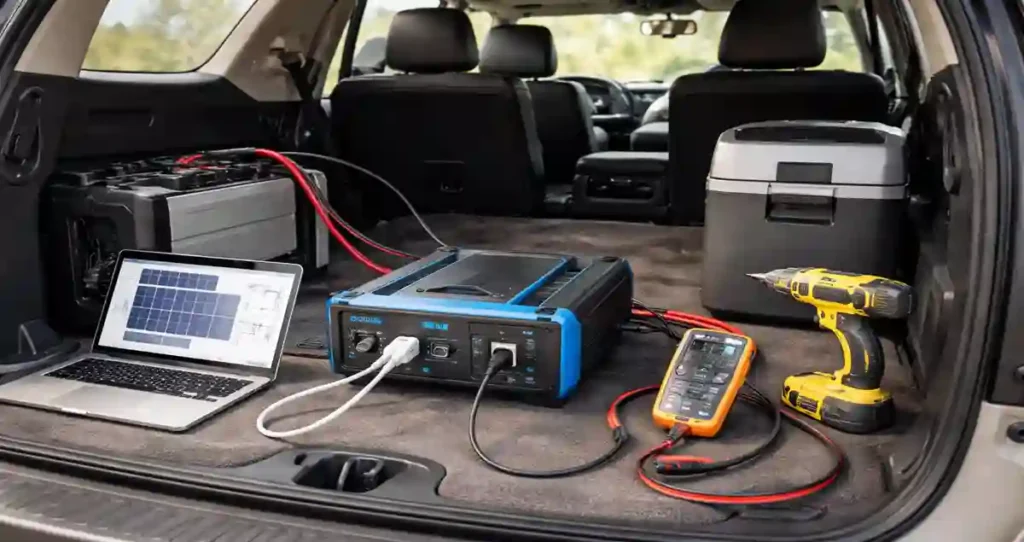
Direct Battery Wiring — Step by Step
- Select cable gauge based on the maximum current draw of your inverter — refer to the sizing table in Section 2. Use welding cable or fine-stranded marine-grade cable, not solid-core house wire.
- Cut the positive cable to length. Install an ANL fuse holder within 18 inches of the battery positive terminal and install the correct fuse rating. This is the most critical safety step.
- Route cables away from hot exhaust components, moving parts, and sharp edges. Use grommets wherever cables pass through firewall penetrations.
- Connect the negative cable directly to the battery negative terminal or a solid chassis ground point. Avoid long ground runs — keep the ground cable as short as practical.
- Connect cables to the inverter last, after all routing and securing is complete. Positive first, then negative.
- Power on the inverter with no load connected and verify the display reads the correct battery voltage. Apply loads incrementally and verify temperature and voltage behavior under load.
| Mount the inverter in a location with adequate ventilation. Most car power inverters use a cooling fan that activates under load — the fan needs airflow. Mounting in a sealed compartment or against a surface that blocks the fan intake will cause thermal shutdown under sustained load, even if the inverter is correctly rated for the load. |
⚡ DANGER: HIGH VOLTAGE & FIRE HAZARD
The 120V AC output from a car inverter is as lethal as a home wall outlet. Treat all connections with professional caution.
- Lethal Shock: Never service AC wiring while the battery is connected. Internal capacitors can hold a high-voltage charge even when powered off.
- Fire Risk: An unfused 12V cable is a thermal runaway risk. Always install a high-current fuse within 18 inches of the battery terminal.
- Explosive Gas: Batteries vent hydrogen. Ensure the area is well-ventilated to prevent ignition from the “pre-charge” spark during connection.
- Water Hazard: Never mount an inverter where it can be exposed to rain, condensation, or spilled liquids.
8. Car Inverters in the Broader Energy Picture
A car power inverter is the simplest form of DC-to-AC conversion — one battery, one inverter, one connection. But the same fundamental technology scales all the way up to hybrid solar inverters managing kilowatts of solar generation, battery energy storage systems with hundreds of kilowatt-hours of capacity, and AI-driven energy management platforms that optimize power flow across an entire facility.
Understanding how a car inverter works — the relationship between battery voltage and current, the importance of wire sizing and protection, the difference between peak and continuous ratings, and the waveform quality implications for different load types — builds the foundation for understanding more complex solar energy systems. The physics does not change; the scale and sophistication do.
In solar energy systems, monocrystalline solar panels and increasingly TOPCon solar panels generate DC power that feeds through an MPPT charge controller into a solar battery bank — and from there through an inverter to AC loads. The car inverter and the home hybrid solar inverter are solving the same fundamental problem at very different scales. If you are interested in how that larger picture fits together — from how solar panels work through to BESS architecture and AI energy management — that full system perspective is what SolarVisionAI is built around.
Conclusion
A power inverter for a car is a straightforward device built on well-understood power electronics — but the difference between a safe, reliable installation and a problematic one comes down to respecting the electrical constraints of the vehicle system it connects to. Size the inverter to your actual loads. Match the connection method to the power level. Wire it correctly with the appropriate cable gauge and fusing. Choose a pure sine wave if you are running anything sensitive.
Get those fundamentals right, and a car power inverter will give you years of reliable service. Get them wrong, and you will spend time troubleshooting problems that should never have occurred — or dealing with consequences considerably more serious than a blown fuse.
| Part of the SolarVisionAI Power Inverter Series: This post is part of a complete guide series covering every power inverter application — from car and RV use through to home solar systems and AI-powered energy management. Each post in the series is written to the same engineering standard: accurate, practical, and free of the vague generalities that fill most energy content online. |
9. Frequently Asked Questions
What is a power inverter for a car?
A car power inverter is a device that converts the vehicle’s 12V DC battery power into 120V AC electricity — the same power standard used by household outlets. It allows you to run AC-powered devices from your vehicle’s electrical system while driving or stationary.
How many watts do I need in a car power inverter?
Add up the wattage of every device you plan to run simultaneously, add 25% safety buffer, and that is your minimum continuous wattage requirement. For laptop and phone charging, 150–200W is sufficient. For adding small power tools or a compressor: 400–750W. For running larger equipment from a truck or van: 1,000–2,000W with direct battery wiring.
Can I run a laptop from a car power inverter?
Yes — a car power inverter for laptop use is one of the most common applications. Most laptops draw 45–90W, which is well within the capacity of even a basic 150W cigarette lighter socket inverter. For extended work sessions, a pure sine wave inverter is preferable to protect the laptop’s power supply from the additional heat generated by modified sine wave output.
What can a 2000-watt power inverter for a car run?
A 2000-watt power inverter for car use can run most power tools, small appliances, a full-size drill or circular saw, a portable compressor, multiple laptops simultaneously, and many other loads that would be impractical on a smaller unit. At 2,000W continuous, the DC draw is approximately 167 amps — this requires direct battery wiring with 1/0 or 2/0 AWG cable and a 200-amp fuse. It will also drain a standard car battery quickly with the engine off; this wattage level is practical only with the engine running or in a vehicle with a dedicated auxiliary battery.
Power inverter for car near me — where to buy?
Car power inverters are available at auto parts stores (AutoZone, O’Reilly, Advance Auto), big-box retailers (Walmart, Home Depot), Amazon, and specialist electrical supply houses for direct-wired high-capacity units. For inverters above 1,000W, specialist electrical suppliers and online retailers typically offer better product selection and more accurate technical specifications than general retail.
How do I know if my car inverter is working correctly?
A functioning inverter should show stable battery voltage on its display (12.0–14.4V depending on engine state), no alarm indicators, and a fan that activates under load. Output voltage should read 118–122V AC under light load. Significant voltage drop under load, repeated thermal shutdowns, or output voltage below 110V AC all indicate problems — either with the inverter itself or, more commonly, with undersized wiring or a weak battery.