
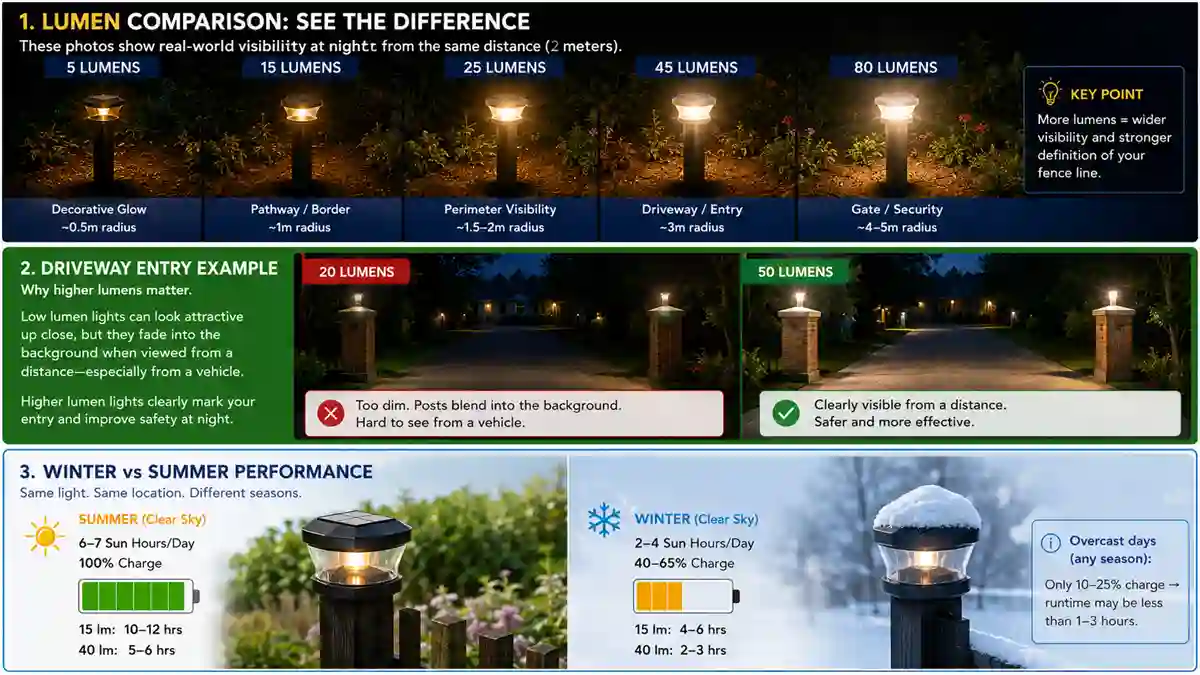
Solar fence post lights lumens explained. Is 30 enough or do you need 60? Engineer’s guide to lumen sizing by application, battery runtime, and season.
A practical lumen sizing guide for solar fence post lights — covering output requirements by application, battery-to-lumen ratios, round post considerations, and seasonal performance. Written by a Registered Professional Engineer with field installation experience.
Lumen ratings on solar fence post lights are one of those specs that look straightforward until you try to use them. The number is on the box, but there’s rarely any context — no mention of what that output actually looks like at ground level, whether the batteries can sustain it through the night, or how it changes in winter when charge hours drop.
The question I get asked most often is some version of: “Is 30 lumens enough?” The answer depends entirely on what you’re trying to achieve. Thirty lumens is more than enough for garden decoration and completely inadequate for a driveway entry post where you need people actually to see the fence line at night.
This guide gives you the numbers behind that decision — by application, by season, and by post type.
1. What a Lumen Actually Means in This Context
A lumen is a measure of total light output — the amount of visible light emitted by a source in all directions. For a solar fence cap light, the relevant question isn’t just total lumens but where that light goes.
Most cap lights direct light downward and outward in a roughly 120–180 degree spread. A 20-lumen cap light isn’t illuminating 20 lumens in every direction — it’s concentrating that output in a cone below and around the post. That’s why even a modest lumen output can be visible at a reasonable distance when the optics are designed correctly.
Lux vs lumens: Lux is lumens per square meter — it tells you the illuminance at a specific point. A 20-lumen cap light spreads its output over a surface area as the distance increases. At 1 meter from the post, you might see 5–8 lux. At 2 meters, it drops to 1–2 lux. This is why higher-lumen lights are needed for larger coverage areas, not just for brightness.
Engineer’s Note: The inverse square law applies here. Illuminance drops with the square of distance from the source. Double the distance, and the illuminance falls to one quarter. A 15-lumen cap light that looks adequate at 0.5m from the post provides very little useful light at 2m. If you need visibility at a distance, you need more lumens — not just a brighter-looking product photo.
2. Lumen Requirements by Application
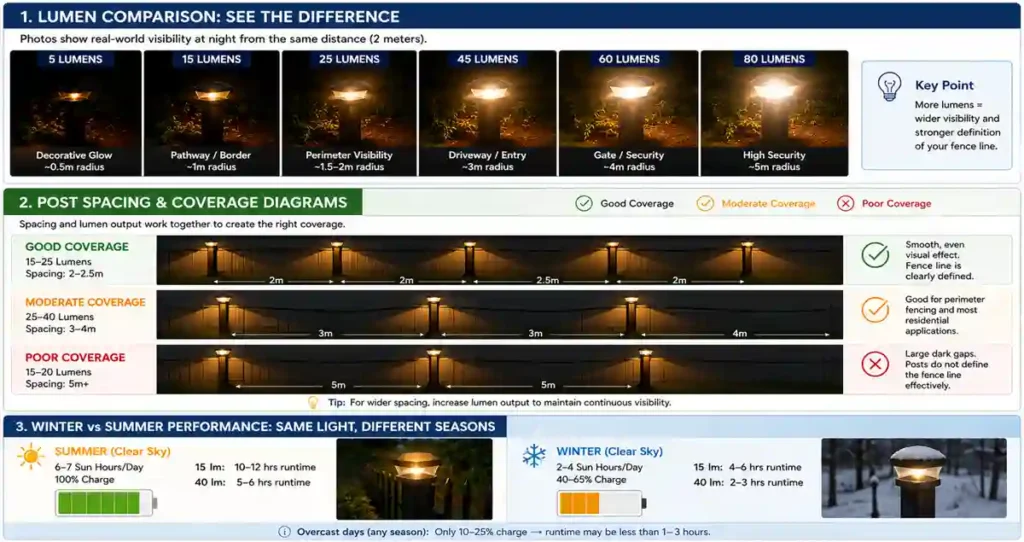
This is the table most product listings don’t give you. Here’s how to match lumen output to what you’re actually trying to do:
| Application | Lumen Range | Visible Radius | Battery Needed | Panel Size (min) |
| Garden decoration only | 5–15 lm | ~0.5m glow | 400–600 mAh | 3×3 cm |
| Pathway border markers | 15–25 lm | ~1–1.5m | 600–800 mAh | 4×4 cm |
| Perimeter visibility | 25–40 lm | ~2m | 800–1000 mAh | 5×5 cm |
| Driveway entry posts | 40–60 lm | ~3m | 1200 mAh | 6×6 cm+ |
| Gate posts / security perimeter | 60–100 lm | ~4–5m | 2000+ mAh | Separate panel |
A few things worth noting in this table:
Garden decoration means the light is there to look nice, not to help anyone see anything. Five lumens is a soft amber glow around the post base. It’s visible, it looks good in photos, and it does nothing for navigation or perimeter definition.
Perimeter visibility means someone walking along the fence line can see where the posts are. Twenty-five to forty lumens achieves this at a typical post spacing of 2–3 meters. Below 20 lumens at that spacing, the posts aren’t visible markers — they’re just decorative.
Driveway entry posts need to be visible from a moving vehicle at night. Forty to sixty lumens is the practical minimum for this. Below that range, the posts blend into the background in low ambient light conditions.
Field Note: A homeowner installed 10-lumen cap lights on driveway entry posts and called back two weeks later, saying they couldn’t see the posts when pulling in at night. Replaced with 45-lumen units on the same posts — same size, same cap style — and the problem was resolved. The 10-lumen rating was never going to work for that application. The spec was the issue, not the installation.
3. Battery Capacity vs Lumen Output: The Ratio That Matters
The lumen output is only half the equation. The battery has to sustain that output long enough to cover the night. This is where many budget solar cap lights fail — the rated lumen output is real, but the battery is too small to maintain it beyond 3–4 hours.
Here’s how lumen output and battery capacity interact at realistic charge levels:
| LED Output | Battery | Runtime (Full Charge) | Runtime (50% Charge) | Season Risk |
| 5 lm | 600 mAh | 8–10 hrs | 4–5 hrs | Low |
| 15 lm | 600 mAh | 5–6 hrs | 2–3 hrs | Medium |
| 15 lm | 1200 mAh | 10–12 hrs | 5–6 hrs | Low |
| 40 lm | 1200 mAh | 4–5 hrs | 2 hrs | High in winter |
| 40 lm | 2000 mAh | 7–8 hrs | 3–4 hrs | Medium |
| 60 lm | 2000 mAh | 4–5 hrs | 2 hrs | High in winter |
The “Season Risk” column reflects winter performance specifically. A 40-lumen unit on a 1200 mAh battery runs 4–5 hours on a full summer charge. In winter, with only 2–3 hours of effective charging, that same battery might reach 50–60% charge, dropping the runtime to 2 hours or less. For a location where sunrise is at 7 AM, that means the light cuts out by 10–11 PM.
Engineer’s Note: The practical rule: for winter reliability, your battery capacity should support at least 8 hours of runtime at your chosen lumen output. A 40-lumen unit needs a 2000 mAh battery to reliably run through a winter night in most northern climates. A 1200 mAh battery at that output is a summer solution.
4. Seasonal Performance: What Changes in Winter
Solar cap lights perform differently across seasons — not because the product changes, but because available charge energy changes significantly. This affects every installation, and it’s worth understanding before you commit to a lumen level.
| Season / Condition | Avg Sun Hours/Day | Charge % (5×5cm panel) | Runtime at 15lm | Runtime at 40lm |
| Summer — clear sky | 6–7 hrs | 100% | 10–12 hrs | 5–6 hrs |
| Spring / Fall — clear sky | 4–5 hrs | 70–85% | 7–9 hrs | 3–4 hrs |
| Winter — clear sky | 2–4 hrs | 40–65% | 4–6 hrs | 2–3 hrs |
| Overcast (any season) | 0.5–1.5 hrs equiv. | 10–25% | 1–3 hrs | Under 1 hr |
The overcast row is the one that matters most in climates with significant cloud cover — the Pacific Northwest, UK, northern Europe, and parts of Canada. In those regions, a unit that runs well in summer may underperform for weeks at a time in winter, not just individual cloudy days.
The engineering response to this: either size the battery for worst-case conditions (overcast winter), or accept that runtime will be reduced in those periods and choose a lower lumen output that the available charge can sustain. Trying to run a high-lumen unit in a low-sun environment is always a losing proposition — the physics don’t allow it.
Engineer’s Note: If you’re in a location with fewer than 3 peak sun hours per day in winter (roughly above 50° latitude), size your solar cap lights for summer enjoyment and expect reduced winter performance regardless of battery size. The panel area on a cap light is too small to overcome a genuine solar resource deficit. This isn’t a product limitation — it’s a physical constraint.
5. Lumens for Round Fence Posts
Round fence posts present the same lumen question, with one additional constraint: the cap size limits the panel area, which limits how much the battery can charge per day. Smaller OD posts have smaller caps, smaller panels, and therefore lower practical lumen ceilings.
| Round Post OD | Common Use | Recommended Lumens | Cap Mount Type | Notes |
| 1.5″ OD | Pool fencing, balusters | 5–15 lm | Friction slip-over | Decorative only — small panel area |
| 2″ OD | Gate posts, perimeter | 15–30 lm | Slip-over + set screw | Verify OD before ordering |
| 2.5″ OD | Commercial perimeter | 25–40 lm | Slip-over + set screw | Less common — measure carefully |
| 3″ OD | Large gate, structural | 30–60 lm | Strap or custom mount | Cap lights limited — consider fixture |
The 3″ OD round post is where cap-style solar lights start to reach their practical limit. At that post diameter, the available panel area in a cap form factor can’t reliably charge a battery large enough to sustain 60+ lumens through a full night. For gate posts or structural round posts where high output is needed, a separate small panel wired to a post-mounted fixture is a more appropriate engineering solution than a self-contained cap.
Field Note: Pool fencing installations with 1.5″ aluminum balusters are common, and the question of solar cap lights on them comes up regularly. The answer is almost always decorative-only — 5 to 10 lumens maximum. The panel on a 1.5″ cap is roughly 2×2 cm, which generates around 40–60 mA in full sun. That’s enough to charge a small NiMH cell for a low-output LED, nothing more. Set expectations accordingly.
6. Post Spacing and Total Coverage Planning
Lumen output per post is one part of the planning equation. Post spacing determines whether your fence line reads as continuously lit or as a series of isolated light points.
At standard residential post spacing of 2.4–3m (8–10 feet): a 20-lumen cap light creates visible but separate pools of light at each post. The fence line is defined but not continuously illuminated.
For a more continuous effect: either reduce post spacing (not always an option with existing fences), increase lumen output to 35–50 lumens so the illuminated radius from each post overlaps with the next, or supplement with pathway-style solar lights between posts.
For driveway entry posts specifically, spacing is typically wider, 3–5 meters between posts. At that spacing, 40–60 lumens per post is needed to maintain visible definition of the entry. Below 30 lumens at 5-meter spacing, the posts aren’t serving their function as visible markers at night.
Engineer’s Note: A simple coverage check: multiply your cap light’s rated lumen output by 0.6 to account for real-world efficiency losses (panel soiling, battery aging, optical losses). Use that adjusted number against the application requirements in Table 1. If it still meets your minimum, the spec is adequate. If it doesn’t, size up before purchasing.
Frequently Asked Questions
Is 30 lumens enough for fence post lights?
It depends on the application. For garden decoration and pathway border marking, 30 lumens is more than sufficient. For driveway entry posts or gate posts where visibility from a distance matters, 30 lumens is borderline — workable at close range but not reliable for vehicle-level visibility at night. For those applications, 40–60 lumens is a more appropriate target.
Why does my solar fence light go dark after a few hours?
The battery capacity is undersized for the lumen output, or the battery has degraded. A 600 mAh battery driving a 30-lumen LED will run roughly 3–4 hours before the battery drops below the LED’s minimum operating voltage. If the unit worked longer when new and has shortened over time, battery degradation is the cause. Replace the cell — most cap lights use standard AA or AAA NiMH cells that cost very little.
Do higher-lumen solar fence lights drain faster in winter?
Yes. The lumen output determines how fast the battery drains. The season determines how fully the battery charges. In winter, shorter days mean a lower charge state each evening — so a high-lumen unit that runs 8 hours in summer may only run 3–4 hours in winter on the reduced charge. This isn’t a fault; it’s a direct consequence of available solar energy. The solution is either a larger battery, lower lumen output, or accepting reduced winter runtime.
How far apart should solar fence post lights be spaced for even coverage?
For 15–25 lumen cap lights, 2–2.5 meter spacing gives a reasonably continuous visual effect. For 40–60 lumen units, 3–4 meter spacing works. Beyond 4 meters between posts, even a 60-lumen cap creates distinct pools of light rather than a continuous fence line. If your post spacing is fixed and wider than ideal, increase lumen output rather than adding intermediate posts.
Can I mix different lumen outputs on the same fence?
Yes, and it’s sometimes the right call. Entry and gate posts where visibility matters can run 40–60 lumen units, while intermediate line posts run 15–25 lumen decorative caps. The visual effect is a brighter definition at access points and softer ambient lighting between them, which is how most landscape lighting schemes are intentionally designed anyway.
Final Thoughts
The lumen number on a solar fence cap light is useful, but it only tells you part of what you need to know. The full picture includes what you’re actually trying to achieve, whether the battery can sustain that output through a winter night, and whether the panel area on the cap you’re considering can charge that battery in your location’s available sun hours.
Get the application requirement right first — decoration, path visibility, driveway entry, or security perimeter. Then work backward to the lumen range, battery capacity, and panel size that supports it. That sequence gives you a product that works long-term, not just in the first summer.
Related guides on SolarVisionAI.com
Solar Fence Post Lights: Cap Sizes, Types & Install Guide
Solar Lights for Vinyl, Aluminum & Wood Fence Posts
Solar Garden & Outdoor Lights: Types, Placement & What to Buy