
Stop confusing Net Metering vs Net Billing. Learn how the 60–80% export credit gap under NEM 3.0 impacts your solar payback—and how AI battery optimization can recover $17,000+ in value.
The terms net metering and net billing are used interchangeably by solar marketers and energy journalists. They are not the same thing. The difference between them is not a technicality — it is a financial gap that adds years to your solar payback period and fundamentally changes whether battery storage and AI optimization make economic sense for your project.
I have designed solar power systems under both billing structures — from residential installations in states with strong retail-rate net metering to commercial projects in California under NEM 3.0, which is effectively net billing under a different name. Here is the honest engineering and financial comparison, including the AI optimization layer that partially closes the net billing value gap.
The Core Difference — One Sentence Each
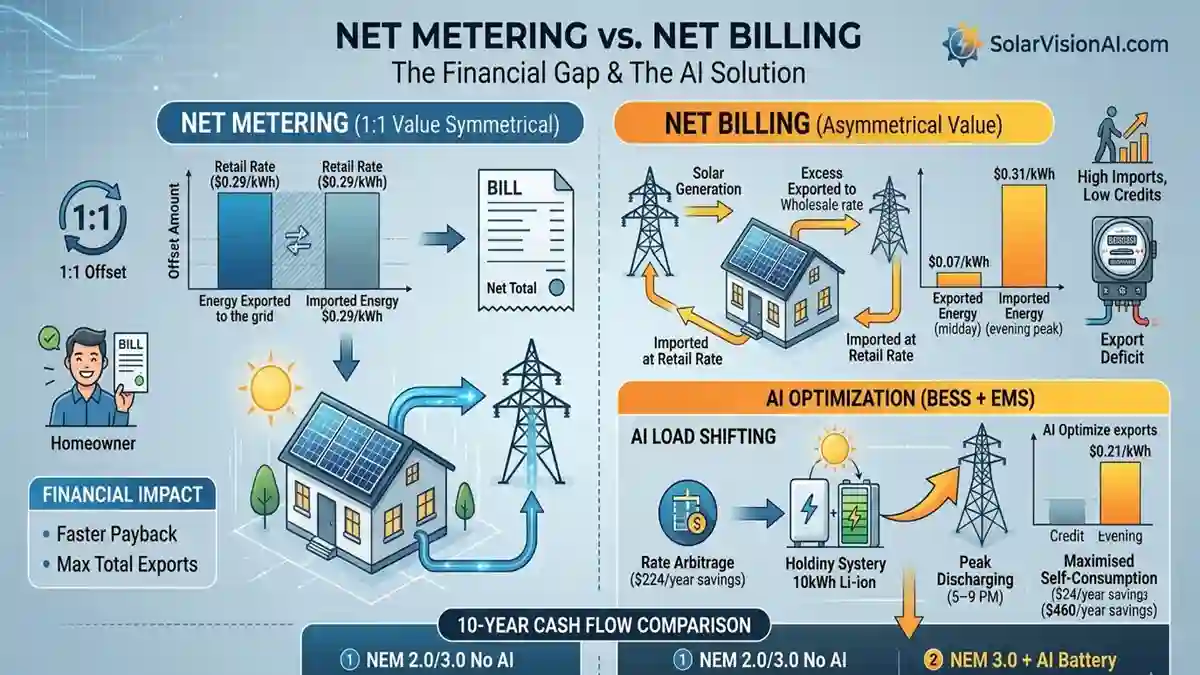
Net metering: You are compensated for exported solar electricity at the full retail electricity rate — the same rate you pay to import electricity from the grid.
Net billing: You are compensated for exported solar electricity at the utility’s avoided cost rate — the marginal cost of generating or procuring that electricity on the wholesale market. This is typically 60–80% lower than the retail rate.
That single rate difference drives everything: system sizing strategy, battery economics, payback period, and the financial justification for AI optimization.
The Billing Mechanics — How Each System Calculates Your Bill
Under net metering, Import and export are settled at the same retail rate. At billing, exported kWh are subtracted from imported kWh, and the net is billed at $0.28/kWh. Export 400 kWh, import 600 kWh: pay for 200 kWh = $56. Export 700 kWh, import 500 kWh: receive 200 kWh credit = $56 carried forward. Clean, simple, symmetrical.
Under net billing, Import and export are settled separately at different rates. Pay $0.28/kWh for every imported kWh. Receive $0.07/kWh for every exported kWh. Export 700 kWh ($49 credit) and import 500 kWh ($140 cost): owe $91, even though you exported more than you consumed. The asymmetry is the mechanism — and it is what AI optimization specifically addresses.
| Engineer’s Note: Under net metering, one exported kWh saves you one imported kWh at the full retail rate — a 1:1 offset. Under net billing, one exported kWh earns you $0.05–0.10 regardless of what you pay to import electricity. An AI energy management system cannot change the export credit rate — but it can shift when you export, ensuring more exports occur during the highest available credit windows, and converting potential exports into self-consumption savings at the full retail rate. |
Financial Impact — 10-Year Cash Flow Comparison
| Metric | NEM 2.0 (Net Metering) | NEM 3.0 No AI | NEM 3.0 + AI Battery |
| System cost after ITC | $19,600 | $19,600 | $26,200 (incl. battery) |
| Annual self-consumption savings | $2,900 | $2,900 | $3,360 (AI peak avoidance) |
| Annual export credit | $1,160 ($0.29/kWh) | $280 ($0.07/kWh) | $504 ($0.21/kWh evening) |
| Total annual bill reduction | $4,060 | $3,180 | $3,864 |
| Simple payback | 4.8 years | 6.2 years | 6.8 years |
| Year 10 cumulative savings | $40,600 | $31,800 | $38,640 |
| Year 25 cumulative savings | $101,500 | $79,500 | $96,600 |
| AI premium vs no-AI NEM 3.0 | — | — | $684/year · $17,100 over 25 years |
The AI optimization premium of $684/year comes from two sources: shifting exports from $0.07/kWh midday to $0.21/kWh evening ($224/year on 1,600 kWh exported), and AI-managed self-consumption increasing savings from $2,900 to $3,360 ($460/year) by ensuring solar covers on-peak consumption. This premium compounds to ~$17,100 over 25 years — more than enough to justify the AI-capable battery and inverter upgrade.
How AI Load Shifting Works Under Net Billing
Track 1 — Export Timing Optimization
Under California NEM 3.0, export credit rates follow a time-of-use schedule published 24 hours in advance by the utility. An AI energy management system reads these rates, combines them with your solar generation forecast and battery state of charge, and schedules battery charge-discharge to:
- Capture midday solar surplus in the battery rather than exporting at $0.05–0.08/kWh
- Export from the battery during the 5–9 pm peak window at $0.18–0.24/kWh
- Hold battery reserve for morning peak windows if the afternoon generation forecast is insufficient to fully recharge
Track 2 — Self-Consumption Maximization
Under net billing, self-consumed solar is worth the full retail rate — every kWh consumed directly from solar avoids a grid import at $0.28–0.36/kWh, regardless of the net billing export rate. AI optimization maximizes self-consumption by:
- Predicting building load patterns from historical data and pre-positioning battery charge before consumption peaks
- Scheduling deferrable loads (EV charging, pool water pump, water heater) to run during solar peak hours when self-consumption is highest
- Managing battery discharge to cover evening on-peak consumption rather than exporting at the lower net billing rate
| AI Insight: Under net billing, the AI system’s objective function changes fundamentally compared to net metering. Under net metering, the objective is to maximize total exported kWh (since each kWh earns the retail rate regardless of timing). Under net billing, the objective is to maximize the value of every kWh — prioritizing self-consumption over export, and within export, prioritizing high-rate evening windows over low-rate midday windows. AI platforms configured for net billing environments use this value-maximization objective rather than simple energy-maximization rules. Not all platforms do this correctly — verify with your installer that the EMS platform has confirmed NEM 3.0 ACC rate optimization. |
How Net Billing Changes System Design — The Engineering Implications
- Size for self-consumption, not maximum generation: Under net metering, larger is generally better up to 100% annual offset. Under net billing, an oversized system exports large volumes at low avoided-cost rates — adding cost without proportional return. AI load analysis is essential to right-size a net billing system.
- Battery storage is a financial tool, not just backup: Under net billing, battery storage pays for itself through rate arbitrage and demand charge reduction. AI management is required to achieve this financial performance.
- Demand charge reduction for commercial buildings: For commercial buildings paying $15–25/kW/month in demand charges, AI battery management can reduce the 15-minute peak demand interval that determines the charge. On a building with $10,000/year in demand charges, a 30% reduction produces $3,000/year in savings, entirely independent of net billing export credit rates.
Key Takeaways
- Net metering pays the retail rate for exports. Net billing pays avoided cost — 60–80% lower. Self-consumption savings are identical under both programs.
- AI load shifting increases net billing export credit value from ~$0.07/kWh to ~$0.21/kWh by shifting exports to evening peak windows — a 3× improvement.
- The AI optimization premium under NEM 3.0 net billing is approximately $684/year on a 10 kW system, compounding to ~$17,100 over 25 years.
- Under net billing, battery storage is a financial necessity, not an optional upgrade — and AI management is what makes the battery perform at full financial potential.
- If grandfathered on a retail-rate net metering program, do not voluntarily switch to net billing under any circumstances.
Related guides: Net Metering Complete Guide · AI Solar Optimization Guide · NEM 3.0 Guide · BESS Battery Storage Guide · Commercial Solar Installation Guide