
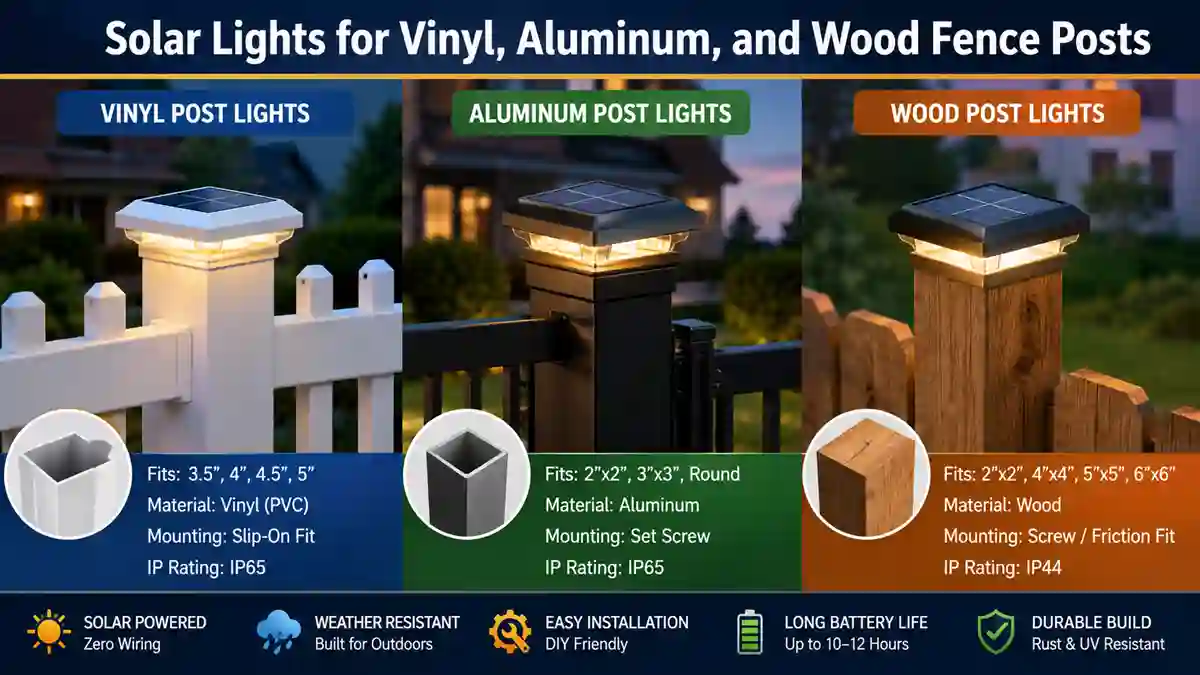
Vinyl, aluminum, and wood posts size differently. Engineer’s guide to measuring your fence post correctly and choosing solar caps that actually fit and seal long-term.
A material-by-material guide to solar fence post light compatibility — covering vinyl post OD sizing, aluminum square and round post dimensions, wood nominal vs actual measurements, and the fit methods that prevent early cap failure. Written by a Registered Professional Engineer.
The single most common complaint I hear about solar fence post lights is that the cap doesn’t fit properly. It rocks on the post, water gets under the base, and within a season, the seal fails. In most of these cases, the product wasn’t defective — it was the wrong size for the post material.
Wood, vinyl, and aluminum fence posts don’t follow the same sizing conventions. A 4×4 wood post, a 4-inch vinyl post, and a 2×2 aluminum post are all measured differently, and ordering a cap without accounting for that difference leads to the problems above.
This guide goes through each material type, how to measure correctly, and which cap dimensions you need before you order.
1. Why Material Type Matters Before Anything Else
The fit method changes completely depending on what your post is made of. Wood posts use nominal sizing — the labeled dimension is not the actual dimension. Vinyl posts are measured by outer diameter. Aluminum posts use true face dimensions. Mix these up, and you’re ordering the wrong product.
Here’s the full comparison before we go into each material:
| Material | Common Sizes | Dimension Basis | Cap Fit Method | Thermal Movement | IP Minimum |
| Wood | 2×2, 4×4, 5×5, 6×6 | Nominal (measure actual) | Friction fit / side screw | Low — stable year-round | IP44 |
| Vinyl | 3.5″, 4″, 4.5″, 5″ | Outer dimension (OD) | Slip-over OD — allow 1–2mm | High — expands/contracts with temp | IP65 |
| Aluminum | 2×2, 3×3, round OD | Outer dimension (OD) | Slide-over + set screw | Medium — less than vinyl | IP65 |
| Steel | 2×2, 3×3, round OD | Outer dimension (OD) | Slide-over + set screw | Low — but check rust risk | IP65 |
| Cedar / Redwood | 4×4, 6×6 most common | Nominal (measure actual) | Friction fit or screw | Medium — swells when wet | IP44 |
Engineer’s Note: IP65 is the practical minimum for vinyl and aluminum posts in any climate that sees real rain. These materials don’t absorb water the way wood does — moisture pools at the cap-to-post interface and sits there. A lower-rated cap on a metal or vinyl post will fail faster than the same cap on a wood post.
2. Wood Fence Posts: The Nominal Size Problem
Wood posts are sold by nominal size, which is not the actual dimension. This is standard practice in the lumber industry, but it consistently causes problems when ordering solar caps online because most product listings don’t clarify which dimension they’re referencing.
Nominal vs Actual Dimensions — Wood Posts
| Nominal Size | Actual Dimension | Cap Internal Size | Typical Application |
| 2×2 | 1.5″ × 1.5″ | 1.5″ square | Light border fencing |
| 4×4 | 3.5″ × 3.5″ | 3.5″ square | Standard residential fence |
| 5×5 | 4.5″ × 4.5″ | 4.5″ square | Heavy timber, entry posts |
| 6×6 | 5.5″ × 5.5″ | 5.5″ square | Structural posts, large gates |
The 4×4 is where most mistakes happen. People see “4×4 solar post cap” in a product title and assume it fits their 4×4 fence post. It should — but only if the cap’s internal base dimension is 3.5″, which is the actual milled size of a nominal 4×4. Some manufacturers label their caps by nominal post size (correct interpretation). Others list the internal cap dimension directly. You need to know which one you’re looking at before buying.
Engineer’s Note: Measure your post with a tape measure before ordering — don’t rely on what it was sold as. Run the tape across the flat face of the post, not diagonally. If you’re working with older posts that have weathered and swelled slightly, remeasure at the top where the cap will actually sit.
Cedar and Redwood Posts
Cedar and redwood posts follow the same nominal sizing as standard dimensional lumber, but they behave differently in the weather. Both species absorb moisture and can swell measurably in wet climates — particularly in the first few years before the wood stabilizes.
For cedar and redwood posts, allow slightly more clearance in the cap fit than you would for pressure-treated pine. A cap that fits snugly in summer may bind in winter after the wood swells from rain. On these species, a friction fit with a small silicone bead at the perimeter is a better practice than a tight mechanical fit.
Field Note: I’ve seen new cedar posts expand enough after installation that solar caps installed in dry summer conditions were cracked by spring. The cap material (usually ABS plastic) doesn’t flex enough to accommodate the wood movement. The fix is simple — fit the cap in the wet season, or allow 2–3mm clearance when installing in dry conditions.
3. Vinyl Fence Posts: Outer Dimension is What Counts
Vinyl posts are hollow and sized by outer dimension — not nominal, not inner. The cap slips over the outside of the post, so the cap’s internal dimension needs to match the post’s outer dimension closely.
Unlike wood, vinyl posts are manufactured to consistent dimensions across most brands. The variation between manufacturers is smaller, but it’s still there — particularly for gate and corner posts, which some manufacturers build to slightly different specs than standard line posts.
Standard Vinyl Post Sizing
| Listed Post Size | Typical OD | Cap Internal Dim Needed | Note |
| 3.5″ vinyl post | 3.5″ OD | 3.5″ ± 1mm | Verify with caliper — brands vary |
| 4″ vinyl post | 4.0″ OD | 4.0″ ± 1mm | Most common residential size |
| 4.5″ vinyl post | 4.5″ OD | 4.5″ ± 1mm | Common in privacy fence systems |
| 5″ vinyl post | 5.0″ OD | 5.0″ ± 1mm | Gate and corner posts — measure carefully |
The ±1mm tolerance is important. Vinyl expands and contracts with temperature significantly more than wood or metal. A cap that fits perfectly in summer (post expanded) may be loose by winter (post contracted). Some play in the fit — 1 to 2mm — is actually correct practice for vinyl. A cap that fits too tightly in warm weather will stress and crack in cold weather as the post tries to contract under the cap.
Engineer’s Note: If you’re installing in a climate with a wide temperature swing (more than 40°F between summer and winter), buy vinyl-specific solar caps that include a rubber gasket or flexible base seal. The gasket accommodates thermal movement while maintaining the water seal. Rigid plastic-to-plastic contact on vinyl posts is a long-term leak point.
Vinyl Post Caps vs Wood Post Caps — Not Interchangeable
A cap designed for a 4×4 wood post (internal dimension 3.5″) will not properly fit a 4-inch vinyl post (OD 4.0″). The vinyl post is larger in outer dimension than the actual face of a nominal 4×4 wood post. Ordering a “4×4 cap” without specifying wood or vinyl is the most common sizing mistake in this product category.
4. Aluminum Fence Posts: True Dimensions, Set Screw Required
Aluminum posts use true dimensions — the labeled size is the actual outer face or diameter. There’s no nominal vs actual discrepancy to account for. This makes sizing more straightforward, but aluminum introduces two considerations that wood and vinyl don’t: vibration and galvanic corrosion.
Aluminum Post Sizing
| Post Type | Actual OD / Face | Cap Size Needed | Common Use |
| 2×2 square aluminum | 2.0″ face | 2″ square cap | Pool fencing, light commercial |
| 3×3 square aluminum | 3.0″ face | 3″ square cap | Commercial perimeter fencing |
| 1.5″ round aluminum | 1.5″ OD | 1.5″ round cap | Pool code fencing, balusters |
| 2″ round aluminum | 2.0″ OD | 2″ round cap | Gate posts, perimeter posts |
Set screws are not optional on aluminum posts. Aluminum transmits vibration efficiently — wind load on a fence panel travels directly up the post. A solar cap sitting on an aluminum post without a locking mechanism will work loose over time. Most aluminum-compatible caps include a set screw through the cap wall that contacts the post face. Use it, and check it annually.
Galvanic Corrosion at the Cap Interface
If your solar cap has any steel hardware — screws, springs, battery contacts — and it’s sitting on an aluminum post, you have the conditions for galvanic corrosion. Aluminum and steel have different electrochemical potentials, and in the presence of moisture (which is inevitable outdoors), the aluminum will corrode at the contact point over time.
The practical solution: use caps with stainless steel or plastic hardware, or apply a thin layer of anti-corrosion compound (Noalox or equivalent) at the metal contact points. This is a small step that significantly extends service life in coastal or high-humidity environments.
Engineer’s Note: Aluminum post caps in coastal environments — within roughly 5 miles of saltwater — should be IP65 rated and use stainless or non-metallic fasteners. Salt air accelerates galvanic corrosion substantially. Standard carbon steel set screws will rust and fuse to the aluminum post within 2–3 seasons, making cap removal difficult without damaging the post.
5. Steel Fence Posts: Same Logic as Aluminum, Higher Rust Risk
Steel fence posts — common in commercial and agricultural applications — follow the same true-dimension sizing as aluminum. The cap sizing approach is identical: measure the actual face dimension or outer diameter and match the cap’s internal dimension to that.
The difference is rust. Steel posts, particularly in unpainted or coated conditions that have weathered, will rust at the post-to-cap interface if moisture is allowed to pool there. A properly sealed cap with an IP65 rating significantly slows this. A poorly sealed cap with standing water at the base accelerates it.
For steel posts, silicone around the cap base perimeter is more important than for any other material. The seal prevents water infiltration, and that’s the primary rust mitigation at the post top.
6. Mixed Installations: When Your Fence Uses More Than One Post Type
It’s common for a fence installation to mix materials — wood line posts with aluminum gate posts, for example, or vinyl posts with a steel structural corner post. In these cases, don’t assume the same solar cap works across all post types just because the labeled size matches.
The practical approach: measure every post type separately and order caps specific to each. Yes, this means potentially ordering from two different product lines. It’s a minor inconvenience compared to returning caps that don’t fit or, worse, leaving poorly fitted caps in place that fail within a season.
Field Note: On a project with vinyl line posts and aluminum gate posts, the homeowner ordered one set of caps based on the vinyl post OD. The vinyl caps fit the vinyl posts correctly but were loose on the aluminum gate posts — the aluminum face dimension was 3mm smaller. Two of the gate post caps blew off in the first storm. Ordering material-specific caps from the start would have cost the same and saved the callback.
7. How to Measure Any Post Correctly Before Ordering
Regardless of post material, here’s the measurement process that gives you the right number:
Square posts (wood, vinyl, aluminum, steel): Measure across the flat face with a tape measure or digital caliper. Measure the top of the post where the cap will sit — not mid-post, where the dimension may differ due to weathering or manufacturing variation. Record the measurement to the nearest 1mm or 1/16″.
Round posts: Wrap a flexible tape measure around the post and record the circumference. Divide by π (3.1416) to get the outer diameter. For example, a circumference of 6.28″ gives an OD of 2.0″. Alternatively, use a caliper directly across the post diameter if you have access.
Hollow vinyl posts: Measure the outer face — the cap fits over the outside. The inner hollow dimension is irrelevant for cap sizing.
Weathered or painted wood posts: Old posts may have swelled, shrunk, or have significant paint buildup. Measure the actual current dimension, not what the post was when new. A 4×4 post with multiple layers of paint can measure closer to 3.6″ on the face than 3.5″.
Engineer’s Note: If you’re ordering caps for more than 10 posts, measure three or four posts at random — not just one. Manufacturing variation in wood and post-to-post differences in vinyl are real. If measurements vary by more than 2mm across your sample, order caps with the larger internal dimension and use silicone to fill any gap on the smaller posts.
Final Thoughts
Getting the material-to-cap match right is genuinely a five-minute job if you measure before you order. The posts are already in the ground — the measurement is the easy part.
Wood posts: measure the actual face, not the nominal label. Vinyl posts: measure the outer dimension, allow 1–2mm clearance. Aluminum and steel posts: true dimensions, set screw required, silicone the base.
If you’re still deciding on what type or brightness of solar cap to use across your fence installation, the main solar fence post lights guide covers lumen sizing, battery specs, and cap types in detail — that’s a good starting point before committing to a specific product.
Frequently Asked Questions
Can I use the same solar cap on wood and vinyl posts if the size number matches?
Usually no. A 4×4 wood cap has an internal dimension of ~3.5″ to fit the actual wood post face. A 4″ vinyl cap needs an internal dimension of ~4.0″ to fit the vinyl OD. The same number label refers to different actual dimensions depending on the material. Always check the cap’s stated internal dimension, not just the labeled post size.
Do solar caps for vinyl posts need to be a loose fit?
A small amount of clearance — 1 to 2mm — is correct for vinyl. Vinyl expands and contracts more than wood or metal with temperature changes. A tight fit in warm weather can crack the cap or stress the post in cold weather. The seal should come from a rubber gasket or silicone bead, not from a press-fit contact between rigid plastic surfaces.
My aluminum post cap keeps coming loose. What’s wrong?
Almost always the set screw isn’t engaged or has backed out from vibration. Remove the cap, clean the post top, reposition the cap, and tighten the set screw firmly against the post face. Apply a small amount of thread-locking compound (Loctite Blue 242) to the set screw threads before reinstalling — this prevents vibration-driven loosening without making the screw permanent.
What if my post size is between standard sizes?
Order the cap with the larger internal dimension and use a self-leveling silicone sealant around the base perimeter and a thin wrap of self-amalgamating tape at the cap-to-post interface if needed. This creates a custom fit that seals against water. Don’t force a smaller cap onto a slightly oversized post — the stress will crack the cap or prevent proper sealing.
Are solar fence post lights suitable for steel agricultural posts?
Standard round agricultural posts (T-posts, star pickets) are not designed for cap-style solar lights — they have a different cross-section and no flat top surface. For these applications, a clamp-mount or stake-mount solar light is more appropriate than a post cap. Square steel posts in commercial fencing applications can accept solar caps if sized correctly and sealed with silicone.
Related guides on SolarVisionAI.com
Solar Fence Post Lights: Cap Sizes, Types & Install Guide
Solar Garden & Outdoor Lights: Types, Placement & What to Buy
Solar Charge Controller: The Complete Guide
MC4 Connectors: Solar Safety & Installation Guide