
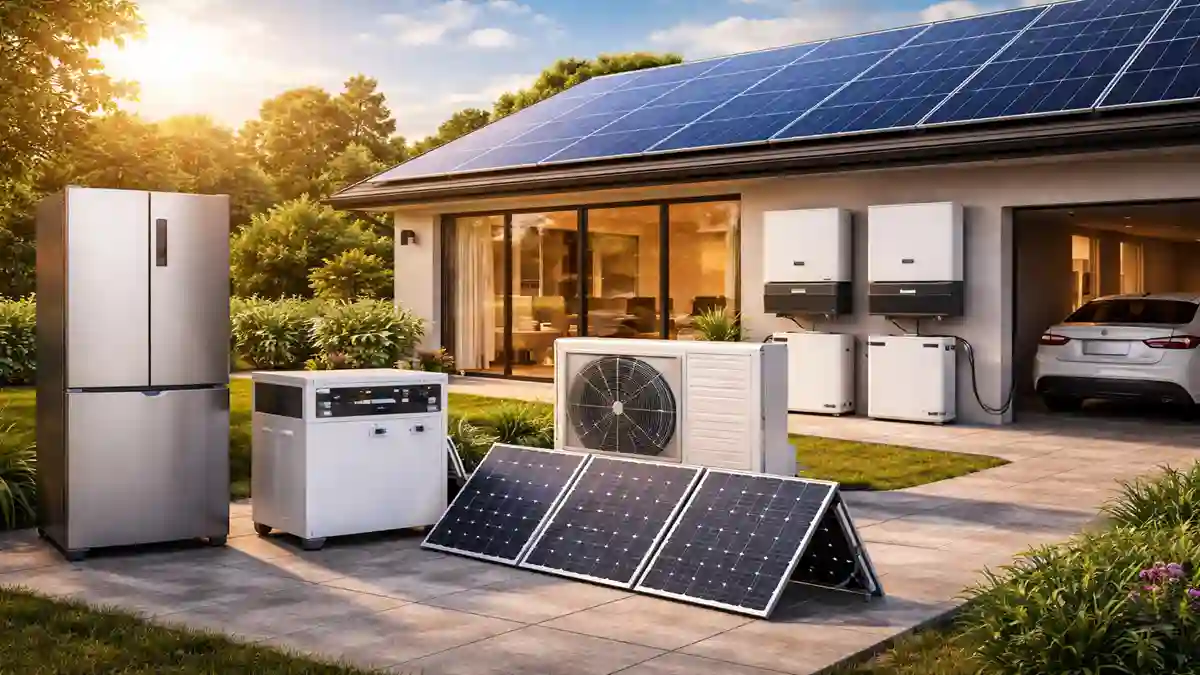
Solar home appliances guide: costs, savings, and how to build an energy-independent home with solar refrigerators, ACs, and smart technology.
Introduction: The Revolution of off grid solar products
As a renewable energy engineer, I’ve observed the solar revolution progress through several distinct phases over the past decade. The first phase focused on installing solar panels on rooftops to generate electricity. The second phase introduced battery storage to capture excess solar power for use at night.
However, the real breakthrough we are witnessing today extends beyond electricity generation—it’s about how our appliances consume that energy.
Modern homes are evolving from simple solar-powered houses into intelligent energy ecosystems. Rather than depending entirely on centralized power grids, households are beginning to operate like small independent power plants. With the integration of a high-quality solar panels kit, smart batteries, energy-efficient appliances, and artificial intelligence, homes can now generate, store, and intelligently manage electricity directly from sunlight
Solar home appliances stand at the center of this transformation, allowing households to run essential equipment using solar energy, reducing electricity bills while supporting a cleaner and more sustainable energy future.
Why Solar Appliances Matter: Resilience and Independence
Solar products for home use are no longer niche gadgets embraced only by environmental enthusiasts. They are rapidly becoming the foundation of modern energy-efficient households.
In many parts of the world, electricity demand continues to rise while grid reliability remains uncertain. Power outages, rising energy prices, and growing environmental concerns are pushing homeowners to adopt renewable energy home appliances and solar energy solutions.
Solar appliances provide two critical benefits: resilience and independence. Instead of relying entirely on the grid, homes equipped with solar systems can continue operating essential appliances even during power interruptions. This proves particularly important in regions where electricity supply remains unstable, as solar systems combined with battery storage can maintain continuous power for lighting, refrigeration, communication devices, and cooling systems.
Today, a wide variety of solar products for home use are available, including energy-efficient cooling systems, solar-powered generators, water pumps, lighting systems, and many other appliances designed to operate efficiently using renewable energy.
The Core Solar Appliance Lineup
Several solar home appliances are already widely used in residential environments. These devices are specifically designed to operate efficiently with solar power systems and battery storage.
Solar Refrigerators
Solar refrigerators rank among the most important appliances for solar-powered homes.
Unlike conventional refrigerators that rely heavily on grid electricity, solar refrigerators use high-efficiency compressors and improved insulation systems to dramatically reduce energy consumption. Many advanced models now incorporate Phase Change Materials (PCM) , which act as thermal batteries by storing cold energy during periods of sunlight. As a result, the compressor does not need to run continuously at night, significantly reducing electricity demand.
Cost Consideration: While solar refrigerators typically cost 20-40% more upfront than conventional models, their energy savings can recover this investment within 3-5 years in off-grid applications. They are commonly used in off-grid homes, rural areas, medical facilities, and food storage applications.
Solar Air Conditioners
Cooling systems typically consume the largest portion of household electricity. Solar air conditioners help solve this challenge by combining solar energy with inverter compressor technology.
These systems adjust their power consumption dynamically based on cooling demand. During peak sunlight hours, when solar panels produce the most electricity, the air conditioner automatically operates at higher efficiency levels. This natural alignment between solar energy production and cooling demand makes solar air conditioning one of the most practical renewable home appliance solutions.
Geographic Note: Solar air conditioners deliver maximum value in sun-rich regions with high cooling demands. In less sunny climates, they function effectively but require larger battery banks or grid backup during extended cloudy periods.
BLDC Solar Fans
Brushless Direct Current (BLDC) fans rank among the most efficient household appliances available today.
Compared to traditional AC fans, BLDC fans consume up to 60% less electricity while delivering the same or even better airflow performance. Because BLDC motors operate using direct current, they are naturally compatible with solar power systems and battery storage. This makes them an ideal solution for homes powered by solar energy.
Solar Water Heaters and Heat Pumps
Solar water heating represents one of the oldest and most efficient renewable energy technologies.
Traditional solar water heaters use thermal collectors to absorb sunlight and convert it directly into heat for water heating. This process avoids electrical conversion entirely, making it extremely efficient—often achieving 60-70% energy savings compared to electric water heaters.
More advanced systems now combine solar energy with heat pump technology. These systems move heat from the surrounding air instead of generating it directly, allowing them to achieve efficiency levels between 300% and 400%. As a result, they require far less electricity than conventional electric water heaters while providing reliable hot water year-round.
Solar Water Pumps
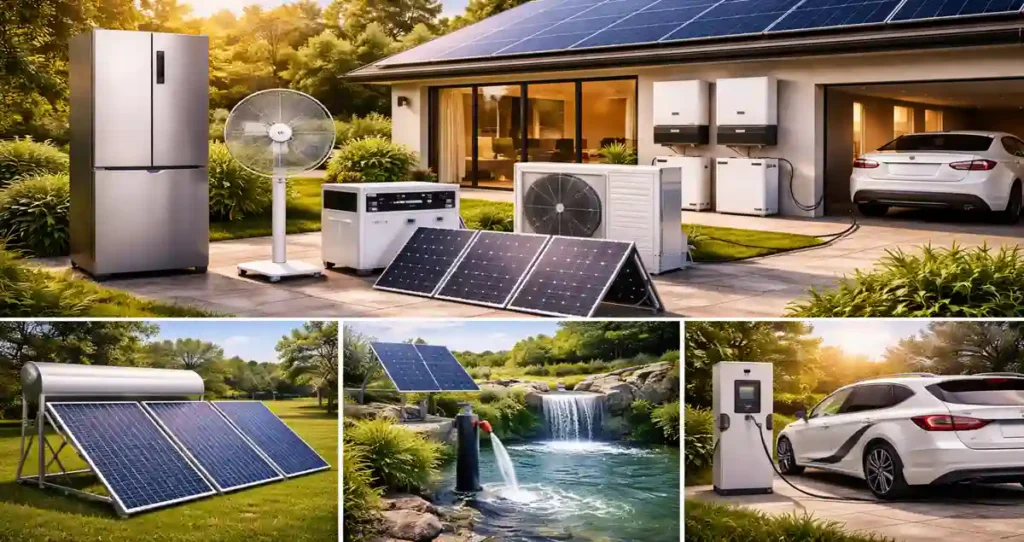
Solar water pumps are transforming water access for homes, farms and agriculture, and remote communities. These systems use photovoltaic panels to power electric pumps, delivering water without grid electricity or fuel costs.
How Solar Water Pumps Work:
Solar water pumping systems consist of three main components:
- Solar panels that generate DC electricity
- A pump controller or variable frequency drive
- The pump itself (surface pump, submersible pump, or booster pump)
During daylight hours, solar panels power the pump directly. Most systems have minimal or no battery storage, instead pumping water into storage tanks for use as needed—a natural form of energy storage.
Solar Generators for Home Appliances
A solar generator is a portable or stationary system designed to store electricity generated by solar panels.
A typical solar generator includes:
- Solar panels to capture sunlight
- Lithium battery storage
- A charge controller to regulate energy flow
- An inverter to power conventional appliances
Solar generators provide reliable power for lighting systems, communication devices, refrigerators, televisions, and other essential equipment. They are especially useful during emergencies, power outages, or in off-grid environments.
Vehicle-to-Home (V2H) Integration
One of the most exciting developments in residential energy systems is the integration of electric vehicles with home solar systems.
Through technologies known as Vehicle-to-Home (V2H) or Vehicle-to-Grid (V2G) , an electric vehicle battery can serve as a large mobile energy storage unit. In practical terms, an electric vehicle can act as a giant solar battery on wheels.
During the day, solar panels can charge both the home battery system and the vehicle. At night, the vehicle battery can supply electricity back to the house, powering essential appliances. This integration significantly increases energy storage capacity and improves household energy resilience.
The Engineering Edge: Why DC Home Appliances Are More Efficient
From a technical engineering perspective, one of the biggest inefficiencies in traditional home electrical systems is what engineers often refer to as the “inverter tax.”
Solar panels naturally produce Direct Current (DC) electricity. Battery storage systems also operate using DC electricity. However, most traditional homes run on Alternating Current (AC) power. Because of this mismatch, solar systems typically convert DC electricity into AC electricity using an inverter. Later, many appliances internally convert that AC power back into DC to run electronic components or motors. Each conversion step wastes energy.
On average, 5% to 15% of electrical energy can be lost as heat during these conversions. DC home appliances eliminate this problem by operating directly on DC electricity.
Advantages of DC Home Appliances and Residential Solar Products
Eliminating Conversion Losses: DC appliances can run directly from solar panels or battery storage without converting electricity multiple times. This increases overall system efficiency and allows homes to utilize more of the energy produced by solar panels.
Higher Energy Efficiency: Because they avoid inverter losses, DC appliances typically operate more efficiently than their AC counterparts. This can significantly reduce the size of solar systems required to power a home, lowering overall system costs.
Improved Motor Performance: Many DC appliances use advanced BLDC motors and water pumps that operate smoothly with minimal energy loss. These motors generate less heat and experience less mechanical stress, resulting in longer device lifespan.
Better Compatibility with Batteries: Battery systems naturally store energy in DC form. DC appliances can draw power directly from batteries without requiring conversion equipment, simplifying system design and reducing equipment costs.
Ideal for Off-Grid Homes: Off-grid homes must maximize every watt of electricity they generate. DC appliances allow households to make better use of available solar energy and extend battery runtime.
Smart Energy Management: How AI Runs Your Solar Home Appliances
Modern solar homes are no longer passive energy consumers.
In 2026, a solar-powered home can operate as a smart energy management system controlled by artificial intelligence. AI-based energy platforms analyze:
- Household electricity usage patterns
- Solar energy production data
- Battery storage levels
- Real-time weather forecasts
Using this information, the system can automatically decide when to run appliances or store electricity. One of the most powerful features of modern systems is solar forecasting.
If the system predicts strong sunlight in the afternoon, it may delay running appliances such as washing machines or dishwashers until peak solar production hours. This strategy, known as smart load shifting, ensures that homes use the maximum possible amount of solar electricity instead of drawing expensive energy from the grid.
Essential System Components
To run solar home appliances efficiently, a home solar system requires several essential components.
| Component | Function | Key Consideration |
|---|---|---|
| Photovoltaic Panels | Capture sunlight and convert to DC electricity | Premium panels achieve 22-24% efficiency |
| Charge Controllers | Regulate voltage to batteries | MPPT controllers boost efficiency by 20-30% |
| Lithium Batteries | Store energy for night use | LiFePO4 lasts 5,000-10,000 cycles |
| Hybrid Inverters | Manage multiple power sources | Maintains AC compatibility when needed |
Solar panel for home appliances
Solar panels capture sunlight and convert it into direct current electricity. High-efficiency panel technologies such as N-type solar cells are continuously improving energy generation capacity. Current premium panels achieve efficiency ratings of 22-24%, meaning more power from limited roof space.
Smart Charge Controllers
Charge controllers regulate voltage and current flowing from solar panels to battery storage systems. They protect batteries from overcharging and extend battery lifespan. Modern Maximum Power Point Tracking (MPPT) charge controllers can increase charging efficiency by 20-30% compared to older technologies.
Lithium Battery Storage
Modern solar systems commonly use LiFePO4 batteries because they support deep discharge cycles and maintain long operational lifespans—typically 5,000 to 10,000 cycles.
Hybrid Solar Inverters
Hybrid inverters allow homes to manage electricity from multiple sources, including solar panels, battery storage, and the electrical grid. Even in DC-optimized homes, hybrid inverters help maintain compatibility with traditional AC appliances when necessary.
Costs, ROI, and Payback Periods
While solar home appliances offer compelling benefits, several important considerations deserve attention.
Upfront Investment
Solar appliances typically cost 20-50% more than conventional alternatives. A complete home solar system with battery storage represents a significant investment, often ranging from $10,000 to $30,000 depending on system size and location.
Return on Investment
Despite higher initial costs, most solar home appliances deliver positive returns through energy savings:
| Appliance | Payback Period | Lifespan |
|---|---|---|
| Solar Refrigerator | 3-5 years | 15-20 years |
| Solar Water Heater | 4-7 years | 20-25 years |
| Complete Home System | 6-10 years | 25-30 years |
After the payback period, electricity remains essentially free for the system’s remaining lifespan.
Geographic Suitability
Solar technology performance varies significantly by location:
- Sun-rich regions (Southwest US, Mediterranean, Australia, parts of Africa and India): Solar appliances deliver maximum performance and fastest payback periods
- Moderate climates (Northern Europe, Northeast US, Pacific Northwest): Systems require larger solar arrays and battery banks to compensate for reduced sunlight, extending payback periods
- Cloudy or high-latitude regions: Solar remains viable but requires careful system sizing and realistic expectations about grid backup requirements
Professional Installation
Unlike conventional appliances, solar systems require professional assessment and installation. Proper system sizing, electrical configuration, and safety compliance demand qualified expertise, adding to initial costs. Always work with certified installers and check local incentives and rebates that may offset installation expenses.
The Future: DC Microgrids and Beyond
Industry trends indicate that residential energy systems are gradually evolving toward DC microgrids.
In a DC microgrid, solar panels, batteries, appliances, and energy management systems operate using direct current electricity within a localized network. This structure eliminates unnecessary conversion steps and improves energy efficiency throughout the entire household.
Future smart homes may include:
- Integrated rooftop solar panels
- Wall-mounted battery storage systems
- DC-powered appliances throughout the home
- Electric vehicle charging infrastructure
- AI-controlled energy management platforms
- Vehicle-to-home integration capabilities
Together, these technologies will transform houses into fully optimized renewable energy environments, and with solar AI minimize the electriciy bills.
Conclusion: Your Path to Energy Independence
Solar home appliances are rapidly reshaping how modern households produce and consume electricity. From solar refrigerators and air conditioners to DC fans and solar generators, these devices allow homes to operate more efficiently using renewable energy.
Advances in AI-driven energy management, electric-vehicle integration, and DC microgrid technology are accelerating the transition to smarter, more resilient homes. While upfront costs and geographic limitations present real considerations, the long-term benefits of energy independence, reduced utility bills, and environmental sustainability make solar appliances increasingly attractive for homeowners worldwide.
The future of residential energy is moving toward decentralized systems where households generate, store, and intelligently manage their own electricity. A well-designed solar power system with modern solar home appliances represents not only an environmentally responsible choice but also a fundamental technological upgrade—delivering lower energy costs, greater reliability, and long-term sustainability for modern living.
Frequently Asked Questions
Can I use solar appliances without a full solar panel system?
Yes, many solar appliances like solar water heaters and solar generators can function independently, though they perform best when integrated with a complete solar system.
How long do solar home appliances last?
Most solar appliances have lifespans of 15-25 years, with proper maintenance. Battery systems typically require replacement every 10-15 years.
Are there government incentives for solar appliances?
Many countries offer tax credits, rebates, and incentives for solar installations. Check with local authorities and energy departments for current programs in your area.
Can I run my entire home on solar appliances?
Yes, with properly sized solar panels, battery storage, and efficient DC appliances, many homes achieve full energy independence, particularly in sun-rich regions.
Do solar appliances work during cloudy weather?
Yes, but with reduced efficiency. Battery storage and grid backup ensure continuous operation during extended cloudy periods.