
Are monocrystalline solar panels still worth it in 2026? Expert engineer review covers TOPCon, HJT, costs, incentives, and why mono remains the foundation of solar technology.
“With all these new solar technologies coming out, are monocrystalline panels still worth it?”
I hear that question from London to Los Angeles, from commercial developers to homeowners. My answer: not only are they still worth it — every advanced solar technology you hear about today is built on monocrystalline silicon.
Monocrystalline solar panels are not a legacy technology; they remain a strong option. They are the platform on which every breakthrough in this industry stands. Let me show you why — and what it means for your solar investment.
What Are Monocrystalline Solar Panels?
A monocrystalline panel is made from a single, continuous crystal of pure silicon, grown through the Czochralski method. That uniform crystal structure gives these panels their signature black appearance and exceptional ability to conduct electricity efficiently. To understand the physics in detail, our guide on how solar panels work covers the process from photon to electron.
Unlike polycrystalline panels — made from melted silicon fragments — monocrystalline silicon has no grain boundaries to impede electron flow. The result is higher efficiency and better long-term performance.
Key specifications (2026 standard):
- Efficiency: 18% – 22% (TOPCon/HJT: up to 26%)
- Lifespan: 25 – 30+ years
- Temperature coefficient: -0.30% to -0.35% per °C
- Annual degradation: ≤ 0.55%
- Appearance: Uniform black cells, low-profile aesthetic
Monocrystalline vs. Polycrystalline Solar Panels: The Real Difference
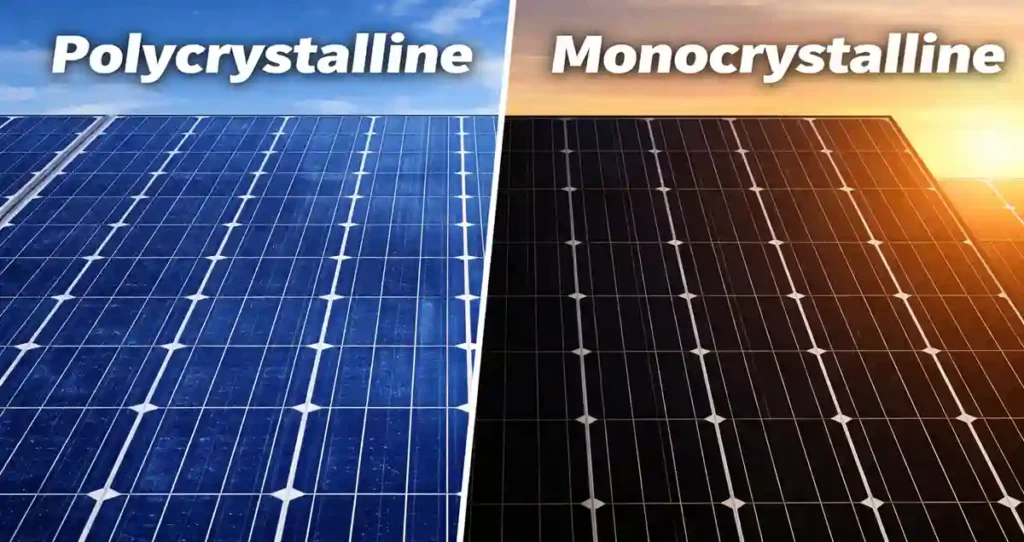
When evaluating monocrystalline vs polycrystalline solar panels, the difference goes beyond aesthetics — it affects generation, longevity, and ROI.
| Factor | Monocrystalline | Polycrystalline |
|---|---|---|
| Efficiency | 19–24%+ (up to 26% with TOPCon/HJT) | 15–18% |
| Appearance | Uniform black | Speckled blue |
| Lifespan | 25–30+ years | 20–25 years |
| Temp. coefficient | -0.30% to -0.35%/°C | -0.40% to -0.45%/°C |
| Space required | 15–20% less roof area | More panels needed |
| 25-year ROI | Superior | Moderate |
For installations across the US, UK, Canada, Australia, and Europe, the higher upfront cost of mono is consistently offset by superior energy yield and property value uplift.
Amorphous vs. Monocrystalline Solar Panels
A third option is amorphous thin-film. When comparing amorphous vs monocrystalline solar panels, the performance gap is significant:
| Factor | Monocrystalline | Amorphous / Thin-Film |
|---|---|---|
| Efficiency | 19–24%+ | 10–13% |
| Lifespan | 25–30+ years | 10–20 years |
| Power density | High | Low |
| Best use | Rooftop, ground-mount | Portable, BIPV, curved surfaces |
For any fixed rooftop installation where maximizing kWh per square metre is the goal, monocrystalline is the correct engineering specification. (There are niche utility projects where thin‑film’s low $/W CAPEX may be chosen on vast unconstrained land — but for serious residential or commercial work, mono wins.)
Why Monocrystalline Remains the Foundation in 2026
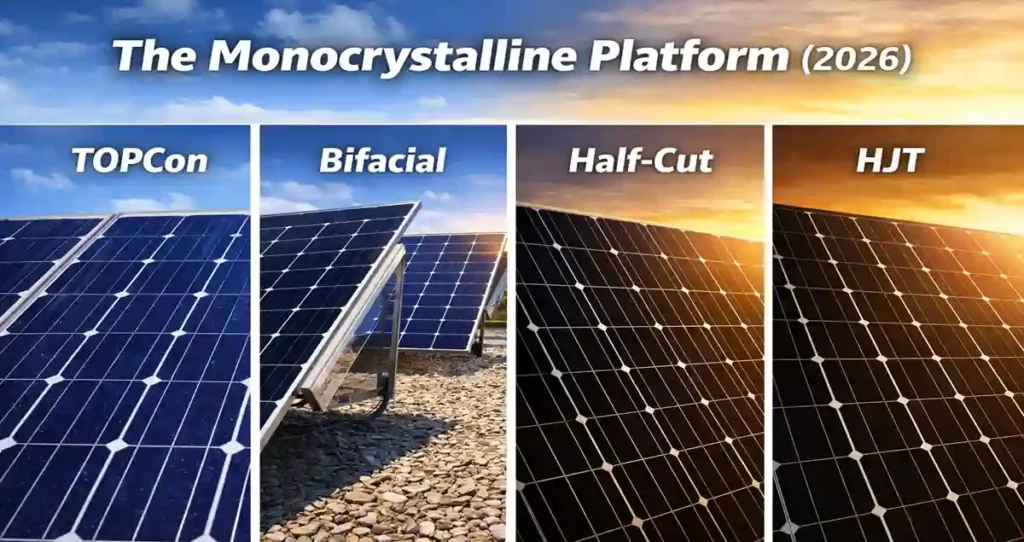
Here is what most buyers miss: when engineers discuss TOPCon, bifacial, half-cut, and HJT technologies, they are not describing replacements for monocrystalline silicon. They are describing upgrades built directly on top of it. Every one of these technologies uses monocrystalline silicon as its core substrate. Mono is not legacy technology — it is the platform.
TOPCon: Mono Evolved
TOPCon (Tunnel Oxide Passivated Contact) replaced PERC as the industry production standard in 2025–2026, reaching 22.5%–25.5% efficiency in mass-market panels. TOPCon is built on N-type monocrystalline silicon. The advancement is a thin tunnel oxide passivation layer on the rear surface that dramatically reduces recombination losses — but the substrate is, and will remain, monocrystalline.
TOPCon’s additional commercial advantage: it can be manufactured on existing PERC production lines with modest retrofitting, because the base material is identical. This is a primary reason TOPCon achieved market dominance so rapidly.
Bifacial Panels: Mono on Both Sides
Bifacial solar panels generate electricity from both the front and rear surfaces, delivering 10–30% additional energy yield on reflective surfaces or ground-mount installations. The commercial panels driving this market almost universally use N-type monocrystalline cells — chosen specifically for zero LID (Light Induced Degradation) and superior long-term performance retention. (N-type also resists LeTID, a degradation mode that affected some earlier P-type PERC cells.)
Half-Cut Cells: Mono Optimised
Half-cut cell technology slices a standard solar cell in two, delivering well-documented engineering improvements for Monocrystalline Solar Panels. By splitting the cells, the electrical current is halved, which reduces internal resistance losses by a factor of four.
Key technical advantages include:
- Reduced Resistive Losses: Current travels a shorter path through each half-cell, significantly increasing overall module efficiency.
- Increased Power Density: Module output typically increases by 5–10W per panel compared to full-cell configurations.
- Enhanced Thermal Performance: Cell operating temperatures run approximately 2°C to 5°C lower than full-cell modules. While this delta seems small, it effectively mitigates long-term thermal degradation and improves energy yield during peak summer irradiance.
- Advanced Shading Mitigation: Since the top and bottom halves of the panel operate independently, partial shading on one section does not shut down the entire module.
This architecture has become the de facto standard for high-performance Monocrystalline Solar Panels globally, ensuring maximum reliability and a superior 25-year return on investment (ROI
HJT: The Premium Architecture
Heterojunction (HJT) panels sandwich a monocrystalline silicon wafer between thin-film amorphous silicon layers, achieving efficiencies of 23.5%–26%. The result is an exceptional temperature coefficient — typically around -0.25%/°C — making HJT the engineering-preferred specification for markets with significant summer temperatures. The crystalline core that makes this architecture work is, again, monocrystalline silicon.
Perovskite-Silicon Tandems: The Next Frontier, Still on Mono
Early commercial perovskite-silicon tandem panels are entering pilot deployments approaching 30% efficiency. The mechanism: a perovskite layer captures a broader solar spectrum on top of a silicon cell. The silicon cell in every tandem configuration in commercial development today is monocrystalline. The platform holds even at the frontier.
Monocrystalline Within a Complete Solar System
A mono panel is the generation engine, but its real‑world performance depends on every component it connects to.
Solar Inverters Selection
The inverter converts DC power into usable AC electricity.
- String inverters: Cost‑effective for straightforward rooftops.
- Hybrid solar inverters: Combine grid‑tie inversion with integrated battery management — the optimal choice for storage.
- Microinverters: Convert DC to AC at each panel, eliminating string‑level shading losses.
MPPT Charge Controllers
For off‑grid and battery‑integrated systems, the MPPT is a critical solar charge controller. It continuously adjusts the electrical operating point to extract maximum available power. A quality MPPT controller typically recovers 15–30% more energy than a basic PWM controller over the system’s life.
Solar Batteries
Pairing mono panels with a solar battery transforms a grid‑tied system into an energy independence platform. Excess generation is stored for evening use. For larger installations, BESS (Battery Energy Storage Systems) provides scalable, rack‑mounted storage with sophisticated energy management.
System Wiring
At the panel level, MC4 connectors are the industry‑standard weatherproof interconnection. Correct specification and installation are non‑negotiable — undersized or poorly crimped connectors cause resistive losses and arc faults.
System Sizing & Application Profiles
Residential Systems
A 10kW solar system using premium mono panels is the most common specification for mid‑to‑large residential properties in 2026. It occupies about 40–50 square metres of roof space and generates 8,000–14,000 kWh annually. For homeowners interested in reducing grid dependence entirely, for urban properties with limited roof access, balcony solar systems using compact mono panels are a viable entry point — especially relevant in Germany, the Netherlands, and other European markets.
Commercial & Industrial Applications
Mono panels are the default for commercial and industrial solar globally. Industrial solar panels in the 580–670W range, built on N‑type TOPCon mono cells, are standard for large‑scale projects. For commercial system owners, proactive maintenance protects long‑term yield. Our guide on commercial solar maintenance covers inspection schedules and performance ratio benchmarking.
Agricultural & Specialist Applications
Monocrystalline is the specification of choice for agricultural solar panels in agrivoltaic installations, where high efficiency maximises land‑use flexibility. The same advantage applies to school solar panels, where limited roof space and long institutional ownership make mono’s lifecycle economics compelling.
What You Can Power
The high output density of mono panels enables energy‑intensive applications that lower‑efficiency panels cannot cost‑effectively support:
- Solar air conditioners – DC inverter units that run directly from solar, eliminating cooling costs in warm climates.
- Solar water pumps– Proven for agricultural irrigation and residential water supply where grid access is unreliable.
- Solar refrigerators – DC compressor units ideal for off‑grid homesteads and agricultural cold storage.
- Solar home appliances – A growing category of DC‑optimised appliances.
- Solar street lights – Commercial‑grade mono‑based lighting now matches grid‑tied luminaires and is routinely specified for new developments.
Monocrystalline Solar Panels Cost: 2026 Outlook
Understanding cost requires looking beyond per‑panel price to system‑level economics. Mono panels cost more per unit than poly, but because fewer panels are needed for the same output, the installed cost gap is narrower.
Typical 2026 installed solar power system cost ranges (residential, 6–10 kW):
- United States: $15,000 – $25,000 (before incentives)
- United Kingdom: £6,000 – £12,000 (0% VAT reduces cost by ~20%)
- Canada: CAD $15,000 – $25,000 (Greener Homes Loan up to $40,000 interest‑free)
- Australia: AUD $5,000 – $9,000 (SRES rebate reduces upfront cost)
- Germany / Europe: €8,000 – €15,000
Realistic payback periods:
- US: 6–10 years
- UK: 7–12 years
- Canada: 8–12 years
- Australia: 3–6 years
- Germany/Europe: 8–14 years
After payback, a mono system continues generating at zero fuel cost for another 15–22 years.
Solar Incentives by Market: 2026
United States
The residential solar landscape in the U.S. has undergone a fundamental shift following the expiration of core incentives. For systems placed in service in 2026, the strategy for maximizing ROI must pivot from direct ownership tax credits to third-party financing and state-level performance programs.
1. Federal Tax Credit Expiration (Section 25D)
The 30% Residential Clean Energy Credit (Section 25D) officially expired on December 31, 2025, under the provisions of the One Big Beautiful Bill Act (OBBBA).
- Direct Ownership: Homeowners who purchase a system outright (cash or loan) in 2026 are no longer eligible for a federal tax credit.
- Expenditure Timing: Per IRS Code Section 25D(e)(8), a system is only considered “expended” when the physical installation is complete. Even if a deposit was paid in 2025, a 2026 completion date disqualifies the project from the 25D credit.
2. The Third-Party Pivot (Section 48E)
While the residential credit has ended, the Commercial Clean Electricity Investment Tax Credit (Section 48E) remains active. This is now the primary vehicle for federal solar subsidies:
- Leases & PPAs: Because the solar provider (a commercial entity) owns the system, they can still claim the 30% ITC. These savings are typically passed to the homeowner via lower monthly lease payments or PPA rates.
- Deadlines: To secure the full 30% credit, providers must generally “Begin Construction” by July 4, 2026. Systems starting after this date face a tighter “placed in service” deadline of December 31, 2027.
- Domestic Content “Adders”: Projects using US-manufactured components may qualify for an additional 10% bonus credit, further lowering the cost of third-party owned residential systems.
3. State and Utility Incentives
With the federal “floor” removed for homeowners, state-level programs are now the main drivers of direct-ownership ROI:
- Refundable Credits: States like New York, Massachusetts, and New Jersey continue to offer significant state-level tax credits, some of which are refundable.
- Performance-Based Incentives (PBIs): Programs like Illinois Shines (ABP) and NJ’s ADI provide ongoing payments based on the actual kilowatt-hours produced.
- Sales & Property Tax Exemptions: Over 30 states (including FL, TX, and AZ) offer 100% property tax exemptions, ensuring your solar investment doesn’t increase your annual tax burden.
4. Net Metering Status
Net Metering (NEM) remains available in the majority of states, though many (such as California with NEM 3.0) have transitioned to “Net Billing” structures. In these markets, pairing solar with a Battery Energy Storage System (BESS) is technically required to preserve the value of generated electrons.
United Kingdom
- 0% VAT on solar installations until March 2027, saving £1,400–£2,000 automatically via MCS‑certified installers.
- Smart Export Guarantee (SEG) pays for exported electricity (3–5p/kWh standard; smart tariffs can exceed 20p/kWh).
- ECO4 grants for low‑income households.
- Businesses: 100% first‑year capital allowance (Full Expensing).
Canada
- Clean Technology Investment Tax Credit: 30% refundable federal credit for businesses through 2034.
- Canada Greener Homes Loan: up to $40,000 interest‑free for homeowners.
- Provincial programmes: Ontario’s Home Renovation Savings Programme, BC Hydro net metering, Alberta’s CEIP.
- Net metering available in most provinces.
Australia
- Small‑scale Renewable Energy Scheme (SRES): upfront rebates via STCs, reducing system price by $1,400–$2,000+ — applied automatically by accredited installers.
- State programmes: Victoria’s Solar Homes Programme, South Australia’s REPS.
- Feed‑in tariffs vary by state and retailer.
- Cheaper Home Batteries Programme supports battery‑integrated systems.
Europe
- Germany: KfW subsidies up to 30% of system cost (up to €6,600) plus Einspeisevergütung feed‑in tariff.
- France: MaPrimeRénov’s grants plus reduced VAT (5.5%).
- Netherlands, Belgium, and others offer VAT reductions, regional grants, and net‑metering equivalents.
- EU‑wide REPowerEU targets 600 GW by 2030, accelerating financing and permitting.
Best Monocrystalline Solar Panels to Buy in 2026
The market has stratified between N‑type TOPCon and HJT at the premium tier, and P‑type PERC in the mid‑market.
| Manufacturer | Flagship Series | Technology | Peak Efficiency | Best Fit |
|---|---|---|---|---|
| LONGi Solar | Hi‑MO 6 / Hi‑MO 7 | N‑type TOPCon | 23.0%+ | Global residential & commercial |
| JinkoSolar | Tiger Neo | N‑type TOPCon | 23.5%+ | Global residential & commercial |
| JA Solar | DeepBlue 4.0 X | N‑type TOPCon | 22.8%+ | Value + performance balance |
| Canadian Solar | HiHero | HJT | 23.0%+ | Hot climates (AU, US South, EU Med) |
| Trina Solar | Vertex S+ | N‑type TOPCon | 22.8%+ | Space‑constrained residential |
| REC Group | Alpha Pure‑R | HJT | 22.3%+ | European premium residential |
| Panasonic / Enefit | EverVolt HK Black | HJT | 22.2%+ | North America — aesthetics + performance |
Technical checklist:
- Cell type: N‑type monocrystalline (TOPCon or HJT) for zero LID and better retention. (N‑type also resists LeTID, which was a concern for earlier P‑type PERC.)
- Efficiency: Premium residential should specify 21%+; TOPCon/HJT routinely reach 23%+.
- Temperature coefficient: -0.30%/°C or better for markets with significant summer temperatures.
- Degradation warranty: Year‑one ≤ 2%, annual ≤ 0.55%, 25‑year linear warranty from a tier‑1 Bloomberg NEF-rated manufacturer.
Protecting Long‑Term Performance: Maintenance
The 25–30 year lifespan of premium mono panels is a warranted specification, not a passive outcome. Soiling — dust, pollen, bird droppings — is the most significant avoidable performance loss. Our detailed guide on how to clean solar panels safely covers correct approaches. Using the right solar panel cleaning solutions and a purpose‑designed solar panel cleaning brush protects anti‑reflective coatings and warranties.
A comprehensive maintenance schedule includes: annual thermal imaging, string‑level performance monitoring via your inverter portal, and connector checks every 3–5 years. For commercial systems,
From Hardware Excellence to Intelligent Powerhouse: What AI Does to Monocrystalline Solar
Monocrystalline panels represent the peak of solar hardware available today. But even peak hardware has a performance gap — the difference between what a panel delivers under Standard Test Conditions and what it actually delivers over decades of real-world operation. Thermal losses, partial shading, soiling, and seasonal irradiance variation — each one quietly erodes yield.
That gap is precisely where AI-driven energy management steps in, and monocrystalline silicon is uniquely suited to benefit from it.
Temperature management is the primary battlefield. Monocrystalline panels lose approximately 0.30–0.35% of output per degree Celsius above 25°C. In warm climates across the US Sun Belt, Southern Europe, and Australia, that is a daily, compounding loss. AI-driven thermal monitoring now tracks cell-level temperatures in real time, adjusting energy routing and flagging hotspot formation before it accelerates degradation.
Beyond thermal management, AI delivers predictive MPPT charge controller optimisation that anticipates cloud cover and irradiance shifts rather than reacting to them; soiling and micro-crack identification years before they become visible; and continuous energy flow optimisation between the panel array, solar battery storage, and grid export — maximising financial return on every kilowatt-hour the system produces.
The outcome: a monocrystalline system without AI monitoring typically delivers 85–90% of theoretical yield potential. An AI-integrated system can push toward 98% or more of that potential, sustained across a 25‑year operational life — a level of performance that was not commercially achievable five years ago.
Who Should Choose Monocrystalline Solar Panels?
- Homeowners with limited or complex roof geometry.
- Commercial and industrial building owners seeking the fastest payback.
- Agricultural operators require maximum land‑use flexibility.
- Educational institutions with long ownership horizons.
- Off‑grid living and hybrid system builders where consistent output is non‑negotiable.
- Anyone prioritising long‑term value.
Engineer’s Verdict
After years of engineering practice and thousands of monocrystalline panels specified internationally, this is my professional assessment: Monocrystalline solar panels are not a legacy technology defending its position. They are the active foundation on which every meaningful advancement in photovoltaics is being built. TOPCon, bifacial, half‑cut, HJT, and perovskite tandems are all — at their core — monocrystalline silicon.
When comparing monocrystalline vs polycrystalline across efficiency, degradation, heat tolerance, and 25‑year yield, mono wins without exception. The conversation has, from an engineering standpoint, been settled. The only remaining question is which monocrystalline technology is the right specification for your project.
The hype around new solar technologies is real — but it is hype about evolutions of the same proven platform. Monocrystalline silicon is not being replaced; it is being refined. And for any serious residential or commercial installation in 2026, it remains the clear, data‑backed choice.
Frequently Asked Questions
Are monocrystalline solar panels still worth it in 2026?
Yes. Monocrystalline panels remain the gold standard for residential and commercial solar. Every advanced technology — TOPCon, HJT, bifacial, and even perovskite tandems — is built on monocrystalline silicon. Their superior efficiency, low degradation, and long lifespan deliver the best 25‑year return on investment.
What is the difference between monocrystalline and polycrystalline solar panels?
Monocrystalline panels are made from a single silicon crystal, offering 19–24%+ efficiency, a uniform black appearance, and better heat tolerance. Polycrystalline panels are made from fused silicon fragments, delivering 15–18% efficiency with a speckled blue look. For space‑constrained or high‑performance installations, mono is the clear winner.
How long do monocrystalline solar panels last?
Premium monocrystalline panels come with warranties of 25–30 years and typically continue producing at 80–90% of rated output well beyond that period. Annual degradation is ≤0.55%, meaning after 25 years, they still generate over 85% of their original capacity
What is TOPCon technology?
TOPCon (Tunnel Oxide Passivated Contact) is the latest evolution of monocrystalline solar cells. It uses an ultra‑thin passivation layer to reduce electron recombination, boosting efficiencies to 22.5–25.5%. TOPCon panels are built on N‑type monocrystalline silicon and have replaced PERC as the industry standard in 2025–2026.
What are the best monocrystalline solar panels to buy in 2026?
Top tier‑1 manufacturers include LONGi (Hi‑MO series), JinkoSolar (Tiger Neo), JA Solar (DeepBlue), Canadian Solar (HiHero HJT), Trina Solar (Vertex S+), REC Group (Alpha Pure‑R), and Panasonic (EverVolt). For most applications, N‑type TOPCon or HJT panels with efficiencies above 21% and strong degradation warranties are recommended.
How much do monocrystalline solar panels cost in 2026?
Installed system costs vary by market. In the US, a 6–10 kW residential system ranges from $15,000–$25,000 before incentives; in the UK, £6,000–£12,000 after 0% VAT; in Australia, AUD $5,000–$9,000 after SRES rebates. Payback periods range from 3–6 years (Australia) to 8–14 years (Europe).
What solar incentives are available for monocrystalline systems in 2026?
In the US, the residential federal tax credit expired in 2025, but commercial ITC (Section 48E) remains for third‑party owned systems (leases, PPAs). State and utility rebates still apply in many states. In the UK, 0% VAT and Smart Export Guarantee payments are available. Canada offers a 30% federal Clean Technology ITC for businesses and interest‑free Greener Homes Loans for homeowners. Australia’s SRES provides upfront rebates via STCs.
Can I use monocrystalline panels with a battery storage system?
Absolutely. Pairing monocrystalline panels with a solar battery or BESS (Battery Energy Storage Systems) allows you to store excess daytime generation for evening use, maximising self‑consumption and energy independence. A hybrid solar inverter is typically the optimal solution for integrated battery systems.
How do I clean and maintain monocrystalline solar panels?
Regular cleaning is essential to prevent soiling losses of 5–25%. Use a solar panel cleaning brush with soft bristles and approved solar panel cleaning solutions to avoid damaging anti‑reflective coatings. Annual thermal imaging and performance monitoring via your inverter portal are also recommended. For detailed guidance,
What is the role of AI in monocrystalline solar systems?
AI‑driven energy management optimises real‑time performance by predicting shading, adjusting MPPT charge controller settings, managing thermal losses, and coordinating energy flow between panels, batteries, and the grid. An AI‑integrated system can achieve 98% or more of theoretical yield, compared to 85–90% without.
Which is better for a small roof: monocrystalline or thin‑film?
Monocrystalline. Its high power density (watts per square metre) means you generate more electricity from limited space. Thin‑film amorphous panels have lower efficiency (10–13%) and require significantly more area for the same output, making them unsuitable for most residential rooftops.
What system size do I need for a typical home?
A 10kW solar system using premium monocrystalline panels is the most common residential size in 2026, covering the majority of annual consumption for a mid‑to‑large home. It requires about 40–50 square metres of roof space.
Can monocrystalline panels power an off‑grid home?
Yes. Monocrystalline panels are the preferred choice for off grid living due to their consistent output, high efficiency, and 25+ year lifespan. A properly sized system with battery storage and backup generation can provide complete energy independence.
Do monocrystalline panels work in cloudy or cold climates?
Yes. Monocrystalline panels perform well in diffuse light conditions. Their superior temperature coefficient (-0.30% to -0.35%/°C) means they lose less efficiency in high heat, but they also operate efficiently in cold temperatures. They are widely used in the UK, Canada, and Northern Europe.