
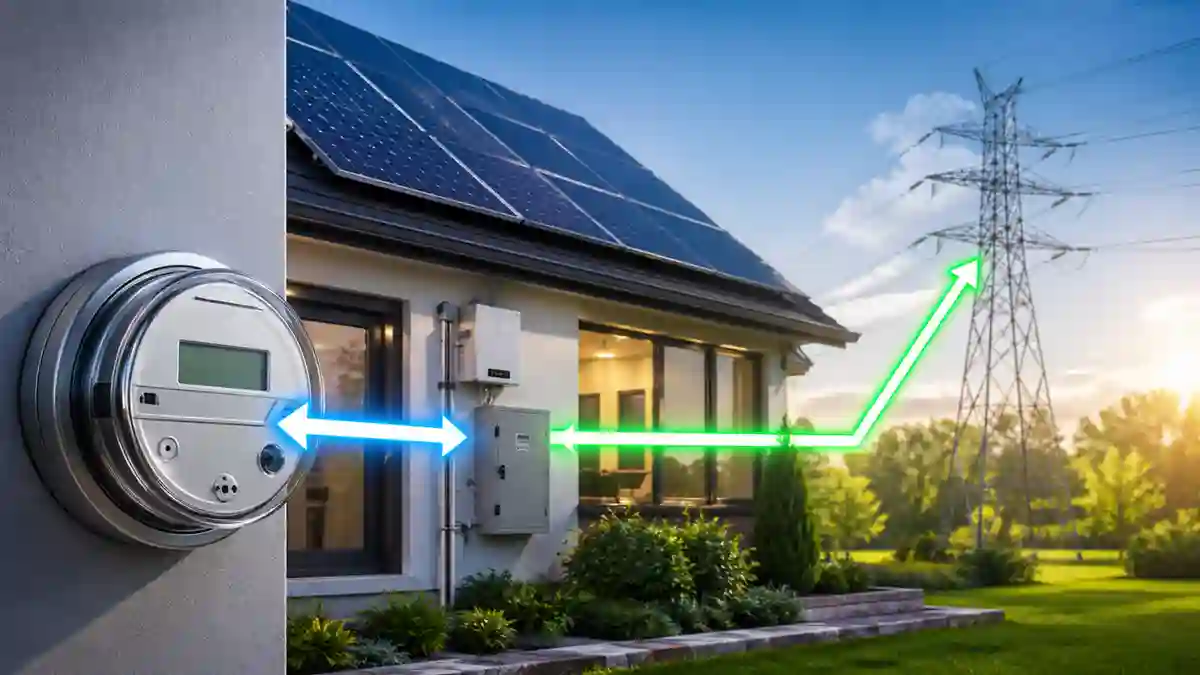
Reverse metering explained by a registered engineer. Bidirectional meters, anti-islanding safety, and AI export timing to maximize net metering credits.
When your solar power system generates more electricity than your home or business is using at any given moment, that surplus does not disappear. It flows backward through your electrical meter, onto the utility grid, and becomes power that a neighboring building can use. This is reverse metering — the physical mechanism that makes every net metering credit possible, and the data stream that modern AI solar monitoring systems track in real time to maximize your financial return.
As a registered professional engineer who has designed and commissioned grid-tied solar systems across residential and commercial applications, I want to give you both sides of this topic: the engineering reality of how reverse metering works, and the AI layer that turns that bidirectional energy flow into optimized financial performance.
What is Reverse Metering
A standard utility meter registers electricity flowing in one direction — from the grid into your building. During the day, your solar panels convert sunlight into DC electricity, which the inverter transforms into AC power and feeds directly into your building’s circuits. When that AC output exceeds what your building’s loads are consuming at any given moment, the net energy flow at the service entrance reverses. Current flows from the inverter, through your main panel, back through the service entrance conductors, through the utility transformer, and onto the distribution feeder in the opposite direction.
The utility meter registers this reverse flow. Under a net metering arrangement, your utility credits this exported energy against your future grid consumption — typically at the retail electricity rate, though this varies significantly by state and utility program.
| Engineer’s Note: The term ‘meter runs backwards’ is accurate for older electromechanical meters with a spinning aluminum disc. Modern smart meters register import and export in two separate data channels — there is no physical reversal. The smart meter communicates both values to the utility’s billing system at intervals as short as 15 minutes, and this granular data stream is exactly what AI solar monitoring platforms consume to detect performance anomalies, validate credit calculations, and optimize export timing. |
The Bidirectional Meter — Hardware That Makes It Possible
Your utility installs a bidirectional smart meter when your solar interconnection application is approved. It maintains two registers: Register 1 for total kWh imported from the grid, and Register 2 for total kWh exported from your solar system. Your net metering bill is calculated from the difference between these two registers over the billing period.
The bidirectional meter is also the primary data source for modern AI solar management platforms. Systems like SolarEdge Home, Tesla Energy Gateway, Enphase IQ System Controller, and third-party platforms such as Span and Emporia tap into this real-time bidirectional flow data to build machine learning models of your building’s consumption patterns and your solar system’s generation profile — then use those models to make optimization decisions automatically.
When Reverse Metering Happens — A Worked Example
Consider a 10 kW rooftop solar system on a commercial building with a daytime load of 4 kW. On a clear midday:
- Solar generation: 9.2 kW
- Building load: 4.0 kW
- Net export to grid: 5.2 kW — reverse metering is occurring
- Meter registers: 0 kWh import / 5.2 kWh per hour export, accumulating
The transition between import and export mode is seamless and automatic — the inverter continuously synchronizes with the grid, and the meter simply measures the net current direction at the service entrance. No manual switching or intervention is required.
| Field Note: Anti-islanding protection is a safety mechanism that disconnects your solar inverter if the grid voltage or frequency deviates from normal operating parameters, which can happen when the grid goes down. Without anti-islanding, an inverter could continue energizing the distribution feeder during an outage, creating shock hazards for utility workers. Every grid-tied inverter sold in the US must comply with IEEE 1547-2018 anti-islanding requirements. This is why standard grid-tied solar provides no backup power during outages — the inverter shuts down within milliseconds of detecting the grid failure, even on a bright sunny day. |
How AI Monitoring Transforms Reverse Metering Data
The bidirectional meter produces a continuous stream of granular energy flow data — import watts, export watts, voltage, frequency, and power factor, updated every 15 minutes or faster in modern AMI systems. Until recently, this data sat in utility billing systems and was only visible to the solar owner as a monthly line item on their electricity bill. AI solar monitoring platforms now consume this real-time data stream and apply machine learning to extract insights and take optimization actions:
- Anomaly detection: AI platforms establish a baseline generation-vs-export pattern for your system, location, and seasonal profile. Deviations — a string underperforming due to shading, a module with early degradation, a loose MC4 connector causing resistance losses — are flagged within hours rather than discovered at the annual string test. AI-driven fault detection reduces energy loss from undetected faults by 15–30% compared to manual monitoring.
- Export credit validation: AI platforms cross-reference your bidirectional meter’s export data against the utility’s billing statement, flagging discrepancies in credit calculations. Billing errors in net metering statements occur more frequently than most solar owners realize — particularly in the first 6 months after interconnection.
- Generation forecasting: By combining your meter’s historical generation data with real-time weather data and satellite irradiance models, AI platforms predict tomorrow’s solar generation within 5–8% accuracy. This forecast drives battery charge-discharge scheduling and load management decisions.
- Export timing intelligence: Under time-of-use net metering rates — and especially under California NEM 3.0’s avoided-cost structure, where evening export earns 3–4× more than midday export — knowing when to export vs. store becomes a revenue decision. AI platforms make this decision automatically every 5–15 minutes based on current TOU rates, battery state of charge, weather forecast, and load prediction.
| AI Insight: Under NEM 3.0, AI-managed systems achieve export credit values of $0.17–0.22/kWh compared to $0.07–0.09/kWh for unmanaged systems exporting the same energy. This 2–3× improvement comes entirely from export timing — shifting battery discharge from midday ($0.05–0.08/kWh) to evening ($0.18–0.24/kWh). On a system exporting 2,000 kWh per year, this timing optimization produces $200–280 in additional annual credit value at zero additional hardware cost. |
Reverse Metering vs Net Metering — The Key Distinction
Reverse metering is the physical event — actual current flowing backward through the service entrance and meter. Net metering is the billing arrangement that assigns financial value to that reverse flow. A solar system can produce reverse metering without net metering enrollment — if you are not in a net metering program, or your utility does not offer one, exported energy may be compensated at a much lower rate or not at all.
For the complete engineering and financial breakdown of how net metering credits are calculated, how AI optimization maximizes those credits, and what NEM 3.0 means for California solar owners, see the Net Metering Complete Guide and the AI Solar Optimization Guide on SolarVisionAI.
Key Takeaways
- Reverse metering is the physical reversal of energy flow through your utility meter when solar generation exceeds building consumption.
- Modern smart meters register import and export in two separate data channels, producing granular real-time data that AI platforms use for optimization and credit validation.
- AI monitoring detects generation faults within hours rather than weeks, protects net metering credit accuracy, and forecasts generation for battery scheduling.
- Net metering is the billing policy that assigns financial value to reverse metering — the two terms describe different layers of the same system.
- Under time-of-use rates and NEM 3.0, AI export timing optimization increases annual net metering credit value by 20–40% compared to unmanaged export.
Frequently Asked Questions
What is reverse metering in solar?
Reverse metering is the physical process where solar energy generation exceeds your building’s consumption, causing electricity to flow backward from your inverter, through your utility meter, and onto the local grid. Modern smart meters track this by using two separate data registers—one for energy imported and one for energy exported.
Is reverse metering the same as net metering?
No, they are distinct layers of the same system. Reverse metering is the physical mechanism of energy flowing back into the grid, while net metering is the specific billing policy that determines the financial value or credit you receive for that exported energy.
Do all solar systems support reverse metering?
While most modern grid-tied inverters are technically capable of exporting power, your utility must approve your interconnection application and install a bidirectional smart meter to officially support reverse metering. Additionally, standard grid-tied systems will stop exporting power during a grid outage due to “anti-islanding” safety protocols, which protect utility workers by disconnecting the system within milliseconds.
What happens if I don’t have net metering?
If you have a bidirectional meter but are not enrolled in a net metering program, your surplus energy still flows to the grid, but you may receive zero compensation or be paid at a significantly lower “wholesale” or “avoided cost” rate. In these scenarios, AI-driven battery storage becomes critical to store that energy for your own use later rather than exporting it for little to no credit.
How does AI improve reverse metering performance?
AI monitoring platforms analyze real-time data from your bidirectional meter to detect faults, forecast future generation based on weather, and optimize “export timing”. For instance, under systems like California’s NEM 3.0, AI can automatically trigger battery discharge during high-value evening hours, increasing the value of your exported credits by 20–40% compared to unmanaged systems.
Related guides: Net Metering Complete Guide · AI Solar Optimization Guide · NEM 3.0 California Guide · BESS Battery Storage Guide