
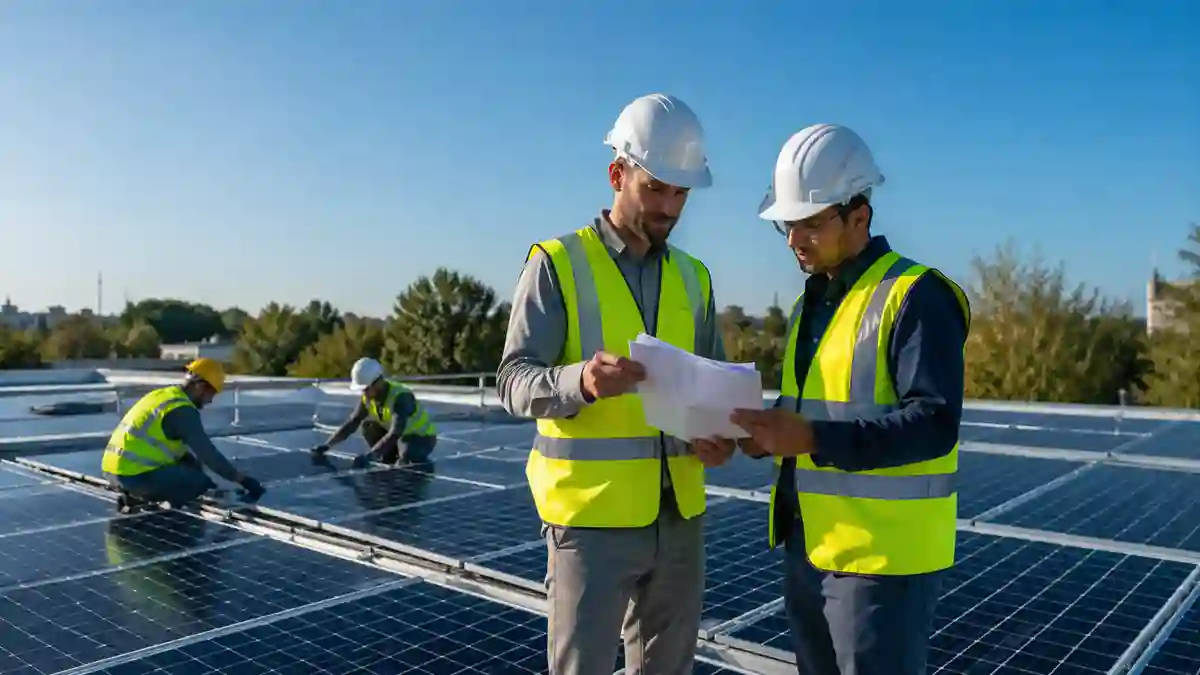
Evaluating commercial solar installers requires more than price comparisons. Learn the engineering standards for RFPs, structural reviews, and NABCEP credentials.
How do you evaluate a commercial solar installer?
To ensure a 25-year system life and safety compliance, look for these six essential engineering credentials:
- Commercial Electrical License: Verification of C-10 (or equivalent) for 480V 3-phase work.
- NABCEP PVIP Certification: The industry’s highest standard for installation professionals.
- PE-Stamped Engineering: Design oversight by a licensed Professional Engineer.
- Utility Interconnection History: A proven track record with IEEE 1547-2018 standards.
- Verifiable Commercial References: Past projects of similar scale (not residential).
- Specific Insurance Limits: Minimum $2M General Liability and $1M Professional Liability (E&O).
I have reviewed commercial solar quotes alongside building owners who had no idea they were looking at a proposal from a company with no licensed electrician on staff, no structural engineering capability, and a portfolio that consisted entirely of residential rooftops. The proposal looked professional. The price was competitive. The project would have been a disaster.
Finding the right commercial solar installer is the single most consequential decision in a commercial solar project. The equipment — panels, inverters, racking — is largely commoditized. The difference between a system that performs for 25 years and one that creates 25 years of problems is almost entirely about who installs it and how.
This guide covers what to look for, what to ask, and what the red flags actually look like in a commercial solar installer evaluation.
1. Why Commercial Solar Installers Are a Different Trade
Commercial solar installation requires a different skill set than residential. Not marginally different — fundamentally different. A residential installer who has never worked on a three-phase 480V system, never coordinated a utility interconnection application, and never had a structural engineer review their work is not a commercial solar installer. They are a residential installer who wants a larger contract.
The technical scope of commercial installation includes three-phase electrical system design and wiring, utility interconnection coordination under IEEE 1547-2018, structural load analysis coordination, National Electrical Code (NEC) Article 690 and 705 compliance, protection relay commissioning, and revenue-grade metering installation. Each of these requires specific training, licensing, and experience that does not automatically transfer from residential work.
2. The Six Credentials That Actually Matter
Licensed Electrical Contractor — Commercial Class
This is the minimum entry requirement. In most US states, commercial electrical work requires a C-10 electrical contractor license (or equivalent) with a qualifying managing employee who holds a journeyman or master electrician license with a commercial endorsement. Verify this directly with your state licensing board — do not accept a certificate copy without cross-referencing the license number.
Engineer’s Note: A residential C-10 license in many states does not authorize commercial work above certain voltage thresholds. Ask specifically whether their license covers 480V three-phase commercial installations.
NABCEP Certification
The North American Board of Certified Energy Practitioners (NABCEP) PV Installation Professional certification is the industry’s gold standard. NABCEP-certified installers have passed a rigorous examination covering PV system design, NEC compliance, and installation best practices. For commercial systems, look specifically for the NABCEP PV Installation Professional (PVIP) certification, not the entry-level Associate credential.
PE-Stamped Engineering Capability
Any commercial solar project above 25 kW will require PE-stamped drawings for the building permit and utility interconnection application. Ask whether they have a licensed Professional Engineer on staff or a specific subcontractor relationship with a PE. Projects where the PE is hired at the last minute to stamp drawings they did not actually review are a significant quality risk — and a personal liability for that engineer.
Utility Interconnection Experience
This is where most residential-to-commercial crossover installers fall short. Ask for a list of commercial utility interconnection applications they have completed — specifically the utility name, system size, and timeline. A commercial installer who cannot name at least five completed commercial interconnections in your utility territory is learning on your project.
Commercial References — Verifiable, Same Scale
References matter only if they are verifiable and comparable in scope to your project. A reference for a 15 kW office rooftop does not validate the capability for your 250 kW warehouse installation. Ask for references from commercial clients with systems within 50% of your proposed system size. Call them. Ask specifically about schedule adherence, punch list completion, and utility interconnection timeline.
Insurance — Minimum Thresholds for Commercial Work
| Insurance Type | Minimum Coverage (Commercial) | Why It Matters |
| General Liability | $2 million per occurrence / $4 million aggregate | Covers property damage during installation on your facility |
| Workers’ Compensation | State statutory minimum — verify active policy | Protects you from liability if a worker is injured on your roof |
| Professional Liability (E&O) | $1 million minimum | Covers design errors — critical for PE-stamped work |
| Completed Operations | $2 million minimum | Covers defects discovered after project completion |
Field Note: Request certificates of insurance directly from the insurer, not from the contractor. COIs can be forged. Call the insurer’s agent contact on the certificate and confirm the policy is active and the coverage limits are as stated.
3. RFP Process for Commercial Solar Installers: How to Structure Your Evaluation
A commercial solar installation procurement should follow a structured RFP (Request for Proposal) process — not an informal multi-quote comparison. The difference is that an RFP specifies exactly what you need so that proposals are comparable. Without a common specification, comparing three solar proposals is like comparing three car quotes where one includes a warranty and two do not.
A commercial solar RFP should include: site information (building drawings, utility bills for 12 months, structural reports if available), system requirements (minimum kW output, roof area constraints, aesthetic requirements), technical specifications (panel tier, inverter type, monitoring platform), contractual requirements (warranty terms, performance guarantees, commissioning protocol), and submission requirements (specific line-item pricing, not bundled totals).
Engineer’s Note: Require line-item pricing in your RFP. A bundled price of ‘$2.90/watt installed’ tells you nothing about where the installer is cutting costs. Line-item pricing shows you exactly what you are buying — and where to negotiate.
4. Red Flags When Evaluating Commercial Solar Installers’ Proposals
These are the patterns I have seen in proposals that preceded problem projects. Each one is worth pressing on during your evaluation:
- No structural engineering in the proposal scope: Any commercial rooftop proposal that does not include a structural analysis line item is either planning to skip it or passing the cost to you later. Neither is acceptable.
- Vague warranty language: “25-year panel warranty” means nothing without the manufacturer’s name, model number, and whether the warranty is for power output or product defect. Manufacturer product warranties are typically 10 to 12 years; performance warranties cover 25 years at a degradation rate. A contractor workmanship warranty of less than 5 years on commercial work is below industry standard.
- Permit-ready drawings listed as an add-on: PE-stamped, permit-ready drawings are not optional on commercial work. If they appear as a line item you can decline, that is a project that was designed to pass initial price comparison, not to actually be built.
- Utility interconnection listed as ‘customer responsibility’: Some installers pass utility coordination to the building owner. This is not inherently wrong, but it should be explicit, and you need to understand exactly what that means for your timeline and what support they will provide.
- References that cannot be verified: If a reference contact number goes to voicemail and is never returned, or if the reference is a company the contractor has a financial relationship with, treat it as a non-reference.
5. What a Strong Commercial Solar Installers Proposal Looks Like
After reviewing dozens of commercial proposals over the years, the ones from genuinely capable installers share a common structure. They include a site-specific production estimate (not a generic calculator output), line-item pricing with equipment model numbers, a clear project timeline with interconnection milestones identified, specific commissioning protocols including protection relay testing, a reference list with real contact names and numbers, and PE involvement specified by name and license number.
The proposal document itself is a signal. A commercial solar installer who treats every project as an engineering project produces proposals that look like engineering documents. A residential installer who wants a bigger contract produces a brochure with a price at the bottom.
6. Connecting Installation Quality to Long-Term Performance
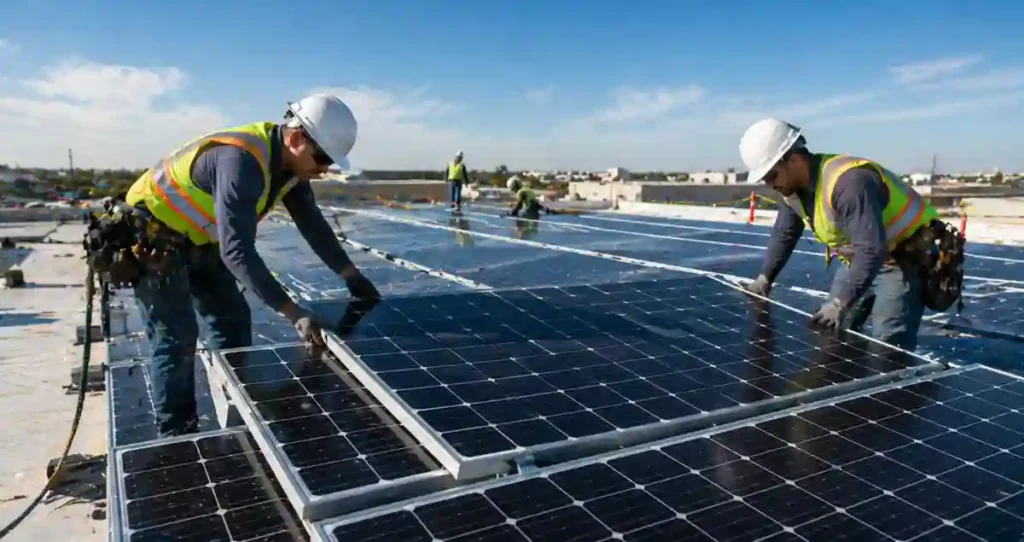
Installation quality has a direct and measurable impact on 25-year solar power system performance. The variables that matter most — and that vary significantly between skilled and unskilled commercial installers — are DC string wiring quality (resistance in undersized conductors compounds into thousands of lost kilowatt-hours over system life), grounding system integrity (inadequate grounding creates fault current paths that degrade equipment and create safety hazards), torque verification on electrical connections (loose connections become hot connections; hot connections become arc faults), and conduit sealing and weatherproofing (moisture ingress into conduit runs is a slow-moving disaster that shows up years after installation).
None of these are visible in the completed installation without a commissioning inspection. This is why the commissioning protocol — thermal imaging, insulation resistance testing, protection relay verification — should be in the contract before you sign, not negotiated after installation is complete.
For more on what a proper commercial installation looks like from a structural and electrical engineering standpoint, see the full Commercial Solar Panel Installation Engineering Guide on SolarVisionAI. For ongoing performance protection after installation, the Commercial Solar Maintenance guide covers the O&M framework that keeps well-installed systems performing for their full service life.