
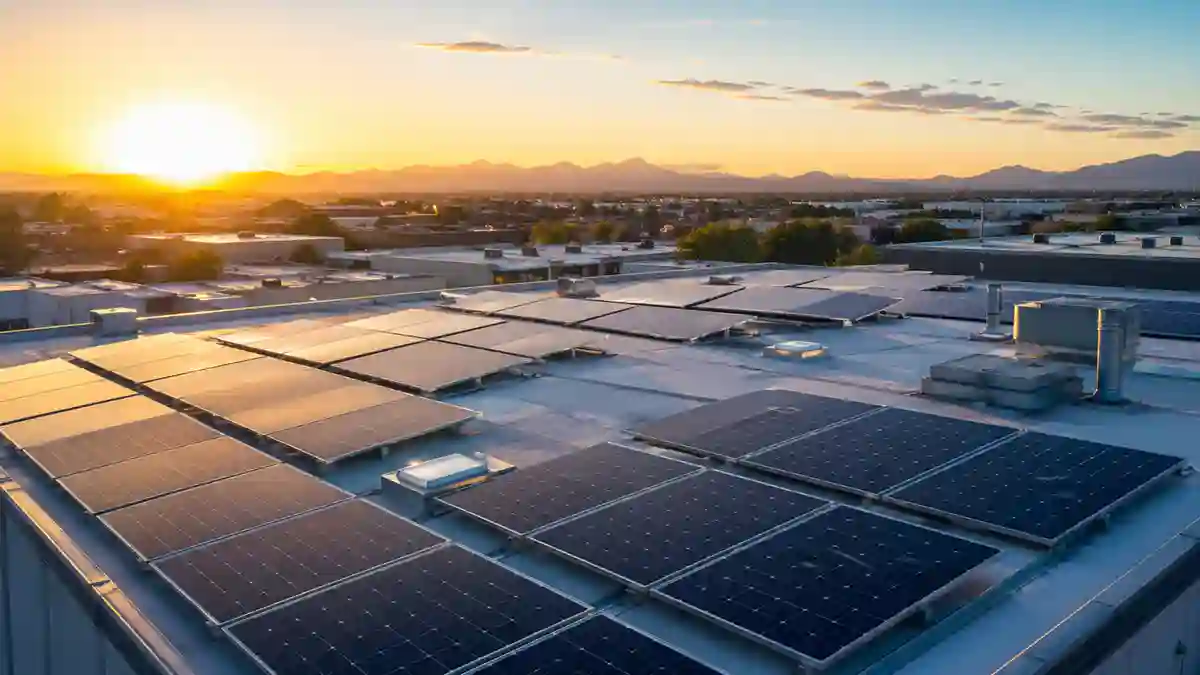
What does commercial solar panel installation cost in 2026? A licensed engineer’s breakdown: $/watt by system size, hidden change orders, C-PACE financing, ITC + MACRS, and real ROI data.
The question is always the same: ‘What’s this going to cost?’ And the honest answer — the one that comes from actually reviewing commercial solar project financials rather than marketing collateral — is that it depends on four things that most commercial solar cost guides never address properly.
It depends on your system size (economies of scale are real and significant). It depends on your building’s existing electrical infrastructure (a 1960s main switchgear that needs modifications adds real cost). It depends on your utility territory (interconnection fees vary from $500 to $25,000 before you’ve spent a dollar on equipment). And it depends on whether your roof can support the system as-designed or needs structural remediation first.
This guide gives you the actual cost data — by system size, by cost category, and including the line items that frequently disappear from installer proposals until they reappear as change orders. It also covers the incentive stack available to commercial solar buyers in 2026, which changes the effective cost picture substantially.
1. Commercial Solar Cost: The $/Watt Reality in 2026
| System Size | Typical Cost Range ($/W) | Gross System Cost | After 30% Federal ITC | Notes |
| 25–50 kW | $2.80–$3.80/W | $70,000–$190,000 | $49,000–$133,000 | Small commercial; limited economies of scale; often string inverters |
| 50–200 kW | $2.40–$3.20/W | $120,000–$640,000 | $84,000–$448,000 | Most common commercial rooftop; good cost efficiency; central or string inverter |
| 200–500 kW | $2.00–$2.70/W | $400,000–$1,350,000 | $280,000–$945,000 | Procurement leverage begins; the central inverter is typically specified |
| 500 kW–2 MW | $1.70–$2.30/W | $850,000–$4,600,000 | $595,000–$3,220,000 | Utility-scale pricing; P&C study likely required; project finance often needed |
| 2 MW+ | $1.40–$1.90/W | $2.8M+ | $1.96M+ | EPC contractor model; full interconnection study; developer overhead structure |
These ranges represent all-in installed cost — equipment, labor, engineering, permitting, and commissioning — but they do not include the additional commercial-specific line items covered below. Always get line-item pricing, not a single $/watt figure.
2. Commercial Solar Cost Anatomy: Where the Money Goes
| Cost Category | % of Total Project Cost | What Drives Variation |
| Solar modules | 20–28% | Panel tier (Tier 1 vs. budget); efficiency; volume pricing leverage |
| Inverters | 8–14% | Type (central vs. string vs. micro); monitoring capability; redundancy spec |
| Racking and mounting | 6–12% | Roof type; ballasted vs. penetrating; tilt angle; ground vs. rooftop |
| Electrical BOS (DC + AC wiring) | 10–16% | Conduit run lengths; switchgear modifications; transformer if required |
| Labor | 18–28% | Local market wages; roof access complexity; crew size and experience |
| Engineering and design | 3–6% | PE-stamped drawings; structural analysis; P&C study if required |
| Permits and interconnection fees | 2–5% | Jurisdiction; utility application fees; P&C study cost |
| Commissioning and testing | 1–3% | System size; monitoring platform; IR testing; protection relay verification |
| Developer overhead and margin | 10–18% | Company overhead structure; project risk pricing; market competition |
Engineer’s Note: The electrical BOS category is where most commercial proposals underestimate costs. Conduit runs from the roof to the electrical room can span 200 to 500 linear feet on large commercial buildings. Switchgear modifications — adding a disconnect, metering section, or bus extension — can add $5,000 to $35,000, depending on equipment age and configuration. Get these as line items, not absorbed into a labor total.
3. Commercial-Specific Cost Items That Disappear From Proposals
These legitimate project costs frequently appear as change orders rather than line items in initial commercial solar proposals. Knowing they exist — and their typical cost range — protects you.
| Line Item | Typical Cost Range | When It’s Required |
| Structural engineering report | $1,500–$6,000 | Every commercial rooftop installation — no exceptions |
| Roof membrane repair or replacement | $8,000–$80,000 | When membrane is within 5 years of end of life (avoid reroofing under an array) |
| Main switchgear modifications | $5,000–$35,000 | When existing equipment cannot accommodate solar POI as-designed |
| Utility P&C study | $8,000–$25,000 | Systems above 500 kW in most utility territories |
| Revenue-grade production meter | $1,500–$4,500 installed | PPA projects; SREC programs; independent performance verification |
| SCADA/monitoring platform (enterprise) | $3,000–$15,000 initial; $1,500–$6,000/yr | Systems above 200 kW; PPA compliance; multi-site portfolio management |
| Step-up transformer (480V to utility MV) | $8,000–$28,000 | When a utility requires a medium-voltage interconnection |
| Battery Energy Storage System (if demand charge reduction is a goal) | $700–$1,100/kWh installed | When facility peak demand occurs outside peak solar production hours |
Field Note: The roof membrane item is the one that blindsides building owners most often. I have seen commercial solar installations where the membrane was 18 years old at the time of install — and needed replacement 4 years later. Removing and reinstalling a 200 kW rooftop array for a reroof costs $15,000 to $50,000 in labor and carries the risk of equipment damage. A pre-installation roof condition assessment by a licensed roofing consultant ($800 to $2,000) is among the best dollars spent on a commercial solar project.
4. The 2026 Commercial Solar Incentive Stack
| Incentive | Value in 2026 | Who Qualifies | Key Condition |
| Federal ITC (Investment Tax Credit) | 30% of the installed cost | Any US business with a federal tax liability | The system is operational in the tax year claimed |
| Bonus Depreciation (MACRS) | 60% first-year bonus + 5-year MACRS on remainder | Any US business with a tax liability | Solar = 5-year MACRS property; bonus phase-down continuing |
| USDA REAP Grant | Up to 50% of the project cost | Rural small businesses and agricultural producers | Competitive; application required; funding limited |
| State commercial incentives | Varies — $0 to $100K+ | Varies by state | Check the DSIRE database for current state programs |
| Utility rebates | $0.05–$0.50/W installed | Varies by utility; many programs have annual caps | Apply early; many programs are first-come-first-served |
| C-PACE financing | 100% project financing; property-assessed repayment | Commercial property owners in C-PACE-enabled states | 29 states + DC as of 2026; no personal guarantee required |
The ITC and MACRS combination deserves emphasis. In 2026, the 30% ITC reduces your tax liability dollar-for-dollar in the year the system is placed in service. The 60% bonus depreciation (phase-down continues — was 80% in 2023, 60% in 2026) allows you to deduct 60% of the depreciable basis in Year 1, with the remaining 40% depreciated over the standard 5-year MACRS schedule.
For a profitable US corporation with a 21% federal tax rate, the effective first-year tax benefit on a $500,000 commercial solar project works out approximately as follows: $150,000 from the ITC plus roughly $56,000 from the Year 1 depreciation tax shield equals approximately $206,000 in combined Year 1 federal tax benefit. That is 41% of the gross installed cost recovered in the first year, before a single month of electricity savings is counted.
Engineer’s Note: C-PACE financing is significantly underutilized in commercial solar. It provides 100% project financing at rates typically 200 to 400 basis points below conventional commercial loans, repaid through the property tax assessment over 10 to 30 years. There is no personal guarantee. The loan transfers with the property at sale. For building owners who do not want to deploy capital — or whose lending relationship precludes additional debt — C-PACE often delivers better IRR than any other financing structure. Check the PACE Nation database for active programs in your state.
5. Commercial Solar ROI: What the Numbers Actually Look Like
| Scenario | State | System Size | Gross Cost | After ITC + Depreciation (Year 1) | Annual Savings | Simple Payback | IRR (25-yr) |
| High-rate market, good NEM | CA / MA / NY / NJ | 200 kW | $560,000 | ~$350,000 net effective cost | $65,000–$85,000/yr | 4–6 years | 18–25% |
| Mid-rate market, standard NEM | TX / CO / IL / GA | 150 kW | $390,000 | ~$244,000 net effective cost | $35,000–$50,000/yr | 5–8 years | 12–18% |
| Lower-rate market, limited NEM | KY / WV / ND / ID | 100 kW | $260,000 | ~$163,000 net effective cost | $18,000–$28,000/yr | 7–12 years | 8–14% |
| Manufacturing + battery (demand reduction) | Any market | 300 kW + 500 kWh battery | $1,100,000 | ~$688,000 net effective cost | $130,000–$175,000/yr | 4–7 years | 15–22% |
These scenarios use conservative electricity escalation assumptions (2.5% annual rate increase) and do not include USDA REAP or state incentives where applicable. In rural markets qualifying for REAP, payback periods can compress by 2 to 3 years.
For the engineering requirements that determine whether a commercial solar system actually performs at its modeled output — structural analysis, three-phase electrical design, protection relay commissioning — see the full Commercial Solar Panel Installation Engineering Guide. For ongoing performance protection after installation, the Commercial Solar Maintenance guide covers the O&M framework that keeps systems performing at their modeled yield.
Frequently Asked Questions (FAQs)
What is the average commercial solar panel installation cost in 2026?
The average cost ranges from $1.40 to $3.80 per watt (DC). Small systems (under 50 kW) sit at the higher end of the scale, while utility-scale projects (2 MW+) leverage procurement volume to drop below $1.50/W.
What factors affect commercial solar installation cost the most?
Costs are primarily driven by economies of scale and Point of Interconnection (POI) requirements. Beyond hardware, the most significant variables are structural remediation of the roof, the distance of conduit runs, and utility-mandated protection and control (P&C) studies.
How much does a 100 kW commercial solar system cost?
A 100 kW system typically costs between $240,000 and $320,000 gross. After the 30% Federal ITC and Year-1 Bonus Depreciation, the net effective cost often drops by 40-45%, depending on your corporate tax bracket.
Are there hidden costs in commercial solar projects?
Yes. In my experience, the “missing” line items are usually Main Switchgear (MSB) modifications, structural PE-stamped reports, and Revenue-Grade Metering required for SREC or PPA tracking. These can add $10,000 to $40,000 to a project if not identified during the audit.
How long is the payback period for a commercial system?
Most systems achieve simple payback in 4 to 7 years. When using C-PACE financing or USDA REAP grants, the “cash-flow positive” date can often be moved to Year 1, as the tax benefits and energy savings exceed the annual debt service.
Does system size affect the installation cost?
Significantly. A 500 kW system is roughly 20–30% cheaper per watt than a 50 kW system. This is due to fixed costs (permitting, engineering, and mobilization) being spread over a larger DC capacity.
Is battery storage (BESS) necessary for commercial systems?
It is functionally necessary if your utility has high Demand Charges. In many commercial tariffs, up to 50% of the bill is based on your highest 15-minute peak. A BESS allows for “Peak Shaving,” which significantly improves ROI in high-demand industrial facilities.
How accurate are initial commercial solar cost estimates?
A “desktop estimate” is usually ±20% accurate. To get a Firm Fixed Price (FFP), you must have an engineer perform a site walk to verify the busbar capacity of your switchgear and the remaining useful life of your roof membrane.
1 thought on “Commercial Solar Panel Installation Cost: 2026 Complete Breakdown by System Size”