
Learn how net metering works in the USA with real examples, billing breakdowns, and AI optimization strategies that can boost solar savings by 20–40%.
Net metering is the billing policy that makes rooftop solar financially viable for most homeowners and commercial building operators in the United States. It is the reason a 10 kW solar system can eliminate a $400 monthly electricity bill, why solar installers quote payback periods of 5 to 8 years, and why 34 states have mandated it for their utilities.
It is also one of the most misunderstood topics in the solar industry — described in marketing materials as if it were a simple energy-for-money exchange, when the reality involves time-varying rates, state-specific billing rules, excess credit policies, and increasingly, AI-driven optimization that increases net metering credit value by 20 to 40 percent compared to an unmanaged system.
I have designed and commissioned on-grid solar systems for residential homeowners, commercial building operators, and industrial facilities. In every case, the client’s financial outcome depended not just on the hardware but on how their utility’s net metering tariff was structured, how the system was sized against it, and how the energy management software was configured to optimize exports. This guide covers all of it.
What is Net Metering?
Net metering is a utility billing arrangement that allows solar energy system owners to receive credit for excess electricity they generate and export to the grid. Your utility measures the difference between the electricity you consume from the grid and the electricity your solar system exports over a billing period. You are billed — or credited — only for the net difference, at the retail electricity rate.
The word ‘net’ is the key. Rather than paying retail for every kWh consumed and receiving a lower avoided-cost rate for every kWh exported, net metering combines both flows into a single net figure at the retail rate. The financial significance of this 1:1 offset is enormous — see the Net Metering vs Net Billing guide for the full comparison.
| Engineer’s Note: Net metering is a billing policy, not a technology. The physical mechanism that enables it — the bidirectional meter that registers both import and export — is called reverse metering. Net metering is what the utility does with that bidirectional data: it credits your exports against imports at the retail rate. These are distinct concepts that are often conflated. See the Reverse Metering Guide on SolarVisionAI for the detailed technical explanation of the metering hardware and the AI monitoring layer built on top of it. |
How Does Net Metering Work? — The Technical Mechanism
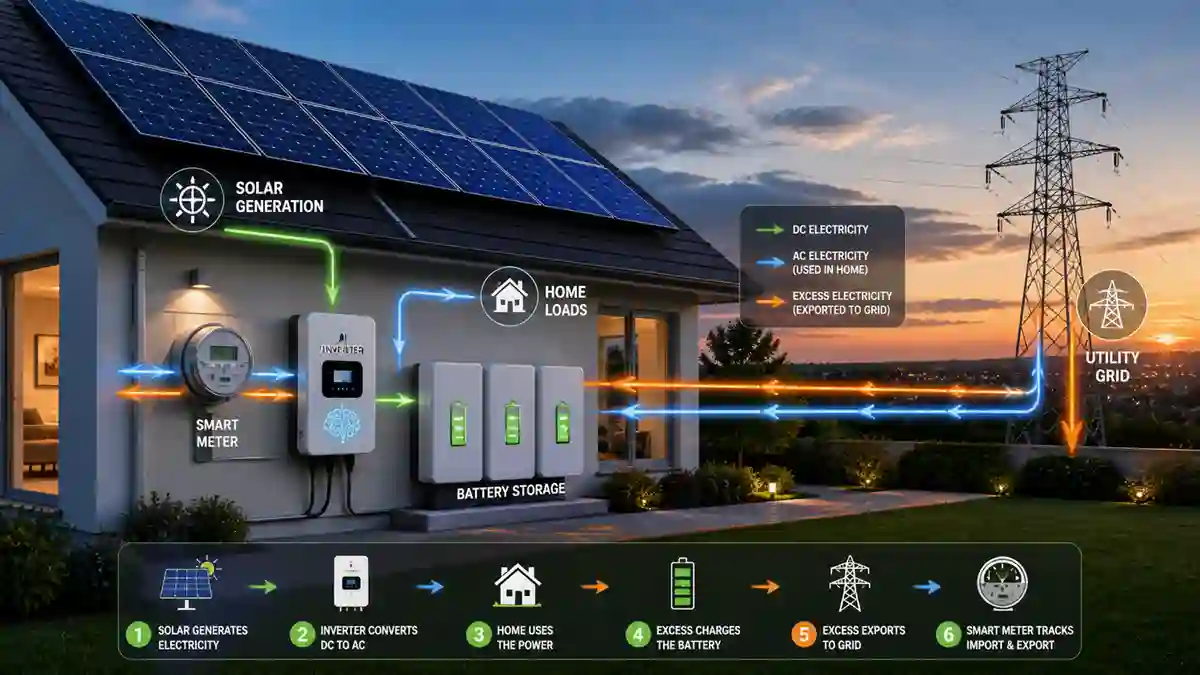
A grid-tied solar system operates in parallel with the utility grid. Your solar inverter converts the DC electricity from the panels into AC electricity synchronized with the grid’s voltage and frequency. This AC output powers your building’s loads first. Any surplus flows backward through the service entrance and onto the utility’s distribution feeder. Your bidirectional meter registers this reverse flow as export.
During periods when your solar system produces less than your building demands — at night, on cloudy days, during consumption peaks — the grid supplies the difference as normal import.
At billing, your utility calculates: (Total kWh imported) minus (Total kWh exported) = Net consumption. You pay — or receive credit — for this net figure only. If net consumption is negative (more exported than consumed), most programs carry the credit forward to the next billing period.
Net Energy Metering (NEM) — The Regulatory Term
Net Energy Metering (NEM) and net metering describe the same billing arrangement — NEM is the formal term used in CPUC rulings and utility tariff documents. NEM 1.0, NEM 2.0, and NEM 3.0 refer to successive versions of California’s net energy metering tariff, each with different export credit rates and program requirements. In other states, the same concept appears under different names: Value of Distributed Generation (New York VDER), Distributed Generation Interconnection, or simply Net Metering.
Solar Net Metering — How Generation Timing Affects Your Credits
Solar generation varies by season, time of day, weather, and system orientation. A 10 kW solar system in the US produces between 1,200 and 1,800 kWh per month, depending on these factors. Summer months generate surpluses that build credit balances; winter months draw on those credits. This seasonal pattern is why most net metering programs use an annual billing cycle for excess credits — the summer surplus offsets the winter deficit.
| Field Note: System sizing relative to your annual consumption is the most important design decision in a net metered solar installation. A system sized at 90–100% of annual consumption optimizes the credit cycle. Oversizing beyond 120% of annual consumption increases upfront cost without proportional financial benefit in most programs — excess annual credits often roll over at a reduced rate. I size every client’s system to 90–100% of annual consumption unless there is a specific reason to design larger, such as a planned EV addition or building expansion. |
The Billing Mechanics — A Complete 12-Month Worked Example
Complete annual example: 10 kW residential system, mid-Atlantic US, annual consumption 14,400 kWh, annual solar generation 13,800 kWh, retail rate $0.28/kWh.
| Month | Gen (kWh) | Use (kWh) | Net | Bill / Credit | Cr. Balance | Notes |
| Jan | 680 | 1,350 | −670 import | $187.60 bill | $0 | Winter deficit |
| Feb | 820 | 1,200 | −380 import | $106.40 bill | $0 | Winter deficit |
| Mar | 1,100 | 1,100 | 0 break-even | $0 | $0 | Break-even month |
| Apr | 1,280 | 1,000 | +280 export | $0 | $78.40 credit | Credit building |
| May | 1,490 | 1,050 | +440 export | $0 | $201.60 credit | Credit building |
| Jun | 1,520 | 1,400 | +120 export | $0 | $235.20 credit | Summer peak gen |
| Jul | 1,480 | 1,600 | −120 import | $0 (offset) | $201.60 credit | Credit offsets |
| Aug | 1,400 | 1,550 | −150 import | $0 (offset) | $159.60 credit | Credit offsets |
| Sep | 1,200 | 1,200 | 0 break-even | $0 | $159.60 credit | Break-even |
| Oct | 1,000 | 1,100 | −100 import | $0 (offset) | $131.60 credit | Credit offsets |
| Nov | 720 | 1,100 | −380 import | $0 (offset) | $25.00 credit | Credit running low |
| Dec | 610 | 1,350 | −740 import | $182.20 bill | $0 | Credit exhausted |
| TOTAL | 13,800 | 14,400 | −600 net | ~$476/yr bill | — | ~$3,556 saved/yr |
Pre-solar annual bill: $4,032. Post-solar annual bill: ~$476. Annual saving: ~$3,556. Simple payback at $28,000 installed (after 30% ITC = $19,600): 5.5 years.
| Engineer’s Note: This example uses a flat rate of $0.28/kWh for simplicity. Most utilities now use time-of-use (TOU) rates, where electricity costs more during on-peak hours (typically 4–9 pm weekdays) and less during off-peak hours. Under TOU rates without an AI-managed battery, your solar system may earn export credits at the lower off-peak rate. In comparison, you pay the higher on-peak rate for evening consumption, reducing net metering value. AI energy management systems address this by scheduling battery discharge to cover on-peak consumption and timing battery export to the highest-credit-rate windows. |
AI-Optimized Net Metering — How Smart Systems Maximize Credits
The traditional net metering model is passive: the solar panel generates, the meter measures, the utility bills the difference. The financial outcome is fixed by system size, local generation potential, and the utility’s rate structure.
AI-optimized net metering is active: a machine learning energy management system monitors generation, consumption, battery state of charge, weather forecasts, and real-time TOU rates — then makes continuous decisions about when to self-consume, when to store, and when to export — to maximize the financial value of every kilowatt-hour.
- Export timing optimization: Under TOU net metering rates, exporting during peak rate periods (typically evening) earns 2–3× more credit than exporting during off-peak periods (typically midday). AI platforms shift solar export from low-rate periods to high-rate periods via battery storage, increasing annual credit value by 20–40%.
- Self-consumption maximization: AI predicts your building’s consumption pattern and solar generation forecast, then coordinates battery charge-discharge to ensure solar covers on-peak consumption rather than drawing grid power at on-peak rates.
- Demand charge reduction (commercial): AI monitors 15-minute peak demand intervals that determine demand charges ($15–25/kW/month) and discharges the battery during demand peaks — adding ROI that is independent of net metering credit rates.
- Fault detection and credit protection: AI monitoring platforms detect generation shortfalls from module degradation, shading, soiling, or inverter faults within hours rather than weeks — protecting the credit stream your net metering system is designed to generate.
| AI Insight: The financial premium from AI optimization is most significant under time-varying rate structures. In California under NEM 3.0, AI-managed systems demonstrate export credit values of $0.17–0.22/kWh compared to $0.07–0.09/kWh for unmanaged systems — a 2–3× improvement on the same exported energy. In states with flat-rate retail net metering, the AI optimization premium is smaller but still positive through demand charge reduction and improved self-consumption timing. The full AI optimization guide — including platform comparisons, configuration recommendations, and ROI analysis by state rate structure — is available in the AI Solar Optimization Guide on SolarVisionAI. |
Net Metering vs Net Billing — A Critical Distinction
| Net Metering | Net Billing |
| Exports credited at full retail rate (~$0.28–0.36/kWh) | Exports credited at avoided cost rate (~$0.05–0.10/kWh) |
| Simple 1:1 offset — 1 exported kWh saves 1 imported kWh at retail | Asymmetric — you pay retail for imports, earn avoided cost for exports |
| AI optimization adds value through TOU timing and demand reduction | AI optimization is essential — without it, net billing ROI is marginal |
| Standard in 34 US states (mandatory programs, 2026) | California NEM 3.0, Hawaii, and some utility territories |
| Policy trend: under utility pressure | Policy trend: growing across states under commission review |
For the full financial comparison and AI response strategies, see the Net Metering vs Net Billing Guide on SolarVisionAI.
Net Metering with Battery Storage
Adding battery storage changes the optimization strategy from passive to active. Without a battery, your export timing is determined by the sun — peaks midday when retail electricity rates are often lowest under TOU pricing. With a battery and AI management, you capture midday surplus, store it, and deploy it when it has maximum value: covering evening on-peak consumption or exporting during high-rate evening windows under NEM 3.0.
For the complete engineering guide to battery storage sizing, chemistry selection, and AI charge-discharge optimization in a net metered system, see the BESS Battery Energy Storage System Guide on SolarVisionAI.
Frequently Asked Questions
What is net metering in simple terms?
Net metering lets you bank surplus solar electricity with your utility and draw on it later. When your solar system produces more than you use, the excess goes to the grid and earns credits. When you consume more than you produce, you draw from the grid and use your credits. You pay only for the net difference.
Does net metering work with battery storage?
Yes, and battery storage combined with AI energy management significantly improves net metering economics — particularly under TOU rates and California NEM 3.0. AI-managed batteries shift solar export from low-rate midday windows to high-rate evening windows, increasing annual credit value by 20–40% compared to unmanaged systems.
What states have net metering?
34 US states have mandatory net metering as of 2026, including Florida, New York, New Jersey, Massachusetts, Colorado, Virginia, Illinois, and Maryland. California has NEM 3.0 (avoided-cost export rates, not full retail). Hawaii has moved away from retail-rate net metering. Texas has no statewide mandate — availability depends on your retail electricity provider.
How much can I save with net metering?
A properly sized 10 kW residential system in a state with retail-rate net metering at $0.28/kWh typically saves $2,800–$4,000 per year, with a 5–8 year simple payback after the 30% ITC. AI optimization adds 10–25% to annual savings in states with TOU rate structures.
Is net metering going away?
Not immediately, but retail-rate net metering is under pressure in multiple states. California’s NEM 3.0 (2023) is the most significant recent change. Net metering reviews are active in Virginia, Georgia, South Carolina, and Louisiana as of 2026. Existing customers typically receive 20-year grandfathering when programs change.