
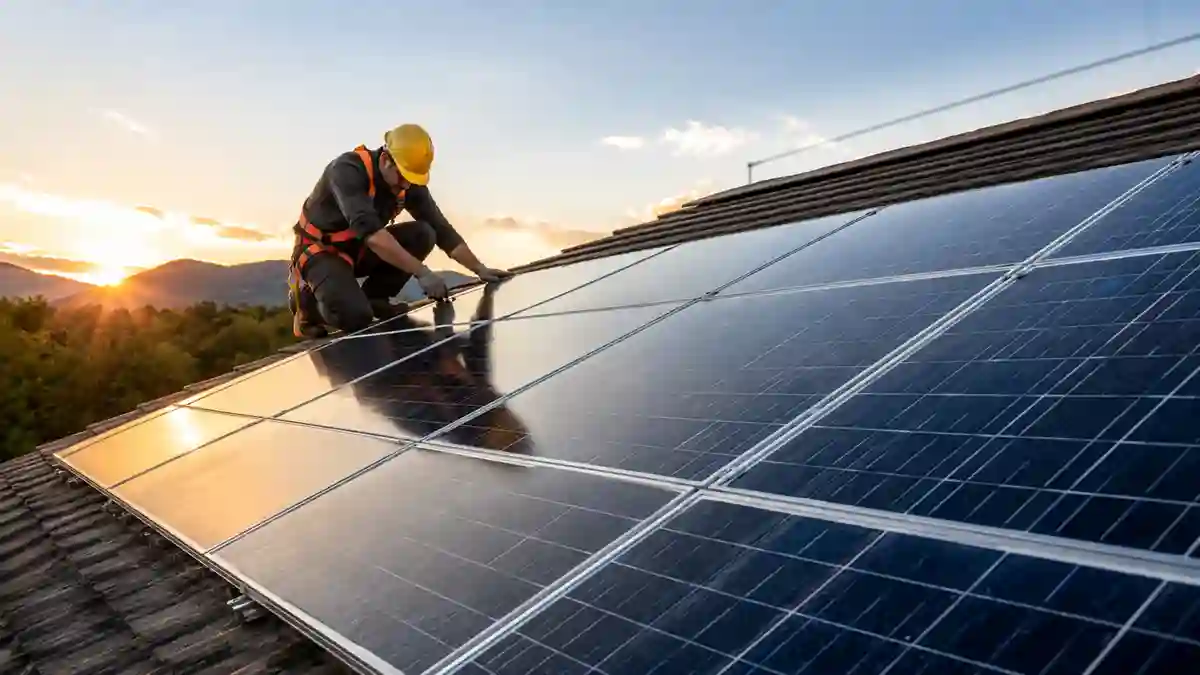
Engineering guide: When is the Best Time to Install Solar Panels? — temperature effects, net metering windows, contractor quality & ITC deadlines explained. Written by a Registered PE.
The honest engineering answer to one of solar’s most searched questions, when is the best time to install solar panels, covering temperature effects, seasonal sun angles, net metering timing windows, contractor availability, and the months that give you the best installation outcome. Written by a Registered Professional Engineer who has commissioned solar power systems across multiple US climate zones.
Every week, someone asks me a version of the same question: when should I actually pull the trigger on solar? Not when should I sign a contract — when should the solar panels actually be installed on my roof?
It is a better question than most people realize. The timing of a solar installation affects more than your calendar. It affects system performance during commissioning, contractor workmanship quality, net metering credit accumulation, and how quickly you reach Permission to Operate. I have seen homeowners make excellent installations go wrong simply by choosing the wrong season for the wrong reasons.
The short answer is that late summer through early winter — specifically August through November — is the optimal window for most US homeowners. But that answer deserves the engineering reasoning behind it, because the right month for your installation depends on your climate zone, your utility’s net metering policy, and how your local contractor market behaves seasonally. Here is the full picture.
1. Weather and Temperature Effects on the Installation Itself
Most people conflate two separate questions: what are the weather conditions during installation, and what are the conditions during operation? These have very different engineering implications.
Temperature and Electrical Commissioning
Solar panels are rated at Standard Test Conditions — 25°C cell temperature, 1,000 W/m² irradiance. In the field, cell temperatures on a summer roof routinely exceed 60°C, which means the open-circuit voltage (Voc) reads lower than the STC-rated value during commissioning. This is expected and correct — not a fault. Cold-weather commissioning is the opposite problem: Voc readings peak at low temperatures, and a 10-panel string that measures 420V in August can reach 480V on a January morning. NEC 690.7 maximum voltage calculations must account for this. String designs that do not include a temperature-corrected Voc calculation for the record low temperature at your location are non-compliant by design.
Engineer’s Note: A Minnesota installer I work with remotely submitted a string design last winter without a temperature-corrected VOC calculation. At that location’s record low of −18°C, the uncorrected design put the string at 503V — above the inverter’s 500V maximum. Caught at the design stage, before procurement. The formula is simple: Voc_max = Voc_STC × [1 + (temp_coefficient × (Tmin − 25°C))]. It must be run for your specific location. Ask your installer to show this calculation before installation begins.
Roof Conditions by Season
| Season | Roof Conditions | Installation Risk | Quality Concern |
| Summer (Jun–Aug) | Dark roofing surface reaches 140°F+ | Heat fatigue risk for crew; rushed morning-heavy schedules | Torque values and sealant application are compromised by heat |
| Fall (Sep–Nov) | Cool, dry, stable temperatures | Ideal — comfortable pace, attentive workmanship | Lowest quality risk of any season |
| Winter (Dec–Feb) | Cold; potential ice in northern states | Icy pitched roofs create fall hazard | Sealant cure failure below 40°F is the primary technical risk |
| Spring (Mar–May) | Mild but rainy in most US regions | Wet roof delays common; unpredictable scheduling | Open roof penetrations during rain create interior water risk |
The winter quality concern is specific: butyl tape, standard silicone, and EPDM-backed flashings all have minimum application temperatures — typically 40°F. Below that threshold, sealants do not cure properly and adhesive-backed products lose bond strength. A lag bolt hole sealed with poorly cured silicone in January becomes a slow leak in April. Quality installers either wait for appropriate temperatures or specify cold-weather-rated sealants and document cure-time protocols in writing.
Field Note: An installer I collaborate with sent me photos of a Pennsylvania job completed the previous January by another contractor. Standard silicone applied at 28°F. Fourteen months later — moisture staining on the attic insulation below three of the six mounting feet. When I reviewed the original documentation remotely, there was no cold-weather sealant spec and no surface temperature requirement in the contract. Repair: $1,800. Entirely preventable with one contract clause.
2. Seasonal Sun Angle and Panel Performance
There is a persistent misconception that installing solar in summer is better because there is more sunlight. This conflates installation timing with operational performance — and they are entirely separate.
Your system’s annual energy production is determined by the full-year irradiance profile at your specific location, not the season in which the system was commissioned. A system installed in November and one installed in April on the same roof will produce identical annual energy over 25 years, assuming both are correctly commissioned. What the sun angle affects is how the commissioning verification is interpreted — and this is easier to assess in shoulder seasons when irradiance is moderate and consistent.
| Season | Solar Noon Altitude (40°N lat.) | Irradiance Quality | Implication for Commissioning |
| Summer solstice (Jun 21) | 73.5° above the horizon | High intensity, shorter string shadows | High irradiance — performance is easy to verify, but crew heat risk |
| Fall equinox (Sep 22) | 50° above the horizon | Near-optimal for south-facing panels at 30–40° tilt | Best commissioning conditions for most US installations |
| Winter solstice (Dec 21) | 26.5° above the horizon | Low intensity, longer inter-row shadows | Low irradiance — harder to verify against modeled output |
| Spring equinox (Mar 20) | 50° above the horizon | Mirror of fall equinox — optimal irradiance angle | Good conditions but contractor backlog peaks in spring |
Engineer’s Note: I review PVWatts simulation reports for US installations commissioned across every month of the year. Annual production figures are identical for the same location and system design regardless of commissioning month. The “install in summer” narrative is a sales point, not an engineering one. Fixed-tilt at your latitude captures maximum annual yield — and the optimal sun angle for that tilt occurs in fall and spring, not summer.
3. Net Metering Timing: The Most Financially Consequential Factor
This is the timing factor most homeowners never hear about from a salesperson — because understanding it requires knowing your utility’s specific net metering policy, and most sales processes skip that analysis.
Net metering credits accumulate when your system exports surplus energy to the grid. Most US utilities allow credits to roll over month to month. The question is what happens at your annual true-up date — when the utility reconciles your credit balance. Most utilities compensate unused annual credits at avoided cost rates (typically $0.03 to $0.06/kWh) rather than retail rates ($0.10 to $0.22/kWh). Every unused credit past your true-up date is worth significantly less than a credit you consume yourself.
The True-Up Window Strategy
The optimal installation timing for net metering economics is approximately 3 to 4 months before your highest-consumption period. This allows your system to build a credit bank during low-consumption spring or fall months before your peak demand season begins.
- Cooling-dominant climates (AZ, TX, FL, CA southern): Install January to March. Generate credits in spring before summer cooling loads peak.
- Heating-dominant climates (MN, WI, ME, CO, northern states): Install August to October. Build credits in the fall before winter heating loads peak.
- Mixed climates (Mid-Atlantic, Midwest, Southeast): September to November is the general sweet spot — peak summer loads are behind you, and you enter winter with credits accumulating.
When Net Metering Policy Is Changing — This Overrides Everything
California’s shift from NEM 2.0 to NEM 3.0 in April 2023 reduced solar export compensation from near-retail rates to avoided-cost rates averaging $0.05/kWh. Homeowners who missed the grandfather deadline saw projected payback periods extend by 3 to 5 years on identical systems. The lifetime financial difference for a typical 8 kW system was $15,000 to $40,000.
Multiple states currently have active net metering reform proceedings. Nevada, Hawaii, and several New England states have amended or are amending their net metering structures. If your utility or state PUC has an announced policy change with a specific effective date, that date becomes your installation deadline — not a seasonal optimization. Check DSIRE (dsireusa.org) for current policy status in your state before letting seasonality drive your timeline.
Engineer’s Note: When I review US solar proposals remotely, the net metering compensation rate is the first number I verify — before system size, before equipment. I have seen post-NEM 3.0 California proposals still using pre-NEM 3.0 export rates in the ROI model. The numbers looked excellent. The actual returns were not. That error does not require being on-site to catch — it requires reading the current utility tariff schedule, which is publicly available. Check DSIRE (dsireusa.org) before signing anything.
4. Contractor Availability, Lead Times, and Crew Quality
The US solar installation industry follows a pronounced seasonal demand curve. Understanding it helps you secure better pricing, shorter timelines, and better crew quality — three things that are simultaneously maximized in the same season.
| Month | Demand Level | Typical Backlog | Pricing Pressure | Core Crew Availability |
| January–February | Low | 1–3 weeks | Lowest — modest off-season discounts possible | High — experienced crews fully available |
| March–April | Rising | 3–6 weeks | Moderate — spring rush building | Medium — backlog starting to stretch crews |
| May–June | Peak | 6–12 weeks | Highest of the year | Lower — seasonal labor deployed alongside core crew |
| July–August | High | 4–10 weeks | High | Medium-low — heat fatigue + volume strain |
| September–October | Moderate | 2–5 weeks | Moderate — shoulder season pricing | High — experienced crews at manageable workloads |
| November–December | Declining | 1–3 weeks | Lower — year-end deals sometimes available | High — focused core crew, deliberate pace |
The crew quality column is the one most people do not factor into their seasonal decision. Residential solar installation requires skilled technicians — roof penetrations, electrical terminations, and system commissioning are not tasks that benefit from rushed execution. During peak season, installation companies deploy seasonal labor hired and trained rapidly to manage backlog volume. The crew on your roof in June may have three months of experience. The crew in October may have three years.
I am not suggesting peak-season installations are uniformly poor. I am saying the probability of undertorqued connections, skipped commissioning steps, and rushed sealant work is statistically higher when crews are overloaded. The core crew — the people who have delivered through multiple seasons — is available in fall and winter at a pace that allows careful work.
Engineer’s Note: A US contractor I work with on remote project reviews shared documentation from two of his own jobs — same crew, same equipment, six months apart. The October installation had documented torque values at every connection and a complete commissioning checklist. The June installation had neither — two undertorqued mounting feet found during a later quality audit. His explanation: In June, they were running four simultaneous jobs. In October, two. Same company, same panels, same inverter. Different season, different outcome.
5. The Federal Tax Credit and Year-End Timing
The 30% federal ITC is claimed in the tax year your system receives Permission to Operate — not the year you sign the contract or the year installation begins. This creates a specific consideration for late-year installations.
A system that receives PTO by December 31 is eligible for the ITC in the current tax year. Given that utility PTO processing typically takes 2 to 8 weeks after installation, a system physically installed in late November has a reasonable chance of PTO before year-end. A system installed on December 20 does not. The ITC carries forward to next year in either case — but for business owners or homeowners with variable income, the credit’s tax year can matter meaningfully. Communicate your tax year objective to your installer before signing the contract, not two weeks before you want the installation complete.
Engineer’s Note: I flag this consistently in remote project reviews: the PTO date — not installation date, not contract date — is what determines ITC eligibility. I have reviewed projects where installation was completed on November 28, but PTO arrived on January 9 due to utility backlog. The credit shifted to the following tax year. Build the PTO deadline into your contract deliverables, and choose an installer who can give you documented average PTO timelines in your specific utility territory.
6. The Verdict — Best and Worst Months to Install Solar Panels
| Month | Rating | Key Advantage | Key Watch-Out |
| January | ★★★★☆ Good | Off-peak pricing; experienced crew availability | Cold sealant cure — specify cold-weather sealant in the contract |
| February | ★★★★☆ Good | Still off-peak; permits move faster | Weather risk in northern states; same sealant spec required |
| March | ★★★☆☆ Fair | Good weather returning; full production year ahead | Backlog building quickly — book a slot early |
| April | ★★★☆☆ Fair | Warming conditions | Peak-season pricing begins; contractor lead times are stretching |
| May | ★★☆☆☆ Poor | Long production months ahead | Peak demand, highest prices, crew overload risk |
| June | ★★☆☆☆ Poor | Maximum daily irradiance for commissioning | Hottest roofs, stretched crews, highest prices |
| July | ★★☆☆☆ Poor | Summer production still ahead | Heat fatigue, crew volume strain, premium pricing |
| August | ★★★★☆ Good | Shoulder season — costs and backlog moderating | Verify sealant temperature spec on hot days |
| September | ★★★★★ Excellent | Ideal temperature, experienced crew, moderate pricing, PTO runway to Dec 31 | None significant for most US locations |
| October | ★★★★★ Excellent | Best overall timing for most US climates | ITC deadline awareness if needed this tax year |
| November | ★★★★☆ Very Good | Off-peak pricing; deliberate crew pace | PTO before Dec 31 becomes tighter — communicate the deadline to the installer |
| December | ★★★☆☆ Fair | Year-end pricing deals sometimes available | PTO before Dec 31 is very high-risk — plan ITC for the following year |
Engineering verdict: September and October are the optimal installation months for the majority of US homeowners. Ideal roof conditions, experienced crews at manageable workloads, moderate pricing, and sufficient runway for PTO before December 31 if current-year ITC capture matters. The only exception: if your state has a pending net metering policy change with a specific deadline date, that date overrides everything else in this table.
Final Thoughts: Timing Helps, But Do Not Let It Paralyze You
I have had this conversation with homeowners who spent 18 months optimizing their installation timing — and spent those same 18 months paying full retail electricity rates while the federal tax credit sat unclaimed. That is not sound engineering decision-making. That is analysis paralysis dressed up as optimization.
The honest recommendation: if you are ready — financially, logistically, and your roof is in serviceable condition — install now and stop optimizing the calendar. If you have genuine flexibility and you are within 60 days of September or October, hold the slot. If your utility has a pending net metering revision, that deadline is your hard target; everything else is secondary.
Good solar installations happen in every month of the year on every roof type across every US climate zone. The engineering factors in this guide help a good installation become a great one. But none of them substitute for choosing a qualified installer, conducting a proper site assessment, and ensuring your system is designed and commissioned with the rigor it deserves.
Frequently Asked Questions for When Is the Best Time to Install Solar Panels?
Is it worth installing solar panels in winter?
Yes — with appropriate precautions. Winter installations are financially sound (lower prices, better crew availability) and technically correct if cold-weather sealant protocols are followed. The requirements: minimum 40°F surface temperature for standard sealants, or specification of cold-weather-rated product (Geocel ProFlex or equivalent), and NEC 690.7 VOC calculations verified for minimum recorded temperatures in your location. In states where ice and snow create pitched-roof safety hazards, some installers appropriately decline January and February pitched-roof work — which is responsible practice, not a limitation.
Does the installation season affect how much energy I produce annually?
No. Annual energy production is determined by your location’s solar resource and system design — not the month of installation. A system installed in November and one installed in May will produce the same total energy over a 25-year period. Seasonal variation in daily production is real, but it averages out identically regardless of when the system was first commissioned.
Can solar panels be installed in rain?
Panel and racking hardware is weatherproof — rain does not damage installed components. The safety concern is crew risk on wet, slippery pitched roofs. Most reputable installers reschedule roof work during active rain and resume when safe. The technical concern is open roof penetrations: any mounting foot holes should not be left unsealed overnight or during rain events. Proper flashings and temporary covers must be in place before crew leaves the site each day during a multi-day installation.
How long does it take from signing to the system turning on?
For a typical US residential installation, the full timeline from signed contract to Permission to Operate is 6 to 16 weeks. Physical installation takes 1 to 3 days. The remainder is permit approval (1 to 6 weeks depending on jurisdiction) and utility PTO processing (1 to 8 weeks). Fall and winter installations typically move through permitting faster because building department application volumes are lower. Spring and summer installations often encounter 2 to 4 weeks of additional delays from permitting backlogs caused by peak-season application volume.
Will my installer give me a discount in the fall or winter?
Some will. Installers with cost-plus pricing models tend to offer modest off-season pricing because crew overhead per job is lower when schedules are relaxed. Fixed-rate market-price installers maintain consistent pricing year-round. Asking directly during the quoting process is legitimate. In competitive markets, fall and winter quotes from the same installer for the same system can come in $500 to $2,000 lower than a peak-season quote — meaningful but not transformative. The larger off-season benefit is crew quality and installation pace, not pricing.
If I miss the fall window, should I wait until next year?
No. Do not let seasonal optimization delay a 25-year investment decision. A November, January, or February installation is still an excellent installation done correctly. The lifetime energy savings difference between a September installation and a January installation is negligible. The only scenario where timing substantially changes the financial outcome is a pending net metering policy change — and in that case, the deadline is the target, not the season.
When is the best time to install solar panels?
The best time to install solar panels is typically between September and November due to ideal weather, better contractor availability, and optimal system commissioning conditions.
Related guides on SolarVisionAI.com
Solar Panel Installation: Complete Engineering Guide (2026)
Solar Panel Installation Cost: The Complete 2026 Breakdown
Commercial Solar Panel Installation: Engineering Guide 2026
Solar Power System in 2026: Types, Cost, ROI & AI Optimization