
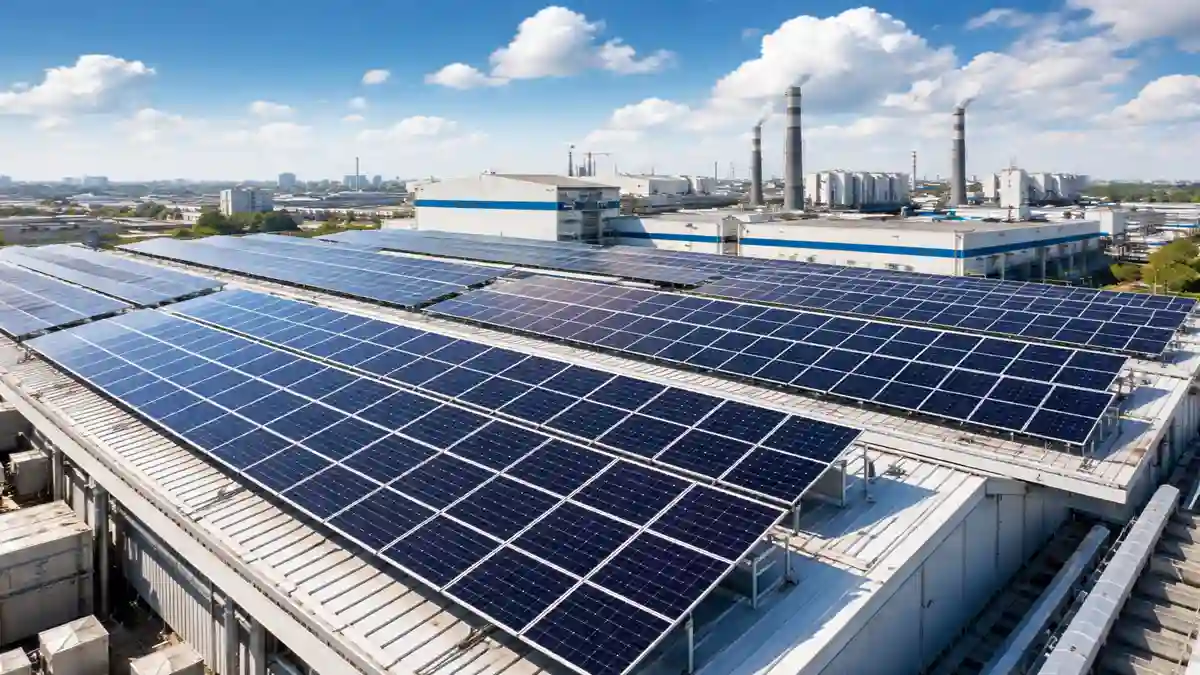
Engineering audit of industrial solar panels: 200kW case study, N-Type TOPCon, BESS, and DC optimization. Plus USA tax stacking for payback under 3 years.
Executive Summary
Industrial solar in 2026 is no longer just about panels on a roof. It is about engineering a complete energy asset that delivers 25+ years of reliable, low-cost power.
This guide distills what I have learned from inspecting failed systems, redesigning underperforming projects, and commissioning hundreds of kilowatts of power across manufacturing facilities. Whether you are a plant manager, procurement lead, or financial decision-maker, here is what matters right now:
1. Panel technology has shifted. N-Type TOPCon bifacial is the 2026 industrial standard. Skip PERC. Prioritize efficiency above 21 percent, degradation below 0.45 percent annually, and glass-glass encapsulation for dusty environments.
2. Architecture determines performance. DC optimization paired with hybrid inverters improves system efficiency by 8–12 percent compared to traditional AC-coupled designs. If you have DC-native loads (LED lighting, forklift charging, EC motors), direct coupling pays.
3. Storage is now standalone-viable. BESS integration reduces demand charges by 15–30 percent and raises self-consumption above 85 percent. Lithium Iron Phosphate (LFP) is the industrial chemistry of choice.
4. U.S. incentives create a 2026 deadline. Projects must begin construction by July 4, 2026, to lock in the full 30% ITC with Safe Harbor. Stack with REAP grants (up to 50% in rural areas) and Domestic Content Bonus (total 40% ITC) for sub-12-month payback.
5. Maintenance is non-negotiable. Industrial soiling losses reach 5–25 percent without regular cleaning. Automated systems pay for themselves above 200 kW.
The 200 kW printing press case study in this guide shows exactly how these elements combine—delivering $13,400 annual savings and compressing payback from 5.5 to 4.3 years through intelligent engineering.
Read the full guide for technical specifications, cost tables, NEC 2026 compliance requirements, and a complete ROI model.
Industrial Solar System
Engineering, Integration, and Financial Performance for Manufacturing Facilities
Industrial solar panels are redefining how factories manage electricity. Rising tariffs, unstable grids, and sustainability targets are pushing industries toward self-generation.
But here is what I’ve learned the hard way as an engineer: installing panels alone is never enough.
I’ve inspected systems where harmonics from VFDs kept tripping inverters—nobody did load profiling. I’ve assessed rooftops never designed for the 400 kW arrays already bolted onto them—nobody did structural verification. I’ve watched plant directors stare at 30 percent performance gaps they can’t explain.
Industrial solar is not residential solar with bigger panels. It is a three-phase, mission-critical generation asset that must coexist with motors, compressors, furnaces, and sensitive production lines. If your electrical room has harmonic filters and surge protection, your solar integration demands the same rigor.
That means:
- Load profiling before solar panel selection
- System architecture before procurement
- Structural assessment before mounting
- BESS and grid integration are designed in, not retrofitted
When engineered correctly, industrial solar becomes a strategic energy asset that stabilizes costs for 25 years.
When engineered poorly, it becomes a very expensive maintenance lesson.
I wrote this guide so you can skip the lessons my team learned the hard way.
What Are Industrial Solar Panels?
Industrial solar panels are high-efficiency photovoltaic modules designed to support medium to large-scale electrical loads ranging from 50 kW to multi-megawatt systems. These systems are engineered to operate within three-phase electrical networks and power heavy equipment such as motors, compressors, chillers, production lines, furnaces, printing machines, and processing units.
How industrial systems differ from residential and commercial:
| Parameter | Industrial Requirement |
|---|---|
| Electrical network | Three-phase, high voltage |
| Load characteristics | High inrush currents, fluctuating demand |
| Power quality | Harmonic distortion from VFDs, reactive power |
| Uptime requirement | Critical, often 24/7 operation |
| Protection class | Industrial-grade, higher fault tolerance |
| Structural loading | Heavy equipment, wind lift calculations |
| Integration complexity | BESS, grid export, DC optimization |
Most industrial facilities consume the majority of their energy during daylight hours, which makes them ideal candidates for solar integration. High daytime load alignment ensures maximum self-consumption and faster payback periods.
Types of Industrial Solar Panels: Technology Comparison
Choosing the right solar panel technology determines energy yield, system footprint, temperature performance, and long-term reliability. Industrial buyers must evaluate not only efficiency but also degradation rates, temperature coefficients, and mechanical durability.
| Technology | Efficiency | Temperature Coefficient | Annual Degradation | Best Application |
|---|---|---|---|---|
| Monocrystalline N-Type | 21–23% | -0.29%/°C | 0.40% | Limited rooftop space, maximum yield |
| TOPCon | 22–24% | -0.28%/°C | 0.38% | High-temperature zones, premium performance |
| Bifacial (N-Type/TOPCon) | 21–23% + rear gain | -0.29%/°C | 0.40% | Elevated mounting, reflective surfaces |
| Monocrystalline P-Type | 19–21% | -0.35%/°C | 0.55% | Balanced cost-performance |
| Polycrystalline | 15–18% | -0.40%/°C | 0.70% | Large available area, budget constraints |
Monocrystalline N-Type Solar Panels
N-Type panels use silicon doped with phosphorus, eliminating boron-oxygen defects found in conventional P-Type cells. This delivers superior durability and lower degradation, typically 0.4 percent annually versus 0.55–0.70 percent for P-Type. For factories seeking 25 to 30 years of operational reliability, N-Type is the reference standard.
TOPCon Solar Panels
Tunnel Oxide Passivated Contact technology reduces recombination losses within the cell structure. TOPCon modules provide higher efficiency, better temperature performance, and improved long-term degradation rates. In 2026, TOPCon represents the leading edge for industrial-scale projects aiming at maximum output.
Bifacial Solar Panels
Bifacial modules generate power from both front and rear surfaces. When installed on elevated structures or reflective surfaces (white membrane roofs, light-colored gravel, concrete), rear-side gain typically reaches 5 to 15 percent. For industrial carports or elevated rooftop mounting, bifacial panels significantly improve performance density.
Comparative Decision Framework
For 2026 and beyond, the industrial recommendation is clear: Monocrystalline N-Type TOPCon bifacial panels represent the most advanced and future-ready technology. The combination of high efficiency, low degradation, bifacial gain, and superior temperature coefficient justifies the modest premium over P-Type alternatives.
Best Industrial Solar Panels: Selection Criteria
The best industrial solar panels in 2026 combine high efficiency, structural durability, and long-term warranty protection. Industrial procurement should prioritize:
1. Efficiency above 21 percent
Higher efficiency reduces structural loading, cabling, and installation labor per watt.
2. Degradation below 0.45 percent annually
Linear performance warranty with ≤2 percent first-year degradation, ≤0.45 percent thereafter.
3. Wind load certification
Minimum 2400 Pa static load, 4000 Pa recommended for high-wind regions.
4. Extended performance warranty
25 to 30-year warranty with 87–92 percent retained output at term.
5. Temperature coefficient ≤ -0.30%/°C
Critical for facilities in warm climates or with limited airflow.
6. PID resistance and anti-LID treatment
Potential Induced Degradation and Light Induced Degradation mitigation verified by third-party testing.
7. Fire safety classification
Class A or C per UL 790 / IEC 61730.
Climate-specific considerations apply. In high-temperature industrial zones (steel, ceramics, foundries), modules with better temperature coefficients provide higher real-world yield. For dusty environments (cement, mining, agro-processing), glass-glass bifacial modules offer improved durability and easier cleaning.
Ultimately, the best industrial solar panel is the one that matches the facility’s energy demand profile, climate conditions, structural constraints, and financial objectives.
Recommended Industrial Solar Panels: N-Type TOPCon bifacial panels with glass-glass encapsulation deliver >21% efficiency, <0.45% annual degradation, and 25–30 year output of 87–92%. Resistant to PID, LID, fire, and wind, they excel in dusty or high-temperature industrial environments and integrate seamlessly with BESS and AI-optimized DC systems, making them the most reliable, future-ready choice for industrial facilities.
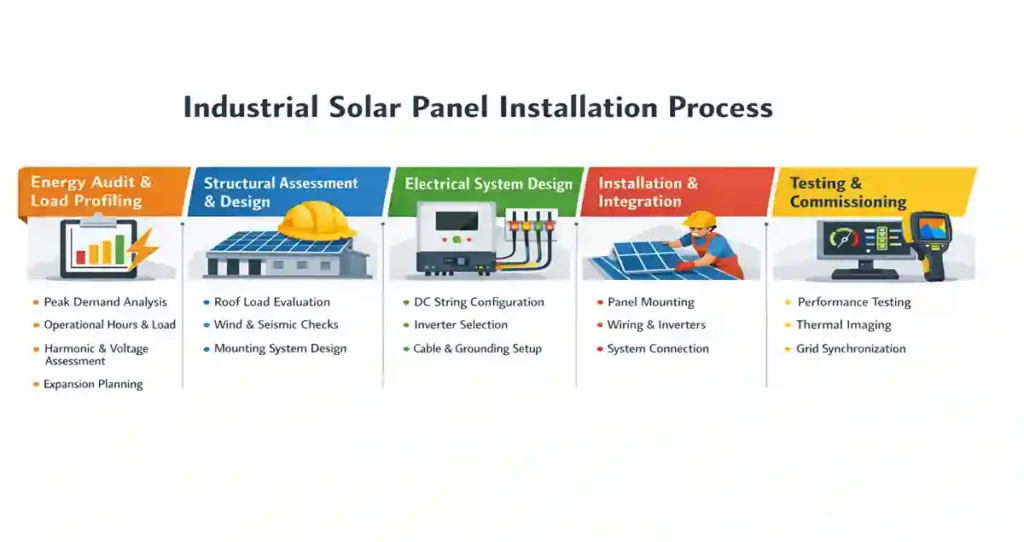
Industrial Solar Panel Installation Process
Industrial installation requires systematic engineering. Unlike standard commercial projects, industrial facilities present unique constraints: operational continuity, limited shutdown windows, complex roof geometry, and existing electrical infrastructure.
Stage 1: Energy Audit and Load Profiling
Load profiles are analyzed to determine:
- Peak demand and base load
- Operational hours and seasonal variation
- Equipment sensitivity and harmonic content
- Voltage regulation requirements
- Future expansion plans
This ensures correct system sizing and inverter configuration. Oversizing is common in industrial solar—PV array capacity may exceed inverter AC rating by 30–40 percent to maximize generation during non-peak irradiance.
Stage 2: Structural Assessment and Mounting Design
Engineers verify:
- Roof load capacity (dead load + live load + wind uplift)
- Anchor pull-out resistance
- Steel structure certification for elevated systems
- Seismic compliance, where applicable
For elevated mounting (1.5–3 meters clearance), structural steel design must comply with local building codes and wind tunnel testing where required.
Stage 3: Electrical System Design
This covers:
- DC string layout and voltage optimization
- Combiner box configuration and string fusing
- Inverter selection (string, central, or hybrid)
- Cable sizing and voltage drop calculation
- Earthing and grounding systems
- Surge protection device coordination
- Grid interconnection protection relay settings
Industrial electrical design must account for power quality. Harmonic filters or active front-end inverters may be required for sensitive manufacturing environments.
Stage 4: Installation and Integration
Installation proceeds with:
- Mounting structure assembly
- Panel placement and torque verification
- DC cabling and combiner termination
- Inverter installation and commissioning
- Integration into the main distribution board
- Metering and monitoring deployment
Stage 5: Testing and Commissioning
Final verification includes:
- Insulation resistance testing
- String current-voltage curve tracing
- Thermal imaging of connections
- Power quality analysis
- Grid synchronization verification
- Performance ratio calculation
Inverter Selection for Industrial Solar Panels
Solar inverters are a critical component of industrial solar systems because they convert DC power from the panels into usable AC for factory loads, protect equipment, and ensure safe grid interconnection. The correct inverter choice impacts system efficiency, reliability, maintenance, and overall ROI.
Industrial facilities require robust inverter architecture due to:
- Large capacity (50 kW–multi-MW)
- Variable loads with high inrush currents
- Sensitive equipment requiring stable voltage and frequency
- Integration with BESS, DC optimization, and net metering
Types of Inverters for Industrial Solar Systems
| Inverter Type | Description | Best Application | Pros | Cons |
|---|---|---|---|---|
| String Inverter | Converts DC from a series of panels (string) to AC | Medium-sized rooftops, modular expansion | Lower upfront cost, easier replacement, flexible layout | Less efficient for large installations, more points of failure if multiple strings fail |
| Central Inverter | Large-scale inverter receiving DC from multiple strings | Large industrial rooftops or ground-mounted arrays | High efficiency at scale, lower $/W, central monitoring | Higher initial cost, complex installation, single point of failure risk |
| Hybrid Inverter | Combines grid-tie and energy storage capabilities | Industrial facilities with BESS | Direct DC coupling of PV and batteries, peak shaving, backup support | More expensive, requires careful design, may need firmware updates for optimization |
| Microinverters | Small inverter per panel | Rarely used in industrial settings | Panel-level optimization, easy maintenance | Not cost-effective for large industrial systems |
| DC-DC Converters / Optimizers | Devices that optimize DC voltage for panels or specific loads | For DC-native loads or BESS integration | Improves efficiency, allows partial DC coupling, and reduces conversion losses | Adds component cost, requires additional design expertise |
Industrial Inverter Selection Considerations for Industrial Solar Panels
- System Size & Layout – Smaller rooftops may use multiple string inverters for modularity. Large continuous roofs benefit from central inverters for economies of scale.
- Load Composition – DC-native loads or LED lighting favor DC-coupled hybrid inverters to reduce unnecessary AC→DC reconversions.
- BESS Integration – For new installations, DC-coupled hybrid inverters are preferred. They charge batteries directly from PV without double conversion, improving round-trip efficiency. AC-coupled systems are suitable for retrofits but incur additional conversion losses.
- Redundancy & Maintenance – String inverters offer easier replacement without full system shutdown, whereas central inverters require careful redundancy planning.
- Grid-Tie & Net Metering – Inverters must comply with local interconnection standards and anti-islanding requirements. Hybrid inverters can also manage export limits for net metering.
- Efficiency & Performance Ratio – Premium inverters (>98% peak efficiency) reduce energy losses and improve overall ROI.
- Environmental Conditions – Industrial rooftops may experience high temperatures, dust, or corrosive atmospheres. Inverter enclosures must meet IP65/66 ratings and include cooling systems if necessary.
Practical Recommendation (2026):
- For medium industrial rooftops (50–200 kW): string inverters with hybrid-ready BESS integration
- For large installations (>500 kW): central inverters with DC optimization + hybrid capabilities
- Hybrid inverters are strongly recommended when net metering, time-of-use tariffs, or peak shaving are planned
By carefully selecting the inverter architecture, industrial facilities can maximize energy yield, reduce operational disruptions, and optimize integration with BESS and grid services.
Industrial Solar Panels Cost Breakdown (2026)
The cost of industrial solar panels depends on capacity, technology selection, installation complexity, and optional storage integration. All figures are indicative and vary by region, labor rates, and supply chain conditions.
| Component | Share of Total Cost | Notes |
|---|---|---|
| Solar modules | 35–45% | N-Type/TOPCon premium: +8–12% vs P-Type |
| Inverters | 10–15% | String inverters: lower cost, central: higher efficiency at scale |
| Mounting structures | 8–12% | Elevated steel: higher cost, standard rail: lower cost |
| DC cabling and combiners | 5–8% | Copper cost sensitive |
| AC distribution and protection | 5–7% | Switchgear, MCCB, SPD, metering |
| Monitoring and control | 2–4% | Panel-level or string-level |
| Engineering and design | 3–6% | Structural, electrical, grid compliance |
| Installation labor | 12–18% | Highly variable by region |
| Logistics and permitting | 3–5% | Import duties, grid application fees |
| Project management | 2–4% | Industrial projects require a dedicated PM |
Typical project cost ranges (2026):
| System Size | Cost Range (USD) | Cost per Watt (USD/W) |
|---|---|---|
| 50 kW | 45,000 – 65,000 | 0.90 – 1.30 |
| 100 kW | 80,000 – 115,000 | 0.80 – 1.15 |
| 200 kW | 140,000 – 220,000 | 0.70 – 1.10 |
| 500 kW | 325,000 – 500,000 | 0.65 – 1.00 |
| 1 MW | 600,000 – 900,000 | 0.60 – 0.90 |
Cost drivers:
- Module tier: Tier-1 N-Type TOPCon bifacial commands a premium over Tier-2 P-Type
- Mounting complexity: Elevated steel +25–40% vs. flat roof ballasted
- Inverter architecture: Central inverters lower $/W at scale, string offers redundancy
- Grid strength: A weak grid requires additional stabilization equipment
- Geography: Labor rates, permitting fees, and supply chain markups vary significantly
Although the upfront investment may appear significant, industrial solar drastically reduces long-term electricity expenditure, making it financially attractive across all manufacturing subsectors.
Note: These are standard cost estimates; actual prices may vary depending on regional and local market rates, material availability, and labor conditions.
Solar Panels for Industrial Buildings and Rooftops
Industrial buildings offer ideal structural conditions for solar installations. Large flat rooftops enable optimal tilt alignment and simplified mounting systems. Elevated structures further improve airflow beneath panels, reducing temperature buildup and enhancing efficiency.
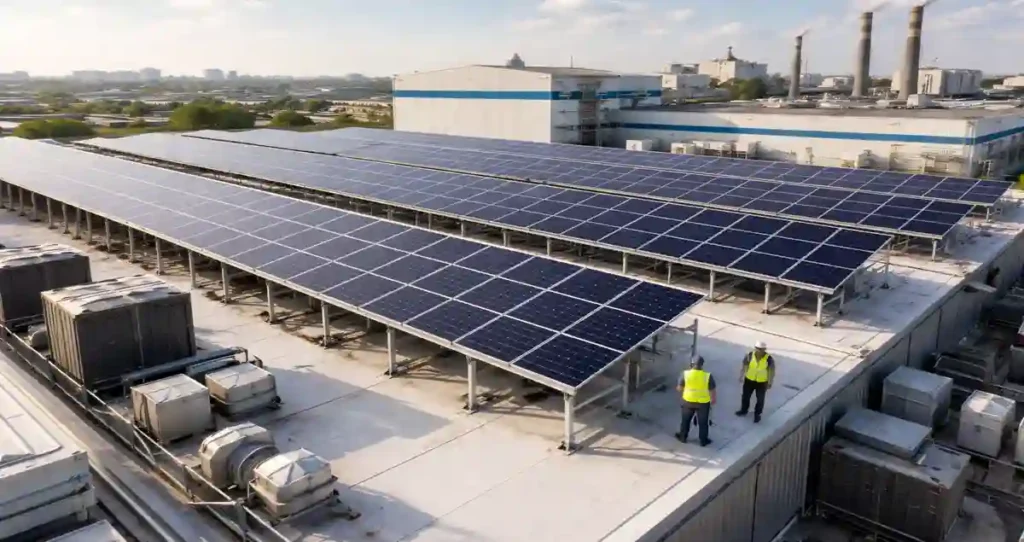
Rooftop solar for industrial buildings delivers maximum value when:
- Daytime operational hours align with solar generation
- The roof structure supports a 25-year service life
- Shading from parapets, HVAC units, and chimneys is minimized
- Net metering or feed-in tariff is available
Ground-mounted systems may be used when land is available, but rooftop and elevated mounting typically provide better land-use efficiency and avoid consuming production or logistics space.
AI Optimization and Energy Trading for Industrial Solar Panels
Modern industrial solar systems are no longer passive generators—they can actively manage energy flows using AI-driven optimization. AI algorithms continuously monitor production, facility load, weather patterns, and battery state-of-charge to maximize efficiency and self-consumption. Explore how to Reduce Your Electricity Bills with AI-Optimized Solar
AI Optimization Benefits
| Feature | Description | Industrial Impact |
|---|---|---|
| Predictive Load Management | AI forecasts facility energy demand and aligns solar generation to high-load periods | Reduces reliance on grid electricity, improves payback |
| PV Yield Prediction | Real-time monitoring of solar irradiance and panel performance | Ensures panels operate at maximum efficiency, detects anomalies early |
| Battery Dispatch Optimization | AI decides when to charge or discharge BESS for peak shaving or backup | Minimizes demand charges, extends battery life |
| DC Load Alignment | Directs solar power to DC-native equipment or LED loads | Reduces conversion losses, increases solar-to-useful-load efficiency |
Energy Trading / Net Metering at Off-Days
Industrial facilities often generate excess electricity during low-production periods, weekends, or holidays. Trading this surplus with the grid through net metering or feed-in tariffs allows factories to monetize otherwise wasted energy.
| Mechanism | Description | Financial/Operational Impact |
|---|---|---|
| Net Metering | Export surplus solar energy to the utility grid, and receive credit against future consumption | Improves ROI, reduces payback period, and avoids energy wastage |
| Energy Arbitrage | AI-controlled storage charges when electricity rates are low, discharges or exports when rates are high | Optimizes tariff savings and generates additional revenue |
| Time-of-Use Optimization | AI aligns solar + BESS usage with peak-rate hours | Reduces peak demand charges by up to 30% |
Integration with Industrial Solar Systems
- AI can integrate with DC-optimized architectures to ensure direct solar delivery to high-priority loads, minimizing unnecessary AC→DC reconversions.
- For BESS-equipped facilities, AI algorithms manage charging/discharging to avoid over-cycling and maximize battery life.
- Off-day trading is automated, allowing industrial operators to set policies: export limits, pricing thresholds, or grid priority schedules.
Case Study Extension: 200 kW Printing Press
After initial DC optimization and BESS assessment, the printing press integrated AI-controlled energy management. Key results:
| Metric | Pre-AI | Post-AI | Improvement |
|---|---|---|---|
| Solar-to-useful-load efficiency | 94.5% | 97% | +2.5% |
| Self-consumption | 82% | 88% | +6% |
| Grid export revenue (weekends/off-days) | $2,800 | $5,400 | +93% |
| Battery peak shaving efficiency | 12–15% demand reduction | 18–20% | +3–5% |
Key Insight:
By combining AI optimization, DC coupling, BESS integration, and net metering, the facility turned it industrial solar panels into a smart energy asset. The system not only supplies reliable power for daytime production but also generates revenue and reduces costs during off-days.
Advanced System Architecture: DC Optimization vs Traditional AC Systems
Traditional solar systems convert all generated DC power into AC through inverters before distribution. While this is necessary for grid-tied export and AC motor loads, it introduces conversion losses—typically 2–4 percent per conversion stage.
The inefficiency problem:
DC → AC (inverter) → distribution → AC motor → mechanical work
DC → AC (inverter) → distribution → AC/DC rectifier → DC load
Each unnecessary conversion stage increases energy loss and generates waste heat.
DC Optimization Strategy
Advanced industrial design minimizes unnecessary conversions by:
- Direct DC coupling of compatible subsystems
- DC-DC converters for LED lighting, DC ventilation fans, and DC process equipment
- DC-coupled BESS avoiding double conversion
- Hybrid inverters with DC coupling architecture
Measurable impact: By reducing DC→AC→DC reconversion pathways, overall system efficiency improves by 8 to 12 percent compared to conventional AC-coupled architecture.
Architecture Comparison
| Parameter | Traditional AC-Coupled | DC-Optimized Hybrid |
|---|---|---|
| Solar to AC load | 96–98% efficient | 96–98% efficient |
| Solar to DC load | 88–92% efficient | 96–98% efficient |
| Battery round-trip | 85–90% (AC coupled) | 92–96% (DC coupled) |
| Component count | Higher | Lower |
| System complexity | Moderate | Higher design, simpler operation |
This engineering approach transforms solar from a simple generation source into an optimized energy architecture tailored to the facility’s actual load composition.
Integration with Battery Energy Storage Systems
Battery Energy Storage Systems enhance industrial solar performance across multiple dimensions. BESS allows factories to store excess daytime generation and deploy it during peak demand periods, evening shifts, or grid outages.
Industrial BESS Benefits
Peak shaving: Reduce monthly demand charges by discharging during facility peak windows. Typical demand charge reduction: 15–30 percent.
Self-consumption increase: Raise solar utilization from 60–75 percent to 85–95 percent.
Backup power: Critical loads maintain operation during grid failure. Requires a transfer switch and islanding capability.
Voltage and frequency support: Stabilize weak grid connections and reduce production stoppages from power quality events.
Energy arbitrage: Where time-of-day tariffs apply, store low-cost solar or grid energy and discharge during high-rate periods.
DC-Coupled vs AC-Coupled BESS
DC-coupled BESS connects batteries to the DC side of the PV system, before the inverter. This reduces conversion losses and allows the inverter to charge batteries directly from PV without double conversion.
AC-coupled BESS connects batteries to the AC side through a separate battery inverter. More flexible for retrofits but less efficient.
For new industrial installations, DC-coupled hybrid architecture is strongly preferred.
Battery Technology Selection
| Chemistry | Cycle Life | Energy Density | Safety | Cost | Industrial Suitability |
|---|---|---|---|---|---|
| LFP (Lithium Iron Phosphate) | 6,000–10,000 | Moderate | Excellent | Moderate | Recommended |
| NMC | 3,000–5,000 | High | Good | Moderate | Limited cycle life |
| Lead-carbon | 1,500–3,000 | Low | Good | Low | High space requirement |
Lithium iron phosphate is the dominant industrial choice due to cycle life, thermal stability, and safety performance.
Net Metering and Grid Interconnection
Net metering allows industrial facilities to export surplus electricity to the grid during low-demand periods such as weekends, holidays, or night shifts. Exported energy is credited against future consumption at retail or avoided-cost rates depending on jurisdiction.
Net Metering Considerations
Export limitation: Some utilities cap export capacity or require bi-directional metering upgrades.
Time-of-use alignment: Maximize export value when generation coincides with utility peak rate periods.
System sizing: Right-sizing prevents excessive export at unfavorable compensation rates.
Regulatory stability: Industrial buyers must assess long-term net metering policy certainty before committing to large systems.
Even where export compensation is modest, net metering ensures that no solar energy goes to waste and improves overall return on investment. Grid connectivity also provides energy security for nighttime operations or extended cloudy periods.
Industrial Solar Panels Cleaning and Maintenance
Industrial environments accumulate dust, particulate matter, and airborne contaminants at significantly higher rates than commercial or residential settings. Regular cleaning is essential to maintain output levels.
Performance Impact of Soiling
| Environment | Typical Soiling Loss | Cleaning Frequency |
|---|---|---|
| Clean industrial (light manufacturing) | 3–7% | Quarterly |
| Moderate dust (warehousing, assembly) | 5–12% | Bi-monthly |
| Heavy dust (cement, mining, agro) | 10–25% | Monthly |
| Sticky residues (printing, chemical) | 15–30% | Twice monthly |
Even moderate dust buildup can reduce performance by 5 to 20 percent. Automated cleaning systems (roller brushes, mobile sprayers) are increasingly cost-effective for systems above 200 kW.
Maintenance Program Components
- Panel Cleaning: Use deionized or distilled water and soft brushes, or employ automated cleaning systems. Avoid high-pressure washing, which can damage seals and glass surfaces. Apply a specialized solar cleaning agent or solar panel cleaner to remove sticky residues, industrial dust, bird droppings, and grime without harming anti-reflective coatings. For optimal results, clean panels regularly according to the level of soiling to maintain maximum energy yield.
- Inverter Inspection: Perform thermal scanning, capacitor health checks, cooling fan operation assessment, and firmware updates. Ensure ventilation is unobstructed and ambient temperatures remain within rated limits.
- Electrical Verification: Conduct torque checks on terminations, insulation resistance testing, string current monitoring, and visual inspection of all wiring. Inspect junction boxes (J-boxes) for corrosion, moisture ingress, or loose connections, and verify all MC4 connectors are properly seated and free from oxidation or wear.
- Structural Inspection: Examine fastener integrity, corrosion on mounting structures, and anchor pull-testing for elevated or rooftop systems. Check that all bolts, clamps, and rails remain secure, especially in high-wind or seismic zones.
- Performance Ratio Analysis: Compare monthly energy yield to modeled expectations to detect early deviations caused by shading, soiling, or equipment degradation.
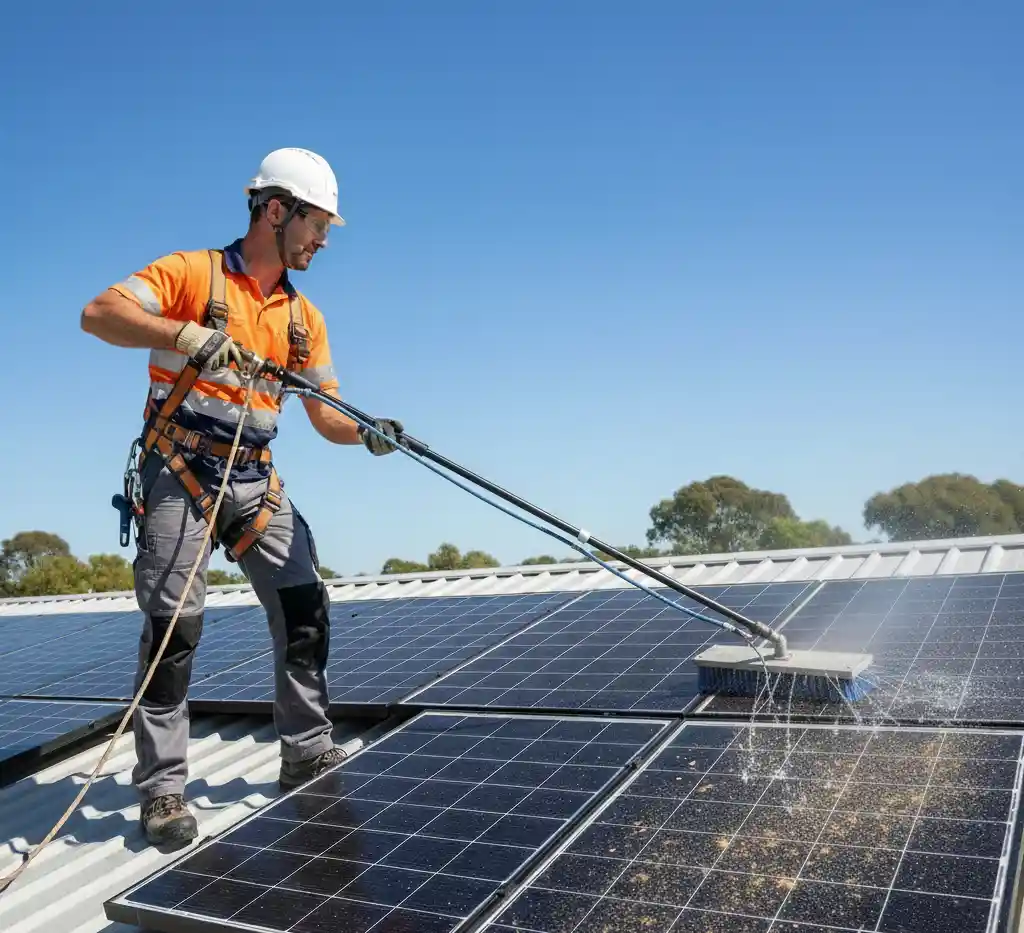
A proactive maintenance program, including wiring and connector inspections along with proper cleaning agents, protects long-term system performance, maximizes energy yield, and ensures the solar installation delivers consistent output over its 25+ year service life.
ROI and Payback Period for Industrial Facilities
Industrial solar panels typically achieve payback within three to six years, depending on electricity tariffs, system size, and self-consumption rate. After payback, facilities benefit from decades of low-cost electricity.
Payback Drivers
| Factor | Impact on Payback |
|---|---|
| Electricity tariff | Higher tariff = shorter payback |
| Self-consumption rate | 70–90% ideal, >50% required for strong returns |
| System size | Larger systems benefit from scale economies |
| Technology selection | Premium modules justified by higher yield |
| BESS integration | Extends payback but improves long-term savings |
| Incentives | ITC, accelerated depreciation, and grants |
Illustrative Payback Calculation: 200 kW System
Assumptions:
- System cost: $180,000
- Annual generation: 280,000 kWh
- Self-consumption: 80% (224,000 kWh)
- Grid tariff: $0.14/kWh blended
- Annual savings: $31,360
- Net metering credit: $0.05/kWh on 56,000 kWh export = $2,800
- Annual O&M: $1,800
- Net annual benefit: $32,360
- Simple payback: 5.6 years
- IRR (25 years): 17.2%
With DC optimization (+10% yield) and BESS demand charge reduction, payback compresses to 4.0–4.8 years with corresponding IRR improvement.
With rising grid tariffs globally, solar serves as a hedge against energy inflation. Additionally, sustainable energy adoption improves corporate environmental credentials and may qualify for preferential green financing rates.
Case Study: 200 kW Solar System for a Printing Press
Facility profile: Medium-sized printing press operating 12 hours daily, five days per week, with occasional Saturday production. Connected load: 200 kW average.
Major loads:
- Offset printing machines (DC drives with AC input)
- Air compressors (AC induction motors)
- Drying systems (resistive heating elements)
- HVAC equipment (variable speed drives)
- LED lighting (DC-native)
Initial Installation
The facility installed a 220 kWp rooftop industrial solar panel system using monocrystalline N-Type panels on an elevated steel structure (2.2 meter clearance). Twelve string inverters (20 kW each) converted all DC power to AC for distribution through the main switchboard.
Performance: Generation met daytime demand adequately. Monthly self-consumption: 74%. Grid dependency reduction: 58%.
Identified inefficiencies: All solar power passed through AC distribution before feeding DC-native LED lighting and DC drive motors. Battery charging for electric forklifts requires AC→DC rectification.
Optimization Intervention
The engineering team implemented:
- Selective DC coupling:DC-DC converters installed for LED lighting circuits, forklift charging stations, and DC water pumps, allowing them to run directly from solar-generated DC power.
- Motor drive upgrades: Older AC motors with variable frequency drives replaced with high-efficiency EC motors accepting direct DC input where operationally feasible.
- Hybrid inverter reconfiguration: Existing string inverters are partially replaced with a DC-coupled hybrid architecture to accommodate future BESS.
- Net metering activation: Surplus weekend generation is exported to the grid with bi-directional metering.
- BESS feasibility assessment: 150 kWh LFP storage projected to reduce monthly demand charges by 12–15 percent.
Results
| Metric | Pre-Optimization | Post-Optimization | Improvement |
|---|---|---|---|
| System efficiency (solar to useful load) | 86% | 94.5% | +8.5% |
| Self-consumption rate | 74% | 82% | +8% |
| Daytime grid dependency | 42% | 27% | -36% |
| Net annual energy cost | $41,200 | $27,800 | $13,400 saved |
| Simple payback (initial) | 5.5 years | 4.3 years | -22% |
Key insight: Industrial solar panels alone were not sufficient. True performance came from intelligent engineering integration—matching generation architecture to load characteristics rather than forcing all energy through conventional AC pathways.
USA Industrial Solar ROI & Financial Strategy (2026 Audit)
For U.S.-based manufacturing and industrial facilities, 2026 is a high-stakes financial year. Federal incentives remain powerful, but a “deadline cliff” and strict domestic sourcing rules now determine whether a project achieves exceptional ROI or loses key benefits. Industrial solar is no longer just a capital expense — it is a structured tax strategy requiring early engineering alignment, procurement planning, and compliance management.
Federal Investment Tax Credit (ITC) – The OBBB Act Deadlines
The foundation of U.S. industrial solar economics remains the 30% Federal ITC under Section 48E. However, the One Big Beautiful Bill (OBBB) Act, signed into law on July 4, 2025, introduced strict new “Begin Construction” deadlines that reshape financial planning.
July 4, 2026 Deadline
To lock in the full 30% credit and secure a 4-year Safe Harbor window, projects must satisfy the “Physical Work Test” by July 4, 2026.
The 2027 Cliff
Projects that fail to begin construction by this deadline must be fully operational (Placed-in-Service) by December 31, 2027, or risk losing the credit entirely as the program transitions.
Standalone BESS Qualification
For the first time, industrial-scale Battery Energy Storage Systems (BESS) of 5 kWh or more qualify for the 30% ITC on a standalone basis. This makes peak shaving and demand charge reduction strategies financially viable even without pairing with solar PV.
USDA REAP Grants – Rural Incentive Acceleration
If your facility is located in a rural area (population under 50,000), the United States Department of Agriculture offers powerful financial leverage through the Rural Energy for America Program (REAP).
50% Funding
In 2026, REAP grants can cover up to 50% of total eligible project costs, capped at $1 million.
Incentive Stacking
REAP grants can be combined with the Federal ITC. When stacked properly, federal support may cover 70–80% of total capital cost for qualifying rural manufacturers.
Domestic Content Bonus – Reaching 40% ITC
An additional 10% Domestic Content Bonus can increase the base 30% ITC to 40% total credit.
2026 Sourcing Requirements
- At least 50% of manufactured product costs (modules, inverters, racking) must be U.S.-sourced
- All structural steel and iron must be 100% U.S.-manufactured
Preferred Module Strategy
Using U.S.-assembled N-Type TOPCon modules from Tier-1 manufacturers such as:
- Qcells (Georgia facility)
- Mission Solar Energy (Texas facility)
provides one of the most reliable pathways to qualifying for the full 40% ITC.
Illustrative 200 kW Industrial Payback Model (2026)
Consider a 200 kW industrial rooftop system with a gross project cost of $200,000:
| Component | Estimated Value | Net Balance |
|---|---|---|
| Gross Project Cost | — | $200,000 |
| Federal ITC + Domestic Bonus (40%) | -$80,000 | $120,000 |
| USDA REAP Grant (50% of gross) | -$100,000 | $20,000 |
| Net Capital Outlay | — | $20,000 |
Engineering Insight
In this fully stacked scenario, the payback period can fall below 12 months. Even without the REAP grant, most U.S. industrial systems achieve a 3–5 year payback due to rising utility tariffs, demand charges, and available bonus depreciation.
NEC 2026 Technical Compliance
Any 2026 U.S. industrial solar installation must adhere to updates in the National Electrical Code (NEC 2026).
Article 110.16 – Arc-Flash Hazard Marking
Now mandates detailed arc-flash hazard labels on nearly all industrial electrical equipment that may be serviced while energized.
Article 690.4(G)
Introduces revised rounding requirements for voltage and amperage calculations, directly impacting string design and conductor sizing.
Section 705.12
Updates inverter and busbar sizing standards for facilities integrating multiple power sources such as solar, BESS, and grid supply.
Failure to align engineering design with NEC 2026 requirements may delay inspection approval and grid interconnection.
Industrial Solar Panels: 2026–2030 Outlook
The industrial solar sector is entering a phase of accelerated transformation.
Technology trajectory: N-Type TOPCon and back-contact cells will dominate new installations by 2027. Heterojunction technology (HJT) may capture premium segments. PERC will phase out in industrial applications.
Integration depth: Solar will increasingly be engineered as a core component of industrial electrical infrastructure rather than a bolted-on addition. DC microgrids, smart load switching, and AI-optimized energy dispatch will become standard.
Storage saturation: By 2028, the majority of industrial solar installations above 100 kW will include BESS. Falling battery costs and demand charge structures make the economics compelling.
Regulatory direction: Carbon border adjustments, mandatory sustainability reporting, and renewable purchase obligations will accelerate industrial adoption, independent of pure payback calculations.
Final Perspective
Industrial solar panels are not merely an environmental upgrade. They represent a strategic transformation of industrial energy infrastructure—from passive consumption to active generation, from tariff-taker to energy manager.
By combining advanced panel technology, structured installation, DC optimization, selective inverter usage, BESS integration, net metering, and preventive maintenance, industries achieve:
- Maximum efficiency from every generated kilowatt-hour
- Long-term financial resilience against tariff inflation
- Operational continuity through grid instability
- Sustainability compliance without premium cost
When engineered correctly, industrial solar panels do not simply reduce electricity expenditure. They power sustainable growth, stabilize operational costs, and future-proof industrial facilities against energy uncertainty.
The question is no longer whether to adopt industrial solar panels, but how well they will be engineered.
FAQs: Industrial Solar Panels 2026
What is the average cost of an industrial solar panel system in 2026?
For systems between 100 kW and 500 kW, costs typically range from $0.65 to $1.15 per Watt. A 200 kW system generally requires an investment of $140,000 to $220,000, depending on mounting complexity, technology selection, and BESS integration. Actual costs may vary based on regional labor rates and material availability.
How long is the payback period for factory solar panels?
Most industrial facilities achieve a full return on investment (ROI) within 4 to 6 years. With advanced DC optimization, AI-driven energy management, and high self-consumption rates (above 80%), the payback period can be reduced to under 4.5 years.
Why is N-Type TOPCon preferred for industrial solar panels in 2026?
N-Type TOPCon modules deliver higher efficiency (22–24%), lower annual degradation (0.4%), and better temperature coefficients compared to conventional P-Type panels. These advantages ensure higher energy yields, superior long-term reliability, and consistent output over a 25–30-year operational life, making them ideal for industrial applications.