
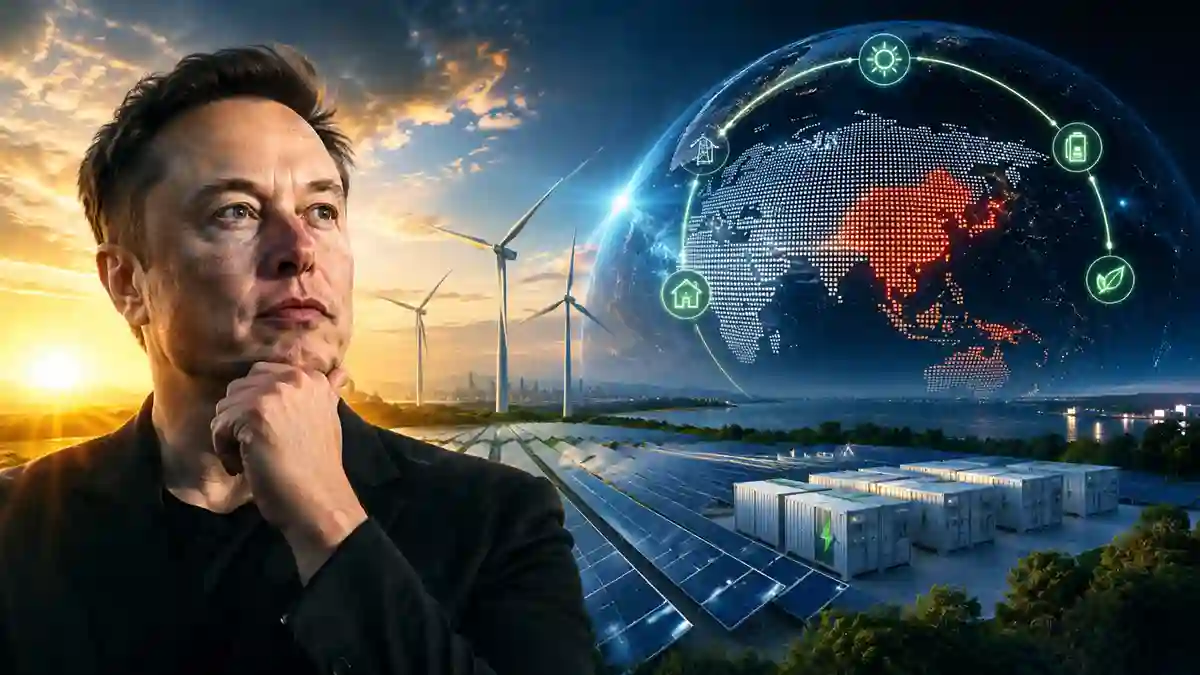
Elon Musk Solar Energy Warning could become the next oil monopoly. He’s 70% right. Here’s what he got correct, what he missed, and the engineering blueprint for a truly resilient energy future.
An authoritative engineering response to the most important clean energy debate of our time — and a blueprint for an energy architecture that no single nation, company, or supply chain can hold hostage
The global energy landscape is undergoing an unprecedented power shift. The question is: are we replacing one monopoly with another — and is Elon Musk right to warn us?
For over a century, geopolitical and economic dominance belonged to nations that controlled finite fossil fuel reserves. Oil was not simply an energy source — it was a weapon, a lever of power, and a structural dependency that distorted economies, triggered wars, and made entire nations hostage to distant supply chains.
Today, the rise of the modern solar power system has fundamentally changed the rules of the game. Energy is no longer an extraction-based commodity sitting under the ground in a handful of countries. It is a technology-driven asset, optimized by engineering scale, intelligent distribution, and rapidly falling manufacturing costs. This is a genuine power shift — and it is overwhelmingly positive.
But a serious Elon Musk solar energy warning has emerged from one of the industry’s most prominent insiders — and as engineers, we owe it a rigorous answer, not a dismissal. This is precisely the concern this article addresses: are the advantages of solar energy being undermined by structural risks we are not discussing loudly enough?
What if we are simply replacing one energy monopoly with another — this time dressed in silicon and lithium? This is the question Musk is asking. And he is not entirely wrong.
In this analysis, we examine Musk’s warning through professional engineering, energy economics, and global supply chain evidence — and we present the blueprint for a truly resilient clean solar energy future built on genuine energy equilibrium through diversification. For the complete engineering verdict on Musk’s specific claims, this article covers everything you need.
1. What Is the Elon Musk Solar Energy Warning?
To engage seriously with the Elon Musk solar energy warning, we need precision about what he actually argues. Musk — as CEO of Tesla and founder of SolarCity — has made four interconnected claims across interviews and public statements:
His four core arguments
- Supply chain concentration: Solar panel manufacturing is dangerously concentrated in China, meaning a single country controls the global transition to clean solar energy
- Intermittency is underestimated: A solar energy system without massive battery storage cannot reliably power a modern industrial economy — and current storage deployment is nowhere near sufficient
- Battery dependency: The storage required to make a solar power system viable at scale creates its own resource monopoly risk — around lithium, cobalt, and rare earths
- Infrastructure gap: The world is deploying solar energy solutions faster than it is building the grid infrastructure to handle the intermittency of solar generation
These are not the arguments of a solar energy skeptic. Musk built his fortune on clean solar energy and battery storage. His warning is an insider’s caution — which carries far more weight than criticism from fossil fuel defenders. That said, a warning from a billionaire entrepreneur is not the same as a comprehensive engineering assessment.
The Elon Musk solar energy warning deserves neither uncritical acceptance nor reflexive dismissal. It deserves engineering analysis — which is what follows.
2. Engineering Verdict: Where Musk Is Right and Where He Misses
Claim 1 — China dominates solar manufacturing
✅ AGREE — AND THE DATA IS MORE ALARMING THAN MUSK’S FRAMING. This is the most valid element of his warning.
| Supply chain layer | China’s global share | Risk level |
| Polysilicon production | ~90% | CRITICAL |
| Silicon wafer manufacturing | ~97% | CRITICAL |
| Solar cell production | ~85% | HIGH |
| Solar module assembly | ~80% | HIGH |
| Inverter manufacturing | ~70% | HIGH |
This is the china solar energy manufacturing dependency in its full scale — not consuming solar from China, but manufacturing every component that makes a global solar power system possible. A single trade dispute, export control, or manufacturing disruption does not just slow the energy transition — it stops it.
Claim 2 — Solar intermittency is underestimated
⚠️ PARTIALLY AGREE — intermittency is real but solvable. The question is speed of storage deployment, not whether solar works.
A solar power system generates electricity only when the sun shines. In regions with monsoon seasons, heavy cloud cover, or short winter days, this intermittency is pronounced — producing the ‘duck curve’ grid mismatch that is now visible across California, Germany, and Pakistan. The engineering response — Battery Energy Storage Systems, pumped hydro, demand response — exists and is commercially proven. The solution is not to slow clean solar energy deployment. It is to simultaneously accelerate storage and grid infrastructure.
Claim 3 — Battery storage creates its own dependency
✅ AGREE — this is the hidden risk in the solar energy solution. Solving solar intermittency with lithium batteries trades one dependency for another.
This is the most sophisticated element of the Elon Musk solar energy warning and the most overlooked. Lithium-ion battery manufacturing is heavily concentrated, and the critical minerals required — lithium, cobalt, nickel — are subject to the same geopolitical concentration risks as oil. The engineering response: diversify storage technologies alongside energy sources — iron-air batteries, vanadium flow, pumped hydro, green hydrogen, sodium-ion. A resilient solar energy solution cannot depend on a single storage chemistry.
Claim 4 — Deployment speed outpacing infrastructure
✅ AGREE IN DEVELOPING MARKETS — disagree as a reason to slow solar. Speed and infrastructure must scale together, not sequentially.
In high-growth solar energy markets — including Pakistan, India, and Nigeria — grid infrastructure has not kept pace with solar deployment, causing real instability. Musk’s observation is correct. But the prescription is not to slow deployment; it is to accelerate grid modernization in parallel.
The Elon Musk solar energy warning is 70% correct engineering and 30% incomplete prescription. He diagnoses the risks accurately but undersells the available solutions.
3. Deconstructing the Macro Power Shift
To understand where the global power shift is taking us, we must understand what we are leaving behind — and what structural patterns we risk carrying forward.
From extraction to technology scale
Historically, energy security was hostage to localized fuel supply chains, shipping bottlenecks, and geopolitical conflicts. The 1973 OPEC oil embargo demonstrated that a small group of resource-holding nations could bring industrialized economies to their knees. That is the defining danger of any single-source energy monoculture — and the pattern the Elon Musk solar energy warning correctly identifies as re-emerging.
A decentralized solar power system redefines this paradigm in powerful ways:
- Sovereignty at the edge: Power generation moves closer to the point of consumption. A rooftop solar power system in Karachi or Nairobi does not depend on a pipeline running through a conflict zone.
- The manufacturing race: Global leverage has shifted from nations sitting on oil fields to those pioneering high-efficiency photovoltaic architectures — N-Type TOPCon, perovskite-silicon tandems, HJT — and controlling supply chain integration.
- Democratized generation: For the first time in energy history, the fuel itself — sunlight — is genuinely free and available to every nation on Earth. No embargo can block the sun.
The warning inside the celebration
And yet, the manufacturing of the systems that capture sunlight is anything but democratized. The power shift away from oil has, so far, concentrated into a new set of choke points — as the supply chain table in Section 2 shows. A solar power system that depends 80–90% on a single country’s manufacturing base has not escaped energy dependency — it has relocated it.
4. The Vulnerability of a Single-Source Solar Monoculture
While maximizing solar deployment is vital, relying on any single generation profile introduces systemic vulnerabilities. The structural disadvantages of solar energy are exactly this: in engineering, a single point of failure is a liability; in grid economics, it can be catastrophic.
The intermittency and duck curve dilemma
A solar-only strategy exposes electricity networks to drastic supply-demand mismatches — the ‘duck curve.’ During peak daylight hours, overproduction from a solar power system can lead to severe grid instability and mandatory curtailment. During peak evening demand, or extended cloud cover during monsoon seasons critical to South Asia and Southeast Asia, a grid without diversified baseload faces severe deficits.
The supply chain single point of failure
The fossil fuel power shift taught us that supply chain concentration is a strategic vulnerability. The current solar power system supply chain is more geographically concentrated than the oil market ever was. Polysilicon, wafers, cells, modules, and inverters all flow predominantly through a single manufacturing ecosystem.
In engineering, we design against single points of failure. The global solar power system supply chain is currently one of the largest single points of failure in modern infrastructure planning.
5. The Full Pros and Cons of Solar Energy in 2025
A responsible engineering analysis of the pros and cons of solar energy goes beyond Musk’s framing to give a complete, evidence-based picture.
What are the advantages of solar energy?
- Renewable and inexhaustible: Is solar energy renewable? Yes — unambiguously. Why is solar energy renewable? Because sunlight is continuously replenished by nuclear fusion in the sun’s core. It requires no extraction, no drilling, no geopolitical negotiation.
- Rapidly falling cost: How much does solar energy cost today? Utility-scale PV now delivers electricity at $0.02–0.04/kWh — cheaper than any fossil fuel source in history.
- Zero operational emissions: How does solar energy affect the environment during operation? Zero direct carbon emissions, zero water consumption for PV systems, zero air pollution.
- Energy sovereignty: A distributed solar power system gives homeowners, businesses, and communities control over their own power — fundamentally different from fossil fuel dependency.
- Why is solar energy good for economic development: It creates local jobs in solar installation, solar maintenance, and engineering — and reduces the import bills that drain developing economies.
- Where is solar energy found: Everywhere the sun shines — every inhabited region on Earth, unlike oil, coal, or geothermal resources.
What are the disadvantages of solar energy?
- Intermittency: How is solar energy converted into electricity from sunlight that disappears at night and during cloud cover — requiring storage or backup generation
- Manufacturing concentration: As Musk correctly warns, the china solar energy manufacturing dependency is a genuine strategic risk to global clean energy deployment
- Battery storage dependency: The solution to solar intermittency — lithium batteries — creates its own critical mineral concentration risk
- Upfront capital cost: Despite dramatic cost reductions, the upfront investment for a quality solar energy system remains a barrier in low-income markets
- Panel end-of-life: How does solar energy affect the environment at end-of-panel-life? Current recycling infrastructure is insufficient — a problem the industry must proactively solve
| Dimension | Advantage | Disadvantage / Musk’s concern | Engineering mitigation |
| Fuel source | Free, renewable, infinite | Intermittent (night, clouds) | BESS, pumped hydro, hydrogen |
| Supply chain | Distributed generation | Manufacturing 85–97% in China | Regional manufacturing investment |
| Cost | Cheapest new electricity ever | High upfront capital | Financing, leasing, PPAs |
| Environment | Zero operational emissions | Panel end-of-life waste | Recycling programs, LCA optimization |
| Geopolitics | Sunlight cannot be embargoed | Components can be cut off | Diversify supply chain geography |
6. Achieving Equilibrium: Environmental and Economic Perspectives
To maintain long-term stability, global energy strategies must prioritize diversification. Nature thrives on biodiversity; a modern electrical grid must thrive on technological diversity. True equilibrium — the answer to the Elon Musk solar energy warning — requires that the power shift toward clean energy be built on multiple pillars, not a single one.
The environmental perspective — designing for climatic balance
A resilient solar power system must be paired with complementary clean technologies:
- Wind and solar synergy: In many regions, wind resources naturally peak during evening hours and colder seasons when solar irradiance dips, creating a balanced near-24-hour clean generation profile.
- Advanced storage and clean baseloads: Integrating utility-scale BESS, pumped-storage hydro, and green hydrogen ensures that surplus daytime solar energy is captured and dispatched when the sun sets — completing the power shift away from fossil peakers.
- Geothermal and small modular nuclear: For regions with limited solar or wind resources, these provide reliable, carbon-free baseload — the backbone that allows a solar power system to operate without fossil backup.
The economic perspective — market resilience against the next power shift
| Risk category | Single-source solar vulnerability | Diversified mix mitigation |
| Supply chain shocks | Polysilicon or mineral crunches halt project pipelines entirely | Blending technologies dilutes reliance on any single raw material |
| Regulatory & tariff shifts | Sudden trade policy changes instantly disrupt solar economics | Multifaceted asset portfolio ensures continuous deployment |
| Inflationary pressures | Grid demand spikes drive extreme pricing during non-solar hours | Hybrid solar power systems with AI-driven arbitrage insulate users |
| Geopolitical disruption | Manufacturing concentration creates leverage for supply cutoffs | Distributed manufacturing eliminates single-actor veto power |
| Technology obsolescence | Overinvestment in one tech leaves stranded assets | Diversified portfolio captures gains across technology learning curves |
The political dimension — energy sovereignty in the new power shift
Oil-producing nations weaponized supply cuts as geopolitical leverage for decades. If the clean energy supply chain remains as concentrated as it is today, the same dynamic will emerge with different actors. Nations that cannot manufacture their own solar power system components, batteries, or critical minerals will find themselves in the position of oil-importing nations in 1973: price-takers with no alternatives. The power shift must include a shift in manufacturing geography, not just energy source.
7. What Real Energy Diversification Looks Like
Diversification does not mean slowing solar deployment. It means building solar as the lead pillar of a multi-source, resilient energy architecture — engineered, not improvised. This is the direct answer to the Elon Musk solar energy warning.
For homeowners and businesses
- Deploy a solar power system paired with multiple battery chemistries — LFP and sodium-ion alongside lithium-NMC — reducing single-chemistry dependency
- Design hybrid systems: solar + micro wind + backup generation for genuine supply redundancy at site level
- Use AI-driven energy management (as covered across SolarVisionAI.com) to optimize dispatch across sources
- Understand what is net metering for solar energy in your local market — it is your grid-as-battery strategy and must be protected against utility lobbying
- Invest in energy efficiency — the most reliable power shift of all is energy you never need to generate
For policymakers and governments
- Build domestic solar power system manufacturing capacity — panel, inverter, and battery production — to break 100% import dependency
- Fund research into next-generation storage: green hydrogen, flow batteries, compressed air, gravity storage
- Develop geothermal, tidal, offshore wind, and small modular nuclear alongside solar — each covers different weather profiles and geographies
- Establish strategic mineral reserves for lithium, cobalt, and rare earths — the energy equivalent of strategic petroleum reserves
- Build international coalitions on critical mineral access — the power shift requires diplomatic infrastructure, not just physical infrastructure
For the energy industry and engineers
- Develop solar power system supply chains across multiple geographies — avoid single-nation dependency for any critical component tier
- Invest in panel and battery recycling infrastructure to close the circular economy loop and reduce virgin material demand
- Build modular, interoperable solar power system designs that integrate new generation and storage technologies as they mature
- Model energy systems for full-spectrum resilience — not just peak efficiency under ideal conditions
| Technology | Best geography | Storage need | Monopoly risk | Grid role |
| PV solar power system | High irradiance regions | High (batteries needed) | Medium-High (supply chain) | Lead variable generation |
| Onshore wind | Coastal and plains | Medium | Low | Evening/winter complement to solar |
| Geothermal | Volcanic/tectonic zones | Very low (baseload) | Very Low | 24/7 clean baseload |
| Green hydrogen | Sunny or windy regions | Built-in (fuel form) | Low if local | Seasonal long-duration storage |
| Small modular nuclear | Any geography | Very low (baseload) | Medium (fuel) | Zero-carbon baseload |
| Tidal / wave | Coastal nations | Low (predictable) | Very Low | Predictable coastal baseload |
| Pumped hydro storage | Mountainous regions | N/A (is storage) | Very Low | Grid-scale solar surplus storage |
No single energy source covers all geographies, all weather conditions, and all storage timescales. This is not a weakness — it is the design principle we should be engineering toward. Diversity is resilience.
Conclusion: Weaving the Resilient Energy Tapestry
The Elon Musk solar energy warning is partly right — and engineers should be grateful for it. Not because it gives ammunition to fossil fuel defenders, but because it specifies the engineering requirements for a genuinely resilient clean energy transition.
Solar energy is renewable, increasingly affordable, scalable, and democratizing in ways that oil never was. The advantages of solar energy are fundamental and durable. The disadvantages of solar energy — intermittency, supply chain concentration, storage dependency — are real engineering challenges with known solutions.
The ultimate goal of the global energy transition — the true power shift — is not to replace an old fossil-fuel monopoly with a new single-technology equivalent. By anchoring high-efficiency solar power system designs within a broader, balanced mix of resilient clean technologies and smart-grid dispatch, we achieve what oil never allowed: genuine energy security. We protect industrial economies from supply chain volatility, and complete the power shift on terms that favor every nation equally.
Solar is not the problem. Monoculture is the problem. The sun is available to every nation on Earth. Let us make sure the systems we build to capture it are equally available — and equally secure.
The best version of the global power shift is one where every nation, every community, and every household has multiple paths to power — and no single company, country, or technology can switch any of them off.
Key Takeaways
- The Elon Musk solar energy warning is largely correct on supply chain risk — China controls 80–97% of critical solar manufacturing layers
- Solar energy is renewable, affordable, and the essential lead technology — but monoculture is the structural problem to solve
- The global power shift away from fossil fuels must not recreate their structural monopoly under a new technology
- A solar power system paired with wind, storage, geothermal, hydrogen, and nuclear is the engineering answer to Musk’s warning
- Manufacturing sovereignty — domestic solar power system production — is as important as the energy source itself
- True energy equilibrium requires diversification of supply chains, mineral access, storage chemistries, and grid architecture
Frequently Asked Questions.
What is the Elon Musk solar energy warning?
Elon Musk has warned that the rapid global shift to solar energy risks creating a new supply chain monopoly — particularly because China manufactures approximately 80–90% of the world’s solar panels, wafers, and polysilicon. He has also raised concerns about solar intermittency and the concentration of critical minerals like lithium and cobalt in battery storage. While his diagnosis is largely correct from an engineering standpoint, the solution is diversification of energy sources and manufacturing geography — not slowing solar deployment.
Is solar energy renewable?
Yes — solar energy is fully renewable. The sun has an estimated 5 billion years of remaining life, and the photovoltaic process that converts sunlight into electricity requires no extraction, no combustion, and no geopolitical negotiation over fuel. This is one of the most fundamental advantages of solar energy that no credible critic disputes. The manufacturing inputs for solar panels — silicon, aluminum, copper — have an environmental footprint that is shrinking rapidly as the industry decarbonizes its own production.
What are the advantages and disadvantages of solar energy?
The advantages of solar energy include: renewable and inexhaustible fuel source, dramatic cost reductions (over 90% since 2000), zero operational emissions, energy sovereignty for deploying nations, and scalability from rooftop to utility scale. The disadvantages of solar energy include: intermittency requiring battery storage or backup generation, supply chain concentration in China, upfront capital cost, panel end-of-life waste management, and grid integration complexity at high penetration levels. The engineering answer to the disadvantages is diversification — not abandonment of solar.
What is net metering for solar energy?
Net metering for solar energy is a billing arrangement in which a solar power system owner can export surplus electricity to the grid and receive credit against their consumption during non-solar hours — effectively using the grid as a virtual battery. It is one of the most important policy tools for distributed solar energy adoption and directly addresses the intermittency concern. Net metering policies are currently under threat in several markets from incumbent utility lobbying — defending and expanding net metering is a critical component of a resilient solar transition.
Why is solar energy good for energy security?
Solar energy is good for energy security because its fuel — sunlight — cannot be embargoed, priced by foreign governments, or withheld by any geopolitical actor. Unlike oil or gas, every nation on Earth receives sunlight. A distributed solar power system gives households, businesses, and entire nations control over their own power supply in a way that fossil fuels never could. The remaining energy security challenge — supply chain concentration in manufacturing — is addressed through domestic manufacturing investment and energy source diversification.
How does solar energy affect the environment?
During operation, solar energy has a near-zero environmental impact — no carbon emissions, no air pollution, no water consumption for photovoltaic systems. The manufacturing phase does have an environmental footprint (mining silicon, aluminum, copper, and for batteries, lithium and cobalt), but this footprint is shrinking rapidly as solar manufacturing becomes cleaner. Panel end-of-life recycling remains an underinvested area requiring urgent policy attention. Overall, the lifecycle carbon footprint of a solar power system is 20–50 times lower than coal and 10–20 times lower than natural gas.
Related guides on SolarVisionAI.com
Solar Panel Installation: Complete Engineering Guide (2026)
Solar Panel Installation Cost: The Complete 2026 Breakdown
Commercial Solar Panel Installation: Engineering Guide 2026
When Is the Best Time to Install Solar Panels?
Solar Power System in 2026: Types, Cost, ROI & AI Optimization