
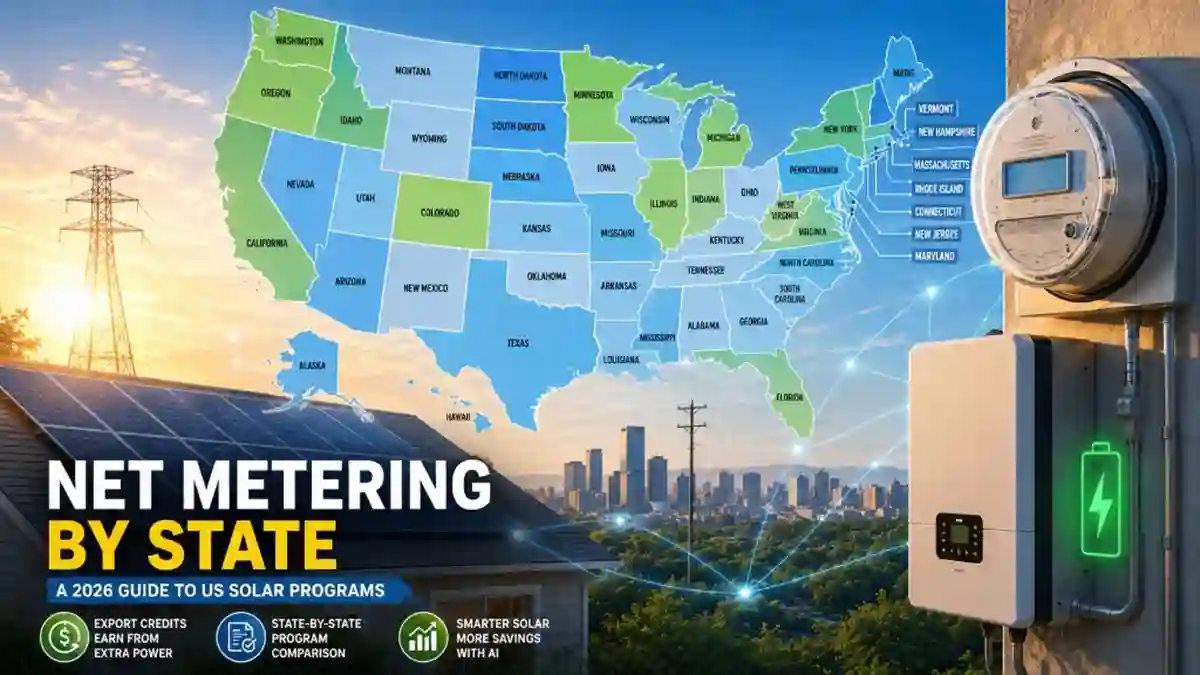
Don’t sign a US solar contract blind. Discover mandatory net metering programs by state across the USA, a complete 6-step FPL walkthrough, and AI compliance rules.
Net metering is available in 34 US states with mandatory programs — but net metering in Florida is not the same as in California, New York, or Arizona. Credit rates, system size limits, eligible technologies, excess credit rules, and the applicability of AI optimization all vary by state and utility. Before signing a solar contract, you need to understand specifically what your state and utility offer — not a generic description.
This guide covers state-by-state program rules, a detailed FPL (Florida Power & Light) net metering walkthrough, the role of AI in credit tracking and compliance monitoring, and the process questions no marketing material covers: interconnection queue timelines, completeness requirements, and the steps that slow commercial net metering projects more than technical problems do.
Net Metering News Today — Recent Policy Updates (April 2026)
Last updated: April 2026. This section refreshes quarterly — next update July 2026.
- Florida (FPL, Duke Energy FL, TECO): Following SB 1024 (2022), customers with systems interconnected before January 2024 remain grandfathered at full retail-rate net metering through December 2029. New installations after January 2024 receive a declining ‘netting rate’ stepping toward avoided cost annually. Verify current rates with your specific utility — the applicable rate depends on your interconnection application date, not your installation date.
- California (NEM 3.0): NEM 3.0 remains in effect for all new interconnections following the April 2023 CPUC ruling. The ongoing rulemaking (R.14-07-002) is evaluating modifications to the Avoided Cost Calculator. No major structural changes expected before 2027. AI battery optimization remains the primary financial response to NEM 3.0’s time-varying export credit structure — see the NEM 3.0 Guide and AI Solar Optimization Guide for the full analysis.
- New York (Value of DG): The VDER tariff continues for new interconnections in Con Edison and NYSEG territories. The value stack — energy, capacity, environmental, and locational components — produces effective compensation near the retail rate for most locations. AI monitoring platforms that decompose the VDER value stack in real time are now available from several providers.
- Texas: No statewide mandatory net metering. Compensation for solar exports is determined by your retail electricity provider (REP) contract in the ERCOT market. Several REPs now offer solar buyback programs with TOU structures — AI optimization adds measurable value in these programs.
- States under active review (Q1 2026): Virginia, Georgia, South Carolina, and Louisiana have active utility commission proceedings on net metering policy. Outcomes expected late 2026 to mid-2027. In these states, the financial case for installing under current net metering terms — before any policy change — is real and time-sensitive.
| Engineer’s Note: The most reliable source for current state net metering policy is DSIRE (dsireusa.org) — the Database of State Incentives for Renewables & Efficiency, maintained by NC State University. Always verify DSIRE data against your specific utility’s current tariff filing — utility implementation can lag behind state policy changes by months. For commercial projects, I request the utility’s current interconnection handbook and Schedule NEM tariff document before completing any financial model. |
Net Metering Programs by State Summary Table
| State | Mandatory | Program | Export Credit Rate | System Limit | Excess Credits | AI Value |
| California | Yes | NEM 3.0 | Avoided cost TOU ~$0.05–0.24/kWh | No cap | Annual at avoided cost | Very High |
| Florida | Yes (mod.) | PSC Net Metering | Retail (grandfathered) / declining (new) | 2 MW/site | Annual at avoided cost | Medium |
| New York | Yes | VDER | Near-retail (value stack) | No aggregate cap | Monthly rollover | Medium |
| New Jersey | Yes | Net Metering | Full retail rate | 2 MW | Annual at avoided cost | Low–Med |
| Massachusetts | Yes | Net Metering | Full retail rate | <60 kW priority | Monthly rollover | Low–Med |
| Colorado | Yes | Net Metering | Full retail rate | No cap | Annual at avoided cost | Low–Med |
| Illinois | Yes | Net Metering | Full retail rate | 2 MW | Annual at retail | Low |
| Maryland | Yes | Net Metering | Full retail rate | 2 MW | Annual at avoided cost | Low–Med |
| Virginia | Yes | Net Metering | Full retail rate | 1 MW (IOU) | Monthly rollover | Low–Med |
| Arizona | Yes | Resource Comp. | Below retail | No cap | Annual at wholesale | Medium |
| Nevada | Yes | Net Metering | Reduced (below retail) | 1 MW | Annual at avoided cost | Medium |
| Texas | No | REP-dependent | Varies by provider | Varies | Varies by contract | High (TOU REPs) |
AI Value: Very High = time-varying avoided cost rates where AI export timing produces 2–3× improvement. Medium = TOU or below-retail structures where AI adds 15–25%. Low–Med = flat retail where AI adds value through demand charge reduction and self-consumption timing. High (TOU REPs) = Texas TOU buyback programs where AI timing optimization is most valuable.
Net Metering Programs by State — Florida Power & Light Complete Guide
Florida Power & Light serves approximately 5.8 million accounts across Florida. FPL’s net metering program has undergone significant changes following SB 1024 (2022) and is among the most important programs to understand before installing solar in Florida.
| Parameter | FPL Details |
| Existing customers (pre-Jan 2024) | Full retail-rate net metering grandfathered through December 2029 |
| New customers (post-Jan 2024) | Declining ‘netting rate’ stepping toward avoided cost annually through 2029 |
| System size limit | 2 MW AC per customer service point (residential and commercial) |
| Metering | Bidirectional smart meter installed by FPL at interconnection approval — no customer cost |
| Credit rollover | Monthly credits roll forward; annual true-up of remaining balance at FPL avoided cost rate |
| Eligible technologies | Solar PV grid-tied; solar + battery storage (batteries must meet FPL specifications) |
| Commercial queue timeline | Completeness review 2–4 weeks; technical review 4–12 weeks for systems above 100 kW |
| AI optimization applicability | Medium — flat retail rate for grandfathered customers; AI value primarily through fault detection and credit validation. New customers on declining netting rate: higher AI value as rate structure becomes more complex. |
| Engineer’s Note: FPL’s interconnection review timeline for commercial systems above 100 kW runs 4 to 8 weeks for completeness review alone, followed by 6 to 12 weeks for technical review if a distribution impact study is required. Submit your interconnection application on day one — before the building permit, before equipment is ordered. The utility queue runs in parallel with the construction schedule. Starting it late makes it the critical path at energization. I have seen commercial projects delayed by 3 months at the final step because the interconnection application was treated as a post-installation task. |
Net Metering Programs by State — 6-Step Process
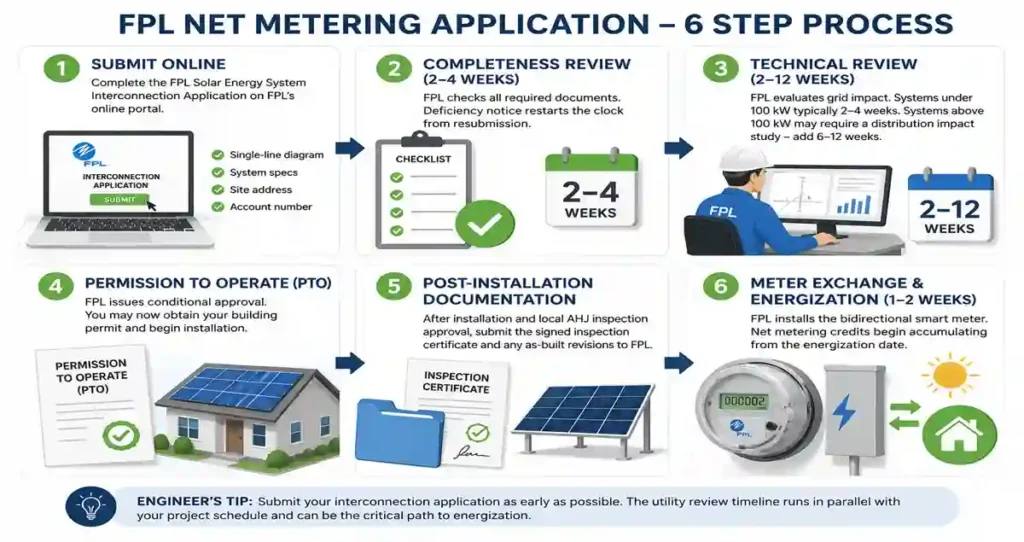
- Step 1 — Submit online: Complete the FPL Solar Energy System Interconnection Application on FPL’s online portal. Required: single-line diagram, system specs (panel model, quantity, inverter model, AC kW output, DC capacity), site address, utility account number.
- Step 2 — Completeness review (2–4 weeks): FPL checks all required documents. Deficiency notice restarts the clock from resubmission. Most common deficiency: single-line diagram does not meet FPL’s current format requirements. Download the current template from FPL’s portal — it updates periodically.
- Step 3 — Technical review (2–12 weeks): FPL evaluates grid impact. Systems under 100 kW typically 2–4 weeks. Systems above 100 kW may require a distribution impact study — add 6–12 weeks.
- Step 4 — Permission to Operate (PTO): FPL issues conditional approval. You may now obtain your building permit and begin installation.
- Step 5 — Post-installation documentation: After installation and local AHJ inspection approval, submit the signed inspection certificate and any as-built revisions to FPL.
- Step 6 — Meter exchange and energization (1–2 weeks): FPL installs the bidirectional smart meter. Net metering credits begin accumulating from the energization date.
| Field Note: FPL’s net metering credit statement can be difficult to audit manually — particularly for commercial accounts with TOU rates, demand charges, and power factor adjustments. AI credit monitoring platforms automatically cross-reference your system’s production data against FPL’s billing statement to flag discrepancies. Billing errors in the first 6 months of net metering operation are more common than most installers acknowledge. |
AI Solar Monitoring for Net Metering Compliance
Beyond financial optimization, AI monitoring platforms provide three compliance-specific functions that directly protect your net metering credit stream:
- Credit calculation verification: AI platforms store your system’s export data from the inverter monitoring system and cross-reference it against the utility’s metered export data in your billing statement. Discrepancies — meter read errors, wrong rate application, missed export registration — are flagged automatically. Billing discrepancies occur in 3–5% of net metering accounts in the first year of operation.
- Interconnection compliance monitoring: Most utility interconnection agreements require the solar system to operate within specific voltage and frequency ranges and comply with anti-islanding response time requirements. AI monitoring platforms log operational data against these thresholds continuously, providing documentation if a utility ever questions compliance.
- Export cap enforcement: Some programs and commercial interconnection agreements limit maximum export capacity to a percentage of the system’s rated output or customers’ peak demand. AI platforms enforce these export caps dynamically, curtailing inverter output when export approaches the permitted limit — preventing interconnection violations.
| AI Insight: In states with frequently changing net metering tariffs — California, Nevada, Arizona, Florida — AI monitoring platforms that subscribe to utility rate updates can automatically reconfigure optimization schedules when credit rates change, without requiring manual reprogramming. For commercial operators managing multiple sites under different utility tariffs, a single AI platform dashboard can show real-time optimization status, credit accumulation, and compliance indicators across all sites simultaneously. |
What to Ask Your Solar Installer Before Signing
- ‘What is the current interconnection queue timeline?’ A six-month installation timeline that ignores a four-month utility queue is not realistic.
- ‘Are you sizing this system for net metering or net billing?’ The answer should reflect your utility’s current export credit structure, not a generic industry assumption.
- ‘Will this system be grandfathered under the current tariff?’ The interconnection application date — not the installation date — often determines which tariff applies.
- ‘Does the inverter and monitoring platform support AI optimization for my utility’s rate structure?’ Key in states with TOU rates or net billing. Not all inverter monitoring platforms support rate-aware AI optimization.
- ‘How will you validate my net metering credits in the first year?’ Billing discrepancies are common in the first 6 months. Ask whether the monitoring system can automatically cross-reference production data against utility billing.
Key Takeaways
- 34 states have mandatory net metering as of 2026. Credit rates, system limits, and excess credit rules vary significantly.
- FPL customers interconnected before January 2024 are grandfathered at full retail-rate net metering through December 2029. New FPL customers receive a declining netting rate.
- AI monitoring platforms cross-reference inverter production data against utility billing, flagging credit errors common in the first 6 months after interconnection.
- States with time-varying net billing rates show the highest AI optimization value — up to 3× improvement in export credit rates through intelligent timing.
- Submit commercial interconnection applications on day one — the utility review timeline is your longest lead item.
Related guides: Net Metering Complete Guide · Net Metering vs Net Billing · NEM 3.0 Guide · AI Solar Optimization Guide · Commercial Solar Installation Guide