
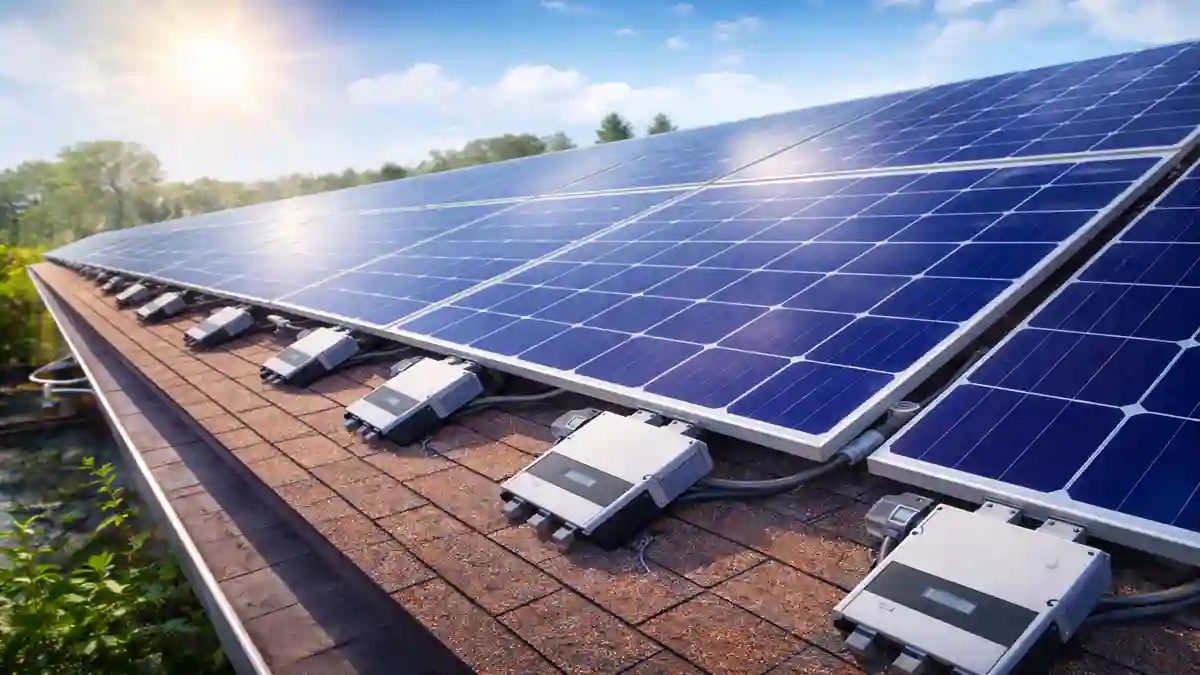
Discover why the solar micro inverter is the 2026 standard for solar efficiency. Compare microinverters vs. string inverters, explore AI optimization, and maximize your ROI.
Solar energy has become more accessible and efficient thanks to technological innovations. One of the most impactful innovations is the microinverter. Unlike traditional string inverters, which rely on a single device to convert DC electricity from all solar panels to AC, microinverters operate at the panel level. This fundamental difference changes everything about how solar power systems perform, especially when conditions aren’t perfect.
This guide will help you understand microinverters in depth, covering everything from basic operation to future trends. Whether you’re considering a residential rooftop system or a commercial solar setup, this guide provides the insights you need to make an informed decision.
Key Takeaways
- Microinverters convert DC electricity to AC at the solar panel level, maximizing energy output by allowing each panel to work independently
- Solar micro inverters minimize the effects of shading, panel mismatch, or dirt accumulation, so a problem with one panel doesn’t drag down your entire system
- Grid-tie micro inverters allow excess energy to be sent back to the electrical grid, lowering your electricity bills through net metering
- Selecting the right microinverter depends on your roof layout, shading conditions, and future expansion plans
- Proper maintenance and monitoring can extend the life of your system and maximize your return on investment
- Microinverters paired with a Home BESS allow homeowners to store excess energy, maximize self-consumption, and reduce reliance on the grid
What Is a Micro Inverter?
A micro solar inverter is a compact electronic device attached directly to a single solar panel. Its job is to convert the direct current (DC) electricity generated by that panel into alternating current (AC) electricity that your home and the electrical grid can actually use. Think of it as a tiny power plant for each solar panel on your roof.
This approach stands in stark contrast to traditional string inverters, where all panels are connected in a series like old-fashioned Christmas lights, feeding their combined DC power to a single central inverter. With microinverters, each panel operates completely independently. If a leaf falls on one panel, only that panel’s production drops. The rest of your array continues to operate at full capacity.
Why microinverters matter:
- Each panel produces maximum power regardless of what’s happening with the other panels
- They provide panel-level monitoring, so you can see exactly how every panel performs through a smartphone app
- This makes it easy to detect issues early, before they cost you significant energy production
- Microinverters often come with 20 to 25-year warranties, matching the lifespan of solar panels themselves
Microinverters are ideal for complex rooftops where panels face multiple directions or where partial shading from chimneys, trees, or neighboring buildings is unavoidable. In these situations, they don’t just perform better than string inverters; they completely transform what’s possible with solar energy.
How Solar Micro Inverters Work
Understanding how solar micro inverters work helps explain why they’re so effective at improving energy efficiency and safety.
Here’s what happens every second the sun is shining:
- Your solar panels generate DC electricity from sunlight through the photovoltaic effect
- The microinverter attached to each panel immediately converts that DC electricity to AC electricity right at the panel level
- This AC electricity flows through standard wiring to your home’s electrical panel to power your lights and appliances
- Monitoring software tracks the output of each panel individually and reports this data to you through a user-friendly interface
Why this panel-level approach matters:
- If one panel is shaded, covered with leaves, or underperforming, the other panels continue operating at full capacity
- In a string inverter system, that single underperforming panel would drag down the performance of every panel connected to the same string
The safety advantage:
- Because conversion happens right at the panel, the wiring across your roof carries lower-voltage AC rather than high-voltage DC
- This dramatically reduces fire risk and makes the system safer for firefighters and maintenance workers
Pro tip: Microinverters are particularly effective on rooftops with partial shading or complex layouts with dormers and valleys. If your roof looks like a puzzle rather than a perfect rectangle, microinverters are likely your best option.
Understanding Inverter Micro Systems
An inverter micro system uses multiple microinverters, each connected to a single panel or sometimes to a pair of panels. This distributed architecture creates a system that performs better and provides more detailed monitoring than traditional string inverters.
The advantages:
- Panel-level efficiency – Each panel operates independently, maximizing overall performance
- Scalability – Adding new panels is straightforward. You simply install new panels with their own microinverters and connect them to existing AC wiring
- Reliability – No single point of failure. If one microinverter fails, the rest of your system keeps producing power
Micro Inverter Solar Setup Explained
A micro inverter solar system differs fundamentally from a traditional string inverter system in both design and operation.
Key features:
- Each solar panel has its own microinverter attached directly to its frame
- Panels facing different directions or experiencing partial shading still produce energy efficiently because each panel’s output is optimized independently
- Real-time monitoring allows you to track performance per panel, identifying issues immediately
- The modular design simplifies both installation and future expansion
The advantages:
- Optimized energy yield from every square foot of your roof
- Low-voltage AC wiring reduces fire risk and eliminates specialized DC components
- Easier troubleshooting, often remotely through software updates
- Flexibility to integrate with battery storage in the future
Consider a typical residential scenario. Imagine a house with panels on both south-facing and east-facing roof sections. The south panels produce all day, while the east panels produce mostly in the morning.
With microinverters: Each panel works independently, maximizing power production despite different sun exposure.
With a string inverter, east-facing panels would reduce the output of south-facing panels because the lowest-performing panel limits the entire string.
How Microinverters Are Transforming Residential Solar Systems
Microinverters operate at the panel level, unlike traditional string inverters that convert power from all panels through a single device. This approach maximizes energy production, improves safety, and makes monitoring easier—especially on complex or partially shaded rooftops.
Case Study: Residential Solar in San Diego, California
A 20-panel rooftop system with partial tree shading used microinverters. Over six months, it produced 7% more energy than a nearby string inverter system and allowed homeowners to monitor each panel individually, reducing maintenance issues.
| Feature | Microinverter | String Inverter |
|---|---|---|
| Power Output | Each panel is independent; shading on one panel does not affect the others | One underperforming panel reduces the output of the entire string |
| Monitoring | Panel-level monitoring via app or web portal | Limited to the overall system output |
| Safety | Low-voltage AC across the roof, reduced fire risk | High-voltage DC wiring requires extra safety components |
| Maintenance | Early detection of issues; easier troubleshooting | Difficult to identify individual panel problems |
| Rooftop Compatibility | Ideal for shaded, multi-directional, or complex layouts | Best for uniform, unobstructed rooftops |
| Warranty | Often 20–25 years, matching panel lifespan | Usually shorter than microinverters |
From an engineer’s perspective, microinverters are highly efficient and safer, making them the preferred choice for modern residential solar installations, especially in urban or shaded areas.
Solar Panel Micro Inverter Types and Applications
Microinverters come in several types to suit different applications and system sizes.
| Type | Best For | Key Benefit | Warranty |
|---|---|---|---|
| Standard | Residential rooftops | Panel-level independence | 20–25 yrs |
| Dual/Multi | Commercial or high-power panels | Supports 2 panels or one high-wattage panel | 20–25 yrs |
| Grid-Tied | Homes & offices | Feed excess energy to the grid | 20 yrs |
| Hybrid | Off-grid + grid | Battery integration | 20–25 yrs |
A standard solar micro inverter connects to a single solar panel, providing complete independence and optimization. Ideal for homes with shading or multiple roof orientations.
Dual or multi-microinverters work for medium commercial applications or modern high-power residential panels, reducing equipment costs while providing panel-level benefits.
Grid-tied microinverters feed excess energy back to the utility grid, synchronizing perfectly with grid power. The standard choice for most installations.
Hybrid microinverters work with both grid-tied systems and battery storage, managing power flow between panels, batteries, home loads, and the grid.
Common applications:
- Residential rooftops with shading or multiple orientations
- Suitable for commercial buildings, warehouses with complex roofs, industrial solar installations, and school solar projects where flexible design, scalability, and reliable performance are essential.
- Solar carports and parking lots
- Hybrid systems with energy storage
Practical tip: For rooftops with significant shading, standard microinverters per panel are strongly recommended. For large, unshaded commercial roofs, dual microinverters can reduce wiring complexity while maintaining excellent performance.
Grid Tie Micro Inverters: Benefits and Selection
Grid tie micro inverters connect solar systems to the electrical grid, creating two-way power flow. When your panels produce excess electricity, it flows back to the grid, spinning your meter backward and earning credits through net metering.
Benefits:
- High system efficiency from every panel on your roof
- Reduced fire risk with low-voltage AC wiring throughout
- Panel-level monitoring to spot problems immediately
- Reliable performance even in shaded or partially obstructed rooftops
How to choose the right grid tie micro inverter:
- Match output capacity to your panel’s wattage – An undersized inverter clips production on sunny days. An oversized inverter adds cost without benefit
- Select reputable brands with solid warranties – Look for 20-25 year warranties from proven manufacturers
- Consider future expansion – Choose a platform that makes adding panels simple
- Think about battery integration – If you might add storage later, choose a brand that supports it
Grid tie microinverters maximize financial returns from your solar investment through net metering and performance optimization.
Microinverters vs String Inverters
This is one of the most important decisions when designing a solar system.
| Feature | Microinverter | String Inverter |
|---|---|---|
| Installation | One per panel | Single central unit |
| Shading impact | Minimal – only the shaded panel is affected | High – entire string affected |
| Monitoring | Panel-level | System-level |
| Scalability | Easy – just add panels | Limited – must work within inverter constraints |
| Cost | Higher upfront | Lower upfront |
| Long-term cost | No replacement needed | Needs 1-2 replacements over system life |
| Reliability | High redundancy | Single point of failure |
| Safety | Low-voltage AC wiring | High-voltage DC wiring |
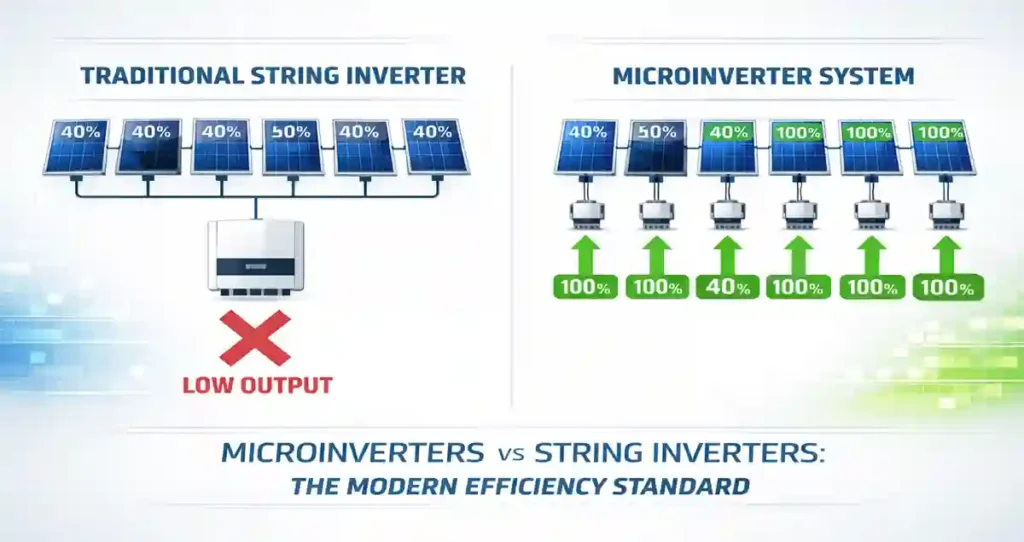
Installation: Microinverters mean more components but simpler wiring. String inverters mean less equipment but higher-voltage DC wiring needing extra safety gear.
Shading impact: With microinverters, only shaded panels are affected. With string inverters, shading on any panel reduces output of every panel in that string.
Monitoring: Microinverters show the performance of every panel. String inverters show only total system output, so you might not know a panel has failed until bills increase.
Cost: Microinverters cost more upfront, but avoid replacement costs. String inverters cost less initially but typically need replacement once or twice over 25 years.
Recommendation:
- Choose a solar micro inverter for roofs with shading, multiple orientations, or complex layouts
- String inverters may work for simple, uniform roofs with no shading, but offer less flexibility and monitoring
Benefits of Using Micro Inverters
- Higher energy yield – Each panel works independently, maximizing output from every square foot of roof space
- Enhanced safety – Low-voltage AC wiring reduces fire risk and meets modern code requirements for rapid shutdown
- Panel-level monitoring – Quickly detect underperforming panels and address issues before they cost you money
- Long lifespan – Most microinverters last 20-25 years, matching panel warranties and avoiding mid-life replacement costs
- Future-ready design – Compatible with battery storage and emerging AI-powered optimization platforms
These benefits explain why microinverters have become the preferred choice for so many solar installations, delivering better results from day one and continuing for decades.
How to Select the Right Micro Inverter
- Roof size and panel layout – Ensure the microinverter handles your specific configuration
- Shading and orientation – Microinverters excel on shaded or complex roofs with multiple directions
- Power rating matching – Match the inverter AC output to the panel DC wattage. Undersizing clips production; oversizing adds cost without benefit
- Brand and warranty – Choose trusted manufacturers with 20-25 year warranties and proven track records
- Expansion potential – If you might add panels later, choose a platform that makes expansion simple
- System type – Decide between grid-tied or hybrid if you plan battery storage now or in the future
Taking time to choose correctly ensures maximum efficiency, safety, and return on investment.
How to Maintain Your Solar Microinverter System
Proper maintenance ensures your solar microinverters and panels operate at peak efficiency. Key steps include:
- Monitor performance regularly – Use manufacturer apps to spot underperforming panels quickly
- Clean panels periodically – Especially in areas with low rainfall or high dust. Use solar cleaning brushes, solar cleaner agents, or professional solar panel cleaning services for safe and effective results
- Inspect microinverters – Check for signs of wear or damage during solar panel cleaning. Quality units often last 20+ years
- Manage vegetation – Keep trees, shrubs, and other plants trimmed to prevent shading on your array
Regular cleaning and monitoring help maximize energy output, extend system lifespan, and reduce maintenance costs for your solar installation.
Compatibility and Integration with Other Solar Components
Microinverters don’t just improve panel-level efficiency—they also integrate smoothly with the rest of your solar system. Here’s how they work with common solar components:
Solar Panels
- Microinverters attach directly to each panel and support most PV panels using MC4 connectors, handling varying wattages and orientations.
- Monocrystalline Panels – High efficiency, ideal for limited roof space
- Polycrystalline Panels – Cost-effective and reliable
- Bifacial Panels – Capture sunlight on both sides; great for shaded areas
- Thin-Film Panels – Lightweight and flexible; performs well in low light
- Topcan Solar Panels – High-quality and consistent output; a perfect choice with microinverters
- Using the right panels ensures maximum energy production, easy monitoring, and long-term reliability
Solar Batteries
- Converts DC to AC at the panel, which allows AC-coupled battery systems to store energy efficiently
- Compatible with popular battery brands like Tesla Powerwall, LG Chem, and Sonnen
- Ensures energy storage continues even if one panel underperforms
Solar Inverters (Hybrid Systems)
- Can work alongside central or string inverters in hybrid configurations
- Some microinverter systems allow grid-tied or off-grid operation, giving flexibility for expansion
- Pairs effectively with a hybrid inverter, enabling smart energy management, reliable backup power, and greater energy independence
Monitoring & Control Systems
- Panel-level monitoring feeds into home energy management systems
- Compatible with mobile apps and web portals
- Can integrate with smart home systems for optimized energy usage
Safety & Wiring
- Uses standard AC wiring instead of high-voltage DC, reducing fire risk
- Connects with other components using standard electrical junctions and breakers
In short, microinverters are highly compatible with the main solar components, making them ideal for flexible, expandable, and safe solar installations, whether your goal is energy storage, grid-tied systems, or hybrid setups.
Electrical Code & Electric Shock Warning for Microinverter Hybrid Systems
Electrical Code Compliance
- Installation must comply with all applicable local electrical codes and standards such as NEC or IEC regulations.
- The system must meet utility grid interconnection requirements when connected to the public power supply.
- Microinverters and hybrid inverters must carry recognized safety certifications such as UL or IEC approval.
⚠️ Electric Shock Warning
- Microinverter systems generate live AC voltage whenever exposed to sunlight.
- Disconnect AC supply and follow proper lockout procedures before servicing.
- Never touch exposed conductors or terminals while the system is energized.
- Improper installation can result in severe electric shock, injury, or death.
- Installation and maintenance should only be performed by qualified and licensed electricians.
How AI-Powered Microinverters Optimize Solar Efficiency
Modern microinverters are evolving with AI-powered energy management, making solar systems smarter, safer, and more efficient. Here’s how:
- AI-powered energy management – Algorithms analyze weather forecasts and household consumption patterns to maximize energy production and usage
- Smart grid integration – Advanced grid support features can generate revenue through utility programs
- Remote monitoring and updates – Manufacturers can diagnose issues and push software improvements without onsite visits
- Hybrid battery integration – Seamless integration with storage systems provides backup power and energy independence
By combining solar microinverters with AI technology, homeowners can minimize electricity bills, optimize system performance, and take full advantage of renewable energy.
Conclusion
Solar micro inverters are the ideal choice for maximizing efficiency, safety, and panel-level monitoring in solar energy systems. The technology has matured significantly, delivering reliable performance and excellent financial returns.
Proper selection, professional installation, and routine maintenance ensure your system performs reliably for decades. The higher upfront investment pays dividends through increased energy production, better monitoring, and enhanced safety.
Ready to see if microinverters are right for your roof? Consult with qualified local installers who can assess your specific situation and provide tailored proposals for your home and energy needs.
FAQs About Microinverters
What is the lifespan of a solar micro inverter?
Most last 20-25 years, matching solar panel warranties.
Can I upgrade from string to micro inverters?
Yes, but ensure compatibility with your panel type and voltage. Consult a professional.
Are microinverters worth the extra cost?
For most installations, yes. Energy yield, monitoring, and long-term reliability outweigh upfront costs.
Can solar micro inverters work with battery storage?
Yes, hybrid microinverters are specifically designed for seamless battery integration.
Do solar micro inverters help with shaded roofs?
Absolutely. Only shaded panels are affected; the rest operate at full capacity.
Are microinverters safe?
Yes, safer than string inverters. Low-voltage AC wiring reduces fire risk significantly.
Are microinverters harder to install than string inverters?
No, microinverters are not harder to install for qualified professionals. They use AC wiring instead of high-voltage DC strings, which can simplify system design and improve installation safety.
Do I need microinverters if my roof has no shading?
Even on unshaded and perfectly oriented roofs, microinverters provide panel-level monitoring, improved system safety, and easier future expansion. These benefits can add long-term value beyond shading optimization.