
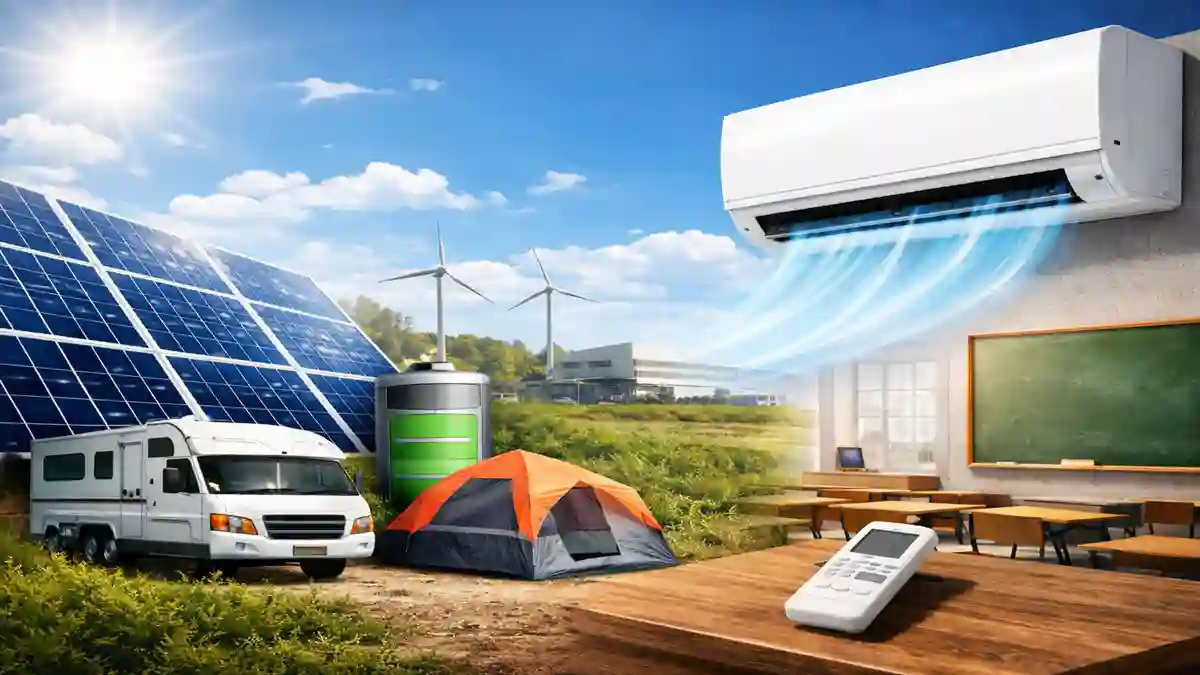
Reduce cooling costs by 80% with this expert guide to solar air conditioner systems. A registered engineer breaks down AI optimization, ROI, and how to choose the right solar powered air conditioner for any facility
A solar air conditioner for home use does exactly what it sounds like: it keeps you cool using energy from the sun rather than relying entirely on expensive grid electricity. By combining high-efficiency cooling systems with properly sized solar panels, you can power your AC using clean, renewable energy and significantly reduce your monthly utility bills.
And honestly? It’s one of those upgrades that makes both financial and environmental sense.
In this guide, I’m sharing everything I’ve learned designing these systems. How they work, which type actually fits your situation, what installation involves, how to size your solar panels correctly, and the part everyone really wants to know: how quickly you’ll recoup your investment.
Let’s get into it.
Solar Air Conditioner Buying Guide
Choosing the right solar air conditioner depends on the size of the room, cooling capacity, and application. Use this guide to pick the most suitable system for your home, office, school, or industrial space:
Buying Guide Table: AC Size and Capacity
| AC Type | Cooling Capacity | Recommended Room Size | Ideal Applications | Notes |
|---|---|---|---|---|
| Mini Split Solar AC | 1 Ton (12,000 BTU) | Up to 150 sq. ft. | Small rooms, offices | Efficient for bedrooms or small apartments |
| Split Solar AC | 1.5 Ton (18,000 BTU) | 150–250 sq. ft. | Medium rooms, homes | Ideal for living rooms or solar air conditioner for home |
| Window Solar AC | 1.5 Ton (18,000 BTU) | 150–250 sq. ft. | Offices, classrooms | Easy installation; requires window space |
| Portable Solar AC | 1 Ton (12,000 BTU) | 100–150 sq. ft. | RVs, camping, off-grid | Compact, mobile, runs on battery or direct solar |
| Full-Home Solar AC | 2 Ton (24,000 BTU) | 250–400 sq. ft. | Large homes, industrial spaces | High-capacity air conditioner for solar power, requires multiple panels |
Tips for Buyers:
- Consider battery backup for nighttime or cloudy day operation.
- Match Topcon bifacial solar panels or equivalent to AC capacity for reliable cooling.
- Check SEER/EER efficiency ratings to maximize energy savings.
- For off-grid living, choose portable or split systems with battery storage.
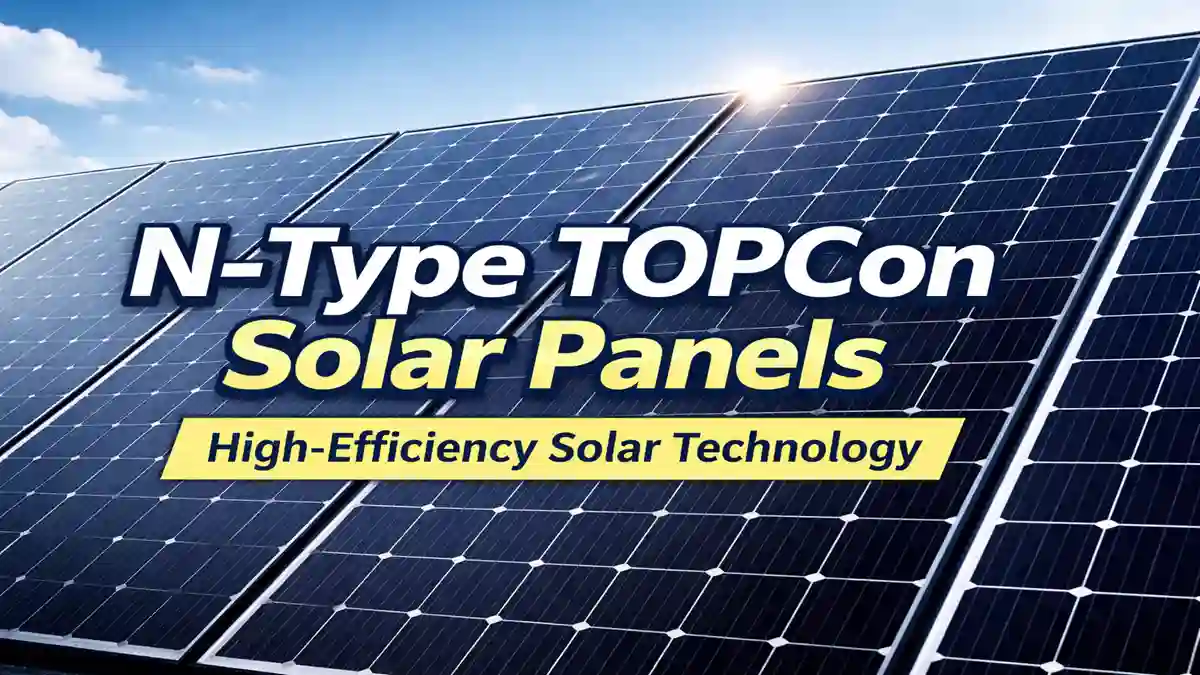
This solar air conditioner buying guide helps you select the right unit for your needs, whether it’s a solar air conditioner for home, office, school, industrial space, or off-grid setup.
How a Solar Powered Air Conditioner Actually Works
Here’s the thing about solar ACs – they’re not complicated magic, just smart engineering. A regular AC and a solar powered air conditioner use the same compressor-and-refrigerant technology to cool your space. The difference? Where the electricity comes from.
Think of it like this: your regular AC constantly reaches for the grid’s cup. A solar AC brings its own energy source, only sipping from the grid when necessary.
Here are the parts that make it happen:
1. Solar Panels
These sit on your roof, soaking up sunlight, turning it into DC electricity. Panel quality, tilt angle, and daily sun hours all matter here. Good panels = more free electricity for your air conditioner for solar power setup.
2. Inverter / Controller
This is the brain. Most homes run on AC electricity, but panels produce DC. The inverter converts DC to AC so your standard AC unit can use it. It also manages where power flows – panels to AC, panels to batteries, batteries to AC. Keeps everything from overloading.
3. The AC Unit Itself
This is the part that actually cools your room – compressor kicking on, fans spinning, cold air blowing. Whether it’s a mini-split or window unit, it behaves exactly like any other air conditioner, except now it’s running on sunshine.
4. Battery Backup (Optional But Worth It)
During the day, your panels might produce more power than your AC needs. Without batteries, that excess goes to waste. Add batteries, and you store that extra energy for nighttime or cloudy days when your solar air conditioner for home would otherwise need grid power.
Why Batteries Make Sense
| Benefit | What It Means For You |
|---|---|
| Cooling after dark | Run your AC all night on stored solar energy |
| Grid independence | Less vulnerable to rate hikes and outages |
| Emergency backup | Stay comfortable even when the neighborhood loses power |
The Energy Flow Is Simple:
Sunlight → Solar Panels → Inverter → Your AC → Cool room
↘ Batteries → Inverter → Your AC (at night)
DC vs AC vs Inverter-Based: Which One for Your Home?
This is where people get confused. Let me break it down in plain language.
1. Regular AC (Grid-Powered)
What it is: The standard AC you probably have right now. Plugs into the wall, pulls from the grid, and runs up your bill every summer.
Best for: Homes with cheap electricity where the upfront cost is the only consideration.
The catch: Zero solar compatibility unless you add an external inverter system. And those electricity bills? Only going up.
2. DC Solar Air Conditioner
What it is: A specialized AC that runs directly on DC power from panels or batteries. No conversion needed, which means less energy loss. Common in portable solar air conditioner designs.
Best for: Small spaces, RVs, cabins, off-grid living. Think portable, lightweight, efficient.
The good: Higher efficiency because you skip the DC→AC conversion step. Perfect for solar-powered camping or tiny homes.
The trade-off: Limited cooling capacity. Won’t cool your whole house.
3. Inverter-Based Solar Air Conditioner
What it is: This is the sweet spot for most homeowners. Standard AC unit plus an inverter that lets it run on solar power. Can integrate with batteries and the grid seamlessly. The ideal solar air conditioner for home setups.
Best for: Homes and offices where you want full cooling capacity with maximum energy savings.
The good: Works with regular AC units you’re already familiar with. Significant long-term savings. Can be sized for any space.
The trade-off: Slight energy loss during conversion (5-10%). Higher upfront cost than a basic DC unit.
Side-by-Side Comparison
| Feature | Regular AC | DC Solar AC | Inverter-Based Solar AC |
|---|---|---|---|
| Power source | Grid only | Solar panels / batteries | Solar → inverter → AC |
| Runs directly on solar? | ❌ No | ✅ Yes | ❌ Needs inverter |
| Energy efficiency | Standard | High (no conversion loss) | Medium-high (slight loss) |
| Installation | Simple | Medium | Medium-complex |
| Best use | Homes with cheap power | RVs, cabins, small spaces | Whole homes, offices |
| Upfront cost | Low | Medium | Higher |
| Long-term savings | None | High | High |
Types of Solar Air Conditioners: What Actually Works
Let me walk you through the main options so you can match the right type to your situation.
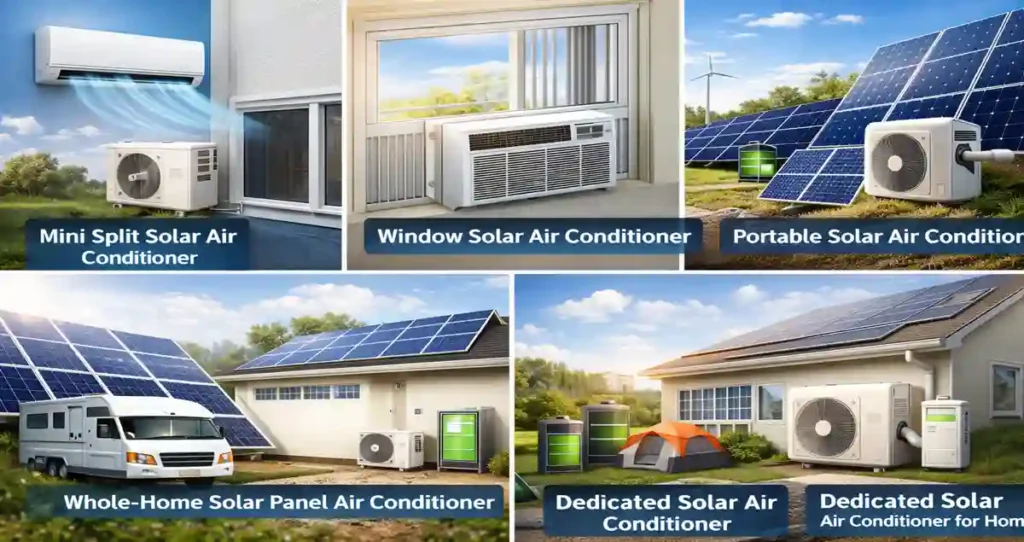
1. Mini Split Solar Air Conditioner
These are my favorites for most homes. Indoor unit mounted on your wall, outdoor condenser outside. They’re quiet, efficient, and let you cool specific rooms instead of wasting energy.
This style works great as a solar panel air conditioner setup when paired with 3-4 panels.
Installation tips from experience:
- Mount the indoor unit on the interior wall, away from direct sun
- Put the outdoor condenser in a shaded spot (runs more efficiently)
- Connect panels through a quality inverter
Pros: Whisper-quiet, excellent efficiency, zoned cooling
Cons: Professional installation, higher upfront cost
2. Window Solar Air Conditioner
Apartment dweller or just need one room cooled? This is your budget-friendly option. Slides right into a standard window opening. A practical solar air conditioner for home use when a whole-house system isn’t feasible.
What I’ve learned:
- Make sure your window frame supports the weight
- Panels can go on a balcony, a roof, or a ground-mounted nearby
- You’ll need an inverter unless you find a rare DC model
Pros: Affordable, easy install, can move between rooms
Cons: Blocks window light, only cools one space
3. Portable Solar Air Conditioner
For RVs, camping, workshops, rentals – anywhere you need flexibility. These roll-on casters set up quickly. The true portable solar air conditioner experience.
Making it work well:
- Position panels in full sun (obvious but crucial)
- Add battery backup for cooling after sundown
- Place near a window or vent for exhaust
Pros: Totally mobile, works off-grid, sets up in minutes
Cons: Limited cooling, shorter runtime without batteries
4. Whole-Home Solar Panel Air Conditioner
This is the full system – rooftop panels, inverters, battery bank, all designed to cool your entire home. A serious solar panel air conditioner installation.
From my experience:
- Get professional load calculation (don’t guess)
- Panel placement matters more than you think
- Quality ductwork makes a huge efficiency difference
Pros: Cools the whole house, maximum bill reduction, adds home value
Cons: Serious upfront investment, needs professional design
5. Dedicated Solar Air Conditioner for Home
For homeowners who want the sweet spot between cost and performance. Properly sized inverter-based system with enough panels to cover AC needs, plus maybe some batteries. The ideal solar air conditioner for home balance.
What works:
- Right-size AC for square footage (bigger isn’t always better)
- Panels in unshaded locations (trim those trees)
- Regular maintenance keeps efficiency high
Pros: 70-80% bill reduction, works with batteries for 24/7 cooling
Pros: Professional installation required
Why Bother? The Real Benefits
Let’s talk about why you’d actually do this.
1. Your Electricity Bills Drop. Significantly.
We’re talking 70-80% reduction in what you currently pay for cooling. If you’re spending $200/month running AC in summer, you might cut that to $40-60. That’s real money. An air conditioner for solar power pays for itself.
2. You’re Actually Helping the Planet
Every kilowatt-hour from solar is one the grid doesn’t have to generate – often from fossil fuels. A typical 1.5-ton solar powered air conditioner prevents about 1-2 tons of CO₂ emissions yearly. Like planting 50 trees. Every year.
3. Energy Independence Feels Great
Rising electricity rates? Power outages? Not your problem anymore – at least not for cooling. With batteries, you run your AC all night while the neighborhood grid is down. Real peace of mind.
4. The Math Actually Works
Yes, upfront cost is higher. But look at real numbers:
| AC Type | Typical Cost | Monthly Savings | Payback Period |
|---|---|---|---|
| Mini Split Solar | $1,200-1,500 | $50-70 | 2-3 years |
| Window Solar | $600-800 | $30-50 | 1.5-2.5 years |
| Portable Solar | $400-600 | $20-40 | 1-2 years |
| Whole-Home System | $3,500+ | $80-120 | 2-3 years |
After payback, your cooling is essentially free for the system’s life – 20+ years with quality panels.
5. They Work Everywhere
Homes, offices, RVs, workshops, schools – I’ve installed solar air conditioners for home systems and commercial setups in all of them. The technology is mature enough that there’s a solution for practically any situation.
Solar Air Conditioner AI Optimization
Modern solar air conditioner systems are getting smarter. With AI optimization, your solar powered air conditioner adjusts performance automatically based on real-time conditions.
How AI Improves Solar AC
- Smart Energy Management – Monitors solar panel output, battery levels, and cooling demand to optimize energy use.
- Predictive Cooling – Uses weather forecasts and usage patterns to pre-cool spaces efficiently.
- Load Optimization – Adjusts inverter-based compressor speed to save energy.
- Performance Monitoring – Detects drops in solar output or issues in inverters and AC components.
- Cost Optimization – Runs more during peak solar hours and less during high-tariff periods.
Why It Matters: AI can boost efficiency by 5–15%, extend system life, and improve ROI. Combining solar panels, battery storage, and AI is becoming the standard for high-performance cooling.
How Many Panels Do You Actually Need?
This is the question I get most often. Using modern 550W bifacial panels (capture light from both sides – clever engineering), here’s what you’re looking at for a solar panel air conditioner setup:
| AC Size | Panels Needed | What It’ll Cool |
|---|---|---|
| 1 Ton | 2-3 panels | Small bedroom, office |
| 1.5 Ton | 3-4 panels | Master bedroom, living room |
| 2 Ton | 4-5 panels | Large space, small apartment |
For a portable solar air conditioner, you might get away with 1-2 smaller panels, especially if you have battery backup.
Pro tip: Bifacial panels are worth the slight premium if you have a light-colored roof or ground-mount setup. That extra 5-15% production adds up over 25 years.
Installation & Maintenance: What I’ve Learned
Getting It Installed Right
- Panels go where the sun is. South-facing (north-facing in the southern hemisphere), tilted correctly, no shade.
- Inverter quality matters. Don’t cheap out here. A good solar inverter lasts longer and protects your system.
- Battery connections need to be solid. Loose connections cause voltage drops and wasted energy.
- Insulation before installation. Seal ducts, check attic insulation, then size your system. You might need less AC than you think.
Keeping It Running
- Panels need cleaning twice a year (more in dusty areas)
- AC filters every month during the cooling season
- Professional checkup annually – refrigerant, electrical connections like MC4 connectors
- Monitor system performance – sudden drops mean something’s wrong
Where People Use Solar ACs Right Now
Homes: Bedrooms, living areas, home offices – anywhere you need cooling without bill shock. The classic solar air conditioner for home application.
Offices: Small office installations. Owners love predictable costs and green cred.
RVs and Camping: Portable solar air conditioner units are game-changers for boondocking. Quiet cooling without firing up a generator.
Workshops and Garages: Working on projects? Solar AC makes hot afternoons bearable.
Schools: More classrooms get solar AC, keeping kids comfortable while teaching renewable energy by example.
Industrial Spaces: Warehouses, factories – savings add up fast cooling large areas.
How to Choose the Right System
Here’s my practical checklist:
- How big is your space? Measure square footage. Don’t guess.
- What’s your budget? Include installation, not just equipment.
- Do you have good sun exposure? Check for shade trees and nearby buildings.
- Do you want battery backup? Night cooling costs more upfront but adds independence.
- What are local electricity rates? Higher rates = faster payback.
- Are there incentives? Tax credits, rebates, utility programs – they change the math significantly.
Ready to Make the Switch?
Solar powered air conditioner technology isn’t experimental anymore. It’s proven tech that saves real money while reducing environmental impact. The upfront cost is higher than conventional AC, but the long-term math is hard to argue with.
My advice: Start with an honest assessment of your cooling needs and sun exposure. Get a couple quotes from licensed installers. Check available incentives in your area. And remember – the best system is properly sized for your actual situation.
Looking for a portable solar air conditioner for your RV? Consider a DC unit with battery compatibility. They’re simpler, more efficient, and perfect for off-grid adventures.
Frequently Asked Questions
Will a solar powered air conditioner run at night?
Only with battery storage. Without batteries, it’s daytime-only. With batteries, you’re cool 24/7.
How long until I break even on a solar air conditioner?
Most solar air conditioner systems reach payback in 2–3 years, depending on solar panel size and electricity rates. After that, the savings are essentially pure profit.
Can I use an air conditioner for solar power in my RV?
Absolutely. Portable DC units are perfect for RVs and camping.
Do I need special wiring for a solar air conditioner?
Yes. A solar air conditioner system with solar panels and inverter integration requires proper electrical wiring by a licensed electrician. It’s not a DIY project.
What size portable solar air conditioner do I need for camping?
For a small RV or tent, look for 5,000-8,000 BTU units. They’ll run on 1-2 panels.
Can I add solar to my existing AC?
Yes, with an inverter and panels. You don’t always need a whole new AC unit.
How long does a solar air conditioner last?
A solar air conditioner powered by quality solar panels typically lasts: panels 25+ years, inverter 10–15 years, AC unit 15–20 years, and batteries 5–15 years, depending on type and maintenance.
What happens to a solar air conditioner on cloudy days?
A solar air conditioner system automatically draws power from batteries or the grid when solar panel output drops. You’ll still have cooling—just with reduced solar contribution.