

What is a Solar Charge Controller?
A solar charge controller is the brain of any off-grid or hybrid solar setup. Positioned between your solar panels and battery, it regulates electricity flow, protects your battery, and optimizes energy use.
Think of it as the well-wisher of your battery life; it cuts off overcharging, prevents deep discharge, and ensures your battery lasts as long as possible.
Without a charge controller, even the highest-quality solar panels or batteries can fail prematurely, reducing efficiency and risking system safety.
In today’s solar setups, a charge controller is not optional; it is mandatory. It ensures that every watt of solar energy is managed intelligently for maximum performance and safety.
What a Solar Charge Controller Does
A solar charge controller is designed to be smart, protective, and efficient. Its key functions include:
- Voltage and current regulation: Ensures your battery receives exactly what it needs
- Overcharge prevention: Stops the battery from being overcharged, which can damage internal chemistry
- Deep discharge protection: Cuts off the battery from excessive draining, prolonging battery life
- Optimized charging stages: Handles Bulk, Absorption, Float, and Equalization in advanced models
- Reverse current protection: Prevents electricity from flowing back to the panels at night
- System protection: Guards against overloads, short circuits, and voltage spikes
- Enhanced efficiency: MPPT controllers adjust for maximum power output even under low sunlight
- Battery well-wisher role: Extends battery life, reduces maintenance, and ensures long-term reliability
What a Solar Charge Controller Cannot Do
- Does not convert DC to AC — that’s the inverter’s job
- Does not run appliances directly
- Does not replace a solar inverter
- Does not store electricity — batteries handle storage
- Does not increase battery capacity
- Does not fix wiring or shading issues
Key takeaway: The charge controller regulates and protects; it does not generate usable AC electricity.
Daily-Life Analogies of a Solar Power Charge Controller
Water Tank Analogy:
- Solar panels = water pump
- Battery = bucket
- Charge controller = smart tap
Without the smart tap, the bucket overflows. With it, water flows safely and efficiently.
Phone Analogy:
- Charging a phone with unregulated electricity can damage the battery
- The phone’s smart circuit protects the battery
- The solar charge controller does the same for your battery, but on a larger scale
These analogies make it clear: a charge controller is the guardian and regulator of your energy flow.
Simple Working of a Solar Charge Controller
A solar charge controller works like a smart gatekeeper between your solar panels and battery. Its main job is to manage the flow of electricity, protect your battery, and make sure your solar system runs efficiently and safely.
Step-by-Step Working in Simple Terms
- Solar panels generate DC electricity
- The panels capture sunlight and convert it into direct current (DC) electricity, ready to charge the battery.For complete setups, you can check our Solar Panel Kits
- Controller monitors battery voltage
- The charge controller constantly checks the battery’s voltage and adjusts the current.
- This prevents overcharging, which can damage or shorten the battery’s life.
- Regulates charging stages
Most controllers manage multiple stages of charging to ensure the battery is charged safely:- Bulk Stage: Battery receives maximum current until it reaches a preset voltage, quickly reaching ~80% charge.
- Absorption Stage: Charging slows to safely fill the remaining 20% of the battery.
- Float Stage: Maintains a low, steady voltage once fully charged.
- Equalization (Optional): Periodically balances the cells in deep-cycle batteries to ensure uniform performance.
- Prevents deep discharge
- Stops the battery from draining below a safe level, extending battery lifespan.
- Supplies regulated voltage to the load
- Ensures electricity delivered to appliances or inverter is stable and safe, protecting sensitive devices from voltage fluctuations.
- Optional MPPT function (for advanced controllers)
- Converts excess panel voltage into usable current to increase charging efficiency, especially under variable sunlight conditions.
Result
By managing these steps, the solar charge controller ensures:
- Your battery stays healthy
- Solar energy is used efficiently
- Appliances receive stable and safe DC power for the inverter to convert into AC
- Your system runs safely and reliably over the long term
Simple Circuit Block Diagram of a Solar Power System with Solar Charge Controller

Explanation of Flow:
– Solar Panels → Charge Controller: Generates DC power; controller regulates it.
– Charge Controller → Battery: Safely stores energy.
– Battery → DC Load: Powers appliances.
– Charge Controller Role: Protects battery from overcharge or deep discharge.
Solar Battery Charging Controller vs Inverter
| Feature | Charge Controller | Inverter |
| Main Purpose | Regulates DC charging | Converts DC to AC |
| Powers Appliances | ❌ No | ✔️ Yes |
| Connects To | Solar panels + battery | Battery + AC loads |
| Controls Battery Charging | ✔️ Yes | ❌ No |
| Provides AC Output | ❌ No | ✔️ Yes |
| Protects Against Overcharging | ✔️ Yes | ❌ No |
System Flow:
Solar Panels → Charge Controller → Battery → Inverter → Home Appliance
What Happens If You Skip a solar panel Charge Controller
- Batteries overcharge and fail prematurely
- Deep discharge shortens battery lifespan
- Reverse current damages solar panels at night
- System efficiency drops significantly
- Appliances fail due to voltage instability
- Risk of fire or short circuits increases
- Frequent, costly battery replacements
Skipping a charge controller is equivalent to leaving your battery unprotected against voltage and current fluctuations.
Types of Solar Charge Controllers
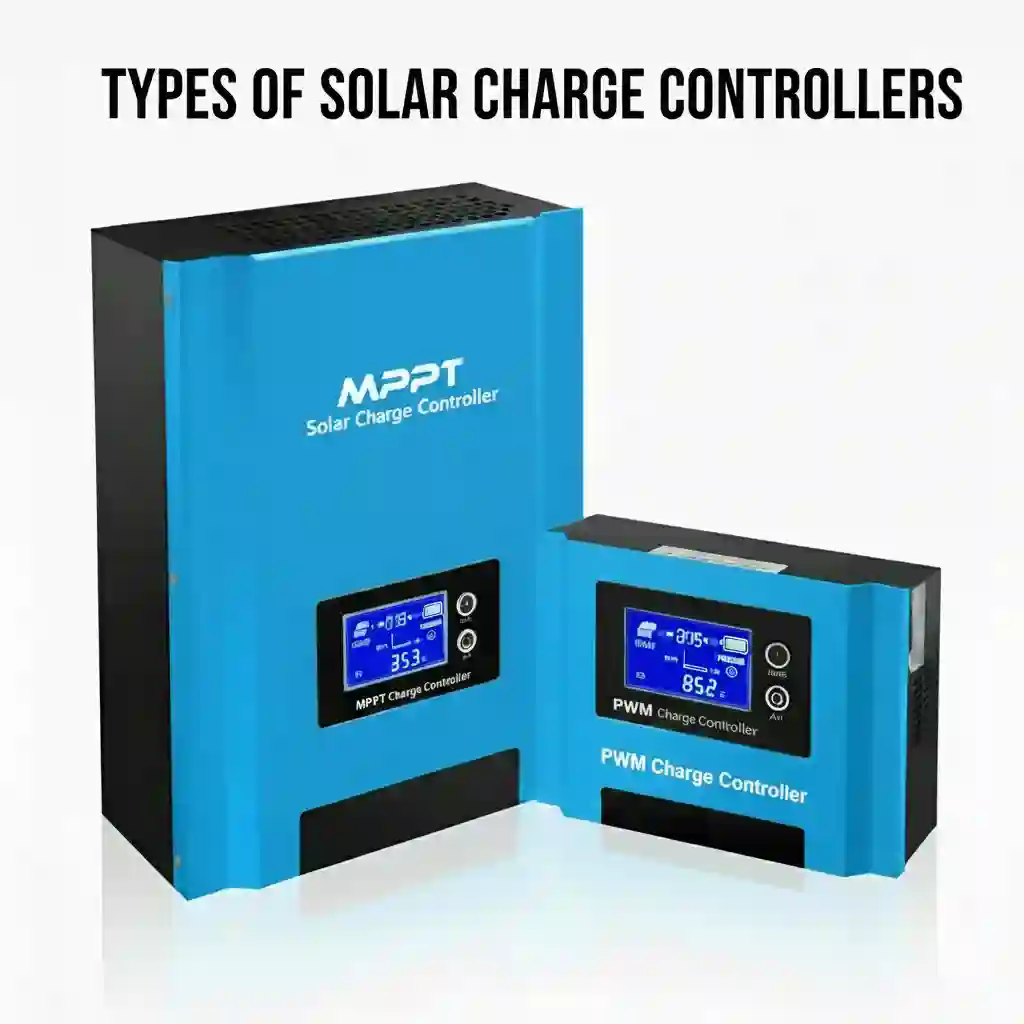
1. PWM (Pulse Width Modulation)
- Affordable, simple, ideal for small setups.
- The PWM controller forces the panel voltage to match the battery voltage.
- Efficient for low-voltage, small-scale systems.
- Less efficient for large solar arrays or mismatched panel/battery voltages.
2. MPPT (Maximum Power Point Tracking)
- Advanced, highly efficient
- Converts excess voltage into extra charging current
- Boosts efficiency by 10–30% (and up to 40% in cold weather or high-voltage arrays)
- Ideal for large systems or higher-voltage panels
- Can track and adapt to varying sunlight conditions
Pro tip: PWM is sufficient for small homes or RV setups; MPPT is necessary for medium to large installations for efficiency and battery health.
Modern Smart Solar Charge Controllers
Note: Modern smart solar charge controllers are available in both PWM and MPPT types. These controllers combine traditional charging methods with intelligent features like Wi-Fi/Bluetooth monitoring, real-time energy tracking, alerts, and advanced battery management, making them suitable for both small and large solar systems.
How to Select a Charge Controller for Solar Panel (With Basic Calculation)
Selecting the right solar charge controller is one of the most critical decisions in designing a safe and efficient solar power system. A properly sized controller not only protects your battery from overcharging and deep discharge but also maximizes the energy harvested from your solar panels. Using the wrong controller can reduce efficiency, damage your battery, and even shorten the lifespan of your entire solar setup.
Here’s a step-by-step guide to help you choose the perfect solar charge controller for your system:
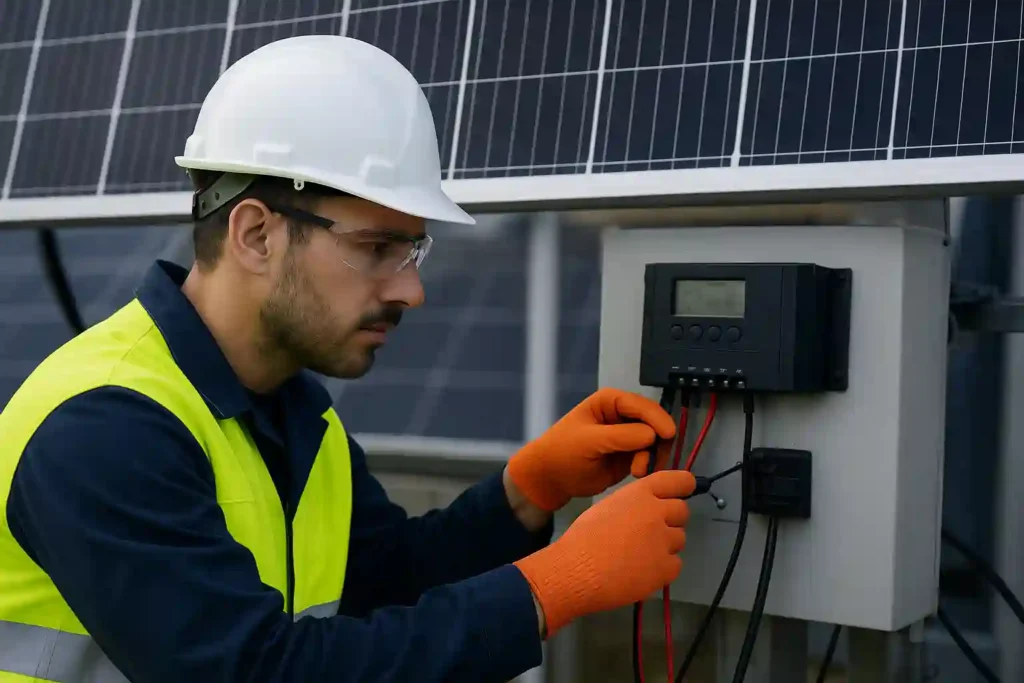
Step 1: Determine Your Solar Panel Current (Imp)
Every solar panel has a maximum current output, usually listed in its specifications as Imp (maximum power current).
Why it matters: The charge controller must be able to handle this maximum current to prevent overheating or failure.
Example:
- Solar panel rating: 100W, 12V
- Maximum current = 100 ÷ 12 = 8.33A
This is the baseline current your controller must safely manage.
Step 2: Add a Safety Margin
Sunlight intensity fluctuates during the day, and your system may expand in the future. To ensure reliability, always add 20–30% extra capacity to your calculated current.
Example:
- Calculated current: 8.33A
- Safety margin: 8.33 × 1.25 ≈ 10.41A
- Round up → 12A controller
This extra margin ensures your controller never operates at its absolute limit, prolonging its life and keeping your system safe.
Step 3: Match the Battery Voltage
Your solar charge controller must be compatible with your battery bank voltage. Common battery voltages are 12V, 24V, and 48V.
Example:
- Battery: 12V
- Controller: 12V
Selecting the correct voltage ensures proper charging, prevents battery damage, and guarantees system efficiency.
Step 4: Decide on the Controller Type
There are two main types of solar charge controllers:
- PWM (Pulse Width Modulation):
- Best for small systems with panel voltage close to battery voltage.
- Simple and cost-effective, ideal for 1–2 panel setups.
- MPPT (Maximum Power Point Tracking):
- Converts excess panel voltage into additional current for the battery.
- Higher efficiency, especially for larger systems or higher-voltage panels.
- Slightly more expensive, but worth it for maximizing energy output.
Tip: If you plan to expand your solar system or use multiple panels, an MPPT controller is a smart investment.
Step 5: Calculate Power Rating (Optional but Recommended)
Some manufacturers provide controller ratings in watts. This can help you cross-check your selection:
Formula:
Controller Wattage = System Voltage × Max Current
Example:
- System voltage: 12V
- Max current (with margin): 12A
- Required controller wattage = 12 × 12 = 144W → Choose a controller rated at least 150W
This ensures your controller can handle the total power without risk of overload.
Practical Example: Selecting a Controller for a Small 12V System
- Solar panels: 150W, 12V each (1 panel)
- Maximum current: 150 ÷ 12 = 12.5A
- Add 25% safety margin: 12.5 × 1.25 ≈ 15.6A
- Round up → 16A PWM controller
Tip: If you use multiple panels or higher voltage panels, an MPPT controller can significantly improve efficiency and extract more energy from your system.
Quick Reference Table: Solar Charge Controller Selection (100W–550W Panels)
Note: Solar panel size may vary depending on your design, but controller selection should always be based on total system current (amps). Always add a 20–25% safety margin to ensure reliability. PWM is suitable for small systems, while MPPT is recommended for larger or high-wattage systems.
| Solar Panel Setup | Max Current (A) | Controller Margin | Recommended Controller Type | Notes |
|---|---|---|---|---|
| 12V, 100W, 1 panel | 8.33 | 10–12A | PWM | Small system, 12V battery |
| 12V, 150W, 1 panel | 12.5 | 16A | PWM or MPPT | Small system, may use MPPT for slightly higher efficiency |
| 24V, 200W, 2 panels | 16.6 | 20A | MPPT | Medium system, 24V battery |
| 24V, 300W, 2 panels | 12.5 | 15A | MPPT | Medium system, MPPT recommended for efficiency |
| 24V, 400W, 2 panels | 16.6 | 20A | MPPT | Higher power, MPPT ensures optimal charging |
| 48V, 400W, 4 panels | 8.3 | 10A | MPPT | 48V system, MPPT needed |
| 48V, 550W, 1 panel | 11.5 | 14A | MPPT | High-wattage panel, MPPT required |
| 48V, 550W, 2 panels | 23 | 28A | MPPT | Two 550W panels, use MPPT for safe charging |
| 48V, 550W, 4 panels | 46 | 55A | MPPT | Larger setup, MPPT mandatory |
| 48V, 550W, 6 panels | 69 | 85A | MPPT | Multi-panel setup, MPPT ensures full utilization |
| 48V, 550W, 8 panels | 92 | 110A | MPPT | High-capacity system, MPPT ensures battery safety |
How to Use This Table
- Check Total Current: Add the currents of all panels in your system.
- Add Safety Margin: Increase total current by 20–25% for variations in sunlight or extra panels.
- Choose Controller Type:
- PWM for small systems (≤150W, 12V setups).
- MPPT for medium to large systems or high-wattage panels (≥24V or ≥400W).
- Ensure Battery Compatibility: Match controller voltage to battery voltage (12V, 24V, 48V).
For example:
Recommended Use Cases for Solar Charge Controllers
- Small homes: PWM controllers are cost-effective and reliable for small setups, such as a single 12V panel or a few panels totaling under 150W. They efficiently protect batteries while keeping installation simple.
- Medium to large solar systems: MPPT controllers maximize energy harvest, especially when panel voltage is higher than battery voltage. They improve efficiency by 20–30% compared to PWM, making them ideal for households or small commercial systems.
- Off-grid cabins, RVs, and boats: MPPT ensures consistent charging even in variable sunlight conditions, which is crucial for off-grid lifestyles where battery reliability is essential.
- Battery protection: Regardless of system size, charge controllers prevent overcharging and deep discharge. This prolongs battery life and ensures your investment in solar energy is safe.
- Remote locations: In isolated setups, charge controllers are critical to avoid battery failures. They automatically regulate voltage and current, ensuring reliable operation even when monitoring isn’t frequent.
Conclusion: The Heart and Well-Wisher of Your Solar System
A solar charge controller is the unsung hero of every solar installation. It ensures your solar energy is managed safely and efficiently:
- Regulates and protects: Maintains proper charging to prevent overcharging and deep discharge.
- Enhances battery life: Optimizes charging cycles to prolong battery lifespan.
- Ensures system efficiency: Works seamlessly with inverters and batteries to deliver stable power to appliances.
- Intelligent energy management: While solar panels capture energy, the charge controller decides how safely and efficiently that energy reaches your battery.
Without a charge controller, even the best panels and batteries cannot perform reliably. It is the intelligent heart and well-wisher of your battery system — no solar setup is truly complete without it.
FAQs About Solar Charge Controllers
1. Can I use a solar charge controller without a battery?
No. Charge controllers regulate battery charging. Without a battery, they cannot perform their function, and your solar energy cannot be stored or used safely.
2. Can a charge controller provide AC output?
No. It only regulates DC power. To get AC power for home appliances, you must use an inverter connected to the battery.
3. How do I choose the right size of charge controller?
Select a controller rated slightly higher than your total panel current, adding a 20–30% safety margin. MPPT controllers also consider voltage conversion, so they are ideal for higher-voltage setups.
4. What happens if my charge controller fails?
Batteries may overcharge, experience deep discharge, and system efficiency drops. This can lead to permanent battery damage and unsafe system operation.
5. Is MPPT always better than PWM?
MPPT is more efficient and ideal for larger or higher-voltage systems, as it can harvest more energy from your panels. PWM is sufficient for small, simple setups where cost is a priority.
6. Can I install a solar system without a charge controller?
No. Skipping a charge controller risks battery failure, reduces system safety, and shortens the lifespan of your solar components.
7. How does a charge controller extend battery life?
By cutting off overcharging, preventing deep discharge, and maintaining optimized charging cycles, it acts as the well-wisher of your battery, keeping it healthy and reliable.
8. Does a charge controller reduce energy production?
No. A quality controller optimizes energy use. MPPT controllers can actually increase total harvested energy by up to 40%, improving system efficiency.
9. Can multiple solar panels be connected to one charge controller?
Yes, as long as the total current of all panels does not exceed the controller’s rated capacity. Always calculate total current and add a safety margin before selecting a controller.
10. Are solar charge controllers maintenance-free?
Mostly, yes. However, occasional inspection of wiring, connections, and battery health is recommended to ensure optimal performance and prevent potential issues.
11. Can I use both DC and AC systems together in my solar setup?
Yes. Many solar setups use DC directly for lighting, pumps, or small appliances while using an inverter to supply AC for regular household appliances. Make sure your charge controller provides a regulated DC output for the DC loads, and the battery/inverter system is sized properly to handle AC loads.
12. What is a smart solar charge controller?
A smart solar charge controller regulates battery charging while offering features like remote monitoring, real-time data, alerts, and load control to optimize efficiency and battery life. Smart controllers are often required for modern LiFePO4 batteries because they enable the specific charging profile and voltage communication these batteries need.
13. Can a smart charge controller be PWM or MPPT?
Yes, smart controllers can use either PWM or MPPT charging methods. The “smart” part refers to features like monitoring and battery management, while PWM/MPPT defines how it charges the battery.