

Master Solar Charge Controller for Lithium Batteries Expert 2026 guide on MPPT sizing, CC/CV profiles, and critical 0°C cut-off for industrial & off-grid.
If you have invested in a lithium solar battery — whether LiFePO4, NMC, or any lithium-ion chemistry — the charge controller sitting between your solar panels and that battery is one of the most critical components in your entire system. Get it wrong and you will either undercharge your battery, shortening its capacity, or overcharge it, triggering the BMS protection and potentially causing permanent cell damage.
This guide covers everything an engineer or informed installer needs to know about selecting, sizing, and configuring a solar charge controller for lithium batteries — including the key differences from lead-acid settings that most generic guides completely miss.
What Is a Solar Charge Controller and Why Does It Matter for Lithium Batteries?
A solar charge controller regulates the voltage and current flowing from your solar panels to your battery bank. Without it, solar panels — which can produce voltages well above a battery’s safe charging threshold — would overcharge and destroy your battery within weeks.
For lithium batteries, the charge controller’s role is even more critical than it is for lead-acid. Lithium chemistry requires a precise Constant Current / Constant Voltage (CC/CV) charging profile. A controller configured for lead-acid will apply the wrong absorption voltage, wrong float voltage, and wrong temperature compensation settings — all three of which damage lithium cells at the electrochemical level over time.
The bottom line: a charge controller is not interchangeable between battery chemistries. Your lithium battery needs a controller explicitly set — or configurable — for lithium.
MPPT vs PWM Solar Charge Controller for Lithium Ion Battery
There are two types of solar charge controllers on the market. For lithium batteries, this choice is not a matter of budget — it is a matter of compatibility and performance.
PWM (Pulse Width Modulation)
PWM controllers work by rapidly switching the connection between the solar panel and the battery, reducing power delivery as the battery approaches full charge. They are simple, inexpensive, and reliable for small lead-acid systems. However, PWM controllers are not recommended for lithium battery systems for one fundamental reason: a PWM controller cannot step down the panel voltage. Your solar panel must already be producing a voltage close to your battery’s charging voltage for a PWM controller to function correctly.
A 12V LiFePO4 battery requires a charging voltage of 14.2–14.6V. On hot days, a standard panel’s output voltage drops — and a PWM controller cannot compensate, resulting in incomplete charging cycles. Over months, this causes chronic undercharging and premature capacity loss.
MPPT (Maximum Power Point Tracking) — The Correct Choice
An MPPT controller uses a DC-to-DC conversion circuit that continuously tracks the solar panel’s maximum power output point and converts excess voltage into additional charging current. This means an MPPT controller can accept a wide range of panel voltages — typically 12V to 150V input — and deliver precisely the right charging voltage and current to your lithium battery regardless of weather, temperature, or panel configuration.
The engineering advantages of lithium solar batteries are clear:
- 10–30% more energy harvested from the same panel array versus PWM
- Precise CC/CV charging profile maintained across all conditions
- Selectable lithium chemistry profiles — LiFePO4, NMC, NCA — with correct voltage thresholds
- No temperature compensation applied to lithium cells — which is correct, since LiFePO4 does not require it
- Compatible with higher panel voltages, enabling series panel strings for lower cable losses
Engineer’s Note: LiFePO4 batteries do NOT require voltage temperature compensation during charging. A charge controller applying temperature-compensated voltage to a lithium battery will overcharge it in cold conditions and undercharge it in heat. Always disable temperature compensation or select a lithium-specific profile.
MPPT vs PWM — Side-by-Side Comparison
| Factor | MPPT | PWM |
| Efficiency | 93–99% | 70–80% |
| Lithium compatible | Yes — dedicated LiFePO4 profile | Limited — voltage mismatch risk |
| Panel voltage input | Wide range — 12V to 150V+ | Must match battery voltage |
| Temp compensation | Disabled for lithium — correct | Applied — incorrect for lithium |
| Best for | All lithium systems — residential, off-grid, agricultural solar | Small lead-acid only |
| Cost | Higher upfront — lower cost per kWh over lifetime | Lower upfront — higher energy loss |
Correct Voltage Settings for Lithium Batteries
This is where most generic solar guides fail. Lithium iron phosphate batteries have a fundamentally different charge profile from lead-acid. Applying lead-acid voltage thresholds to a LiFePO4 battery will either overcharge or permanently undercharge it.
| Parameter | 12V LiFePO4 | 24V LiFePO4 | 48V LiFePO4 | Lead-Acid 12V (for reference) |
| Bulk / Absorption V | 14.2–14.6V | 28.4–29.2V | 56.8–58.4V | 14.4–14.8V |
| Float Voltage | 13.6V or NONE | 27.2V or NONE | 54.4V or NONE | 13.5–13.8V |
| Low Voltage Cut-off | 10.0–11.0V | 20.0–22.0V | 40.0–44.0V | 11.5–12.0V |
| Temp Compensation | DISABLED | DISABLED | DISABLED | Required |
Critical: LiFePO4 batteries do not require a conventional float charge stage. The engineering-preferred approach is one of two options:
(1) Set float to 13.6V — this equals the resting voltage of a fully charged LiFePO4 cell (3.4V per cell × 4 cells), meaning virtually zero current flows. Still, the BMS remains active, and communication with the charge controller is maintained.
(2) Disable float entirely and configure a Re-Bulk voltage of 13.2V — the controller sits idle until the battery self-discharges to 13.2V, then initiates a new charge cycle. Both approaches protect the cycle life. What to avoid: a float voltage above 13.8V on a LiFePO4 battery, which causes continuous micro-cycling and accelerates calendar ageing by keeping cells at a high state of charge unnecessarily.
How to Size a Lithium Battery Solar Charge Controller
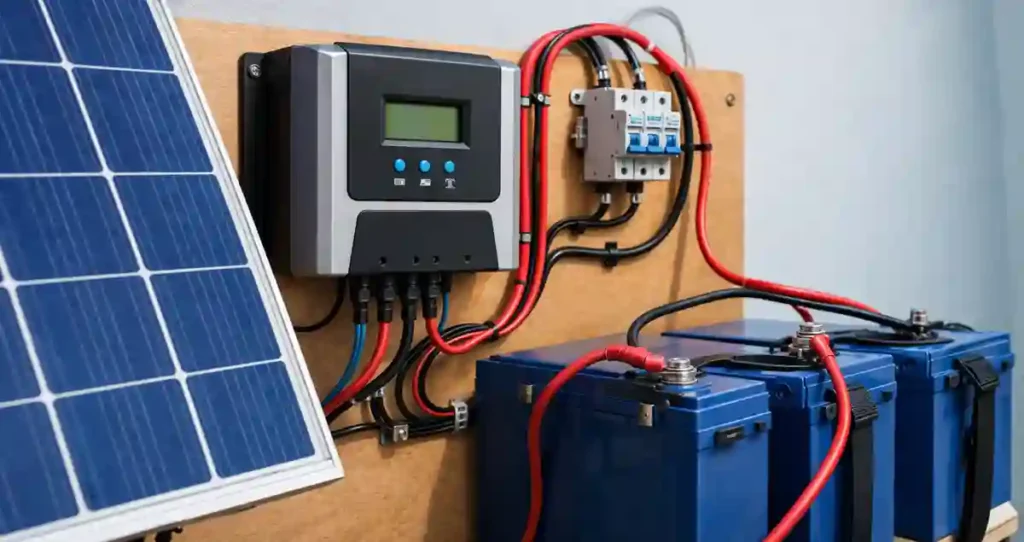
Correct sizing is a two-step engineering calculation. Undersizing causes controller overheating and system faults. Oversizing wastes budget without a performance benefit.
Step 1 — Calculate Minimum Controller Amperage
Use this formula:
Controller Amps = Total Solar Panels Array Watts ÷ Battery Bank Voltage
Example: A 1,200W solar array charging a 24V lithium battery bank: 1,200 ÷ 24 = 50A. Select a 60A MPPT controller to allow 20% headroom for safety and future panel expansion.
Step 2 — Verify Maximum Input Voltage
For MPPT controllers, check the maximum open-circuit voltage (Voc) of your panel string. On a cold morning, panel Voc can exceed rated voltage by 15–25%. Your MPPT controller’s maximum input voltage must never be exceeded — this is the most common cause of controller failure in cold-climate installations across Northern Europe and high-altitude regions.
Example: Three panels in series, each with Voc of 42V: 42 × 3 = 126V string voltage. Select an MPPT controller with at least 150V maximum input rating.
Engineer’s Rule: Always add 25% safety margin to your calculated controller amperage output. A 50A calculated requirement = 60A or 80A controller selected. Heat derating at high ambient temperatures (common in the Middle East, South Asia, and North Africa) can reduce controller output current by 10–20% — the headroom protects system performance year-round.
Charge Controller Compatibility With Your Lithium Solar power System
A solar charge controller for lithium batteries must be verified compatible with three other components in your system:
- Your lithium battery BMS — the controller’s charging voltage must not exceed the BMS overvoltage protection threshold
- Your hybrid solar inverter — some hybrid inverters have an integrated MPPT controller; adding a standalone MPPT creates conflicting charge sources
- Your solar panel array — panel Voc in cold conditions must stay within the controller’s maximum input voltage rating
For complete off-grid living systems, the MPPT charge controller sits between your solar array and your solar battery bank, while the hybrid inverter manages AC loads and grid interaction separately. In a grid-tied system with a hybrid solar inverter that has integrated MPPT inputs, a standalone charge controller is typically not required — check your inverter datasheet before purchasing.
Common Mistakes When Setting a Solar Charge Controller for Lithium Batteries
- Using lead-acid voltage presets on a lithium battery — causes overcharge and BMS disconnection
- Leaving temperature compensation enabled — over-voltages lithium cells in cold weather
- Setting float voltage too high — causes chronic overcharge micro-cycling
- Undersizing the controller — overheating, thermal shutdown, voided warranty
- Ignoring cold-climate Voc rise — panel string voltage exceeds controller rating on cold mornings
- Connecting panels before battery — MPPT controller must detect battery voltage before panels connect; reverse order damages the controller
- Charging lithium batteries below 0°C (32°F) — LiFePO4 chemistry cannot accept a charge below freezing. Doing so causes lithium plating on the anode, permanently reducing cell capacity. Always select an MPPT controller with a Low-Temperature Charge Cut-off feature — this is non-negotiable for installations in Northern Europe, Canada, high-altitude regions, and anywhere sub-zero morning temperatures occur
The Bottom Line
A solar charge controller for lithium batteries is not a commodity purchase — it is a precision engineering component. The right MPPT controller, correctly sized and configured with lithium-specific voltage settings, will protect your battery’s cycle life, maximise solar harvest, and ensure your system runs safely for a decade or more.
Choose MPPT over PWM for any lithium system without exception. Size your array and battery voltage with 20–25% headroom. Disable temperature compensation. Set absorption and float voltages to your battery manufacturer’s specifications — not the controller’s default lead-acid preset. Follow these four rules and your solar battery will deliver its rated 3,000–10,000 cycles reliably, whether your system is a residential rooftop in Europe, an agricultural installation in South Asia, or an off-grid setup in Sub-Saharan Africa.
Frequently Asked Questions
Can I use a PWM charge controller with lithium batteries?
Technically possible with some modern PWM units that include a lithium setting — but not recommended. PWM controllers cannot step down the voltage and will fail to fully charge lithium batteries in hot conditions when the panel voltage drops. MPPT is the correct choice for any lithium battery system.
What MPPT charge controller settings should I use for LiFePO4?
Set absorption voltage to 14.2–14.6V (for 12V systems), float to 13.6V or disabled, low-voltage cutoff to 10.5–11V, and temperature compensation to zero. Always select the lithium or LiFePO4 profile if your controller offers it, and verify settings against your battery manufacturer’s datasheet.
How do I size a solar charge controller for my lithium battery bank?
Divide your total solar array wattage by your battery bank voltage to get the minimum amperage. Add 20–25% safety headroom and verify the controller’s maximum input voltage covers your panel string’s Voc under cold conditions. For a 1,200W array on a 24V bank: 1,200 ÷ 24 = 50A minimum → select a 60A MPPT controller.
Does a lithium battery need temperature compensation from the charge controller?
No — and this is critical. LiFePO4 batteries do not require temperature-compensated charging voltage. Enabling temperature compensation on a lithium battery system will cause overcharging in cold weather. Disable this feature entirely or confirm it is set to zero millivolts per degree Celsius.
Can one MPPT controller charge multiple lithium batteries?
Yes, as long as the batteries are of the same chemistry, voltage, and capacity and wired in parallel. The controller sees the combined bank as a single battery. Never mix lead-acid and lithium batteries on the same charge controller — the conflicting voltage profiles will damage one or both battery types.