
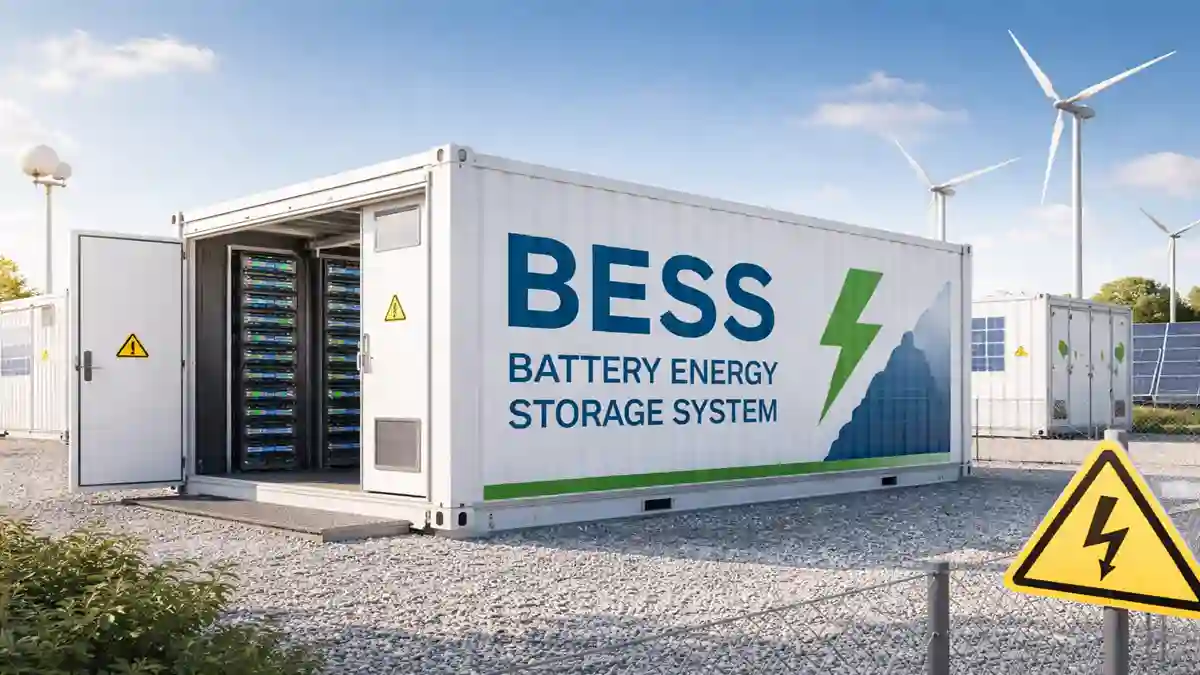
What is BESS? Explore the future of smart grids, AI-driven energy dispatch, and BESS design principles. Professional engineering insights for 2026 energy. Uses, Cost, Design & Future
As an engineer working in solar power systems, solar integration, and grid-connected infrastructure, I have seen firsthand how energy challenges are evolving across both developed and developing markets. The increasing penetration of renewable energy, the pressure on aging grids, and the demand for reliable backup power have created a strong need for smarter energy solutions.
One of the most impactful technologies addressing these challenges today is the Battery Energy Storage System. Far beyond simple battery backup, BESS represents a critical pillar of modern energy infrastructure, supporting grid stability, renewable integration, peak load management, and energy resilience.
This article explains the BESS definition, how it works, its applications, system design principles, real-world case studies, and why it is becoming essential for the future of power systems.
BESS Definition (Battery Energy Storage System Explained)
BESS stands for Battery Energy Storage System, a technology designed to store electrical energy and discharge it when needed. It enables electricity generated from solar, wind, or the grid to be stored and used later, improving reliability, efficiency, and cost savings.
In simple terms, a Battery Energy Storage System acts as a buffer between power generation and consumption, helping to balance supply and demand in real time. Unlike traditional backup solutions such as diesel generators or UPS systems,
What Is BESS and Why Does It Matter in Modern Power Systems
A Battery Energy Storage System (BESS) is not just a battery—it is a complete energy storage package. It integrates batteries, inverters, control systems, energy management software, and safety mechanisms to store electricity efficiently, manage power flow, and deliver energy when needed. This combination of components allows the Battery Energy Storage System to provide far more than simple backup power
As modern power systems shift toward decentralized and renewable energy sources, managing variability has become a growing challenge. Solar panels and wind power are inherently intermittent, peak electricity demand continues to strain grid infrastructure, and power outages can disrupt businesses, essential services, and daily life. These challenges highlight the need for technologies that can balance supply and demand while improving system reliability.
Battery Energy Storage Systems play a critical role in addressing these issues by storing excess energy and releasing it when needed. BESS enables more efficient use of renewable energy, provides instant backup power during outages, supports peak shaving and electricity tariff optimization, and enhances grid stability through fast frequency and voltage regulation. It also empowers microgrids and off-grid systems to operate independently, reducing reliance on traditional fossil-fuel-based generation.
From an engineering perspective, BESS fundamentally transforms conventional power networks from passive energy distribution systems into smart, responsive, and controllable energy platforms. By adding flexibility, resilience, and intelligence to the grid, BESS is becoming a cornerstone of modern and future-ready power systems.
How BESS Works — Engineering Overview
A Battery Energy Storage System captures electrical energy and stores it chemically in battery cells. When energy demand rises or supply drops, the system converts stored energy back into electricity.
The operational flow includes:
Charging from solar panels, the grid, or generators
Battery storage in lithium-ion or LFP cells
Monitoring and optimization through software
Discharging through a power conversion system
BESS reacts within milliseconds, making it ideal for grid frequency regulation and critical backup power.
BESS System Components (Battery, PCS, EMS, BMS)
From an engineering design perspective, a BESS consists of several integrated subsystems, each playing a critical role in ensuring safe, efficient, and reliable energy storage and delivery.
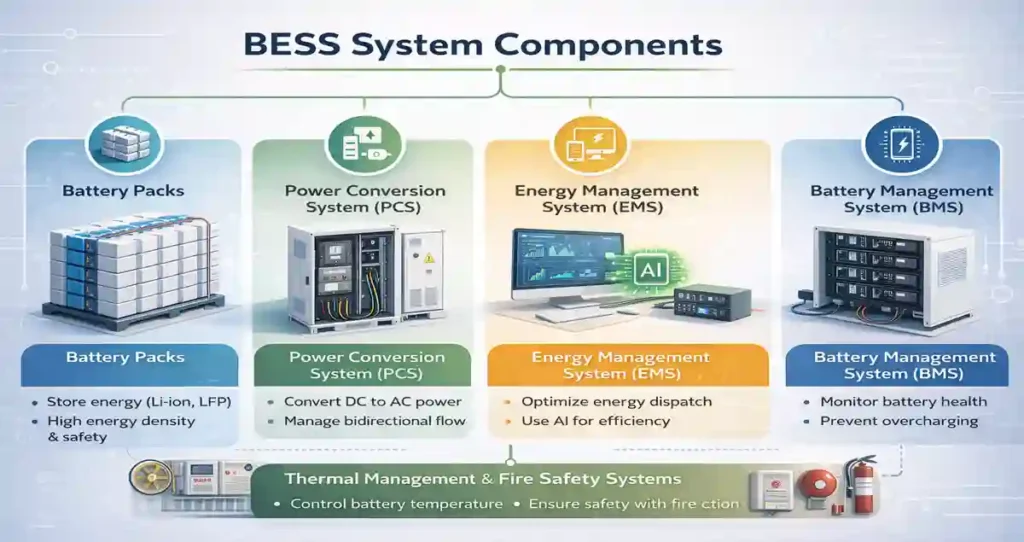
Battery Packs:
Battery packs are the core of a BESS, responsible for storing electrical energy in chemical form. They typically use lithium-ion or lithium iron phosphate (LFP) chemistry due to their high energy density, long lifespan, and safety advantages. The overall system capacity and performance depend heavily on battery quality and configuration.
Battery Management System (BMS):
The BMS monitors and controls battery health by regulating voltage, current, temperature, and charging cycles. It prevents overcharging, deep discharging, overheating, and cell imbalance, ensuring safe and optimal battery operation. A well-designed BMS significantly extends battery life and improves system reliability.
Power Conversion System (PCS):
The PCS converts stored DC power from batteries into AC electricity that can be used by homes, businesses, or the grid. It manages bidirectional power flow, allowing the system to both charge and discharge efficiently. The PCS also supports grid synchronization, power quality control, and protective functions.
Energy Management System (EMS):
The EMS acts as the intelligent control center of the BESS, optimizing when and how energy is stored or released. It analyzes electricity tariffs, load demand patterns, solar generation, and grid signals to maximize efficiency and cost savings. Advanced EMS platforms use automation and AI to improve system performance over time.
Thermal Management & Fire Safety Systems:
Thermal management systems regulate battery temperature to maintain safe operating conditions and prevent overheating. Fire detection, suppression, and ventilation systems are integrated to mitigate safety risks and meet regulatory standards. These safety measures are essential for protecting both equipment and the surrounding infrastructure.
Battery Types Used in BESS — Comparison Table
| Battery Type | Common Chemistry | Typical DoD (%) | Cycle Life (Approx.) | Key Advantages | Typical Applications |
|---|---|---|---|---|---|
| Lithium-Ion (Li-ion) | NMC, NCA | 80–95% | 3,000–6,000 cycles | High energy density, fast charging, high efficiency | Residential BESS, commercial storage, EV charging, grid-scale |
| Lithium Iron Phosphate (LFP) | LiFePO₄ | 90–100% | 4,000–8,000 cycles | High safety, long lifespan, thermal stability | Home storage, solar BESS, microgrids, C&I systems |
| Lead-Acid | AGM, Gel | 40–60% | 500–1,500 cycles | Low cost, mature technology | Telecom backup, small off-grid, UPS |
| Sodium-Ion (Na-ion) | Sodium-based | 80–90% | 2,000–4,000 cycles | Lower cost potential, safer chemistry | Emerging grid-scale storage |
| Flow Batteries | Vanadium Redox | 90–100% | 10,000+ cycles | Extremely long life, scalable capacity | Utility-scale, long-duration storage |
| Nickel-Based | NiMH, NiCd | 70–90% | 1,500–3,000 cycles | Durable, good temperature tolerance | Industrial backup, harsh environments |
| Solid-State (Emerging) | Solid electrolyte | 90–100% | Expected 5,000+ | Higher safety, higher energy density | Future EVs, next-gen BESS |
Battery Energy Storage System Design — Key Engineering Principles
Capacity Sizing
Engineers calculate energy storage requirements based on load demand, backup duration, peak shaving objectives, and renewable energy production capacity. Accurate sizing ensures optimal system performance without overspending on unnecessary storage. Proper capacity planning directly impacts reliability, ROI, and operational efficiency.
Power Rating
Power rating defines how quickly energy can be discharged to meet peak loads and sudden demand spikes. It determines the system’s ability to support high-power equipment and critical infrastructure. A well-matched power rating ensures stable operation during peak demand events.
Cycle Life & Degradation
Battery lifespan is influenced by charge cycles, depth of discharge, and thermal stability. Frequent deep discharges and poor temperature control accelerate degradation. Engineering design focuses on optimizing operating conditions to extend battery life and maintain performance.
Grid Compliance
BESS installations must meet grid codes for frequency response, reactive power control, and protection coordination. Compliance ensures safe grid interaction and regulatory approval. Grid-ready design allows seamless integration with utility infrastructure.
Safety & Redundancy
System design includes fault isolation, ventilation, fire detection, and fire suppression systems. Redundancy ensures continuous operation even during component failures. These safety measures are essential for long-term reliability and risk mitigation.
BESS Applications Across Sectors
| Sector / Load Type | Primary Application | How BESS Is Used |
|---|---|---|
| Solar & Renewable Energy | Energy shifting and solar optimization | Stores excess solar energy during the day and supplies power at night, improving renewable utilization and solar ROI |
| Residential (Home Load) | Backup power and self-consumption | Provides backup during outages, increases solar self-use, and reduces reliance on the grid |
| Commercial Load | Peak shaving and cost optimization | Reduces peak demand charges, lowers electricity bills, and manages tariff-based energy consumption |
| Industrial Load | Critical power backup and load management | Ensures uninterrupted power for factories, hospitals, and data centers while optimizing energy costs |
| Utility / Grid Load | Grid stabilization and frequency regulation | Supports frequency control, voltage stability, and black-start capability for power networks |
| Microgrids & Off-Grid Load | Energy independence and diesel reduction | Stores renewable energy, reduces diesel generator use, and ensures 24/7 power in remote areas |
BESS for Solar & Renewable Energy
BESS stores excess solar energy generated during the day and makes it available for use at night or during periods of low solar generation. It improves renewable energy utilization and reduces energy waste. This leads to better solar return on investment (ROI) and improved system efficiency.
BESS for Home (Residential Energy Storage)
Residential BESS provides reliable backup during load shedding and power outages, ensuring uninterrupted electricity for homes. It allows homeowners to maximize solar self-consumption instead of exporting power to the grid. This reduces grid dependency and enhances long-term energy savings.
BESS for Commercial & Industrial Facilities
Commercial and industrial users deploy BESS to reduce peak demand charges and lower electricity bills. It ensures a continuous power supply for critical operations such as data centers, schools, hospitals, and manufacturing plants. BESS also optimizes overall energy costs through smart load and tariff management.
BESS for Grid Stabilization
Grid-scale BESS supports frequency regulation by responding instantly to supply-demand imbalances. It provides voltage support and improves power quality across transmission and distribution networks.
BESS for Microgrids & Off-Grid Areas
BESS enables energy independence in remote and off-grid regions by storing renewable energy for continuous use. It significantly reduces reliance on diesel generators, lowering fuel costs and emissions. This ensures 24/7 power availability and improves energy reliability in isolated communities.
BESS vs Generator vs UPS — Practical Comparison
| Feature | BESS | Generator | UPS |
|---|---|---|---|
| Response Time | Instant | Minutes | Seconds |
| Operating Cost | No fuel cost | Fuel required | Limited runtime |
| Noise & Emissions | Silent & clean | Noisy & polluting | Silent but short duration |
| Maintenance | Minimal | High | Moderate |
| Scalability | Modular | Inefficient | Limited |
BESS is increasingly replacing traditional backup solutions for modern power systems.
Battery Energy Storage System Cost & ROI Considerations
BESS cost primarily depends on battery capacity (in kWh), power rating (in kW), battery chemistry, brand, and installation complexity. Larger systems with higher power output and longer backup duration typically cost more.
Typical ROI Drivers
BESS generates financial returns through:
- Peak shaving savings
- Tariff arbitrage (charging at low rates, discharging at high rates)
- Fuel cost avoidance (reducing diesel generator use)
- Grid incentives and demand response programs
- Reduced losses from downtime and outages
Simple ROI Calculation Example
Assume a Commercial BESS System:
- System Size: 100 kWh
- Total Installed Cost: $40,000
- Monthly Savings from Peak Shaving & Tariff Optimization: $900
- Annual Savings: $900 × 12 = $10,800
Payback Period Calculation
Payback Period = System Cost ÷ Annual Savings
$40,000 ÷ $10,800 = ~3.7 Years
So, the system recovers its cost in approximately 3–4 years, after which savings become net profit.
Key Insight
For commercial and grid-scale applications, BESS payback typically ranges from 3–7 years, depending on electricity tariffs, usage strategy, and operational efficiency. Smarter energy management leads to faster ROI and higher long-term savings.
Case Study 1 — Grid-Scale BESS for Frequency Regulation (USA)
Project Overview:
A utility-scale BESS project was deployed to stabilize grid frequency in a high-renewable region.
Engineering Challenge:
- Solar and wind caused rapid frequency fluctuations
- Grid operators needed fast-responding balancing power
- Traditional gas turbines were too slow
Solution:
- 100+ MW lithium-ion BESS
- Real-time EMS integration
- Automated frequency response
- Grid-code compliant PCS
Results:
- Millisecond-level response improved grid stability
- Reduced reliance on fossil-fuel peaker plants
- Lower operational costs
- Higher renewable energy absorption
Engineering Insight:
BESS can outperform conventional spinning reserves, making grids more resilient and efficient.
Case Study 2 — BESS for Remote & Isolated Communities (USA)
Project Overview:
A remote Alaskan community relied heavily on diesel generators.
Engineering Challenges:
- High fuel transport costs
- Noise and pollution
- Limited grid infrastructure
- Harsh environmental conditions
Solution:
- Hybrid solar + BESS microgrid
- Smart EMS for load balancing
- Reduced diesel generator runtime
Results:
- Diesel fuel consumption reduced by over 60%
- Lower electricity costs
- Improved reliability during extreme weather
- Cleaner and quieter power
Engineering Insight:
BESS enables sustainable electrification in remote regions while reducing fossil fuel dependence.
BESS for Home & Small-Scale Systems
Residential adoption is rising due to load shedding, high electricity tariffs, and solar self-consumption. Typical system sizes:
- 5–10 kWh: Small homes
- 10–20 kWh: Medium homes
- 20+ kWh: Large homes with AC backup
Homeowners benefit from energy independence, reliability, and long-term cost savings.
Future of BESS And AI Optimization
The future of Battery Energy Storage Systems is being shaped by rapid technological and market advancements, with AI-driven energy optimization emerging as a key breakthrough. Artificial intelligence enables smarter charging and discharging decisions by analyzing load patterns, electricity tariffs, weather forecasts, and grid signals in real time, maximizing efficiency and cost savings.
Other major innovations include Virtual Power Plants (VPPs), which connect thousands of distributed batteries into coordinated grid-supporting networks, and second-life EV battery reuse, which reduces storage costs while extending battery lifecycles. The industry is also moving toward long-duration energy storage for multi-hour or multi-day backup, along with solid-state battery development that promises improved safety, higher energy density, and longer operational life.
As renewable energy adoption continues to accelerate, BESS is expected to become a backbone technology for smart grids, electric vehicle infrastructure, and decentralized energy systems. It will play a central role in stabilizing power networks, strengthening grid resilience, and enabling a more flexible, intelligent, and sustainable global energy ecosystem.
BESS Maintenance & Compatibility: Engineering for Longevity
To achieve a 10 to 15-year operational lifespan, a Battery Energy Storage System (BESS) requires more than premium hardware. Long-term reliability depends on structured maintenance, compliance with standards, and optimized integration of the solar system.
1. BESS Maintenance Checklist (2026 Standards)
Modern BESS maintenance blends real-time EMS/BMS monitoring with scheduled inspections, aligned with NFPA 855 and IEEE 2030.2 for safety and warranty protection.
| Frequency | Task | Objective |
|---|---|---|
| Real-Time | EMS/BMS Monitoring | Track SOC, SOH, and cell temperature |
| Monthly | Thermal Inspection | Detect hotspots using infrared scanning |
| Quarterly | HVAC Service | Maintain optimal battery operating temperature |
| Bi-Annually | Torque Audit | Prevent loose terminals and arc faults |
| Annually | Capacity & Fire Safety Test | Calibrate SOC and verify fire systems |
2. BESS Compatibility with Solar Systems
Successful BESS integration depends on inverter communication, voltage matching, and secure electrical interconnection.
Hybrid Inverters and AC-coupled systems should support CAN bus or RS485, while closed-loop BMS communication ensures safe, real-time charge control. PV arrays must align with BESS DC input voltage, comply with Rapid Shutdown standards, and use certified MC4 connectors to ensure long-term electrical reliability.
3. Best Solar Panel Technologies for BESS (2026)
N-Type TOPCon Panels
The leading choice, offering 22–24% efficiency, ultra-low degradation, and strong low-light performance — ensuring consistent battery charging over long system lifetimes.
Bifacial Solar Panels
Provide 5–30% additional energy yield by capturing rear-side sunlight, enabling faster battery charging without expanding PV footprint.
HJT Panels
Designed for high-temperature environments, HJT panels maintain stable output in extreme heat, reducing battery stress and improving BMS stability.
Final Recommendation
For most installations, N-Type TOPCon Bifacial solar panels deliver the best balance of efficiency, durability, and battery-charging performance, ensuring faster charge cycles and long-term BESS reliability.
Frequently Asked Questions (FAQ) – BESS
What is a BESS?
BESS stands for Battery Energy Storage System, a complete energy storage package that includes batteries, inverters, control systems, energy management software, and safety mechanisms. It stores electricity from solar, wind, or the grid and delivers it when needed.
How does a BESS differ from a generator or UPS?
Unlike generators that require fuel or UPS systems with short runtimes, BESS responds instantly, operates silently, produces zero emissions, and can be scaled modularly. It also provides energy optimization through AI and supports renewable integration.
What types of batteries are used in BESS?
Common BESS batteries include Lithium-Ion (Li-ion), Lithium Iron Phosphate (LFP), Lead-Acid, Sodium-Ion, Flow Batteries, Nickel-Based, and emerging Solid-State batteries. Each type varies in energy density, cycle life, depth of discharge (DoD), and application.
What are the main applications of BESS?
Residential: Backup power, solar self-consumption.
Commercial & Industrial: Peak shaving, critical load backup, energy cost optimization.
Grid & Microgrids: Frequency regulation, voltage support, black-start capability, energy independence in off-grid areas.
How is the cost of a BESS calculated?
Costs depend on battery capacity (kWh), power rating (kW), chemistry, brand, and installation complexity. ROI is influenced by savings from peak shaving, tariff optimization, fuel avoidance, and reduced downtime. Payback periods typically range 3–7 years.
Can BESS be used with solar systems?
Yes, BESS complements solar installations by storing excess generation during the day and supplying power at night or during low-generation periods. This improves solar ROI and reduces reliance on the grid.
What is the future of BESS?
Future BESS trends include AI-driven energy optimization, Virtual Power Plants (VPPs), second-life EV battery reuse, long-duration storage, and solid-state batteries. BESS will be a backbone technology for smart grids, EV infrastructure, and decentralized energy systems