
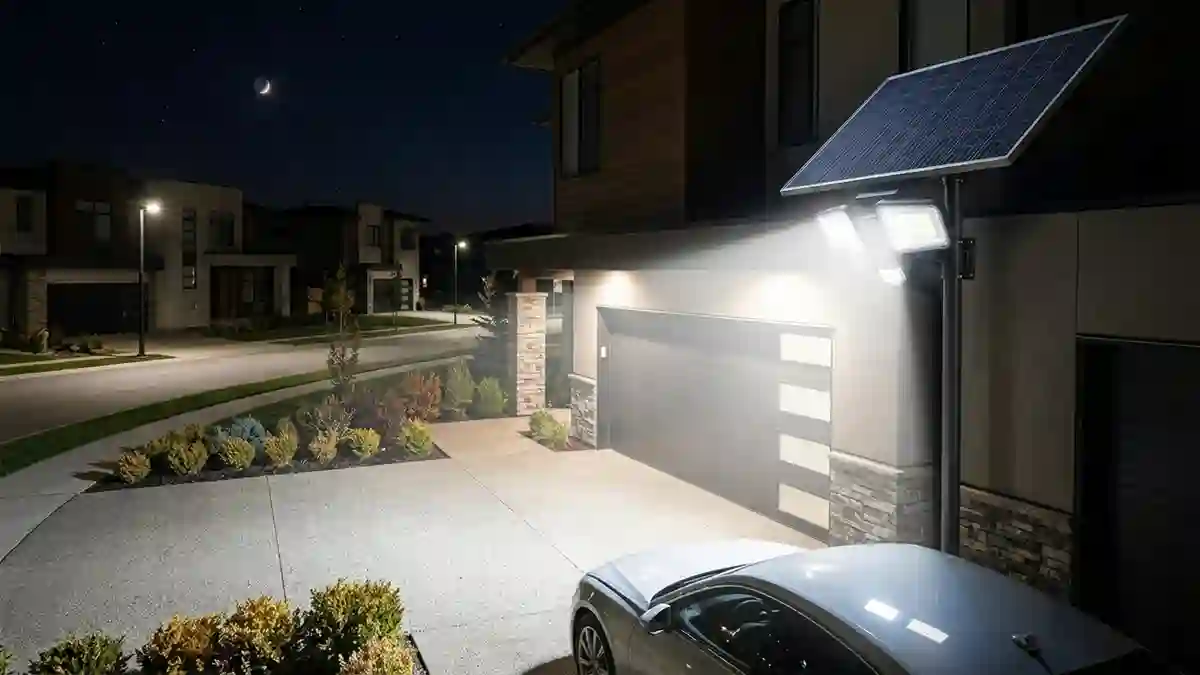
Solar flood lights sizing made simple — lumens by application, IP44 vs IP65, PIR detection geometry, battery capacity for winter, and when self-contained units hit their limits.
A practical engineering guide to solar motion sensor flood lights — covering lumen sizing by application, IP rating selection, PIR detection zone geometry, battery capacity for winter reliability, and when self-contained units reach their limits. Written by a Registered Professional Engineer.
Solar flood lights occupy a different performance category from solar security lights and fence post caps. The lumen outputs are higher, the solar panel and battery requirements are more demanding, and the IP rating matters more because most flood light applications involve fully exposed mounting positions.
The engineering challenge with solar flood lights is matching the spec to the application. A 2000-lumen unit that works well for a residential driveway is undersized for a construction site. A 10,000-lumen unit on a separate panel that’s right for a commercial perimeter is overkill for a backyard. Getting the sizing right before purchasing saves a significant amount of frustration.
This guide gives you the sizing framework, the IP rating context, and the motion sensor geometry that determines whether a solar flood light actually covers the area you intend it to.
1. Solar Flood Light vs Solar Security Light: What’s Different
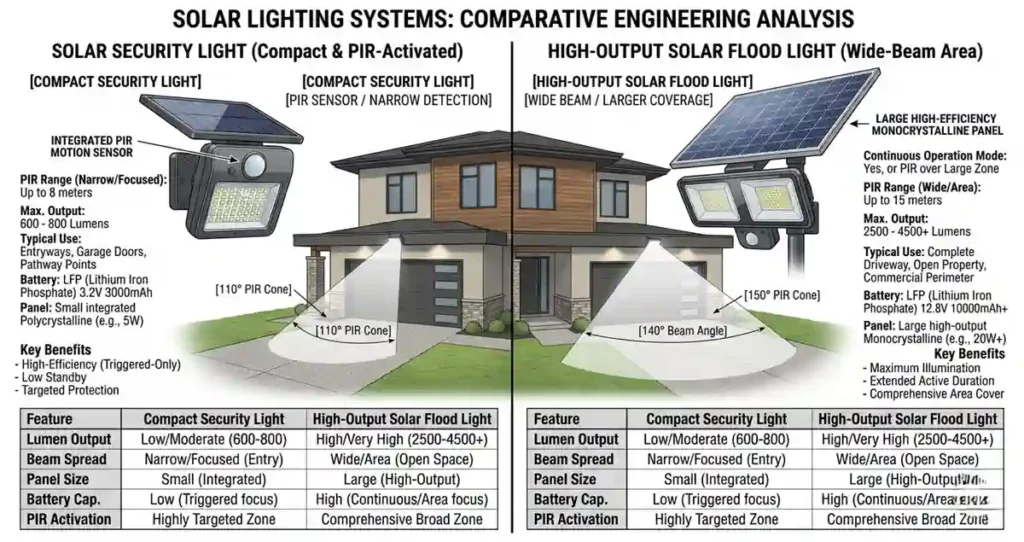
The terms are sometimes used interchangeably in product listings, which causes confusion. Here’s the engineering distinction:
Solar security lights are optimised for motion-triggered detection illumination — lower baseline output, motion-triggered peak output, designed to cover a defined detection zone at residential scale.
Solar flood lights are optimised for high-output area illumination — higher lumen output, wider beam angle, larger panel and battery requirements. Motion sensing may be present as a feature, but the primary function is flood illumination of a wide area rather than targeted detection-zone lighting.
In practice: a 500-lumen solar security light is appropriate for a side gate. A 3000-lumen solar flood light is appropriate for a driveway or garage approach. The overlap between categories exists, but the sizing requirements diverge significantly above 1500 lumens.
Engineer’s Note: The beam angle matters as much as lumen output in flood lighting. A 3000-lumen unit with a 60° beam angle concentrates that output in a narrow cone — useful for illuminating a specific target but not for wide area coverage. A 3000-lumen unit with a 120° beam angle spreads the same output over a much larger area at lower lux density. Always check beam angle alongside lumen output for flood applications.
2. Lumen and Panel Sizing by Application
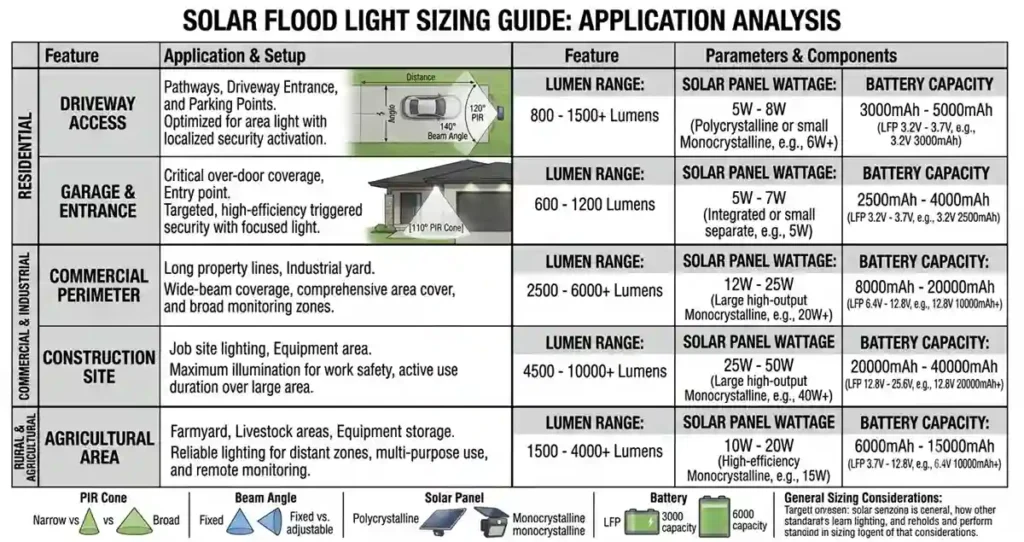
Here’s how to match output requirements to your specific application:
| Application | Min Lumens | Panel (min) | Battery (min) | IP Rating | Mounting Height |
| Residential driveway | 1500–2500 lm | 10W | 6000 mAh | IP65 | 3–4m |
| Garage / carport | 2000–3000 lm | 12W | 8000 mAh | IP65 | 3–4m |
| Construction site | 5000–10000 lm | Separate panel | 20000+ mAh | IP65 | 4–6m |
| Commercial perimeter | 3000–6000 lm | 20W+ | 15000+ mAh | IP65 | 4–6m |
| Agricultural / rural | 2000–4000 lm | 15W | 10000 mAh | IP65 | 4–5m |
The panel wattage column is the figure most often undersized in consumer solar flood lights. A 10W panel in good sun conditions generates approximately 50Wh per day over a 5-hour charge period. A 3000-lumen LED running at 30W draws 150Wh for 5 hours of operation. The math doesn’t work with a single charge day — you need either a larger panel, a larger battery buffer, or reduced runtime expectations.
Engineer’s Note: For any flood light application requiring more than 4 hours of sustained full-output operation per night, calculate the daily energy demand first: (LED wattage) × (runtime hours) = Wh/night. Then check whether the panel can replenish that in one charge day under your winter sun conditions. If not, size up the lithium battery to buffer across 2–3 days, or add panel capacity. This is the same calculation used in off-grid solar design — the scale is smaller but the principle is identical.
3. IP Ratings for Solar Flood Lights
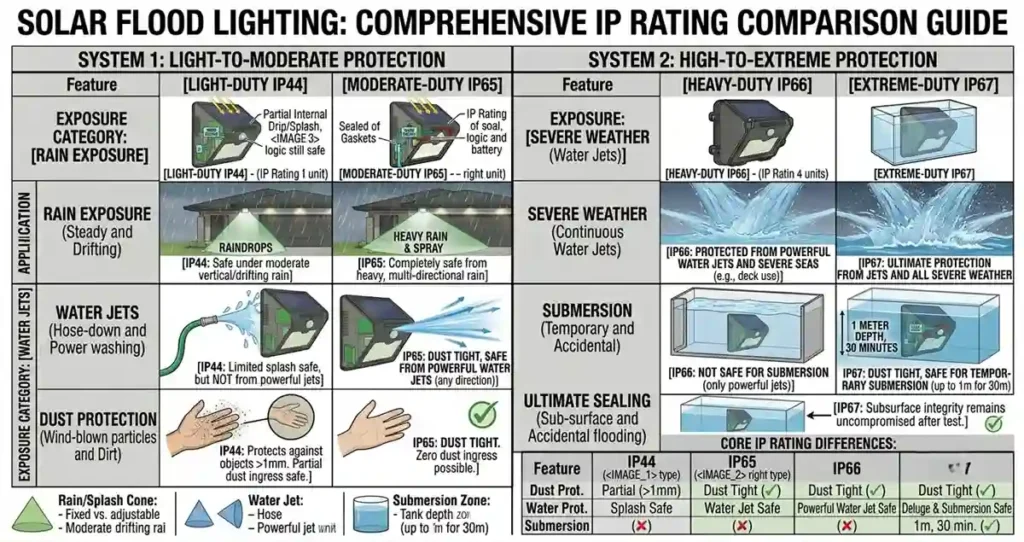
Flood lights are almost always mounted in exposed positions — walls, poles, brackets at height. IP rating determines whether the unit survives the weather it will actually encounter.
| IP Rating | Protection Level | Suitable For | Not Suitable For |
| IP44 | Splash from any direction | Covered locations, under eaves | Exposed mounting, driving rain |
| IP65 | Water jets from any direction | Any outdoor exposed mounting | Submersion, power washing direct |
| IP66 | Powerful water jets | Coastal, high-rain, power-wash areas | Submersion |
| IP67 | Temporary submersion to 1m | Flood-risk areas, ground-level | Continuous submersion |
For most solar flood light applications, IP65 is the correct minimum. It covers direct rain, hose spray during cleaning, and general weather exposure. Units rated below IP65 for exposed outdoor mounting are a compromise you’ll likely regret by the second wet season.
Coastal installations — within 5 miles of saltwater — add a corrosion requirement on top of the IP rating. Salt-laden air attacks exposed metal components, connectors, and mounting hardware regardless of IP rating. For coastal applications, look for units with stainless steel hardware, marine-grade coatings, and sealed connector interfaces.
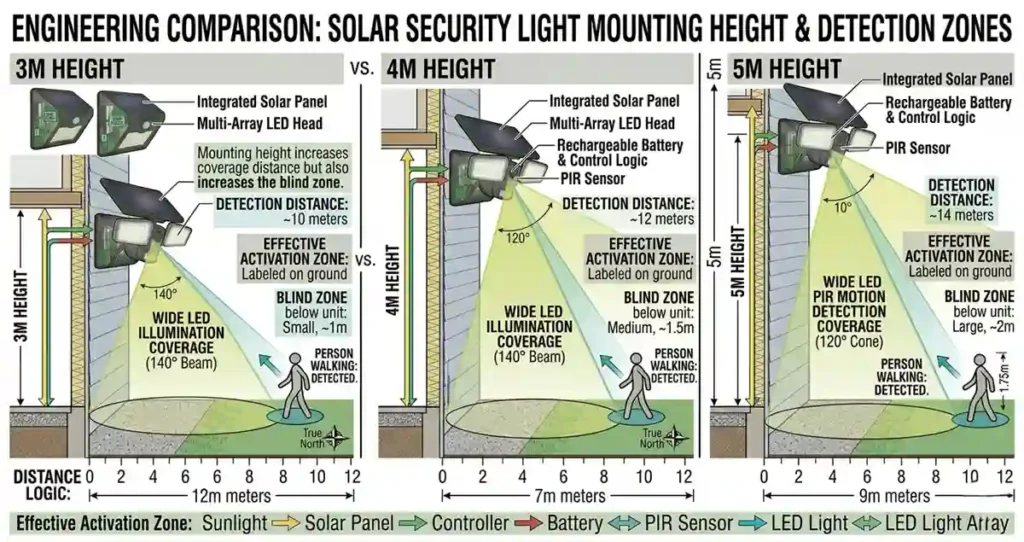
4. Motion Sensor Geometry for Flood Lights
Solar flood lights with PIR motion sensors have the same detection geometry principles as security lights, but the higher mounting heights typical of flood applications change the numbers.
| Mounting Height | Detection Range | Detection Angle | Coverage Area | Recommended Application |
| 2.5m | 8–10m | 120° | ~75 m² | Residential entry, side gate |
| 3m | 10–12m | 120° | ~110 m² | Driveway, garage approach |
| 4m | 12–15m | 120–180° | ~170 m² | Commercial entry, large yard |
| 5m+ | 15–20m | 180° | 240+ m² | Construction site, perimeter |
The blind zone directly below the mounting point increases with mounting height. At 5m mounting height, the area directly below the fixture may have a detection gap of 2–3m radius where the PIR cone doesn’t reach ground level. For applications where coverage directly below the mounting point matters — a building entry, for example — a second lower-mounted fixture or a wide-angle PIR unit is needed to fill that gap.
Engineer’s Note: Tilt the PIR sensor downward 15–20° from horizontal when mounting above 3m. This shifts the detection zone toward the fixture base and reduces the blind zone below. Most floodlight PIR housings allow manual tilt adjustment — use it. A horizontally-mounted PIR at 4m height has its detection zone starting 4–5m out from the base, leaving a significant undetected area beneath the fixture.
5. Battery Sizing for Solar Flood Lights
Floodlights draw more current than security lights, making battery sizing more critical. A 3000-lumen LED array draws approximately 25–35W. At 6V battery voltage, that’s 4000–5800 mA current draw. A 6000 mAh battery at that draw rate lasts approximately 1–1.5 hours at full output.
For practical all-night coverage, floodlights in the 2000–3000 lumen range need 15,000–20,000 mAh battery capacity for 6–8 hours of operation. This is why most quality solar floodlights in this output range use a separate panel rather than an integrated one — the required panel and battery sizes simply don’t fit in a compact integrated housing.
For battery technology in solar flood applications, LiFePO4 is the engineering choice for commercial and demanding residential applications — 2000–3000 charge cycles, reliable to -30°C, and no thermal runaway risk. For budget residential applications, Li-ion is adequate. NiMH is undersized for high-drain flood light applications in most cases.
The battery sizing principles used in standalone flood lights are the same as those in larger solar storage systems. The BESS guide on SolarVisionAI covers the full depth of battery sizing methodology if you’re working on a larger installation where flood lighting is part of a broader solar system.
6. When Self-Contained Units Reach Their Limits
Self-contained solar flood lights — panel, battery, and LED in one housing — have a practical output ceiling of approximately 3000–4000 lumens for reliable all-night operation. Above that threshold, the panel area and battery capacity required to sustain higher outputs overnight exceed what can be practically housed in a single unit.
At that point, a separate panel mounted for optimal sun exposure, wired to a dedicated battery enclosure and a high-output LED fixture, is the correct engineering approach. This is standard practice in commercial solar flood lighting installations — the component separation allows each element to be sized and positioned optimally.
For the commercial-scale application of this principle, the commercial solar flood lights guide covers wattage, mounting, and grid-tie options for larger installations.
7. Remote Control Solar Flood Lights
Several solar flood light models include a remote control for adjusting brightness, motion sensitivity, and timer settings without accessing the mounted fixture. This is a useful feature for flood lights mounted at height — adjusting PIR sensitivity or switching between full-bright and motion-only modes from ground level saves significant time during commissioning and adjustment.
The remote control function typically operates via RF (radio frequency) at 433MHz — a short-range signal that works through walls and at distances up to 20–30m. IR remote controls also exist but require line of sight to the receiver, which is impractical for fixtures mounted at 4–5m height.
For installations with multiple floodlights, look for systems that support zone control — grouping multiple fixtures to a single remote command. Individual remotes per fixture become unmanageable above 4–5 units.
Frequently Asked Questions
How many lumens do I need for a solar flood light?
For a residential driveway or garage approach: 1500–2500 lumens. For a large yard or agricultural area: 2000–4000 lumens. For a commercial perimeter or construction site: 3000–10,000 lumens. Above 4000 lumens, self-contained units typically can’t sustain output all night — a separate panel and battery configuration is the more reliable engineering approach.
Do solar flood lights work in winter?
Yes, with battery sizing appropriate for reduced winter charge capacity. Most residential solar flood lights rated for 6–8 hours summer runtime will deliver 3–5 hours in winter in locations with 3–4 peak sun hours per day. For critical applications requiring all-night coverage regardless of season, size the battery for 2 days of reserve capacity — this buffers through consecutive cloudy days without full discharge.
What is the difference between IP65 and IP67 solar flood lights?
IP65 protects against water jets from any direction — adequate for rain, garden hose spray, and normal outdoor weather exposure. IP67 adds temporary submersion protection to 1 meter depth. For standard outdoor mounting, IP65 is sufficient. IP67 is relevant for ground-level installations in flood-prone areas or locations subject to power washing. The additional cost of IP67 is marginal and worth it if there’s any doubt about submersion risk.
Can I use a solar flood light for a construction site?
Yes, but spec it correctly. Construction sites need 50 lux minimum at the work surface for general tasks — significantly higher than perimeter security applications. A 5000-lumen flood light at 4m mounting height delivers approximately 50 lux over a 100 m² area. For larger sites, multiple units or higher-output fixtures with separate panels are needed. Portable tripod-mounted units are practical for construction applications where the lighting position changes as work progresses.
Why does my solar flood light dim after a few hours?
Battery capacity is insufficient for the lumen output. Most solar flood lights include a power management mode that dims the LED when battery voltage drops below a threshold — this extends runtime at reduced output rather than cutting off abruptly. It’s normal behaviour, not a defect. To maintain full output all night, you need either a larger battery or a lower lumen output setting. Check whether the unit has adjustable brightness modes — running at 70% output significantly extends battery runtime.
Final Thoughts
Solar flood lights are practical and cost-effective for a wide range of applications — from residential driveways to agricultural perimeters to small commercial sites. The key is matching the spec to the application before purchasing.
Lumen output, panel wattage, battery capacity, and IP rating all need to be verified against your specific requirements. A unit that looks adequate in the product listing but is undersized for your actual application will underperform from the first winter.
For the motion sensor geometry detail that determines whether your flood light actually covers the intended area, the solar powered flood lights with motion sensor guide covers detection angles and zone setup in full.
Related guides on SolarVisionAI.com
Solar Security Lights: What Actually Works — solarvisionai.com/solar-security-lights/
BESS — Battery Energy Storage System Guide — solarvisionai.com/bess-battery-energy-storage-system-guide/Solar Charge Controller: The Complete Guide — solarvisionai.com/solar-charge-controller-the-complete-guide/