
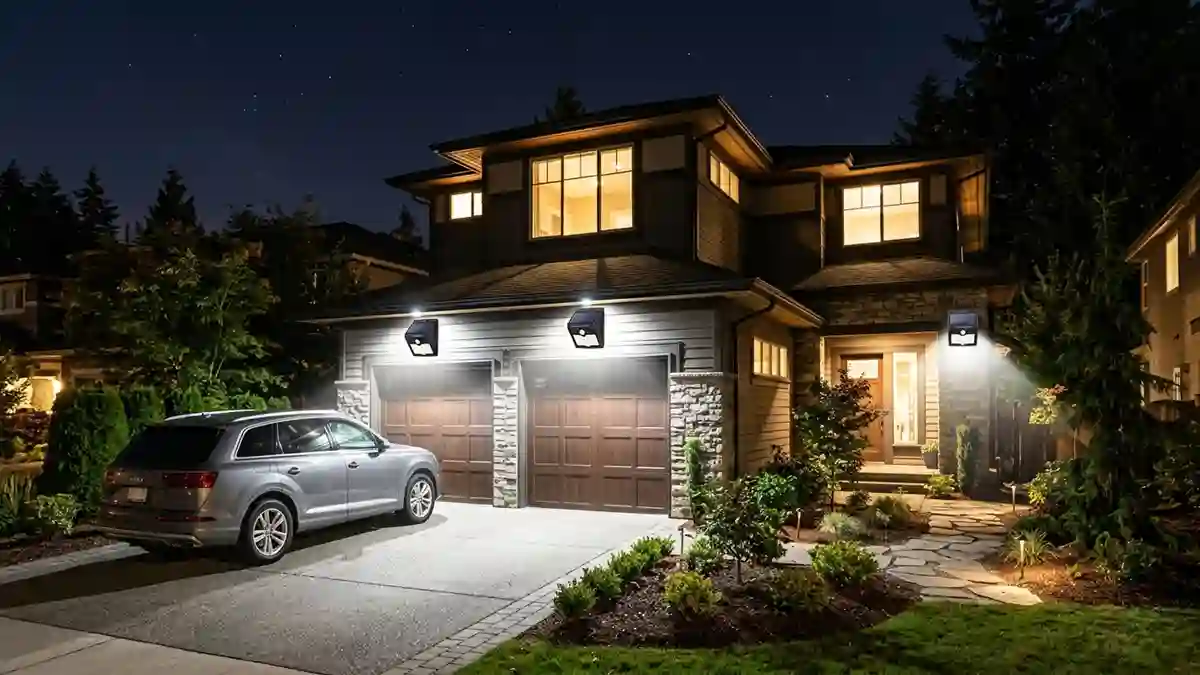
Solar security lights explained by a PE — PIR detection range, lumen specs by application, battery sizing for winter, and what separates reliable units from ones that fail.
A practical engineering guide to solar security lights — covering PIR motion detection, lumen requirements by application, mounting height and detection zone geometry, battery sizing for winter reliability, and the specs that separate units worth buying from ones that fail early. Written by a Registered Professional Engineer.
The solar security light market has a quality spread problem. At one end, units that work reliably for three or four years with minimal attention. On the other hand, products that look identical in the listing photo, cost half as much, and stop working reliably by the second winter. This is similar to the solar panels market, where products can appear identical yet differ significantly in performance, durability, and long-term reliability.
The difference between them isn’t usually visible in the marketing spec sheet. It’s in the battery capacity, the PIR sensor quality, the panel wattage, and whether the IP rating reflects an actual sealed enclosure or just a label. This guide gives you the engineering criteria to tell them apart before you buy — and the placement guidance to get the most out of whichever unit you choose.
1. How Solar Security Lights Actually Work
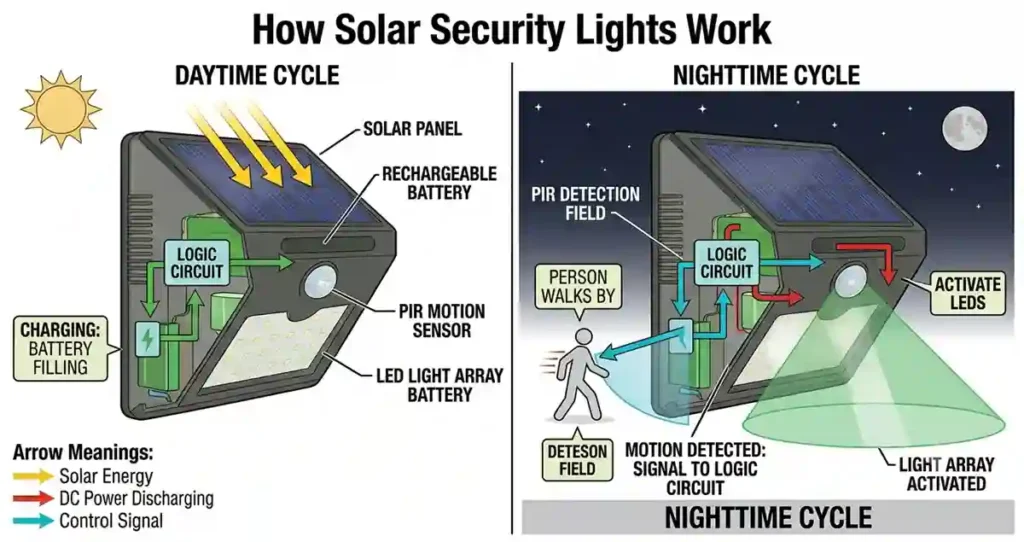
A solar security light is a self-contained system with four components: a solar panel (charges the battery), a rechargeable battery (stores energy), a PIR motion sensor (triggers the light), and an LED array (provides the output). In most units, these are housed in a single enclosure. In higher-output units, the panel is mounted separately and wired to the light.
The operating sequence: the PIR sensor detects infrared radiation change — a body moving through its detection cone. It triggers the LED array to step up from standby brightness (usually 5–20% of rated output) to full brightness. After a set time — typically 20–60 seconds — the light returns to standby or switches off completely, depending on the mode setting.
The solar panel charges the battery during daylight hours. At dusk, a light-dependent resistor (LDR) switches the unit to night mode. PIR triggering then draws from the battery. Quality of the PIR sensor, battery capacity, and panel-to-battery charge ratio determine real-world performance.
Engineer’s Note: The LDR and PIR are separate sensors with separate failure modes. An LDR failure typically causes the light to activate during the day or stay off at night. A PIR failure causes missed detections or false triggers. These are diagnosable separately — which helps narrow down what’s wrong when a unit underperforms.
2. Solar vs Wired Security Lights: When Solar Makes Sense
Solar security lights make sense where running a cable is impractical, expensive, or not permitted — detached structures, fence lines, gates, garden perimeters, and properties where trenching isn’t an option. They don’t require an electrician, have zero operating cost, and can be repositioned without rewiring.
Where wired lights remain the better engineering choice: applications requiring 2000+ lumens sustained output, locations with significant winter shading, and commercial installations where guaranteed uptime regardless of weather is a specification requirement.
| Feature | Solar Security Light | Wired PIR Light | Battery PIR Light | Wired Constant | Best For |
| Install | No wiring needed | Licensed electrician | No wiring needed | Licensed electrician | Solar or battery |
| Running cost | Zero | ~$5–15/yr | Battery replacement | ~$30–80/yr | Solar |
| Max lumen output | 400–2000 lm | 500–5000 lm | 200–800 lm | 500–10,000 lm | Wired constant |
| Winter reliability | Reduced on cloudy days | 100% regardless | 100% regardless | 100% regardless | Wired |
| Motion trigger speed | <0.5 sec (PIR) | <0.5 sec (PIR) | <0.5 sec (PIR) | N/A — always on | All PIR options |
| Detection range | 5–12m typical | 8–15m typical | 5–10m typical | N/A | Wired PIR |
Engineer’s Note: For a residential front entry or driveway, solar security lights in the 800–1200 lumen range are a practical choice — the output is adequate, the install is straightforward, and winter performance in most US climates is acceptable. For a commercial perimeter or a location above 50° latitude with extended cloud cover, wired lighting is the more reliable engineering solution.
3. PIR Motion Sensor: The Spec That Matters Most
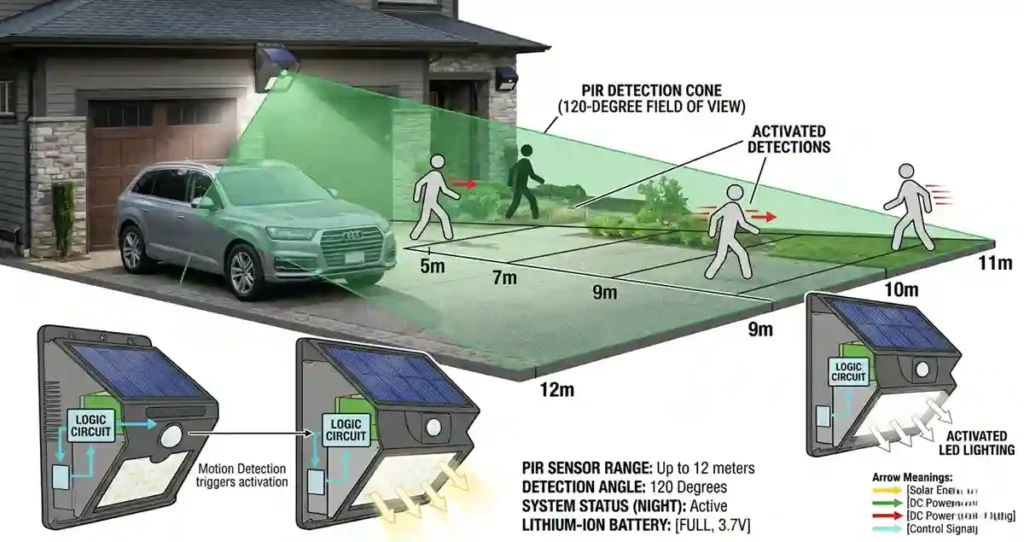
The PIR sensor is where most solar security light failures originate, and it’s rarely the headline spec in a product listing. Here’s what to look for:
Detection Angle
Most consumer solar security lights use a 120° detection cone. Some go to 180°. The detection angle determines how wide the coverage area is, but it doesn’t tell you about sensitivity — a 120° sensor with good sensitivity outperforms a 180° sensor with poor sensitivity.
Detection Range
Listed detection range is measured under ideal conditions — warm ambient temperature, person walking directly toward the sensor. Real-world range is typically 70–80% of the listed figure. A unit listed at 10m detection range reliably detects motion at 7–8m in normal conditions.
Temperature affects PIR sensitivity significantly. PIR sensors detect the difference between the ambient temperature and the detected object’s infrared signature. In summer, when ambient temperature approaches body temperature, detection sensitivity drops. In winter, the contrast is higher and detection tends to be more reliable — the opposite of what most people assume.
False Trigger Rate
False triggers — the light activating without a person present — are caused by animals, moving vegetation, HVAC exhaust, or direct sunlight on the PIR lens. Quality units include a Fresnel lens over the PIR that limits the sensor’s field of view to its intended detection zone and filters out ambient temperature fluctuations from non-moving sources.
Field Note: I’ve had clients report solar security lights triggering repeatedly throughout the night with no apparent cause. In most cases, the issue was a nearby AC condenser cycling on and off, or a tree branch within the detection zone. Repositioning the light 20–30 degrees eliminated the problem. The PIR was working correctly — it was detecting the right temperature differential from the wrong source.
4. Lumen Output: Matching Spec to Application
Security lighting has a specific requirement that decorative lighting doesn’t: the output needs to be sufficient to identify a person or vehicle at the detection range. This drives the minimum lumen requirement higher than for general outdoor lighting.
| Application | Min Lumens | Min Battery | Min Panel | IP Rating | Detection Range |
| Side passage / gate | 400 lm | 2000 mAh | 6V/3W | IP44 | 5–7m |
| Driveway / front entry | 800 lm | 3000 mAh | 6V/5W | IP65 | 8–10m |
| Garage / carport | 1000 lm | 4000 mAh | 6V/6W | IP65 | 10–12m |
| Garden / backyard | 600 lm | 2500 mAh | 6V/4W | IP44 | 6–8m |
| Commercial perimeter | 1500+ lm | 6000+ mAh | Separate panel | IP65 | 12–15m |
The “solar-powered security lighting” category on most e-commerce platforms includes units from 100 lumens to 3000 lumens. A 100-lumen unit is not a security light — it’s a decorative light with a motion sensor. For actual perimeter security applications, 800 lumens is a practical floor for residential use.
Engineer’s Note: Lumen output in solar security lights is often listed at peak — the maximum output for the first few seconds after trigger. Sustained output after 30 seconds may be 60–70% of peak as the LED driver throttles to protect battery voltage. For spec comparison, look for sustained lumen output at 30 seconds, not peak. If the manufacturer only lists peak, treat it with appropriate scepticism.
5. Mounting Height and Detection Zone Geometry
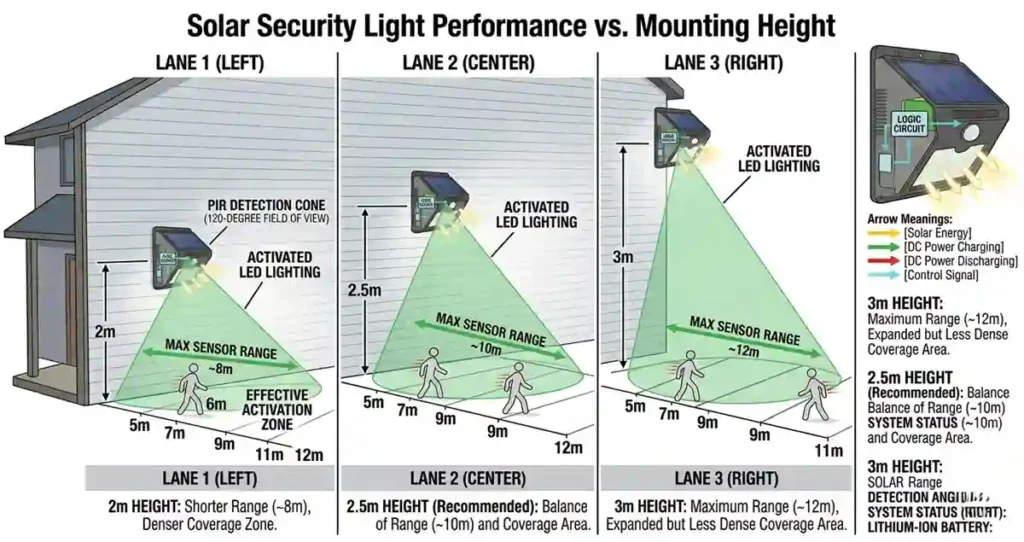
Mounting height directly affects detection zone coverage and lumen effectiveness. Too low and the detection cone clips the ground before reaching the intended coverage area. Too high, and the effective lumen density at ground level drops due to the inverse square law.
| Mounting Height | Detection Range | Detection Angle | Coverage Area (approx.) | Placement Note |
| 2m (6.5ft) | 5–7m | 120° | ~40 m² | Ground-level coverage — paths, steps |
| 2.5m (8ft) | 7–9m | 120° | ~65 m² | Standard entry, driveway edge |
| 3m (10ft) | 9–12m | 120° | ~100 m² | Wide area coverage — garage, yard |
| 3.5m+ (12ft+) | 10–14m | 120–180° | 120+ m² | Commercial — wide perimeter coverage |
The practical sweet spot for most residential applications is 2.5–3 meters of mounting height. This balances detection range, coverage area, and ground-level lumen density. Units mounted above 3.5 meters need higher lumen output to compensate for the increased distance between the light source and the illuminated area.
Engineer’s Note: Angle the PIR sensor slightly downward — 10 to 15 degrees below horizontal — when mounting at 2.5m or above. A horizontally-mounted PIR at that height has its detection zone starting several meters out from the fixture, leaving a blind zone directly below the mounting point. Tilting down eliminates that gap.
6. Battery Sizing for Winter Reliability
Battery capacity is the most common under-spec in solar security lights. The panel rating and LED output get the marketing attention; the battery capacity is often buried in the spec sheet or omitted entirely.
The calculation is straightforward. If a unit triggers 10 times per night at 30 seconds per trigger at 1000 lumens, and the standby current draw is 20mA, the battery needs to support that total energy demand on a winter charge — which may be 40–60% of a full summer charge in climates above 45° latitude.
As a rough guide: for a 1000-lumen security light in a location with 4+ peak sun hours in winter, a 4000 mAh battery is the practical minimum for reliable all-night coverage. For locations with fewer sun hours, increase battery capacity proportionally or reduce lumen output expectations.
6.1 Battery Types Used in Solar Security Lights
NiMH (Nickel-Metal Hydride)— Most common in budget units. 500–800 cycles. Capacity drops 20–30% below -10°C. Usually user-replaceable.
Li-ion (Lithium-Ion) — Mid-range standard. 1000–1500 cycles. Holds better in cold down to -20°C. Sometimes replaceable.
LiFePO4 (Lithium Iron Phosphate)— Commercial-grade. 2000–3000+ cycles. Reliable to -30°C. Highest upfront cost, lowest total cost of ownership.
| Type | Cycles | Cold Performance | Replaceable |
|---|---|---|---|
| NiMH | 500–800 | Poor below -10°C | Usually yes |
| Li-ion | 1000–1500 | Moderate to -20°C | Sometimes |
| LiFePO4 | 2000–3000+ | Good to -30°C | Rarely |
Engineer’s Note: Below -10°C regularly? Avoid NiMH. Cold weather plus short charge days is a double hit on capacity. LiFePO4 is worth the extra cost in those conditions.
7. IP Rating: What It Actually Means for Security Lights
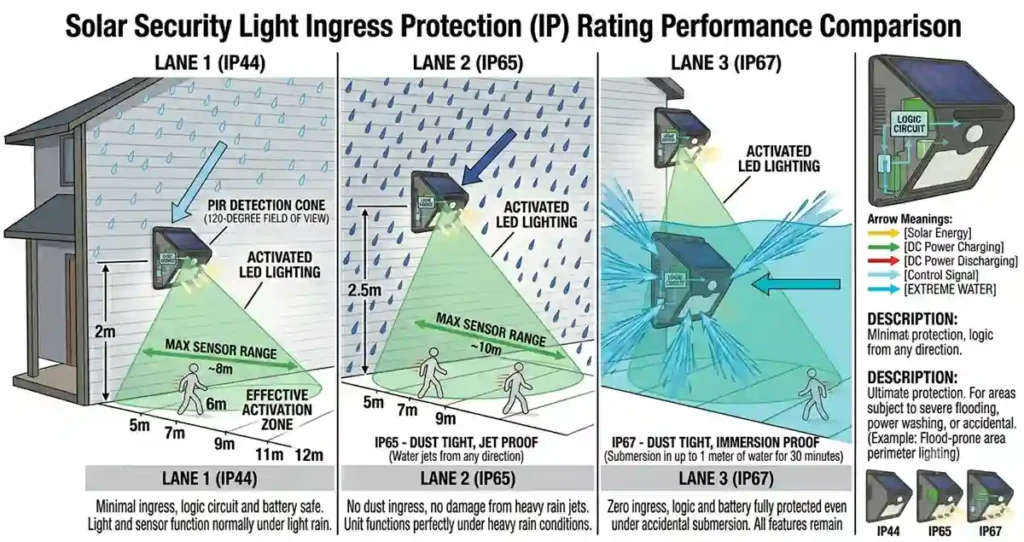
Security lights are outdoors by definition, so IP rating matters. The two digits indicate dust protection (first digit) and water protection (second digit).
IP44: Protected against solid objects >1mm and water spray from any direction. Adequate for covered locations — under an eave, recessed mounting. Not adequate for fully exposed locations in heavy rain climates.
IP65: Fully dust-tight and protected against water jets from any direction. The practical standard for any exposed outdoor security light. This is what you should default to for any mounting position exposed to direct weather.
IP66 and IP67: Higher water resistance — jet-resistant and submersion-resistant respectively. Relevant for locations exposed to power washing, flooding risk, or driving rain. Overkill for most residential applications but appropriate for commercial coastal installations.
Engineer’s Note: IP rating covers the enclosure, not the mounting hardware or wiring entry points. A light rated IP65 can still allow water ingress at the cable entry if that point isn’t sealed correctly during installation. Apply self-amalgamating tape or outdoor-rated silicone at any cable or mounting screw penetration, regardless of the unit’s IP rating.
8. What to Look for in a Solar Security Light: Buying Checklist
Before purchasing, confirm these specs for your application:
Lumen output (sustained, not just peak) — minimum 800 lm for driveway/entry applications
Battery capacity — minimum 3000 mAh for 1000 lm units; 4000+ mAh for winter-reliable performance
Panel wattage — minimum 5W for 1000 lm units; look for separate panel mounting option at higher outputs
PIR detection range (real-world = 70–80% of listed) — minimum 8m for driveway use
IP65 rating — non-negotiable for any fully exposed mounting position
Mode settings — standby/motion/full-time modes give flexibility for different seasonal requirements
Adjustable PIR sensitivity and timer — reduces false triggers and conserves battery
Frequently Asked Questions
Do solar security lights work in winter?
Yes, with caveats. PIR detection is actually more reliable in winter due to the greater temperature contrast between ambient and body heat. The limitation is battery charge — shorter winter days mean less charge per day, which reduces the number of full-brightness trigger events the battery can support per night. A well-spec’d unit with adequate battery capacity works through winter reliably. An undersized battery on a high-output LED is the typical winter failure mode.
Why does my solar security light stay on all night?
The LDR light sensor is either covered, failed, or the unit is set to permanent-on mode. Check the mode setting first — most solar security lights have a switch or button that cycles through motion-only, dim-plus-motion, and permanent-on modes. If the unit is in the correct mode and still stays on, cover the panel for 10 seconds to reset the LDR. If it persists, the LDR has failed.
How far away can a solar security light detect motion?
Real-world detection range is typically 70–80% of the listed specification. A unit listed at 10m detection range reliably detects a walking adult at 7–8m under normal conditions. Range decreases in hot ambient temperatures (reduced thermal contrast) and at the edges of the detection cone. For a 10m driveway, a unit listed at 12–15m detection range gives adequate real-world coverage.
Can I adjust the sensitivity on solar security lights?
Many mid-range and above units include adjustable PIR sensitivity — typically a small dial on the sensor housing. Reducing sensitivity decreases false trigger rate from animals and vegetation. Some units also allow adjustment of the detection zone angle and the post-trigger on-time. These adjustments make a significant difference in real-world performance and are worth the slight additional cost over fixed-setting units.
What’s the difference between solar security lights and solar flood lights?
Solar security lights are motion-triggered, typically run at lower standby output, and are optimized for detection-triggered illumination of a defined zone. Solar flood lights provide sustained high-output illumination of a wide area — typically without motion triggering, or with motion as a secondary mode. For security perimeter applications, floodlights are covered in detail in the solar flood lights guide on this site.
Final Thoughts
Solar security lights are a practical, cost-effective solution for most residential perimeter applications. The units that work long-term are the ones specified correctly — lumen output matched to the application, battery capacity sized for winter reliability, IP65 rating for the mounting position, and PIR sensitivity adjusted for the environment.
The ones that don’t work are almost always the result of purchasing on price and photo alone, without verifying the specs that determine real-world performance.
Related guides on SolarVisionAI.com
LED Solar Security Lights: Efficiency, Placement & Motion Zones – SolarVision AI