
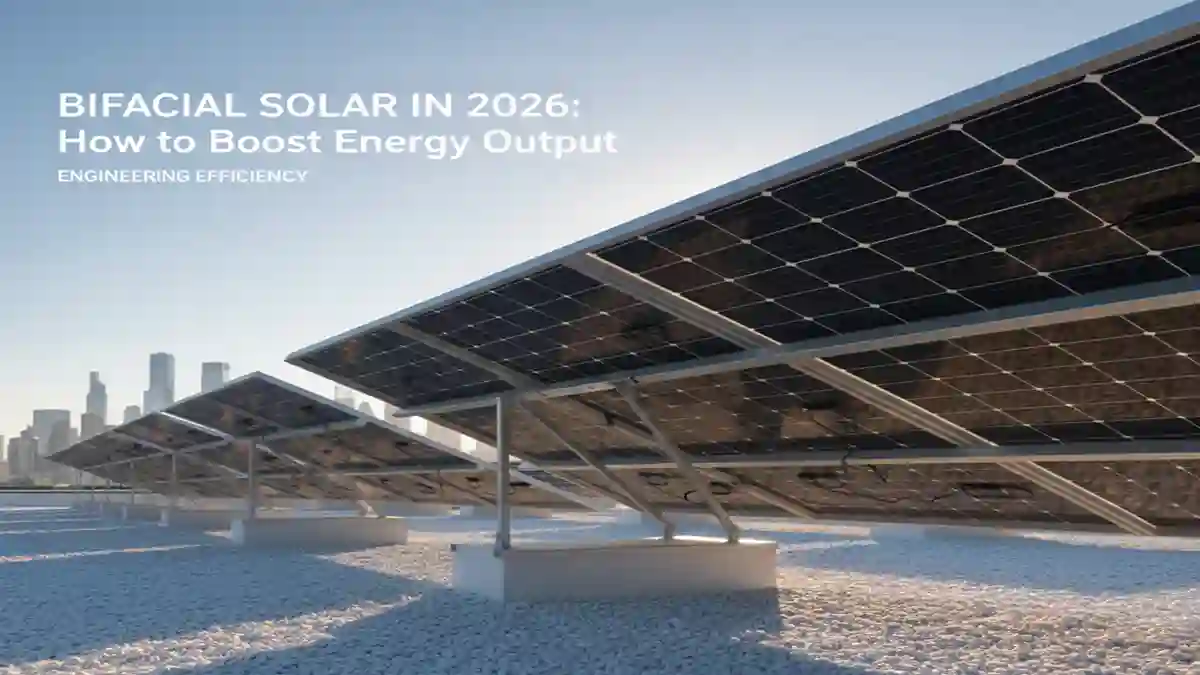
Learn how bifacial solar panels capture reflected sunlight. Optimize surface albedo and mounting height to increase real-world energy yield.
Standard solar panels have been the industry backbone for decades, but they’ve always had a blind side—literally. In my work as a solar engineer, I’ve consistently seen traditional monofacial modules leave usable energy untapped by ignoring sunlight reflected from the ground. Bifacial solar panels are designed to address this limitation by converting reflected light into additional electrical output.
In 2026, however, simply installing bifacial panels does not automatically guarantee a strong return on investment. Based on real-world site behavior, inadequate mounting height or low-reflectivity ground surfaces can reduce bifacial energy gains by 5 to 8 percent, even when high-efficiency modules are used. This loss is not a technology issue but an installation and design problem—much like restricting airflow or fuel in a high-performance engine.
This guide explains the applied science behind albedo (surface reflectivity) and the engineering-defined installation heights required to effectively capture rear-side irradiance. Whether you are a homeowner refining a small system or a commercial developer optimizing large-scale layouts, the focus here is on measurable, field-validated performance improvements, not theoretical maximums.
Buying Guide: Choosing the Right Bifacial Module
Selecting a bifacial solar module involves more than just efficiency ratings. Consider wattage, cell technology, durability, rear-side gain, and installation feasibility. For high-performance installations, N‑Type TOPCon bifacial modules are recommended due to higher efficiency, low degradation, and strong rear-side energy capture.
| Type / Code | Max Wattage Available | Key Advantages | Best For |
|---|---|---|---|
| N‑Type TOPCon Bifacial (IEC 61215 / IEC 61730 compliant) | 650W+ | High efficiency, low degradation, strong rear-side yield | Large rooftops, utility-scale ground arrays |
| N‑Type TOPCon Bifacial (IEC 61215 / UL 61730) | 500–550W | Compact, durable, good low-light performance | Residential rooftops, small commercial systems |
| N‑Type TOPCon Bifacial (IEC 61215 / IEC 61730) | 430–480W | Lightweight, easier installation | RVs, off-grid systems, portable applications |
Tips for Choosing the Right Module:
- For maximum energy output, select the highest wattage N‑Type TOPCon module suitable for your installation area.
- Pair panels with reflective surfaces or elevated mounts to maximize rear-side gain.
- Ensure modules are internationally certified (IEC/UL) for safety and reliability.
Using N‑Type TOPCon technology ensures long-term efficiency and stronger rear-side energy capture, making it the top choice for modern bifacial installations worldwide.
RV Solar System Optimization Bifacial Panels
How to Get 15–30% More Power (With Smart Setup Tips)
Bifacial solar panels are a powerful upgrade for RVs because they generate electricity from both the front and the back. The rear side captures reflected light (called albedo) from the RV roof or the ground, potentially increasing energy output by 15% to 30% compared to standard panels.
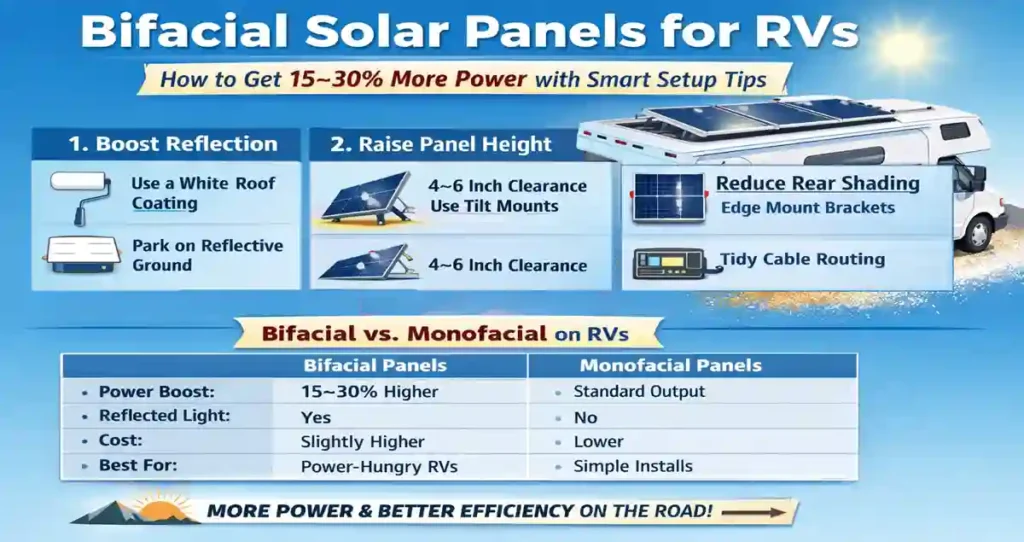
However, to unlock this extra power, you need to set them up correctly. Most RV installations mount panels too close to the roof, limiting their bifacial advantage. Below are simple hacks to maximize performance.
1. Boost Light Reflection (Albedo Matters Most)
The biggest factor in bifacial gain is how reflective the surface under the panel is.
White Roof = More Power
If your RV roof is dark, dusty, or dirty, you lose much of the bifacial benefit.
Applying a high reflectivity white roof coating (such as Dicor or Henry’s Tropi-Cool) can increase rear-side power by up to 25%.
Park Smart for Extra Gain
When possible, park on reflective surfaces like:
- White gravel
- Sand
- Light concrete
- Snow
Tilting your panels toward the sun lets the back side collect even more reflected light.
2. Raise the Panel Height (Critical Upgrade)
Most RV bifacial solar panels are mounted just 1 inch above the roof, which blocks light from reaching the back.
Ideal Clearance
Aim for 4–6 inches of space between the panel and the roof.
This allows diffuse light to reach the underside and boost output.
Use Tilt Mounts
Tilting panels at 25°–35° creates an open angle underneath, allowing reflected light from both:
- The roof
- The ground
This significantly increases rear-side energy capture.
3. Reduce Rear Shading (Small Shadows = Big Losses)
Anything blocking the back of a bifacial solar panel reduces performance.
Better Mounting Style
Use edge-mounted brackets instead of rails running under the panel cells.
Rails can create shadow lines that reduce power.
Clean Cable Routing
Route wires neatly along:
- Panel frame edges
- Center split (if applicable)
Loose wires hanging under the panel can block light and reduce energy production.
4. Electrical Setup Tips (Don’t Bottleneck Your Power)
Because bifacial solar panels can produce extra current, your electrical system must support it.
Oversize Your Charge Controller
If a panel is rated 200W, a 20% bifacial boost means it can act like a 240W panel.
Make sure your MPPT charge controller can handle the higher current (Isc).
Parallel Wiring Helps in RV Use
Rear-side lighting can be uneven.
Wiring panels in parallel or using high-quality MPPT per panel helps reduce mismatch losses caused by partial shading.
⚠️ Never compromise on MC4 connectors. Low-quality connectors can cause power loss, overheating, voltage drops, and even fire risks. Always use certified original MC4 connectors with proper crimping tools to ensure safety, efficiency, and long-term durability on the road.
5. Choose the Right Power Inverter
Bifacial panels produce extra DC power, so your inverter must handle it.
- Right Size: Match peak AC load plus 20–30% for bifacial gain
- Pure Sine Wave: Protects electronics and improves efficiency
- Thermal/Weather Rated: IP66 or thermal protection ensures reliable operation in hot conditions
A proper inverter ensures all extra solar energy is effectively converted for use.
Bifacial vs. Monofacial Solar Panels on RVs
| Feature | Bifacial Panels | Monofacial Panels |
|---|---|---|
| Power Output | 15–30% higher potential | Standard |
| Works with Reflected Light | Yes | No |
| Performance in Hot Weather | Often better | Standard |
| Installation Sensitivity | Higher | Lower |
| Cost | Slightly higher | Lower |
| Best For | Power-hungry RV setups | Simple installs |
Bottom Line
Bifacial solar panels can outperform traditional RV solar systems, but only when installed with:
- Enough height
- Good reflection
- Minimal shading
- Proper electrical sizing
If done right, they deliver more power, better efficiency, and greater energy independence on the road.
Applications of Bifacial Solar Panels
Bifacial modules have become a mainstream energy solution, capturing sunlight on both the front and rear sides. Residential rooftops benefit from rear-side energy gains when reflective surfaces or slightly elevated mounting are used. Commercial buildings and warehouses can increase electricity production without adding more panels by installing bifacial solar modules over large roof areas. Utility-scale farms utilize ground-mounted panels on high-albedo surfaces, such as white gravel or sand, to enhance efficiency. Specialized applications, such as carports, RV installations, and floating solar systems, demonstrate the versatility of bifacial technology in real-world settings.
Real-World Case: Engineering Insights
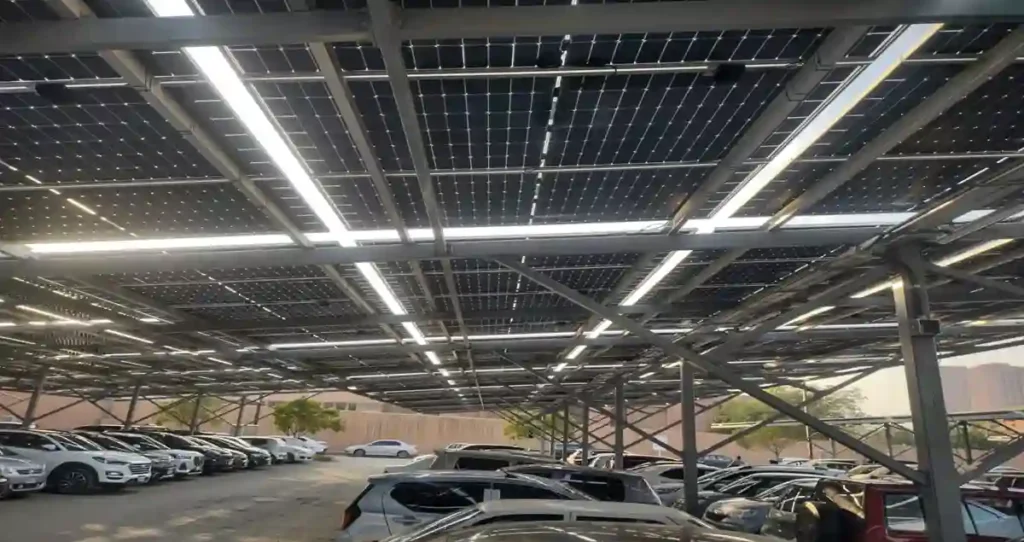
When I recommended N‑Type TOPCon bifacial solar panels for a 120 kW hospital parking installation, I immediately noticed the site’s unique potential. The existing monofacial panels were already installed at 4 meters (12 feet) with the same wattage, but they only captured front-side sunlight.
What made this parking area special was the dynamic environment. The mix of cars coming and going and the reflective surfaces of the light-colored parking lot meant the rear side of the bifacial solar panels could capture sunlight bouncing off these surfaces. Every parked car, every white line, and every reflective patch of asphalt contributed to extra energy production.
After installing the N‑Type TOPCon bifacial panels, the results were clear. Even at the same height and wattage, these panels produced 5–8% more energy than the old monofacial setup. Morning and late afternoon sunlight, which previously contributed minimally, now added noticeable power thanks to scattered and reflected light.
| Parameter | Monofacial Panels | Bifacial N‑Type TOPCon Panels | Gain / Impact |
|---|---|---|---|
| Panel Type | Monofacial | N‑Type TOPCon Bifacial | Captures rear-side reflected light |
| Wattage | 500W | 500W | Same wattage; performance boost from bifacial design |
| Installation Height | 4 m / 12 ft | 4 m / 12 ft | Gains from reflection off the ground and vehicles |
| Surface | Asphalt / dark lot | Reflective coating + light gravel + car surfaces | Enhanced rear-side energy |
| Annual Energy Yield | 120 kW | 126–129 kW | ~5–8% higher |
| Degradation | ~0.7% / year | ~0.3% / year | Longer-term efficiency |
| ROI | Baseline | Improved | Faster payback due to higher yield |
This project showcases the real-world advantage of bifacial panels. It’s not just about panel wattage—it’s about understanding the environment, leveraging reflective surfaces, and capturing every possible photon. The parking lot is now quietly generating extra clean energy every day, proving the real value of smart engineering.
What Is a Bifacial Solar Panel?
A bifacial solar panel is a photovoltaic module designed to capture sunlight on both the front and rear surfaces. Unlike traditional monofacial panels, which use only direct sunlight, these modules convert reflected light from the ground or nearby surfaces into additional electricity. Understanding what a bifacial solar panel is helps engineers, homeowners, and developers maximize energy efficiency and system performance.
How Bifacial Solar Panels Work
Bifacial modules operate on standard photovoltaic principles, with extra cells on the rear to capture reflected sunlight. Direct sunlight strikes the front surface, while rays reflected from the ground reach the back, producing extra kilowatt-hours. Tilt angle, row spacing, and surface reflectivity influence the rear-side energy contribution. Well-designed bifacial modules can achieve 5–15 percent more energy output than monofacial panels, depending on environmental conditions.
Impact of Surface Albedo on Bifacial Efficiency
The albedo, or reflectivity, of the surface beneath bifacial panels greatly impacts rear-side energy capture. Surfaces with higher reflectivity, such as fresh snow or white concrete, enhance energy yield, whereas darker surfaces reduce efficiency. The table below shows typical albedo coefficients:
| Surface Type | Albedo Coefficient (%) | Impact on Bifacial Modules |
|---|---|---|
| Fresh Snow | 70–90 | Maximizes rear-side energy gain |
| White Concrete / Gravel | 30–50 | Provides significant reflected light |
| Dry Sand | 30–40 | Moderate reflection, ideal for arid regions |
| Grass | 15–25 | Lower reflection, common in rooftops and lawns |
| Asphalt / Dark Roof | 5–15 | Minimal contribution to rear-side yield |
| Water (Calm Surface) | 10–15 | Slight diffuse reflection, varies with sun angle |
Impact of Surface Albedo
Surface reflectivity, or albedo, plays a critical role in the performance of bifacial solar panels. While bifacial panels can theoretically boost yield by up to 30% in snowy or highly reflective environments, standard real-world installations on darker surfaces often see more modest gains of 5–8% if not optimized.
For example, in our hospital parking case study, the mix of light-colored asphalt, reflective paint lines, and moving cars contributed to a realistic 5–8% increase in energy production compared to existing monofacial panels. This demonstrates that understanding both the environment and installation strategy is essential for maximizing rear-side energy capture.
Factors Affecting Bifacial Module Performance
Efficiency depends on mounting height, tilt, orientation, and row spacing. Shading should be minimized, and surface color plays a key role. Properly engineered bifacial panels outperform monofacial modules by converting reflected light into usable electricity.
Quick Tips for Optimal Bifacial Performance:
- Elevate modules to capture maximum rear-side irradiance.
- Use reflective surfaces beneath panels to improve albedo.
- Ensure correct tilt and row spacing to avoid shading.
- Clean both front and rear surfaces regularly.
Bifacial vs Monofacial Solar Panels
Bifacial modules generally deliver higher energy output than monofacial panels because they utilize reflected light. Monofacial panels are simpler and cheaper upfront, but bifacial efficiency in high-albedo settings provides a superior long-term return. Comparing bifacial vs monofacial panels is essential for both residential and commercial installations.
Types of Solar Panels: Monofacial and Bifacial Options
Solar panels come in several types, each with unique advantages. Understanding the differences helps you choose the right panel for your project.
| Panel Type | Description | Efficiency / Key Feature | Temperature Coefficient (%/°C) | Best Use Cases |
|---|---|---|---|---|
| Monofacial Polycrystalline | Made from multiple silicon crystals, blue-colored | Moderate efficiency (~15–18%), lower cost | -0.45 to -0.50 | Residential rooftops, basic commercial systems |
| Monofacial Monocrystalline | Single-crystal silicon, black in appearance | High efficiency (~18–22%), compact design | -0.35 to -0.40 | Rooftops with limited space, high-performance projects |
| Bifacial Monocrystalline (N‑Type TOPCon) | Captures front and rear sunlight, often dual-glass | High efficiency (~20–24%), slower degradation (~0.3%/yr) | -0.30 to -0.35 | Roofs, parking lots, utility-scale farms, RVs |
| Thin-Film Panels (CdTe, CIGS) | Lightweight, flexible, low silicon use | Lower efficiency (~10–15%), better performance in diffuse light | -0.20 to -0.25 | Large-scale installations, building-integrated solar, off-grid solutions |
| PERC Monofacial Panels | Passivated Emitter and Rear Cell tech | Improves rear-side photon absorption slightly (~18–22%) | -0.35 to -0.40 | Residential and commercial rooftops looking for extra efficiency without a bifacial setup |
Among these, bifacial N‑Type TOPCon panels offer a compelling balance of high efficiency, low degradation, better temperature performance, and rear-side energy capture, making them ideal for both residential and commercial installations.
Bifacial Panels on Rooftops
Yes, rooftop bifacial solar panels are effective, but rear-side gains depend on roof reflectivity and mounting height. Light-colored roofs, elevated installation, and minimal shading maximize reflected light capture. Dark or low-mounted roofs reduce rear-side contribution, limiting efficiency. Proper engineering ensures measurable energy gains on rooftops.
Factors Affecting Performance & Installation Tips
To maximize bifacial solar panel efficiency and avoid the common “efficiency gap,” follow these engineering-backed steps:
1. Mounting Height:
Maintain at least 0.5–1 meter (1.5–3 feet) of clearance for ground-mounted panels. This allows sufficient light to reach the rear cells and boosts energy capture.
2. Surface Treatment:
For rooftops or dark surfaces, consider a white reflective coating or light-colored gravel. This significantly improves rear-side production.
3. Maintenance:
Keep both front and rear sides clean. Dust or dirt on the rear side can reduce bifacial gains by 2–5% over time.
4. Avoid Shading:
Ensure that mounting rails or nearby structures do not block the rear-side light. Consider landscape orientation or specialized bifacial racking systems for optimal exposure.
Pros and Cons of Bifacial Solar Panels (Including RVs)
Advantages:
- Higher energy yield due to rear-side capture
- Better long-term ROI in high-albedo environments
- Flexible installation: rooftops, utility-scale farms, RVs
Limitations:
- Performance depends on surface reflectivity and installation quality
- Slightly higher upfront cost than monofacial panels
- Rear-side gains may be modest in shaded or low-albedo locations
Maximizing Bifacial Module Energy Yield
To extract full potential, consider tilt, row spacing, and reflective surfaces. Seasonal adjustments and cleaning both surfaces maintain efficiency. Well-engineered bifacial solar panels can produce 5–15 percent more energy than monofacial counterparts in high-reflectivity environments.
Brands and Products to Consider
| Brand / Model | Wattage | Key Features | Best For |
|---|---|---|---|
| Hyperion 400W bifacial solar panel | 400W | High efficiency, durable, glass-glass construction | Rooftops, small commercial installations |
| EcoFlow 220W bifacial solar panel | 220W | Lightweight, compact, reliable | RVs, small-scale solar projects |
| Aptos 370W bifacial module | 370W | Rear-side gain optimized, high-performance | Residential and commercial rooftops |
| Canadian Solar 530W bifacial solar panel | 530W | High output, utility-scale ready | Large commercial or ground-mounted arrays |
Selecting the right bifacial solar panel depends on project size, environment, and budget. This table allows quick comparison while maintaining an engineering perspective.
Bifacial Solar Panels Integrated with AI
Bifacial solar panels benefit from reflected light, but rear-side energy varies throughout the day due to surface albedo, shading, vehicle movement, and sun angle. AI helps manage this variability by continuously analyzing real-time data and optimizing system operation.
AI-powered monitoring and forecasting tools predict front- and rear-side generation more accurately, allowing inverters and energy storage systems to respond efficiently. This is especially useful in parking lots, rooftops, and commercial sites where reflected light changes frequently.
AI-assisted MPPT control improves energy capture during short periods of increased rear-side irradiance, while predictive maintenance systems detect rear-side soiling or shading early. This prevents unnoticed 2–5% energy losses over time and reduces manual inspection needs.
AI does not change the physical efficiency of bifacial panels, but it helps protect and fully realize the realistic 5–8% rear-side gain by improving energy capture, maintenance timing, and long-term performance stability.
From an engineering perspective, AI turns bifacial solar systems from passive installations into actively optimized energy assets, ensuring consistent yield and better long-term ROI without exaggerated performance claims.
To better understand how intelligent monitoring and predictive optimization reduce energy waste, explore our detailed guide on Solar AI: Lower Your Monthly Electricity Bills Effortlessly, where real-world applications show how AI improves solar performance without increasing system size or hardware cost.
Bifacial Solar Panels: Component Compatibility
Bifacial solar panels don’t work in isolation—they are part of a complete solar energy system. Ensuring compatibility with other components is essential for maximizing efficiency and longevity. Here’s what to consider:
1. Inverters:
- Most standard string or central solar inverters work with bifacial panels.
- MPPT-enabled inverters are ideal for capturing fluctuating rear-side irradiance effectively.
- For RV or off-grid setups, hybrid or solar-plus-storage inverters are recommended.
2. Batteries:
- Compatible with Li-ion, LiFePO4, or advanced lead-acid batteries.
- N‑Type bifacial panels paired with energy storage optimize self-consumption and enhance ROI.
3. MC4 Connectors & Cabling:
- Bifacial panels use standard MC4 connectors, making them plug-and-play with most PV systems.
- Use UV-resistant and outdoor-rated cables to maintain safety and performance.
4. Solar Kits & Mounting Structures:
- Bifacial panels are compatible with dual-glass mounting kits for rooftops, ground, or parking areas.
- Adjustable tilt racks help optimize rear-side energy capture based on local albedo.
- Ensure adequate airflow under the panel to reduce heat and improve efficiency.
5. Monitoring & Controllers:
- Most solar monitoring systems and charge controllers work seamlessly with bifacial panels.
- Use bifacial-aware monitoring for more accurate yield tracking and ROI calculations.
| Component | Compatibility Notes | Tip |
|---|---|---|
| Inverter | String, central, hybrid, MPPT | MPPT inverters capture fluctuating rear-side irradiance |
| Batteries | Li-ion, LiFePO4, lead-acid | Pairing with storage maximizes self-consumption |
| Connectors | MC4 | Standard; ensure UV-resistant cables |
| Mounting Kit | Dual-glass racks, adjustable tilt | Elevate panels slightly to boost rear-side gain |
| Monitoring | Most PV monitoring systems | Use bifacial-aware tracking for accuracy |
When integrating bifacial solar panels, consider the whole ecosystem—inverters, batteries, connectors, racks, and monitoring. A fully compatible setup ensures you capture every possible watt and maintain long-term reliability.
Maintenance & Longevity of Bifacial Solar Panels
Bifacial solar panels are built to last, especially N‑Type TOPCon models, but proper care ensures they deliver maximum energy yield over their lifetime.
Maintenance Tips:
- Clean both sides regularly: Dust, pollen, and debris on the rear surface can reduce rear-side gains by 2–5% over time.
- Tools for cleaning:
- Solar brushes: Soft-bristled brushes designed to remove dirt without scratching the panel surface.
- Solar cleaners / water-fed poles: Allow safe, efficient cleaning from the ground, especially for rooftop or elevated installations.
- Inspect mounting and connectors periodically to prevent shading or loose connections.
- Check for damage after storms, heavy winds, or snowfall—dual-glass construction is robust but benefits from routine inspections.
- Avoid harsh chemicals; use only water or solar-approved cleaning solutions.
Longevity Insights:
- N‑Type TOPCon bifacial panels degrade more slowly than standard monofacial panels, often ~0.3% per year, compared to ~0.7% for typical panels.
- Properly maintained bifacial panels can easily last 30+ years, delivering a strong long-term ROI.
- Combined with reflective surfaces and strategic installation, your system maintains high efficiency throughout its lifecycle, ensuring every watt counts for decades.
With regular maintenance, simple cleaning routines, and the right tools like solar brushes and solar cleaners, your bifacial system not only outperforms traditional panels but also remains a reliable, long-term energy solution, quietly generating extra clean energy every day.
FAQs: Bifacial Solar Panels
What is a bifacial solar panel?
A bifacial solar panel captures sunlight on both its front and rear surfaces, converting reflected light from the ground or surrounding surfaces into extra electricity. This improves overall energy yield compared to traditional monofacial panels.
Can bifacial panels be installed on rooftops or parking lots?
Yes. They are versatile and perform well on rooftops, parking areas, and even mobile setups like RVs. Reflective surfaces and proper mounting height enhance rear-side energy capture.
How much more energy can I expect compared to monofacial panels?
Depending on site conditions and reflective surfaces, bifacial panels can generate 5-8% more energy than monofacial panels. Gains are higher on light-colored or reflective surfaces and lower in shaded or dark areas.
Which surfaces maximize bifacial performance?
Surface reflectivity, or albedo, is critical for rear-side energy capture. Here’s a quick reference for common surfaces:
Surface
Albedo Coefficient
Effect on Rear-Side Gain
Fresh Snow
0.75–0.90
Very high reflection; maximum rear-side gain
White Gravel / Concrete
0.40–0.60
Strong reflection; ideal for rooftops, parking lots, and ground mounts
Grass / Lawn
0.20–0.25
Moderate reflection; better than dark asphalt
Light Sand
0.30–0.45
Good reflection; suitable for utility-scale solar farms
Asphalt / Dark Roof
0.10–0.15
Low reflection; rear-side gains minimal unless treated
Parking Lot with Cars
0.25–0.35 (average)
Dynamic reflection; moving or light-colored cars increase rear-side contribution
Do bifacial panels require special maintenance?
Maintenance is straightforward. Cleaning both sides regularly with soft solar brushes or water-fed solar cleaners prevents dust from reducing rear-side gains by 2–5%. Periodically inspect mounts and connectors to avoid shading or loose connections.
Are bifacial panels compatible with existing solar system components?
Yes. They work with standard MC4 connectors, string or central inverters, and most solar batteries (Li-ion, LiFePO4). MPPT-enabled inverters and bifacial-aware monitoring systems help maximize energy capture.
How long do bifacial solar panels last?
High-quality N‑Type TOPCon panels degrade slowly, around 0.3% per year. With proper maintenance, they can last 30+ years, providing reliable energy and a strong long-term return on investment.
Can I use bifacial panels for RVs or mobile setups?
Absolutely. While gains may be smaller than those of stationary installations, rear-side capture still improves total energy output, especially when mounted over reflective surfaces.
What improves bifacial panel performance on an RV?
Key factors include higher mounting clearance, reflective roof surfaces, minimal rear shading, and smart wiring (parallel or MPPT per panel).
RV Solar System Optimization Bifacial Panels: Really worth it?
Yes. With proper setup, RV Solar System Optimization with Bifacial solar Panels can boost energy output by 10–15% compared to standard panels.
Excellent point! The albedo effect from reflective roofing is often the difference-maker between a 5% and 15% gain. Glad you found the bifacial factor breakdown helpful.