
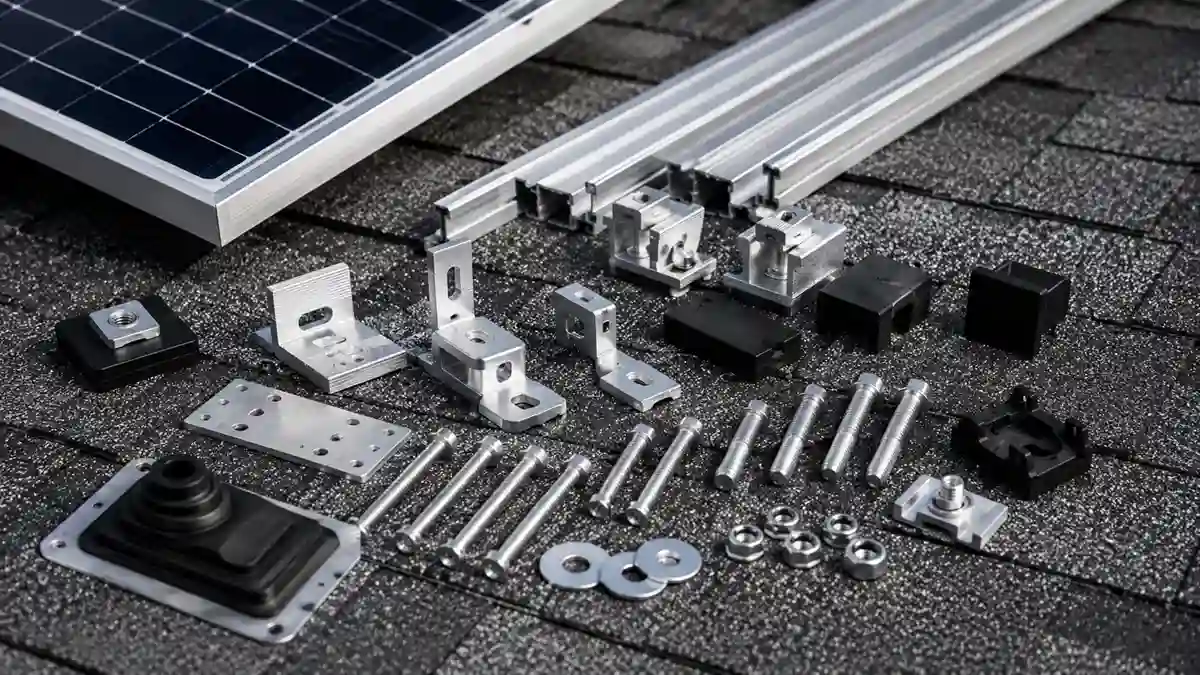
Solar panel mounting brackets with hardware — what a complete kit must contain, the 8-point submittal checklist engineers use, and what missing components actually cost you.
A mounting bracket kit is not a commodity purchase. Two kits priced at different points may look identical in a product photo and be fundamentally different in structural capability, material quality, and long-term performance. The difference lies in the hardware specification — the fastener grades, the clamp geometry, the rail alloy, and the waterproofing components.
This guide is the companion to the Solar Panel Mounting Brackets buying guide. Where that guide covers bracket types and structural requirements, this one covers what the complete hardware kit must physically contain — and how to verify a submittal before accepting it for a commercial solar installation.
1. The Anatomy of a Complete Solar Mounting Bracket Kit
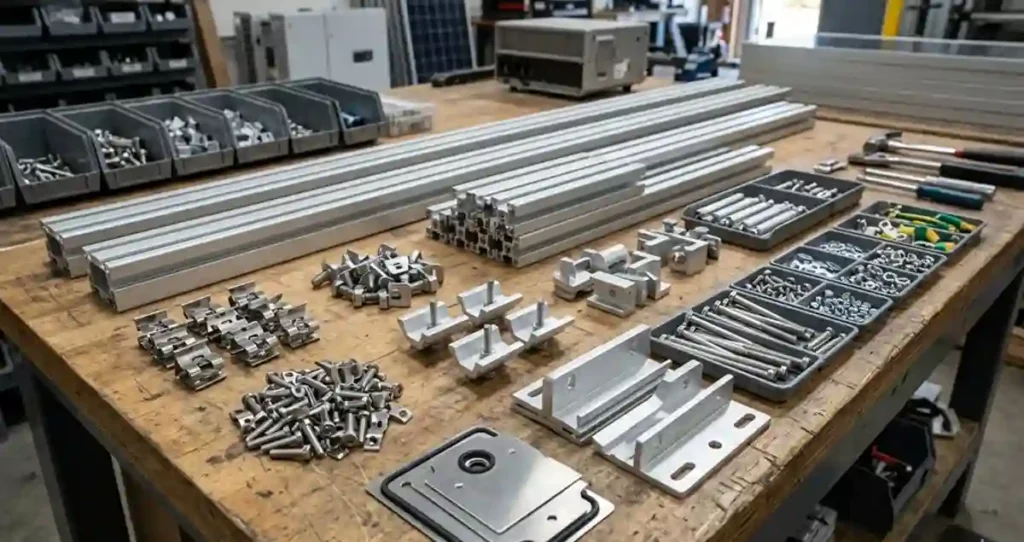
Roof Attachment Components
What is commonly missing from budget kits: the roof-specific flashing plate. Generic L-foot brackets without an integrated flashing plate require field-fabricated flashing — the single most common source of installation-related roof leaks. The Roof Solar Panel Mounting Brackets post covers the correct waterproofing detail for each roof type.
Mounting Rail
The horizontal rail spans between attachment points. Rails are extruded aluminum 6063-T5 or 6061-T6 alloy. The full engineering specification — alloy, T-slot geometry, span capacity, and thermal expansion design — is in the Solar Mounting Rails guide. The short version: 6061-T6 has nearly double the yield strength of 6063-T5 and is the correct specification for commercial installations in high-wind or high-snow-load zones.
Module Clamps
Clamps come in two types: mid clamps (which hold two adjacent module frames simultaneously) and end clamps (which hold a single module at the array edge). Both must grip the module frame within its specified clamping range. Clamp material must be the same alloy as the rail to avoid galvanic corrosion at the contact interface.
Grounding Hardware
NEC Article 690 and UL 2703 require bonding of all conductive module frames and mounting system components. The hardware kit should include WEEB clips, grounding lugs compatible with the rail profile, or integrated bonding washers at the module clamp.
Fastener Set
A correctly specified fastener set includes: 316 stainless steel lag screws for roof attachment, machine bolts for rail splice connections, carriage bolts for clamp attachment, and nylon-insert locknuts to prevent vibration loosening.
Engineer’s Note: If a mounting kit specifies ‘zinc-plated’ or ‘carbon steel’ fasteners anywhere in the hardware list, it is not appropriate for any permanent rooftop installation. Zinc plating provides approximately 5 years of corrosion protection in a typical rooftop environment. A 25-year installation needs 25-year fastener corrosion resistance. Grade 316 stainless delivers it.
2. Hardware Specifications by Roof Type
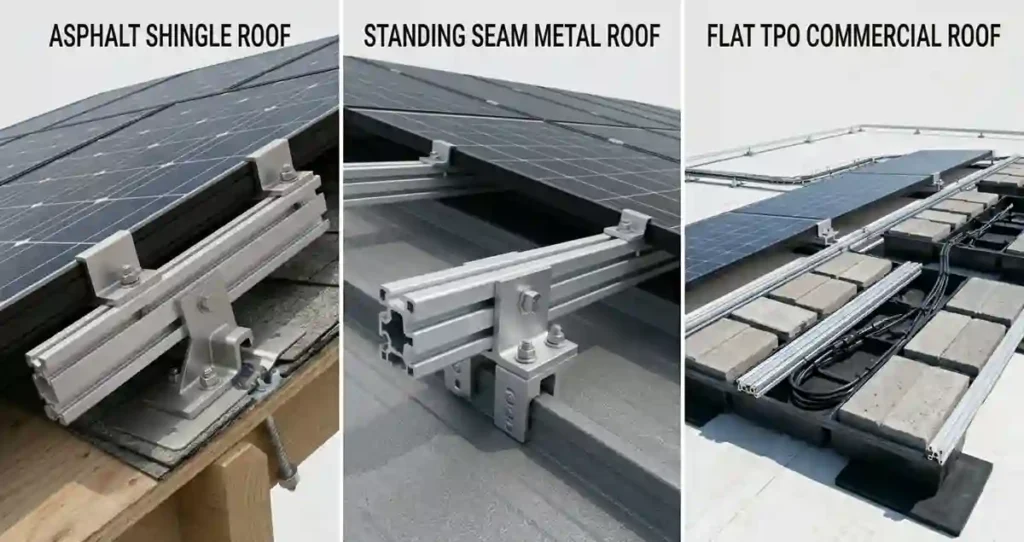
| Roof Type | Attachment Hardware | Fastener Specification | Waterproofing Component |
| Asphalt shingle, wood rafter | L-foot with lag screw | #14 x 3.5″ 316 SS lag into rafter, min. 2″ engagement | EPDM gasket under L-foot base; butyl sealant on lag |
| Concrete tile, wood rafter | Tile hook, tile replacement | #14 x 3.5″ 316 SS lag into rafter | Flashing under replacement tile; no exposed sealant |
| TPO/EPDM flat roof, ballasted | Ballast tray, rubber feet | No structural fastener — weighted system | Rubber pads rated for membrane compatibility (no petroleum-based) |
| Standing seam metal | Profile-specific seam clamp | 5/16″ 316 SS machine bolt at clamp | No penetration — clamp geometry is waterproof by design |
| Corrugated metal, purlin | Purlin clamp or through-fastener | M8 316 SS bolt through purlin, neoprene grommet | Neoprene grommet compression — do not over-torque |
3. What ‘Complete’ Actually Means — The Hardware Checklist
- Roof attachment component identified and specified as profile-specific for the project roof type
- Rail alloy designation confirmed (6063-T5 or 6061-T6 per design)
- Rail span verified against structural calculation for site-specific wind and snow loads
- Module clamp clamping range confirmed compatible with module frame dimensions on this project
- Grounding hardware identified, UL 2703 listed, compatible with module frame and rail profile
- Fastener grade confirmed as 316 stainless steel throughout — no zinc, no 304 at exterior locations
- Torque specifications provided for every fastener type in the kit
- Waterproofing components specified and compatible with the roofing membrane manufacturer requirements
Field Note: I have reviewed commercial solar hardware submittals from five different Tier 1 mounting system manufacturers and two budget suppliers. The Tier 1 submittals include material certifications, load test reports, and torque specifications without being asked. The budget submittals include product photos and a price sheet. The difference in submittal quality is a reliable proxy for the difference in the engineering behind the product.
4. Common Kit Shortfalls — and What They Cost You
| Missing Component | What Happens Without It | Typical Cost to Retrofit |
| Roof-specific flashing | Field-fabricated flashing, improper sealing, and roof leaks in years 1-3 | $150-400/penetration for leak investigation and repair |
| 316 SS fasteners | Fastener corrosion in 5-7 years, loosening brackets, and potential panel displacement | $3,000-15,000 to refasten a commercial array |
| WEEB/bonding clips | Non-compliant grounding — NEC 690/UL 2703 violation, AHJ rejection at inspection | $500-2,000 to retrofit grounding hardware |
| Torque specifications | Inconsistent installation — over or under-torqued fasteners across the array | Unknown — detected only by system inspection or post-storm damage |
| Load test documentation | PE cannot stamp drawings based on unverified hardware | $2,000-8,000 for independent load testing or system redesign |
5. The Procurement Decision: Integrated Kit vs. Component Assembly
For commercial rooftop installations, integrated kits from manufacturers with UL 2703 listing and published load test data are almost always the correct choice. For the full context of how this hardware fits into the mounting system engineering, see the Solar Mounting Systems hub and the Solar Panel Rail Mounting Kit installation guide. For load rating analysis of each bracket type, see the Mounting Brackets for Solar Panels: Types, Load Ratings & Roof Compatibility guide.
Frequently Asked Questions
What is included in a solar panel mounting bracket with a hardware kit?
A complete kit typically includes roof attachments, mounting rails, module clamps, fasteners, grounding hardware, and waterproofing components.
Why are 316 stainless steel fasteners recommended?
Grade 316 stainless steel offers superior corrosion resistance, especially in coastal and humid environments.
Can I mix hardware from different manufacturers?
Mixing components may void load testing certifications, engineering approvals, and manufacturer warranties.
What is UL 2703 certification?
UL 2703 is a safety standard covering mounting systems, grounding, bonding, and mechanical performance for photovoltaic installations.
Why are grounding components included in solar mounting kits?
Grounding hardware provides electrical bonding between conductive components and helps meet electrical code requirements.
What happens if mounting hardware is missing from a kit?
Missing flashing, grounding hardware, fasteners, or load documentation can lead to installation delays, code violations, or long-term system failures.
Related guides on SolarVisionAI.com
Solar Panel Installation: Complete Engineering Guide (2026)
Solar Panel Installation Cost: The Complete 2026 Breakdown
Commercial Solar Panel Installation: Engineering Guide 2026
When Is the Best Time to Install Solar Panels?
Solar Power System in 2026: Types, Cost, ROI & AI Optimization